At the LORD’s Right Hand

OLD TESTAMENT: Isaiah 57 & 58

POETRY: Psalm 110

NEW TESTAMENT: James 5

Isaiah 58:6-7 (LEB):

“Is this not the fast I choose: to release the bonds of injustice,

to untie the ropes of the yoke,

and to let the oppressed go free,

and tear every yoke to pieces?

Is it not to break your bread for the hungry?

You must bring home the poor, the homeless.

When you see the naked, you must cover him,

and you must not hide yourself from your relatives.”

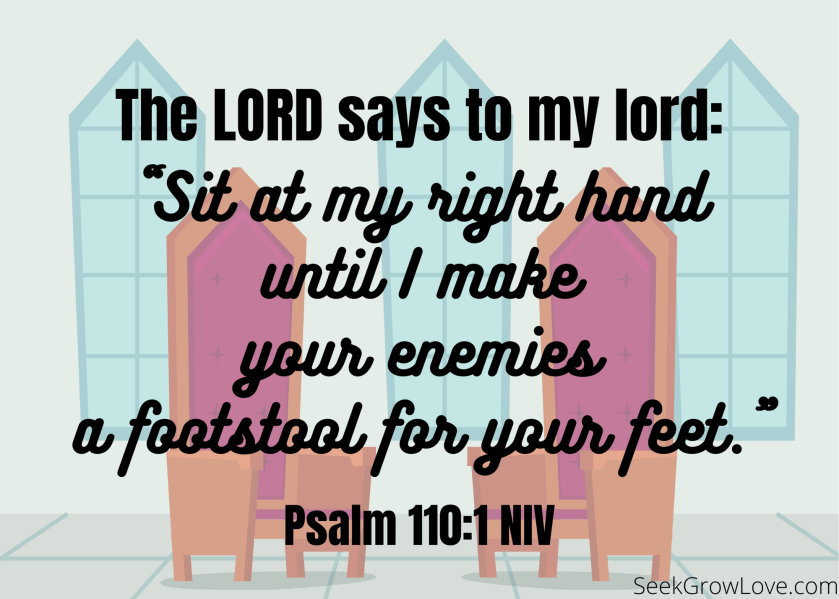
Psalm 110:1-2 (LEB):

“Yahweh declares to my lord,

‘Sit at my right hand

until I make your enemies your footstool.’

Yahweh will send out your mighty scepter from Zion;

rule in the midst of your enemies.”

James 5:8-9 (LEB):

“You also be patient. Strengthen your hearts, because the coming of the Lord is near. Do not grumble against one another, brothers, so that you may not be judged. Behold, the Judge is standing at the doors!”

Isaiah 57 highlights the wickedness of the people, contrasting their idolatrous practices with the righteousness God desires. The chapter serves as a warning against superficial worship and the danger of following our own desires. However, Isaiah 58 provides a blueprint for what true righteousness looks like. God calls His people to a life of justice, mercy, and compassion—acts of righteousness that reflect His heart.

The fast that God desires is not one of mere ritual, but one of active love and justice. Releasing the oppressed, feeding the hungry, housing the homeless, and clothing the naked are the tangible expressions of worship that please God. These acts of mercy demonstrate a heart aligned with God’s purposes, as opposed to empty religious practices that neglect the needs of others.

Psalm 110 speaks prophetically about the Messiah’s reign. It describes a vision of the Lord’s anointed seated at the right hand of God, with His enemies made a footstool beneath His feet. This psalm points to Jesus Christ as the exalted King and Priest, who rules with power and authority.

As we reflect on the reign of Christ, we are reminded that no matter what challenges or opposition we face, Jesus is given all authority, and his victory is assured. He rules in the midst of his enemies, and God’s people are called to trust in the ultimate triumph achieved through Christ. Psalm 110 provides a powerful reminder that Christ’s kingdom is both now and not yet—he reigns even as we wait for the fullness of his victory to be revealed.

James calls believers to patience as they await the coming of the Lord. He uses the example of the farmer who waits for the precious crop, trusting that the rains will come in their time. In the same way, we are to strengthen our hearts and remain steadfast in the face of trials, knowing that the Lord is near.

James also warns against grumbling and impatience with others, encouraging believers to live in unity and peace. The passage reminds us that we will be held accountable for our actions and words, and that God, the righteous Judge, is always watching. We are called to endure suffering with patience, just as the prophets and Job did, trusting in God’s faithfulness through it all.

This week, let Isaiah 58 challenge you to live out true righteousness by pursuing justice and compassion. Trust in Christ’s sovereign reign as declared in Psalm 110, and ask God to strengthen your heart as you patiently endure trials, knowing that the Lord is near. Let your life reflect the love, unity, and hope that comes from living in light of his victory and imminent return.

-Jeff Ransom

Reflection Questions:

How can you actively live out the righteousness described in Isaiah 58 in your daily life?

In what areas of your life do you need to trust in Christ’s reign, knowing that he is seated at the right hand of God with all authority?

How can you strengthen your heart in times of trial, and what does it mean for you to patiently endure as James encourages?

Are there relationships or situations where you are tempted to grumble or grow impatient? How can you bring those before God and seek His peace and patience?

Save Us!

Old Testament: Deuteronomy 2

Poetry: Job 26

New Testament: Mark 11

As we just celebrated the triumphal entry it got me thinking about 1 aspect of Palm Sunday. The hosannas that the people yelled out to Jesus. What does that mean?

Hosanna is a word used in some songs of praise, especially on Palm Sunday. It is of Hebrew origin: “Hosanna to the Son of David! Blessed is he who comes in the name of the Lord! Hosanna in the highest heaven!” (Mark 11).

Hosanna is often thought of as a declaration of praise, similar to hallelujah, but it is actually a plea for salvation. The Hebrew root words are found in Psalm 118:25, which says, “Save us, we pray, O LORD!”. The Hebrew words yasha (“deliver, save”) and anna (“beg, beseech”) combine to form the word that, in English, is “hosanna.” Hosanna means “I beg you to save!” or “please deliver us!”

So, as Jesus rode the donkey into Jerusalem, the crowds were perfectly right to shout “Hosanna!” They were acknowledging Jesus as their Messiah, as shown in their address “Son of David.” Theirs was a cry for salvation and a recognition that Jesus is able to save.

When is the last time that you have yelled out to Jesus to save you? It’s an important question, and one that needs to be on our lips all the time.

There is nothing more satisfying in all the world than to be followers of a king like Jesus. Picture him riding toward Jerusalem, the rebellious city. A multitude praising him: “Hosanna, blessed, is the king who comes in the name of the Lord.” He knows the praise is shallow. In a few days it will fade away. But does he rebuke them? No. He defends them against the criticism of the Pharisees: “‘Teacher, rebuke your disciples!’ . . . ‘I tell you, if these were silent, the very stones would cry out.'” He knew his days were numbered. He knew their cries were not completely sincere.

The praise the people gave was not because they recognized Him as their Savior from sin. They welcomed Him out of their desire for a messianic deliverer, someone who would lead them in a revolt against Rome. These are the ones who hailed Him as King with their many hosannas, recognizing Him as the Son of David who came in the name of the Lord. But when He failed their expectations, when He refused to lead them in a massive revolt against Rome, the crowds quickly turned on Him.

Within just a few days, their hosannas would change to  Crucify Him.

Those who hailed Him as a hero would soon reject and abandon Him.

The story of the triumphal entry is one of contrasts, and those contrasts contain applications to us. It is the story of the King who came as a:

servant on a donkey, not on a white horse.

not in royal robes, but on the clothes of the poor and humble.

Jesus Christ comes not to conquer by force but by love, grace, mercy, and His own sacrifice for His people.

 His is not a kingdom of armies and splendor but of lowliness and servanthood.

He doesn’t conquer nations but hearts and minds. His message is one of peace with God.

If Jesus has made a triumphal entry into our hearts, He reigns there in peace and love. As His followers, we exhibit those same qualities, and the world sees the true King living and reigning in triumph in us.

If he lives in us today, we sing Hosanna. With a true and right heart. We don’t crucify him again and again with our sin.

We cry out to save us, not we can save ourselves. What do you cry out to Jesus for? Is it sincere? Is it true? Ask God to give you a sincere heart, so that your worship to God through Jesus is a saving worship. 

-Andy Cisneros

Reflection Questions

  1. What can you learn from the King who came on a donkey?
  2. Where else in Scripture do you find humility honored? Are you more known for your humility or pride?
  3. In what ways, at what times, have you tried saving yourself? When have you cried out for Jesus to save you?

The Day We Have All Been Waiting For

Old Testament: Zechariah 5 & 6

Poetry: Psalm 144

New Testament: Luke 2

“For unto you is born this day in the city of David a Savior, who is Christ the Lord.”

            It’s Christmas Day!  The day we have all been waiting for.  Unless you’re really, really good, you likely will have already gotten up, peeked in your stocking and maybe opened gifts with your family.  You may have even eaten a large meal.  Maybe now you’re taking a few minutes to check your email and give some attention to your devotions for the day.  Whether you’re reading this at 8 a.m. or 8 p.m., it’s still Christmas Day.  A day you’ve been waiting for.  Christmas comes every year so at most, you’ve had to wait 364 days for Christmas. 

            The people of Israel had to wait hundreds of years for the first Christmas.  From the time King David was first promised that his son would be the Messiah and would reign forever, it had been many generations.  Now that day had finally come.  Normally, when a royal birth happens, especially a future King, it’s a pretty big deal.  There are grand proclamations that come from out of important palaces in important cities.  The whole community might stand outside the walls of the royal palace to hear the great news officially announced.  But this first Christmas announcement was quite different.  It wasn’t in the city of Jerusalem outside the palace walls, it was in the fields of rural Bethlehem.  The audience wasn’t the whole city gathered, it was a few sleepy shepherds in the middle of the night making sure their sheep were safe from predators.  The one making the announcement wasn’t the royal page or member of the court of Jerusalem, it was an angelic messenger of God.

            News of the Messiah’s birth went largely unnoticed for many years.  It would take several announcements from God “a voice from heaven saying, this is my beloved son, with whom I am well pleased.”  Eventually, his few disciples understood that he was the Messiah.  What finally sold many people was his death and resurrection.  The Bible says that one day “every knee shall bow and every tongue confess that Jesus is Lord” (Messiah/king).  On this Christmas Day, let us be sure that we not only hear and believe the Good News that at long last the promised Messiah was born in a manger in Bethlehem over 2000 years ago, but that he died for our sins and God raised him up from death and clothed him in immortality, he has ascended to the side of God and will come again to reign over all.  One day every knee will bow, but for today, be sure that you are bowing and giving your allegiance to King Jesus, and be sure to share this news with everyone you know. 

Merry Christmas!

-Jeff Fletcher

Reflection Questions

  1. How was God’s plan for a Messiah different from what many people expected? What do you love about how God brought about His plan for a Messiah? What does His plan reveal about Him? 
  2. Does your holiday festivities show that you are celebrating that Jesus is Lord? How are you bowing before him and confessing that he is Lord – yesterday, today and tomorrow?
  3. How can you share the good news of great joy? Who needs to hear it?

Let it Be to Me

Old Testament: Zechariah 3 & 4

Poetry: Psalm 143

*Theme Week – Celebrating Jesus: Luke 1

            ’Twas the Night Before Christmas….  Originally published 200 years ago, in 1823, as A Visit from St. Nicolas authorship credited to and later claimed by Clement Clarke Moore.  Moore was a theology professor- a Bible teacher.  He originally wrote the poem for fun, he said, for his children.  This story helped to shape the way many began to celebrate Christmas and has had a lasting cultural impact.  I find it interesting that a Bible teacher is responsible for the way most Americans celebrate Christmas with its focus on Santa Claus, gift-giving, and all the rest of the things that tend to draw attention away from the original meaning of Christmas, the birth of Jesus.  Now Bible teachers and preachers are trying to remind us that “Jesus is the reason for the season” but more often that plea has fallen on deaf ears.  More people are interested in getting the latest iPhone or other coveted goodies.  On this Christmas Eve day, we take a quick pause from our parties, food and gift-buying and wrapping and consider the first part of the Christmas story. 

            In today’s reading from Luke one, we see the announcement of two unlikely births, two cousins to be born named John and Jesus.  Israel’s story in the Old Testament has a giant pause and collective waiting.  Israel was waiting for the arrival of their promised king or messiah.  Several hundred years BC God promised David, the King, that he would have a son who would reign as king over a kingdom that would be unending.  At first, people thought Solomon was the fulfillment of that promise.  Solomon started well, sought God’s wisdom above all else and the Kingdom of Israel prospered.  But Solomon’s heart turned away from faithfulness to God, he was not to be the true Messiah.  His son, Rehoboam ruled after him and things went from bad to worse.  Eventually, civil war caused his kingdom to split.  Eventually, God punished a succession of unfaithful kings with the destruction of the temple, the fall of the capital Jerusalem, and the end of the heirs of David ruling as kings.  For hundreds of years, there was no heir of David.  The hope for the messiah remained a longed-for and unfulfilled expectation. 

            The last of the historical/prophetic books of the Old Testament is Malachi.  Malachi ends with the hopeful promise that an Elijah-type prophet will come and get people ready for the final day of the Lord that was to come. 

            Fast forward about 400 years, and Israel is still waiting for the 2 anticipated births- of the Elijah-type prophet, and the Messiah-King, heir of David’s throne.  Out of this 400 years of waiting comes Luke 1 with the announcements of two unlikely births.  Unlikely because one was promised to an older childless couple, and the second to a young, engaged couple where the young woman was still a virgin.  In both cases, God would perform a miracle to bring forth these two baby boys, John and Jesus.

            It’s important to note in the story that when the Angel comes to Mary announcing God’s plan for her, Mary offers her consent “Let it be to me according to your word.”  This makes perfect sense.  We know that in human relationships consent is morally required before union.  Anything less than consent is unacceptable and morally reprehensible.  It stands to reason that before God placed his son Jesus in her womb she would give consent.  “Let it be” or “I agree to allow your word, your promise, your plan for your son, the Messiah to be formed in me.”

            The same is true for all of us.  God wants to place His word in us and for us to bear the fruits of Jesus.  In Galatians 4:19 Paul uses this metaphor of birth: “My dear children, for whom I am again in the pains of childbirth until Christ is formed in you…”. God wants Christ to be formed in us.  Christ was formed in the womb of Mary uniquely, but God wants all of us to be spiritually transformed, to become like Jesus in our character, in our singular commitment to bring glory to God and to seek first God’s Kingdom (Matthew 6:33) and righteousness (right living in covenant relationship with God).

            Sorry this is getting kind of technical, but the bottom line is, for Mary to give birth to Jesus, she first had to give God her consent “Let it be”.  For Christ to be formed in us, we must also give our consent.  God will not force us to receive His word and be transformed, to have Christ formed in us, we must receive it.

            So on this night before Christmas, as you watch the lights on the tree and listen to Christmas music, play games with your family, wrap presents and drink egg nog, or go to Church and any combination of the above, listen for God’s invitation.  He wants to plant His word in you so that Jesus Christ might be fully formed in you.  Will you give your consent?  Will you say as Mary did “Let it be to me according to your word?”

-Jeff Fletcher

Reflection Questions

  1. How will you celebrate Jesus today and tomorrow and the rest of the week and in 2024?
  2. Have you given your consent and received God’s word and spiritual transformation? 
  3. What might it look like and feel like to have Jesus Christ fully formed in you? 

Popularity – and Rejection

Old Testament: Micah 1 & 2

Poetry: Psalm 135

New Testament: Matthew 21

As we come to the Christmas season, reading about these last days of Jesus puts a different light on the passage. 

At the beginning of the chapter, we see Jesus riding into Jerusalem on a donkey as the king he was prophesied to be.  This lines up with what was expected from his birth!  And yet, as we continue to read though the last parable in the chapter, we see that rejection starting to come.

In the parable of the tenants, we see a landowner who planted a vineyard, took care to put in safety precautions, then rented it out when he moved.  He sends his servants back first to collect the harvest.

The result?  One is beaten, another killed, and a third stoned.  He sends more servants, and they continue to treat them in the same way.

Finally, the landowner decides to sends his son, certain that he will be respected.  Instead, the tenants kill the son in an effort to steal his inheritance. 

Jesus explains that those who behave in this way – those that reject God’s servants, and ultimately his son – will have the kingdom taken away from them and given to someone else who will produce fruit.

Those who are reading these devotions are probably Christians.  But do we have times in our lives where we reject God’s son all the same?  Probably not an outright rejection or denial, but we might push him to the side of our lives or we might not be willing to speak of the gospel in front of others which is another way of denying him.

As we get closer to Christmas, let’s remember the amazing miracle of Jesus’ birth through the ultimate proof that he was the Messiah by his resurrection and focus on sharing the good news rather than denying his name.

~Stephanie Fletcher

A short bio about me: I live in Minnesota with my husband and our two kids – 5 & almost 3.  We may be a little crazy, but a couple of years ago, we bought a home with my parents – it is like two regular sized homes stacked on top of each other, and we all live there together.  For a short while, my sister, her husband, and their baby lived there too.  We live there with our dog, Indiana (a compromise from Han Solo or Ford based on my liking of Harrison Ford), and a pet fish – Mickey Rainbow Mermaid Fish (name courtesy of my daughter as technically, it’s her pet).

Reflection Questions

  1. What can you learn from Jesus in how he handled popularity? And, from how he handled rejection? 
  2. How have your actions or words (or lack thereof) been a denial of Jesus Christ?
  3. How can you do better? 
  4. What fruit is the landowner looking for? 

YHWH is Salvation

*Old Testament Reading: Isaiah 49-50

Poetry Reading: Psalm 83

New Testament Reading: Mark 14

In this week’s readings, I notice the parallel between the OT and NT readings. While I will focus on the Isaiah passages, if you are finishing up Mark instead, you will certainly notice the connections.

The reason I personally chose to focus on Isaiah is because comparatively to Psalms and Mark, I am far less knowledgeable, and it is always a book I want to take the time to “study more.” In addition to that, I’m enjoying a Christian historical fiction book series loaned to me by some friends that is set in Jesus’s time, but told from a Jewish family’s perspective. They have all sorts of questions about the book of Isaiah and their awaited Messiah, and as I have enjoyed seeing those connections unfold in the book, I thought I just might enjoy a deeper look at Isaiah this week myself.

Isaiah grew up during an affluent and successful time overall during the reigns of King Uzziah of Judah and King Jeroboam II of Israel. Economically and politically, things were going pretty well.  In addition to being born in a prosperous time, many commentators suggest that as son of Amoz, Isaiah had access to the royal family itself and was born into a cultivated upper class. Of course, riches and power don’t last forever, particularly when nations and individuals prioritize those things over following the LORD. In fact, his call to prophesy aligned historically with the increasing threat of Assyria toward Israel. Isaiah’s name means “YHWH is salvation” and the book shares the story of salvation and redemption that transcends challenging times of collapsing kingdoms and disobedient hearts.

In today’s reading of Isaiah 49-50, we come into this book of prophecy a little over halfway through, finding ourselves amidst one of four poems sometimes referred to as “servant songs” by commentators.   They are poems worth reading and are reflected in the New Testament when the Messiah comes on the scene.  I enjoyed how both 49:1 and 49:5 quickly reference the LORD’s calling and forming being from the womb. I think in America, amidst the chaotic noise on this subject, it is far to0 easy to gloss over its significance. Having had the opportunity to work with children who are born prematurely, seeing God’s creation itself at an age when a child should ideally still be “in the womb” combined with the overarching message of what is fortunately still the best selling book of all time (The Bible!), it isn’t poetic “fluff” when we see the emphasis on God’s prenatal calling on His intentional creation as part of His sovereign plan.

Chapter 49’s poem includes a servant ready to restore the nation to the LORD. And not just the tribes of Jacob mentioned in verse 6, but “that my salvation may reach to the ends of the earth.” We see a God who doesn’t forsake His people even during dark days, and Chapter 49 concludes with glory given to the LORD through that relationship. “And humanity shall know that I, the LORD, am your savior, your redeemer, the Mighty One of Jacob.” -(Isaiah 49:26)

In Chapter 50 we see prophecy of a servant who was not rebellious, who would not be ashamed, and who trusted and relied upon the LORD. We are challenged to do the same and to obey the LORD’s Messiah, walking in light.

Such great hope in the words “Behold the LORD God helps me. Who is he who condemns me?” -Isaiah 50:9

-Jennifer Hall

Reflection Questions:

1. How have your growing up years in the United States been similar or different to Isaiah’s growing up years in a prosperous Jerusalem? How might prosperity and power affect a nation’s spiritual health?

2. Have you ever felt forsaken by the LORD or outside of his reach of forgiveness? What do the messages of these poems say about redemption and salvation?

3. How might the LORD receive glory through the plan He has had for you since before you were in the womb?

Who is Jesus?

*THEME WEEK – Peter: Matthew 16

Old Testament: Ezra 4 & 5

Poetry: Psalm 15

Today’s devotion comes from Matthew chapter 16:13-15. In the story, we hear Jesus ask Peter a question. This is what it says:

“Who do people say the Son of Man is?”

They replied, “Some say John the Baptist; others say Elijah; and still others, Jeremiah or one of the prophets.”

“But what about you?” he asked. “Who do you say I am?” 

In a society that always asks who you are, it’s nice to hear Jesus say, who do you say I am? Isn’t that a better question to ask? So many times we’re worried about who we are and what people think of us. We’re worried about what we’re doing and feeling . We’re worried about how people see us. Jesus cuts through that and asks the real question – who do people say he is?

There’s so much to unpack with that question when we ask – who do people say Jesus is? We can use that in a personal way. We can use it in a way to re-center and refocus on what’s truly important.

So here’s a good question. Who do you think Jesus is? Do you get to say who he is or does God tell us who Jesus is and we need to re-center and refocus what he really is to us. Do you have a real view of Jesus, or a caricature of something you’ve made up in your mind? Too many times we make Jesus what we want him to be rather than what he is. He is the Christ, the son of the living God. He is our savior. He is our Messiah. He is our Lord.

Do you see him that way? If Jesus asks you who he is, would you have a good answer? Are you living that out? So here’s your question for today – who do you say Jesus is? 

-Andy Cisneros

Reflection Questions

  1. Who do you say Jesus is?
  2. How do you live that out?
  3. How does your answer to the question “Who is Jesus?” make a difference in your life? How does it help you re-center and refocus?

Who’s the Messiah?

Old Testament: 1 Samuel 27 & 28

Poetry: Proverbs 15

New Testament: Acts 9

We will continue to look at some theological themes from the book of Acts by studying the story of Saul’s conversion. When you look at the big picture, we can see Jesus chasing Saul and transforming his life into one that aligned with God’s will for his life. Saul truly believed that he was doing God’s will by persecuting Christians and the early church. From a Jewish perspective, we can understand why Saul thought this. Jesus came claiming to be the Messiah, but the Jews did not accept Jesus as the Son of God, just as it was prophesied. But in chapter nine of Acts, we see Jesus appear to Saul on the road to Damascus as he reveals to him his identity as the Messiah. Jesus chose Saul to preach the name of Jesus as the Messiah to both the Gentiles and Jews. I love this because it shows how much God and Jesus can use us for their Kingdom work when we let them. They have the power to transform lives. The power to turn persecuting Saul into preaching Paul.

Saul is instructed to preach that Jesus is the Son of God (8:20). He was instructed to teach the Jews in the synagogues that the Jesus they rejected was the Savior whom they were waiting for. At no point is Saul told to preach that Jesus was God in human form. The Jews knew their prophecies and understood that the Messiah would save the world as a representative of God, not as God himself. So when it says that Saul preached Jesus as the Christ, the Jews should have understood this to mean that Jesus was the chosen human savior to complete God’s work on earth. Additionally, Jesus had the perfect opportunity to explain to Saul who he was. Saul asked who was speaking to him, and Jesus simply replied with, “I am Jesus, whom you are persecuting.” If Jesus were trying to get Saul—a practicing Jew with power and authority among the Jewish community—to understand that he was God, then he would have said something that clarified and explained how he was a god in flesh. Sometimes we can learn a lot from what is not said in the Bible. Verse 22 says, “Yet Saul grew more and more powerful and baffled the Jews living in Damascus by proving that Jesus is the Messiah.” If Saul proved to the Jews in Damascus that Jesus was the Messiah, then they simply would have understood it from a Jewish theological perspective. Saul did not even attempt to change or ‘correct’ their understanding of the Messiah, he simply revealed who the Messiah was. Current Jews today are still waiting for their Messiah to return because they missed it the first time. Therefore, they believe that God is one, and not a triune God. This idea of three entities would be considered idolatry from a Jewish perspective, because from the very beginning, God has revealed himself to his chosen people as the one true God. This means that the early church and apostles would have had to correct thousands of years of ‘incorrect’ theology if they wanted to preach that Jesus was God. Instead, the book of Acts stays consistent with the rest of the Bible, and preaches that Jesus was the Messiah.

Although looking at a chapter and studying what it leaves out does not necessarily prove anything, we can see that the Bible is consistent in the fact that there is no explanation of who Jesus is other than a human that God sent to be the Messiah, the Christ, the Son of the living God. Therefore, from a Trinitarian perspective, Acts would be a book full of missed opportunities to preach true theology to the Jews. But since God does not make mistakes, Acts is a beautiful book of theological truths that align with the rest of Scripture and paint a picture of Jesus as the Messiah that the Jews should have known and loved.

-Makayla Railton

Reflection Questions

  1. How does one let Jesus transform their life?
  2. How has the definition of Messiah changed over the years from the Jewish understanding to modern mainstream Christianity?

Good Question

Old Testament Reading: Genesis 19 & 20

Psalm Reading: Psalm 12

New Testament Reading: Matthew 11

Where is the darkest place you have been? So dark, you were scared to take a step? The most difficult place you’ve been? So difficult, you doubted? When have your dark, difficult, trying circumstances caused you to doubt what you previously knew to be true?

You are not alone. John has been there, too. Sometimes referred to as John the Baptist or the Baptizer for his message of repentance and baptism, John had faithfully worked for years. Known for his simple lifestyle, his ministry was not about him – but about the one who was to come – the Messiah. He had prepared the way for Jesus’ entrance. He had not taken the easy road. He had not backed down from authority. He continually stood for what was right and true – even when it landed him in prison. The ruling Herod and his wife didn’t appreciate John speaking out against their unlawful marriage.

With his ministry and freedom taken from him, and his future in question, John had a lot of time to think in the darkness of his circumstances. Why? What if…? Was it worth it? Was this supposed to happen? Had he been right? Or wrong? We don’t know all the questions John asked in his prison cell. But, we do know the most important one. The one he needed an answer to. He sent his disciples to ask Jesus, “Are you the one who was to come, or should we expect someone else?” (Matthew 11:3)

And Jesus answered. Restating the truth that John needed to hear again. Pulling up Old Testament scripture from Isaiah and giving evidence of how his own ministry lined up with what had been foretold: the blind see, the lame walk, the leper is cured, the deaf hear, the dead are raised and the GOOD NEWS is preached to the poor (Matthew 11:5).

In our dark days and when we question what we knew to be true, we would do well to return to Jesus. Tell me again, Jesus. Give me proof of who you are. Read again who he is, what he has done, what he taught, what he did for me. The story of Jesus never gets old, but we do need to be reminded of what we know. And then we have the beautiful opportunity and mandate to tell others of what we have seen and heard.

In the rest of this chapter (as well as the previous one) Jesus demonstrates that following him can be hard. People will criticize everything – our job is not to make people happy. There will be many unrepentant people (and cities) who do not accept the work that Jesus has done for them or the path that Jesus has laid out. Don’t be swayed, know that judgement will come and make sure you are on the right side. Stay close to the one who knows and reveals the Father. Jesus, the Son of God, is the only way. Work with him. Stay attached to Jesus. Take his yoke upon you (Matthew 11:29).

-Marcia Railton

Reflection Questions

  1. Who is Jesus? Do you know that he is the one who was to come? How do you know this? What is the value in reading the Old Testament? What is the value in reading the New Testament?
  2. What is repentance? Why is it important? Without it, what will happen? (Matthew 11:20-24)
  3. What do you learn about God in today’s reading? What do you learn of His Son?

Unexpected Moments

Luke 2

Friday, December 9, 2022

Sheep are stinky. 

Consequently, shepherds stink. 

Tending sheep, especially overnight, was a pretty thankless job, and took a toll on a lot of those who did it. Shepherds were not very well thought of by those who had more respectable agrarian jobs, or those who worked in the city. 

But God chose them to be the first ones to know the messiah is born. They saw him in the manger after the angels made their Christmas announcement!

Old people who spend their days alone can sometimes be weird. 

In fact, some of the best people are the old weird people who spend most of their time in prayer to God. The family of Jesus are accosted when they take him to be consecrated on the eighth day. Simeon and Anna may have been well respected, but they were still both older, and both a little weird. 

But God chose them to be among the first to share the message of the Messiah. They spoke the message, Simeon ready for death, knowing the Messiah had come!

The story of Jesus is full of unexpected moments like this. You didn’t see shepherds shouting out with joy, speaking to all who would listen. You didn’t see Simeon and Anna stopping families to talk on the way to the temple. You didn’t see a twelve year old boy going toe-to-toe, blow-for-blow with the religious scholars of the day. 

But God chose these moments, these people, these places, to give us a clue that in the rest of Luke we’re going to see unexpected moments. 

With the familiarity of the passage at Christmas, it may seem common place. But as you read Luke 2 today, remind yourself again just how radical *and strange* the birth of Christ was. May you find comfort in the fact that no matter if you are

Old

Young

Weird

Normal

Or even stinky

God is choosing you to believe in Christ this Christmas. It is up to you to choose to believe. 

-Jake Ballard

Reflection Questions

  1. What do you find most surprising in Luke 2?
  2. Do you believe in Christ? How will that change your day, season and life?