Backchannels and Backstabbers

Matthew 26 and Mark 14

Devotion by JJ Fletcher (Minnesota)

People are complex. We have ideals that we want to live by, but often fall short and fall into patterns of behavior that disgust us. I’m sure all of us want to live like the gospel is the primary motivator for our lives. We want to care for others, we want to honor God and Jesus with our behavior, and we want to shine the light of truth into a dark world. We hit speed bumps, we have a bad day, someone slights us, and we are consumed by disappointment, anger, or frustration, and take our eye off the ball.

We want to honor God, but we also want to be comfortable. We want to be well off financially or to be perceived in a certain way, and we sometimes will slide into behaviors that are focused on taking care of our needs and desires rather than building God’s Kingdom.

Sometimes fear is a motivator rather than hope. How will people view us if we stand out as different from the status quo? What if the movement or organization that we are a part of falls apart? Will we be seen as a failure? Will we be shunned? Will we suffer the same defeat or demise as those whom we have followed or associated ourselves with?

In Matthew 26, we are in the lead-up to the Passover celebration. While this is in view, Jesus also knows what is about to happen… His arrest and execution.

The Pharisees are frustrated. They have been seeing Jesus grow in influence and popularity, which in turn has diminished their influence and the perception that they are the leaders and influencers of the Jewish people. They confront Jesus constantly, yet they are no match for his wisdom and insight. Jesus, in his spirit-filled wisdom, always has the upper hand over the Pharisees, who seem far more interested in discrediting and diminishing Jesus than actually considering that he may be the Messiah. They want to remain the thought leaders of the people, and Jesus is putting the kibosh on them.

As I’ve already brought up, Jesus is popular, and if the Pharisees were seen to be actively trying to dispose of him, they would face some severe backlash. With Passover just around the corner, they see the need to be careful. There are extra eyes everywhere as people have come into Jerusalem to celebrate. So, they start plotting how to secretly apprehend Jesus and quietly have him put to death. They want to make it seem like this is not of their doing, but how? They are dealing in back-channel communications to figure out how to proceed. A golden, or maybe silver, opportunity will soon present itself.

Enter Judas. He’s been with Jesus through the thick of his ministry. But Judas perhaps is not a fan of Jesus’ teaching on wealth. No one is identified specifically in Matthew 26:8-9, but I wonder if Judas is a driver of the indignant attitude of the disciples about this valuable ointment that Jesus is anointed with. In John 12, we are told that Judas would help himself to the money that was collected, and the sale of this ointment would give him more funds to dip into. Judas doesn’t care about the poor; he cares about himself. Judas sees the success of Jesus’ ministry as an opportunity to enrich himself. Perhaps Judas does believe that Jesus is who he claims to be, but he is motivated by his own desires, and this gives an opening for some back-channel dealings with the Pharisees. Judas goes to the Pharisees in secret and asks how much of a payoff they will give him if he delivers Jesus to them. What a backstabber, the ultimate betrayal. Jesus, of course, knows this is going to happen, which must make his preparations for the upcoming events even more brutal to contemplate.

Peter is bold. But he’s also kind of a coward. Jesus knows this. Deep down, maybe Peter knows this, but he’s not willing to cop to it. When Jesus is about to be arrested, Peter is willing to go on the offensive in the moment; he’s willing to go down to protect Jesus, but after Jesus is arrested, Peter has time to think, and he perhaps ponders what will happen to those who were closely associated with Jesus if he is convicted and executed. He ends up denying Jesus as his fear gets the better of him. A bit of a stab in the back to Jesus.

Both Peter and Judas fell into the trap of doing what they saw as best for them, rather than what was right. Judas ends up committing suicide; he can’t live with what he has done, or the repercussions of what this will do to his standing and life outlook. Peter, however, finds redemption. Jesus gives him three opportunities to affirm him, and after Jesus ascends to heaven, Peter becomes the primary leader of the church. Never again will he deny Jesus; he will die for the sake of the gospel. 

Reflection Questions:

1.        In what ways have you experienced failures in your walk? What has allowed you to overcome failure and not let it defeat you?

2.        How can we navigate our pride and celebrate the successes of others, rather than act like the Pharisees and look to undermine or defeat others? How can these attitude dynamics make or break a church? 

3.        Can you think of some ways that help set you up to put faith before your wants and superficial needs?

The Unwritten Rules

Matthew 15, Mark 7

Devotion by J.J. Fletcher (Minnesota)

I’ve been following baseball for around 30 years. My dad was (and still is) a Baltimore Orioles fan, but when the time came for me to pick my team, I pledged my allegiance to the Atlanta Braves. In the late 90s, one of my most despised teams was the Montreal Expos. In 2005, the aforementioned villains moved to Washington, DC and became the Nationals. My dad was also a Senators fan when he was a kid, growing up just outside of DC, so he also began rooting for them after the move brought the nostalgia of baseball back to the nation’s capital. My dad has always given a couple of my brothers guff for being Yankees fans, but I felt similar betrayal.

Baseball is known for its “unwritten rules”. Though these rules are waning as younger players enter the league and the stalwarts retire, they still exist to some degree. Your best player gets hit by a pitch? The next guy up in the opposing lineup is taking one in the ear or back. You don’t celebrate home runs, or you get hit the next time up. You don’t walk over the pitcher’s mound or bring up the fact that a perfect game is going on. The list goes on and on, but you won’t find them written down anywhere official. They have not been codified in the official MLB rule book. But the players expect each other to abide by these traditions that have become known as the Unwritten Rules.

We see some Pharisees confronting Jesus about his disciples not conforming to the “Traditions of the Elders”. Specifically, the disciples are not washing their hands before they eat. Now, there are some regulations in the Torah about washing hands, but they are very specific. They have nothing to do with washing hands before eating. Over time, new “rules” or traditions morphed from the written law into behaviors that were expected, perhaps even viewed as equally important to the codified text of the Torah.

Think of your time attending church. Growing up, there were probably some things you were told not to do (running in the sanctuary) that don’t appear anywhere in scripture, but people were passionate about it (you’d better dress up for church). Some churches have certain ways of doing things: Do you take the Lord’s Supper weekly, monthly, or quarterly? Do you use grape juice or wine? Who can pass out or pray over the emblems? Is it sacrilegious to have a guitar on stage? Maybe you’ve moved from your childhood church, or maybe you’re like me and have moved many times. Things are different at your current church, right? So, who is right and who is wrong? Or are different ways of doing church equally proper? 

Sometimes the way we do things is perfectly fine, but it’s not necessarily “the right way”. We sometimes run into obstacles when someone tries to serve in their church, and the status quo gets in the way. There are times and seasons for various ministries. Often, the reason that something is done a certain way is because the first person who served in a role or started a ministry did things that way. It was a fine way to do it, but was it the right way? Was it the only way? Maybe there’s a better way? Or maybe it just comes down to being a different way, because a different person is leading a ministry or function of the church. It’s ok to have preferences, and it’s ok to do things WAY differently from other churches. The main thing is to make sure that what we are doing is furthering the Kingdom of God and benefiting the body of Christ. Sometimes it will be necessary to restrict things or do things in a particular way because scripture instructs it. The Bible and our faith should never be weaponized to keep us comfortable, but rather our sword and shield should be wielded to fight spiritual battles. We are to fight against darkness, not dwell in or create a new kind of darkness, but I’m afraid that can sometimes happen when we cling to traditions the same way that we cling to the hope of the Risen Savior.  

Back to the Pharisees. They were calling out the disciples for violating the unwritten rules, which had no true basis in the Law, and treating them like lawbreakers. Jesus points out the irony of them making these accusations. By following the tradition of the elders that allows one to declare something as “corban”, to be set apart for use in the temple, they are violating the Law of Moses. By setting aside money that might be used to support their elderly parents to instead go to the temple (where they may then benefit from it due to their roles) they are not honoring their parents, which by the Law is punishable by death. 

Jesus quotes Isaiah 29:13 “This people honors me with their lips, but their heart is far from me; in vain do they worship me, teaching as doctrines the commandments of men.”

Traditions can be valuable. They can be invaluable. They cannot equal or trample the law or instruction that comes from God. 

Reflection Questions

  1. What traditions do you hold dear? How would you approach someone who wanted to do something differently?
  2. How might you deal with a person in a loving way who is clinging to tradition to the detriment of another, to the body at large, or even to themselves?
  3.  Is there an evaluation process in place to think about how and why your church does certain things and considers how things may need to change over time?

To Wash or Not to Wash

Old Testament: Numbers 31 & 32

Poetry: Job 22

New Testament: Mark 7

To wash or not to wash – that was the question the Pharisees and teachers of the law asked Jesus: Why don’t your disciples wash their hands before they eat? Good question, most of us would agree it’s a good thing to wash your hands before you eat, and when you return from the marketplace, and several other times of the day. This Jewish delegation (comparable to today’s church leaders) were very curious about Jesus and his followers. They had traveled all the way from Jerusalem to Galilee (approximately 70 miles over rough terrain, most likely walking for 2 or more days) to check out this Jesus. They had heard about his many miracles and teachings, and had probably been around long enough to witness some as well. They were watching him closely to decide what they were going to do with this man. And then they saw a problem they could attack: Jesus’ disciples didn’t wash before they ate. It is interesting that Matthew says “your disciples”, Mark says, “some of your disciples”, but it does not say that Jesus didn’t wash – so it doesn’t appear the Pharisees could personally attack Jesus for his own uncleanliness – but what of his disciples? They asked Jesus, “Why do your disciples break the tradition of the elders? They don’t wash their hands before they eat!” (Matthew 15:2 – even with exclamation!)

Jesus quickly flipped the question around – “And why do you break the command of God for the sake of your tradition? (Matthew 15:3). And then he gave an example of how they enticed people to break God’s law which said to honor their parents. It appears they were encouraging people to give large showy gifts to God even when it meant they no longer had the means to provide for their aging parents. Jesus shows how the Pharisees had majored in the most minor issues (like pointing out someone’s dirty hands) and left the most important things neglected.

I think of my daycare children and all the potty-training and hand-washing I have taught over the years. I can certainly attest that hand-washing is very important. However, supremely more important is that child’s love for God and others. Imagine a child who is a beast all day long. Fighting with the other children, biting, ripping toys out of their playmates’ hands, yelling at authority, and screaming during lunch time prayer. But, they washed their hands very well before coming to the table. When I give a report to the parents at the end of the day how foolish it would be for me to congratulate them on a child who follows well the rules of man and has clean hands to eat.

Likewise, at the end of the day, we will stand before Judge Jesus. Some will expect to be commended. They did a really great job of following the laws of the land or the traditions of the church, they loved their family, excelled in their business and other man-made expectations. They always washed their hands before they ate. They were good people.

But, that is not what will matter. Jesus will be rewarding those who truly love God and love people – not just in their words but in their actions and sacrifices and daily priorities. Did they keep God’s law first, even when society said they should follow man’s law instead? Did they accept God’s son as the only way to salvation, even when the world said there are many different roads to salvation? Did they carry their cross, even when the world mocked and pointed fingers and threw accusations?

Beware of following the wisdom of this world and the traditions of men. It won’t get you where you want to be in the end. Instead, consider carefully God’s way, every time, and walk in it. In what areas of your life would God have you turn your back on the traditions of men and human rules and expectations to instead dive deeper and deeper into His way – love God, love others, accept Jesus, prepare for the Kingdom.

-Marcia Railton

(Originally posted Oct 18, 2020 for SGL)

Reflection Questions

  1. Where have you seen Christians stressing and honoring the traditions of man instead of the commands of God?
  2. Is there anywhere you can see it in yourself?
  3. In what areas of your life would God have you turn your back on the traditions of men and human rules and expectations to instead dive deeper and deeper into His way – love God, love others, accept Jesus, prepare for the Kingdom.

Merely Human Rules

Old Testament: Amos 3 & 4

Poetry: Psalm 129

New Testament: Matthew 15

Jesus is on a bit of a tirade at the start of this chapter.  He has got to be pretty sick of the Pharisees!  But when he quotes from Isaiah to them in verses 8 and 9, I wonder if we fall into this trap too, and how frustrated he might feel with us at times. 

“‘These people honor me with their lips,
    but their hearts are far from me.
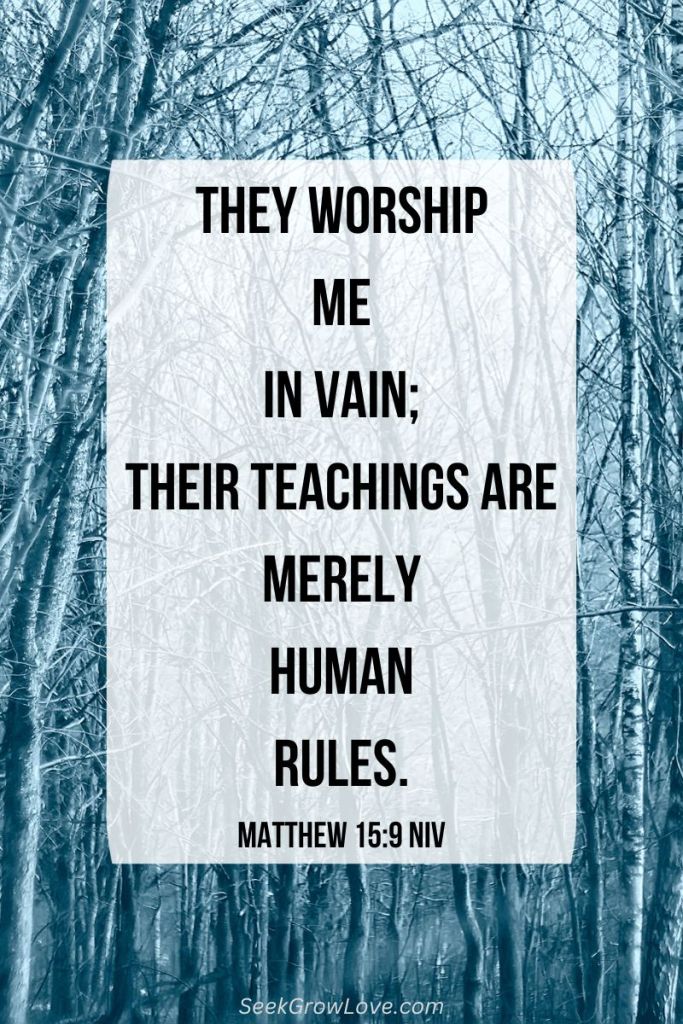
They worship me in vain;
    their teachings are merely human rules.’”

I have been doing some reading on church history earlier this year, and it seems this was some of the problem that started the reformation back in the 1500s.  Some brave individuals stood up to the churches that led culture at the time and said that people were no longer following the word of God, but rather they were just following the church’s rules which were made by people, often for political reasons.

Are we still doing this?  Teaching things that are merely human rules rather than focusing on God?

While we are to follow the laws of the land that were created by people (as long as they don’t contradict God’s laws), we should not be so focused in our churches on following a set of rules of how a worship service should be set up, or the exact number of times per year you should have communion that we miss out on looking at the heart.  There is a difference between Jesus’ teachings and a tradition set up in a church.

Traditions can be good, but when we focus so much on them that we don’t pay attention to the results of what is being done or said, they have no purpose.  If someone new comes in from another church and they ask “why are you doing things this way?” people tend to get defensive even when the question is asked with a genuine desire to understand rather than to criticize.  The truth is, we should be able to answer that question, or if we can’t, consider the practice to determine if what we are doing does still make sense, or if it has become an outdated tradition that could be changed to better serve people.

After Jesus speaks, the disciples come out like “hey, did you know what you said upset the Pharisees?”  Jesus doesn’t care if they were offended by what he said.  He spoke the truth and wants people to realize the meaning and intent of things.  Yes, washing your hands before you eat is a good practice.  You are less likely to consume bacteria that way.  But not doing that doesn’t defile you spiritually.  The things that come out of your mouth (which come from your heart) do – evil thoughts, murder, adultery, sexual immorality, theft, false testimony, slander.

~Stephanie Fletcher

Reflection Questions

  1. What is something in your life that needs to be examined to ensure your heart is in the right place?
  2. What instances can you think of in which the church is following mere human rules and not the word of God and teachings of Jesus?

The Problem with Traditions

Mark 7

Friday, July 29, 2022

How easily can we judge others for not upholding our standards which don’t even derive from the word of God? In Mark Chapter 7, the religious leaders gathered around Jesus and began to ridicule him and his disciples for not upholding their traditions. They didn’t even pretend that this was the command of the Lord, they said to Jesus, “Why do your disciples not walk according to the tradition of the elders, but eat their bread with impure hands?” The sad thing is that they wanted to enforce their traditions on others. Jesus quickly rebukes them with the words of the prophet Isaiah, “These people honor me with their lips, But their heart is far away from me…”. It is a matter of the inner man (the heart), these people acted for an outward display of “their righteousness”. “For they loved the approval of man rather than the approval of God”(John 12:43). Jesus goes on to say “You are experts at setting aside the commandment of God in order to keep your tradition”.

It’s so easy to look at the Scribes and Pharisees and ridicule them for being so unbelieving. However, if we’re being honest, the modern day church is a lot like them and maybe it’s become worse. Let us ask ourselves, have we become experts in setting aside the word of God to hold to our traditions? Have we skillfully misinterpreted texts and passages to alter the identity of Jesus Christ? Have we become experts at downplaying scripture which glorifies the all powerful saving grace of God? Maybe the church relates to the Scribes and Pharisees a lot more than we think, “That which has been is that which will be, and that which has been done is that which will be done, so there is nothing new under the sun”(Ecclesiastes 1:9). “Let us examine ourselves” but let us also be merciful because, “this man was handed over to you by God’s deliberate plan and foreknowledge; and you, with the help of wicked men, put him to death by nailing him to the cross”(Acts 2:23). Could it have been any other way? There had to be the unbelieving ones who would hand him over. The Scribes and Pharisees were clay in the hands of the potter. They were doing only what God’s plan intended. Did Jesus not have to die for the sins of the world? Would we have forgiveness of sins if he hadn’t? 

Later on in the chapter, Jesus declares that it’s the things that flow from the heart that defiles a person, and not that which enters, “(Thus he declared all food clean)”. Jesus is speaking of the works of the flesh and sinful nature we have inherited. Romans 11:32 says “For God has shut up all in disobedience so that he may show mercy to all”. And again, “the body that is sown is perishable, it is raised imperishable”(1 Corinthians 15:42). For a temporary purpose God has given us corruptible, sinful, and perishable bodies. However, “Just as we have borne the image of the earthly, we will also bear the image of the heavenly.”(1 Corinthians 15:49). Out of the heart (inner man) flows these sinful actions and thoughts. But thanks be to God who gives us his spirit to purify the inward man to be renewed day after day. Romans 8:29 says “For those he foreknew, He also predestined to be conformed to the image of his son…”. It is an ongoing process that we are being made into the image of God, we are being conformed, even as I type this and even as you read this. “For God is at work in you both to will and to do of his good pleasure”(Phil. 2:13). 

Later on in Mark 7, Jesus performs a miracle and heals a deaf and dumb man. Jesus says “Be opened!”, “And his ears were opened, and the impediment of his tongue was removed, and began speaking plainly”. The people spoke “He has done all things well; He makes even the deaf to hear and the mute to speak”. Before I give the spiritual revelation on what Jesus is doing, these things can still happen today. God can still do miracles because “For I, the Lord, do not change”(Malachi 3:6) God is still just as powerful today as he was back then. Okay moving on, what is happening? “However, the spiritual is not first, but the natural; then the spiritual.”(1 Corinthians 15:46). Jesus is doing something first that we can see and experience with our eyes, then he will later perform the spiritual. There was evidence naturally that the man could now hear and speak. “Yet to this day the LORD has not given you a heart to know, nor eyes to see, nor ears to hear”(Deuteronomy 29:4). God has to open our eyes and ears and hearts spiritually for us to understand and perceive the things of the spirit. Jesus opened the man’s ears to hear naturally, but Jesus opens ears now to hear and perceive spiritual truths. “But the person without the spirit of God does not accept the things that come from the spirit of God but considers them foolishness, and cannot understand them because they are discerned only through the spirit.” (1 Corinthians 2:14). And again “The mind governed by the flesh is hostile to God; it does not submit to God’s law, nor can it do so”. (Romans 8:7). The person without the spirit of God cannot understand. The person who Jesus doesn’t say “Be opened!” to, cannot yet perceive. This however, is only a temporary purpose, “for the earth will be filled with the knowledge of the glory of the LORD, as the waters cover the sea”(Habakkuk 2:14).  Jesus opens our hearts, minds, and ears by giving us the spirit of God so that we can hear and speak the truths of God. Otherwise, we cannot hear. It’s a miracle from God for us to understand spiritual truths. “To you it has been granted to know the mysteries of the kingdom of heaven, but to them it has not been granted”(Matthew 13:11). 

-Ryan Prott (recently earned his Associates degree from Atlanta Bible College and currently serving in Arkansas)

Application Questions

  1. Truthfully consider, what human traditions do you hold tighter to than to the commands/word of God? Why is this a problem? What changes need to be made?
  2. Pray, asking God to open your eyes, ears, and hearts to spiritual truths. Who else will you pray this prayer for?

Believe the Works

John 10

If I am not doing the works of my Father, then do not believe me. But if I do them, even though you do not believe me, believe the works, so that you may know and understand that the Father is in me and I am in the Father.

John 10:37-38

In chapter 10 we get to see Jesus once again being challenged by the Pharisees. His reply here reminds us that our actions matter more than our words. He tells them that since they don’t believe his words, to judge him by his actions.

This mirrors what Jesus said in Matthew 7:

Thus, by their fruit you will recognize them.

And also what we read in Proverbs 20:

Even a child makes himself known by his acts, by whether his conduct is pure and upright.

It also reminds me of this saying a friend shared with me several years ago:

I don’t trust words. I even question actions. But I never doubt patterns.

You see, people can lie with their words. They can even act in the ‘right’ way and mislead you…for awhile. Eventually, if we are looking for them, patterns reveal themselves.

Not only is this something we should be aware of and be watching for in others in order to live a discerning life; but also something that we should be aware of in our own life. I’m wondering if we could confidently say, “Even if you don’t believe my words, watch my actions. That will convince you.” Paul said something like that to the church in Corinth when he wrote:

Follow my example, as I follow the example of Christ.

After Jesus issues his challenge to the Pharisees and the others listening, we’re told that he goes away from them, but many people followed him to where he went. Then we’re told that:

And many believed in him there.

I guess his actions spoke for themselves.

-Susan Landry

Questions for Reflection and Discussion:

  1. Discuss the idea of not trusting words, even actions, but watching for patterns. Why is this important?
  2. Why is it so scary to think about telling people they could ignore our words and just watch our actions? Why do you think Paul was confident enough to say that?
  3. Take some time to look for patterns in your own life.
    1. Look for patterns that may reveal things you want to change.
    2. Look for patterns that show positive traits that could point someone to Christ.

Forgiven Much, Loves Much

John 9

April 6

Jesus heals a man born blind with a spit-filled mudpie. Creative. Unexpected. A tiny bit gross.

Totally worth it though, I imagine, to the man who can now see.

What we’re going to focus on, however, is the reaction to this healing by the elite, the ultra-religious, the Pharisees. Because this man’s miraculous healing happened on the Sabbath, they’re a little put out. A lot, actually.

As they drill him for information about the person who healed him, he does pretty good holding his own:

“Here is an astonishing thing! You do not know where he comes from, and yet he opened my eyes.We know that God does not listen to sinners, but he does listen to one who worships him and obeys his will.Never since the world began has it been heard that anyone opened the eyes of a person born blind.If this man were not from God, he could do nothing.”

They answered him, “You were born entirely in sins, and are you trying to teach us?” And they drove him out.

What they’re really saying is, “Who do you think you are?”

Matthew Poole’s commentary captures the attitude of their statement in this interpretation of their words:

Thou that art such a marked villain from thy mother’s womb, or that art such an ignorant idiot, dost thou think thyself fit to instruct us about true and false prophets, who are of God, and who are not? Surely we are to be thy teachers, and not thou ours.

It’s an indignant attitude, definitely an attitude of pride, wouldn’t you say? But we’ve all been there. We refuse the information because we don’t like the source. Maybe it’s because we feel superior (like the Pharisees). Or perhaps we simply don’t like them.

This passage reminds me of another time we can see the Pharisees’ pride shine a spotlight on their shame.

Luke describes a time that Jesus was dining at a Pharisee’s home and a sinful woman anointed him. In chapter 7 it says that she was “at his feet, weeping, and began to bathe his feet with her tears and to dry them with her hair. Then she continued kissing his feet and anointing them with the ointment.”

The passage goes on to describe how Jesus puts the shocked and indignant religious crowd in their place. He tells them that her sins, which are many, are forgiven—for she loved much. But he who is forgiven little, loves little.””

In both of these cases, we see beautiful examples of how Christ’s mercies are most valued by those who have felt the want of them. (Matthew Henry’s commentary on John 9:34)

There’s a song by Ten Shekel Shirt that captures this, I think. And it’s a good place to pause and reflect after this chapter.

I come to Your feet and weep
Remembering how You changed me
I kneel at Your feet humbly
I pour out my love and my thanks

I am the one who’s been forgiven much
I am the one who loves much

I sit at Your feet in peace
Sensing a smile over me
I’m here at Your feet gladly
Giving my love and my thanks

Listen here: https://www.youtube.com/watch?v=_VrfvALiE8s

-Susan Landry

Questions for Reflection and Discussion:

  1. Have you ever struggled to accept something as truth just because of the source? Why do you think that is? How can we be better at preventing this attitude?
  2. Do you feel like you are someone who ‘loves much’ or ‘loves little’? If you’re unsure, pay attention to your actions, thoughts, and words for the next week and ask God to show you.
  3. Re-read John 9:40-41. Restate Jesus’ words in a different way. What is he saying? What can we learn from his statement?

Looking for Debate not Understanding

John 8

April 5

We’re going to primarily look at one verse from John 8 today. It’s a verse that offers us (perhaps) a small glimpse into Jesus as more than just the say-er of the fancy red words in our Bibles.

I love verses that give insight into what some of our beloved Bible figures were feeling. For example, some translations of Judges 14:7 tell us that a woman was ‘pleasing’ to Samson. But the NIV version (and some others) say, “Then he went down and talked with the woman, and he liked her.”  It’s such a simple way to describe how he felt. No flowery language, just, ‘he liked her.’

John 8:25 isn’t quite that direct in expressing how Jesus is feeling, but still paints a picture we can relate to. Jesus has been talking with the Pharisees, and every statement he makes is countered with pushback and ignorant questions. It’s obvious that their intent is to trip him up or catch him in a mistake (unlikely). They are not really listening.

We’ve all had conversations with people who are listening only enough to pick our words apart, people who are looking for a debate more than understanding. Thinking about those experiences, perhaps you can hear the exasperation in Jesus’ voice in verse 25:

They said to him, “Who are you?” Jesus said to them, “Why do I speak to you at all?”

I can almost see Jesus doing a facepalm or simply quietly closing his eyes and shaking his head. Talking to people who aren’t genuinely interested in understanding is wearying.

I should note that some versions of the Bible translate this verse a bit differently. Your version may say:

“Who are you?” they asked. “Just what I have been telling you from the beginning,” Jesus replied.

I consulted a number of commentaries on the differences and what I found is best summed up by this commentary, which says, “the commentators are almost hopelessly divided.” All do seem to agree that regardless of which translation is correct, there seems to be some exasperation in Jesus’ reply.

And who could blame him?

-Susan Landry

Questions for Reflection and Discussion:

1 While we can probably think of times we’ve talked with others who are not genuinely interested in understanding what we have to say, it would be wise of us to also consider if we have ever been that person.

a. What types of conversations do you find yourself tuning out? Listening only to critique or correct? Or simply waiting for your turn to talk?

b. Are there things you can do to limit the frequency of this occurring?

c. Pray for God to soften your heart to seek to listen in order to truly understand the person who is talking.

2. Being a poor listener to people can damage our relationships. What about how well we listen to God?

a. Do you ever find yourself tuning out what you know God may be trying to speak into your life? Why do you think we do that?

b. What can we do to better position ourselves to truly listen to God?

The Anger of a Gentle Man

Matthew 23

January 23

I’ve heard a quote from an author of fiction. In The Wise Man’s Fear, Patrick Rothfuss writes “There are three things all wise men fear: the sea in storm, a night with no moon, and the anger of a gentle man.” While we could think about every point, the one most important to the author, and for our reading today, is the last one : what does it look like to kindle the anger of  a gentle man?

Jesus was a man of gentleness.(Matthew 11:29) He did not “break a battered reed” or “extinguish a smoldering wick”(Matthew 12:20), meaning he was careful to not be aggressive in his movements and actions. He was led like a lamb to the slaughter and as sheep are silent so was he. (Acts 8:32) But, we must never assume that Jesus was timid. The same man who accepted his sacrifice as the plan of God(Matthew 26:39) and who felt the lost-ness of the people in his gut (Matthew 9:36) is also the man who turned over the tables (Matthew 21:12) and called out the Pharisees like we see today. 

Why did Jesus rail against the scribes and the Pharisees in the way he did? It is interesting to note it is not about theological disagreement. If you compare Jesus’s teaching to the teachings of the Pharisees, they are similar on most counts. It’s not about what they say, but about what they do… or rather, what they fail to do. They claim that to be righteous, holy, dedicated, people must behave in specific ways. However, they then do not help people meet those demands. Jesus tells a healed man to take his mat and go home; instead of praising God for the miraculous healing, the Pharisees complained the man was carrying his mat! They were so focused on the letter of the law, and keeping it so that they would be seen as holy, that they were unable to see the Holy One who was in their midst.

Because of their hypocrisy, their “do-as-I-say-not-as-I-do” mentality, Jesus pronounces seven or eight woes upon them (the second woe, “devour widows houses” is not in the earliest manuscripts). Jesus is angry enough at their actions to ask God to bring a curse upon them; that is what these woes are. They block people from the kingdom, they attack the weakest in society, they convert people not to truth but to their own misconception of God and scripture, they twist the words of promises and vows, they focus on the minutiae of law keeping while ignoring mercy and justice, they strive to look holy while not BEING holy, they claim they would have listened to the prophets while plotting to kill God’s greatest prophet, Jesus.

WHAT ANGER! You can feel the white hot accusations that Jesus rails against these men. He does not treat the woman caught in adultery, or the sinner at the well, or the demon-possessed, or Zacchaeus this way. Jesus says “go and sin no more”, he says “I, who speak to you, am he [the Messiah]”, his presence demands that demons flee and that Zacchaeus give back what he has stolen. But we don’t see his anger on the people, because they recognize that they are broken sinners. The scribes and Pharisees are committing the greatest sins, because while being blind to the light of the world, they claim that they see. 

Jesus’s anger is replaced with sorry in verses 37-39. Can you hear him cry out, lamenting over the people who are currently rejecting him? How often I wanted to gather you in! How I longed for you. But you were unwilling! Jesus knows that he does not have long left. He knows the ultimate rejection is coming and is venting his final words towards the city and its leaders before he is killed for the sins of the world. He is *the* man of gentleness, showing anger to those who harm the faith and obedience of others. 

-Jake Ballard

Questions for Reflection or Discussion

  1. When you picture Jesus, who do you picture? A kind teacher, expressing words of care? A strong Lord, decreeing his will to his followers? A fiery prophet, defending faith and expressing woe to those who disobey God? In what ways would your faith life be different if one of these images were lacking, or one placed above the truth of the other two?
  2. Should we assume Jesus only speaks this way to the hypocrites of his day? In what ways might you and I be hypocritical? Is Jesus shouting at us to wake us up and have us change our ways before it is too late?
  3. If you do not have a relationship with Jesus, I warn you that this gentle Lamb will one day come as the Roaring Lion, the Carpenter of Nazareth will come as the King of creation. Are you ready for the wrath of God displayed in the return of Christ to judge those who sin on the earth? (Revelation 19:15) If you are not, what can you do today to take the next step to make Jesus both your savior and your lord?

*Note: Jake Ballard has never read The Wise Man’s Fear or any other book by Patrick Rothfuss. Neither Jake nor Seek-Grow-Love condone any other part of his work or works or the views expressed therein. 

This one is tricky, sort of.

Matthew 22

January 22

Like the parable of the tenants from the previous chapter, the parable of the wedding banquet illustrates how God has and continues to call out to His people. Yet time after time they reject Him with many of His prophets dying at the hands of the Israelites. This is a bit of foreshadowing on Jesus’ part as the Jewish leaders would soon call for his death.

Although Jesus was speaking to the people of his own day and their situations, verses 11-14 could just as easily be directed at our current age. A fine dining restaurant today will provide the loan of a suit jacket during the meal and the king would have provided the loan of the required garments for his banquet. The man not accepting the clothes and refusing to answer the king are deliberate acts. Here we see, in parable form, a man standing boldly defiant before God. How often do we see people doing this same thing today?

As difficult as that is, what we find after the parable is where it gets really tricky, or rather where they get tricky. The Jewish leaders were constantly trying to trip up Jesus, to find some flaw or inconsistency in what he taught. Naturally, they failed every time.

A major issue that they had with Jesus as the Messiah and why they did not accept him as such goes back to their expectations. The Messiah was supposed to be this mighty king who would save them all from the oppression of the worldly rulers. They expected a return to the earthly kingdom of Israel while God’s plan for Jesus was to establish His heavenly kingdom here on earth.

Their question about paying taxes was a challenge to his supposed authority. It was kind of a, “If you are the king then we should be able to tell Caesar to take a hike.” How Jesus responded was probably the last thing they expected. It says that they were “amazed” and we might think, “Wow!” but it is just as likely that it was a disbelief, shaking of their head as they walked away.

There are a number of Scriptures that tell us that God sets each ruler in place for His purposes. Jesus makes clear that we give to the worldly rulers what is due to them – the material things that are of the world and will decay and be gone. He then says to give to, “God what is God’s.” What is God’s? Everything! Specifically? Our love, adoration, praise, worship, attention, focus, our faith, our very life. These things, what is God’s, will endure. These things matter.

Then a group that did not believe in resurrection tried to trick Jesus concerning marriage. It says that they were astonished by his answer. I think about them standing completely speechless with their mouths hanging open. What really prompted that reaction was his description of God, quoting from Exodus 3:6, “I am the God…” and the revelation that “He is not the God of the dead but of the living.” By adding that Jesus reminded them that God did not speak in past tense but in the present. He did not say, “I was.” This points to the resurrection, to new life.

The rivals to this group were probably very pleased to see them stupefied and stepped in with their own question. “Which is the greatest commandment?” Jesus quotes from Deuteronomy and Leviticus to beautifully sum up all of the Law. “Love the Lord your God” – the first four of the Ten Commandments are about our relationship with God. “Love you neighbor” the remaining six commandments are about our relationship with one another.

Each time they tried to trick Jesus, they failed. Jesus responds to every inquiry and deception with Scripture and they are said to be astonished, amazed, and in awe. Then it is Jesus’ turn. He asks whose son the Messiah is. Knowing that the Messiah would come from the line of David it is a no-brainer to say David. Jesus then reminds them of Psalm 110:1, “The LORD said to my Lord.” LORD is God – Yahweh who is speaking to David’s Lord, or one greater than David and not his son. This points to Jesus as the Son of God which shuts their mouths once and for all, “No one dared to ask him any more questions.”

Trickery is the weapon of the devil. It is used to cause doubts to rise. Trickery makes us question what we know and believe. We are bombarded constantly with misinformation and attempts to shift reality to fit feelings and desire. Jesus faced these same challenges and responded confidently with the truth contained in the Word of God. I pray that we all follow his example.

-Jeff Ransom

Questions for Reflection and Discussion

  1. The best way to avoid bad situations is knowing how to recognize them. What subtle ways do you see people, corporations, etc. standing defiantly before God? The ungodly may use what points to God to deceive people. What evidence of this have you seen?
  2. Remember that God places all authorities in place; from our parents, teachers, supervisors, politicians, etc. What are some things that we ought to give back to these authorities? I already mentioned what is God’s but what does that look like in your own life?
  3. The truth in God’s Word, as I mentioned, is vital to staying true to God and not being deceived. What are some other ways that you can be prepared to defend against the trickery of the world? And remember to always temper your discernment with love.