God’s Wisdom

James 1-2

Devotion by Juliet Taylor (Tennessee)

How do you want to be known? James calls himself, “a slave to God and to the Lord Jesus the Christ.” Though we’re no longer slaves, but friends of Christ, it is a great grand opening to talking about how to be perfect, which is in doing the will of God until the end of our lives (because we’ve become people who really want to)!

James is writing to the 12 tribes dispersed abroad, so in other words, he’s writing to Jewish Christians in various lands. I’m not sure what persecution was going on at the time of James’s writing, but we have seen in other books of the Bible that spreading the Gospel put a target on Christians. James gives his brethren what they need to endure whatever happens to them to the end of their lives. He gives them God’s wisdom.

James encourages his brethren to consider various trials with joy, as a testing of their faith, as it produces endurance, which results in perfection. These words point my thoughts to Jesus in the garden. What was about to happen to him was happening because others hated him for what he spoke and did, and they wanted his influence to stop. They were jealous.

Jesus was in agony thinking about the cross and thinking about the disciples and early Christians who were about to be scattered for his sake, that James may be writing to now. He endured the cross by thinking about what would be accomplished because of this final trial.

This is how you endure hardships for the Lord; you think about all of the people you will influence by following Jesus’s example so that they too can desire to love like Jesus and be saved. This perspective can bring you joy. Changing your mind to have this perspective during various trials is wisdom from God.

But if we lack wisdom about what to do, especially during hardships, all we need do is ask and God will be generous to teach us his ways. But we must ask in faith, without doubting.

We shouldn’t doubt that he’ll give us wisdom about what to do when we ask because he’s proven that he’s a good God and father, who teaches us his ways for our own good. A good father won’t give his children something that’s going to harm them when they ask for something they desire, right (Luke 11:11-13)? Of course not. He’s going to give them what they need (though it may not always seem like it, such as in the case of Jesus going to the cross).

If you doubt that God is going to give you wisdom for your own good, and instead will give you wisdom that will harm you or make your situation worse (e.g., Massah & Meribah), you’re showing him that you don’t trust him. You’re like the surf of the sea, driven and tossed by the wind. You’re not going to get anything from him if you don’t trust him.  

James goes on to teach the dispersed brethren a bit of wisdom that we can all heed. I think it is the wisdom of God that’s of utmost importance for us to follow as his disciples. We’re not given a set of laws we must follow in the New Covenant, but we are given wisdom. Let’s desire it like Solomon did and do it like Jesus did:  

A poor man knows that God is his provider. He can glory in his humility (glory in that he seeks God’s wisdom for his survival). But a rich man that does not rely on God for his means and pursues what he wants for his own personal gain can glory in his humiliation. He’s not going to make it to the Kingdom of God without seeking the father’s wisdom about his provisions (or his abundance).

Know that this life comes with trials. Trust in God’s wisdom to get through it and let it shape you into the kingdom citizen God wants you to be, so that you won’t be a person that desires harm to come to anyone, rather, you’ll be a person who loves like his son. In the end, your crown of life will be waiting.

Understand that when temptation comes, it didn’t come from God. It came because our world has been shaped by people who didn’t always choose God’s will. It came because there is a devil lurking about, persuading people to choose to eat of the tree that’s choosing their own wisdom about what’s good and evil, and then they do evil, which affects everyone. It came because we ourselves don’t always choose God’s will. Our own lust breeds sin that will always lead to death. But choosing God’s wisdom about what we should do to overcome our lust (our own will) approves us as one who wants God as our judge when we do what God says is good.

Every good and perfect gift given comes down from the father above (meaning, it was given by God, and it was his will). It was his will that he brought us forth by the word of truth (his wisdom about creating us new in Christ), that we would be a kind of first fruits among his creation. So be the first fruits you were meant to be, as lights to the world like his son.

You already know God’s word, so put away what remains of filthiness in your life that will prevent you from seeking God’s wisdom and doing his will. Be quick to hear from God, slow to speak, and slow to anger so that you will be a person prepared to receive the word implanted, which is his wisdom about what you should do to save your soul (and your neighbor’s soul).

If you hear the word of God (God’s wisdom about what you should do) but then fail to do it, you’re like someone who looks at himself in a mirror (hearing the word only), but then walks away, forgetting what he looks like. I equate this with going to church, getting filled with the Holy Spirit to do God’s will, then forgetting that you are a child of God throughout the week, and that you were meant to shine for others to see through your works. We need to actually do what we hear. That’s the word implanted. It’s continually being filled by the holy spirit so that we can walk by it (action).

Instead of looking at yourself in the mirror, look intently at the perfect law of liberty, to love as Jesus loved, so that you won’t be an effectual hearer only of the word, but a doer. Notice in this example that there’s no walking away, in contrast to the mirror. You look intently at it so that you won’t walk away and forget. Your eyes are continually fixed upon the law that says to do something, for loves sake, to save others, just like Jesus did.

Bridle your tongue to let God’s wisdom about what you should do prevail and guide you (by being quick to hear when you ask, slow to speak so that you’re sure you’re speaking God’s will and not your own, and slow to anger – God’s will about what you should do isn’t going to be to tell you to get angry, for the most part, because anger does not bring about the righteousness of God). Your own tongue can deceive you into thinking that you’re doing God’s will, but it’s just lip service if you’re not doing what God says to do.

Pure and undefiled religion is in the doing of God’s will continually, instead of our own (which is sinning). Doing God’s will will keep us unstained by the world. For Jesus, pure and undefiled religion was laying down his life for us. For us, it may be to love orphans and widows in their distress by visiting them and giving them what they need. It can be loving anyone in distress by visiting them to help them, especially the brethren.   

Don’t just do good for those who society favors. If you do, you’ve chosen to be the judge of who’s deserving of God’s royal treatment, rather than relying on his wisdom about it. God favors those who favor him, who are generally the poor, because they’re humble (they rely on God for his wisdom instead of the rich, who generally rely on their wealth).

If you show partiality by way of how you treat the poor compared to the rich, then you’ve dishonored the poor. And for what? The favor you show to the rich goes to people who oppress you. They are those who have no problem dragging you into court when an issue arises, and will there blaspheme your name to win a case against you.

If you are fulfilling the royal law from scripture (Lev 19:18), “You shall love your neighbor as yourself,” you are doing well, because that’s God’s will (and in so doing, you fulfill all the Law of Moses and the prophets (Mat. 7:12; 22:40 with the Shema)).

If you show partiality however, that is sin. It is sin because you’re using your own wisdom/being the judge of who’s deserving of God’s royal treatment (who gets your love and who doesn’t?). It is better to be merciful to the poor than to judge them unworthy of your mercy by way of how you treat them.

And if you sin in this way, you are guilty of sin and are convicted as a violator of the Law (of Moses, I think; but also of the law of liberty). Not showing partiality is a moral law we should still “follow” under the law of liberty because we want all people to enter the kingdom of God. Treating the poor as well as we treat the rich just may show them the love of Christ, planting a seed of faith/trust that will bring them to the kingdom.

Jesus explained how to do this with some of the laws from the Law of Moses in his Sermon on the Mount. Here it looks like James is doing it with the law against showing partiality. The wisdom from God then, is the same wisdom from God under the New Covenant regarding how to fulfill this commandment. It’s in loving your neighbor as yourself – not just the rich and influential.  

Under the New Covenant, we are to speak and act as those who are to be judged by the law of liberty, serving all with God’s royal treatment (treat them how you’d want to be treated because you are motivated by love to get them into the kingdom).

If you committed the sin of showing partiality under the Old Covenant, you would have to repent by making a sacrifice to cover the sin. Under the New Covenant, you need to repent to your high priest Jesus (a much easier yoke), and stop showing partiality because you realize that you want the poor to know the love of Jesus and enter the Kingdom of God as much as you want to. If you don’t show them mercy, God will not show mercy to you on the day of judgment.

You can’t rightly say you have faith without works that are evident of your faith. Your works are how you treat people based on whose will you decide to follow. If someone says he has faith but no works, it is like telling the cold and hungry person who asked you for food to, “Go in peace, be warmed and be filled,” without actually giving him anything. This is worthless if you don’t give him what he needs when you are able.

Belief that something is true is not enough for justification’s sake. Take the belief that God is one for example. The demons believe this to be true, but shudder. They know the truth, but their actions reveal that they follow their own will and oppose the preaching of faith in Jesus. They shudder because they know they are guilty before a powerful God and will face destruction soon.

Abraham (a Jew) had faith, and so did Rahab (a Gentile). They believed that God was able to fulfill his promises to them for their good (or that God’s people would fulfill their promise because of who their God was in Rahab’s case), and so they acted based on their belief. They are included in the promises of God because of this. Likewise, let’s prove that we have faith by our works, which are acts of love, proving that we are becoming a person like Jesus, who chooses to do God’s will for the good of all; for loves sake.

QUESTIONS

1. Do you think that the sins of others in times past have affected your walk with God? If so, how can you change that so that you will affect others with the good you do?

2. Do you think the Royal law is the same as the law of liberty/freedom?

3. If we are guilty of a sin (like showing partiality) under the law of liberty/freedom, how does our high priest Jesus differ in how our sin is handled from the high priest under the Old Covenant?

Ask Not for Justice, but for Forgiveness

Nehemiah 13 and Malachi 1-4

Devotion by Telva Elwell (SC)

Oh, how Nehemiah must have wished for a happy ending.  Jerusalem seemed to have been on the right track. The people were singing songs of praise and worship as they marched on the newly rebuilt wall of Jerusalem.  Joy filled the streets of Jerusalem and the hearts and souls of the people.  Fast forward to the future by about 11 or 12 years, and during that time the people had jumped off the wall and were up to their eyeballs in the filth of sin and rebellion to God and His laws.  Nehemiah had gone back to Shushan to his previous position, but when he heard the news of the sad state of affairs in Jerusalem, he returned to Jerusalem once again.  How could things have gone so terribly wrong?

If Nehemiah had prepared a list of things the people were doing wrong, it would have looked something like this.

Things you are doing wrong:
Nehemiah 13
  1.  You are mixing it up with outsiders like the Ammonites, and Moabites, who are enemies.
  2. You are allowing Tobiah to live in a large room in the temple.  Eliashib, a high priest, has given him a room because one of his relatives was married to Sanballat’s daughter, and Sanballat and Tobiah were friends.  (I know, it’s a bit confusing.  But we all know who Sanballat and Tobiah are, and this just can’t be good.)
  3. Tobiah is literally living in a room of the temple dedicated to the storing of the offerings used by the Levites.  (Umm, not good.  Where are the offerings kept now?)
  4. Where ARE the offerings?
  5. You are allowing your daughters and sons to marry people from Ashdod, Ammon and Moab, which you promised NOT to do.  Many of their children even speak foreign languages.
  6. You have stopped paying taxes!  You have stopped giving tithes and offerings to the priests and can’t even provide wood for the altar. (13:32-39). (Guess that is why “room” previously used for storage and offerings had opened up for Tobiah in the temple.)
  7. You are working and selling on the Sabbath, which you promised not to do! (10:31).
  8. Need I continue?
Signed:  Nehemiah

Sounds like Nehemiah had his work cut out for him.  Apparently so did Malachi, the prophet.  Malachi’s words against the people of Israel sounded hauntingly similar to Nehemiah’s words when describing the sins of the people of Israel.

Things you are doing wrong:
  1. You doubt the love of God (Mal 1:1-5) (see also Deut. 6:4,5).
  2. The priests are cheaters who offer polluted, lame, sick and blemished offerings to God (1:6-14).
  3. You divorce your wives then marry pagans (2:1-16).
  4. “You have wearied God with your words saying, everyone who does evil is good in the sight of the Lord, and He delights in them” (2:17-3:6).
  5. You are thieves.  You are keeping your tithes and offerings (3:1-8).
  6. “You have spoken against God by saying that it is vain to serve Him, and what is the profit of keeping His commandments? You call the arrogant blessed” and say that “evildoers prosper”. (3:13-15)
  7. You ask, “Where is the God of justice?” (2:17)
        Signed:  Malachi, the Prophet

What Israel did not realize was that they did not need justice as much as they needed forgiveness.

Whereas Nehemiah took a more hands on approach to the problems, even to the point of throwing furniture, hitting and cursing certain men, and pulling hair from their heads (Neh 13:25), Malachi would debate them, beginning with an accusation, then Israel would dispute that accusation, but in the end, God would have the final word. 

Israel demanded to know “Where is the God of justice?”  What they wanted was justice for their wicked enemies and they wanted it now. They claimed that “everyone that doeth evil is good in the sight of the Lord, and He is pleased with them” (2:17). How can a just God do such things?

And so, God Almighty responded! “I will send my messenger, who will prepare the way before me. Then suddenly the Lord you are seeking will come to his temple; the messenger of the covenant, whom you desire, will come. (3:1) He then asked a question: “Who can endure the day of His coming, and who can stand when He appears?” (3:2) For “He will purify the sons of Levi and refine them like gold and silver” (3:2,3) “So I will come to put YOU on trial…says the Lord Almighty.” (3:5).

This is not where Israel expected the debate to go. They wanted God to deal with their enemies now. Instead, Malachi is telling them that they need to be cleansed and purified now.

 “Return to Me, and I will return to you.” (3:7) Will they accept that cleansing?   Will they return to Him?  Will they accept His forgiveness? Oh, how Nehemiah and Malachi must have longed for the people to return to God, and “to assemble with fasting, and with sackcloth and earth upon them.  And for the seed of Israel to separate themselves from all strangers, and stand and confess their sins, and the iniquities of their fathers”, as they did when the wall was rebuilt. (9:1-2).

Hope and a Promise

God, the God of Justice, assured them that He will take care of the evil ones.  “Surely the day is coming; it will burn like a furnace. All the arrogant and every evildoer will be stubble, and the day that is coming will set them on fire,” says the Lord Almighty. “Not a root or a branch will be left to them.  But for you who revere my name, the sun of righteousness will rise with healing in its rays.  And you will go out and frolic like well-fed calves.  Then you will trample on the wicked; they will be ashes under the soles of your feet on the day when I act,”’ says the Lord Almighty. (4:1-3) But for Israel it depended upon them deciding now which group they belonged to—the arrogant and evildoers, or those who revere His name.

 “Return to Me”, He pleads.

 He then ends with this promise: “I will send the prophet Elijah to you before that great and dreadful day of the Lord comes.  And he will turn the hearts of the parents to their children, and the hearts of the children to their parents” (4:5).

 As for us, just like Israel, it all depends upon taking accountability and confessing our sins because He is faithful and just and will forgive. (1John 1:9)

Reflection Questions

  1. Did jealousy play a role in the sins of Israel?  If so, does it still play a role in our lives and sin today?
  2. Why do you think it was so easy for Israel to fall back into sin repeatedly?  Were they sincere when they walked the wall of Jerusalem singing praise and thanksgiving?
  3. Do you find it difficult to stay away from sin?  Why?  Can you relate to Paul’s struggles in Romans 7:7-25? In what ways?

The Writing on the Wall

Daniel 4-6

Devotion by John Tullis (Ohio)

Have you ever heard someone say “I see the writing on the wall…”? 

Sometimes the truth of a situation can be so obvious and plain that we can do nothing but accept it as reality.  After the reign of the Babylonian king Nebuchadnezzar, his son Belshazzar took the Babylonian throne (Daniel 5:1-2).  As a son, he no doubt saw the amazing transformation of his father from a king who worshipped gods of gold and silver to a devoted worshipper of the one True Living God (Daniel 4).  But he failed to acknowledge God as the source of his wealth and power.  Instead, Belshazzar gave praise and thanksgiving to the old gods of his father Nebuchadnezzar (Daniel 5:4).  As a consequence, The One True Living God (our God Yahweh) decided to destroy the Babylonian empire because of the sinfulness of its leader, King Belshazzar. 

What Belshazzar needed to read was “the writing on the wall”.  Daniel tells us that the “fingers of a human hand appeared and wrote on the plaster of the wall of the king’s palace” (Daniel 5:5).  The king was terrified and pleaded for someone to help him understand the writing that had appeared on the wall.  Once again, Daniel was brought before the king to interpret the strange message – Mene, Mene, Tekel, Peres.

As we have seen, Daniel was a devoted follower of the One True Living God.  All the days of his captivity in Babylon, Daniel had been richly blessed by God.  Daniel was able to read the writing on the wall.   He delivered the terrible message that Belshazzar would be brought to an end, that he had been found guilty of sin, and that his kingdom would fall to his enemies.  Stunned by the message, Belshazzar rewarded Daniel for his honesty and skill in deciphering the message.  That very night, the king would be killed by the enemies of Babylon, the Medes and Persians.

It is difficult to face the truth of sin in our lives.  Each of us, like Belshazzar, has been “weighed in the balances and found wanting” (Daniel 5:27).  Each of us has been found guilty by God because of the sin that is in each of us.  His word says that each of us has sinned and fallen far short of God’s glorious, holy standards (Romans 3:23).  Like Belshazzar, we deserve to suffer the consequence of that sin (Romans 6:23).  But God desires to offer His grace to each of us.  He wants to forgive us of our sin and restore us to a right relationship.  He gave us this chance by delivering up His only Son to be the “atoning sacrifice” to take away our sin (Romans 3:25).  Though we deserve spiritual and eternal separation from God, He graciously offers to us a path of salvation.  Some believe that Nebuchadnezzar may have submitted himself to the one True God.  This new faith in God could have resulted in his redemption.  God himself refers to Nebuchadnezzar three times as his “servant” (Jeremiah 25:9, 27:6, and 43:10).  Perhaps, just maybe he was a recipient of God’s amazing grace. 

The message is so clear and is freely given to each of us.  It is as if He wrote the message clearly upon the walls of our hearts and minds (Ezekiel 36:27-28).  The message of grace, freely given by God, to offer us salvation and adoption into His family – through faith (Ephesians 2:8).  This very moment, will you read the “writing on the wall” and place your faith in the Son of God, for the forgiveness of sin?

Questions for Discussion:

  1. Why did God continue to bless Daniel during the reign of three different kings?
  2. Why do you suppose Belshazzar fully accepted Daniel’s interpretation of the writing on the wall?
  3. Daniel consistently stood for God despite dangerous opposition.  How can you faithfully submit to God in your situations?

Clean the Pot

Ezekiel 24-27

Devotion by Rebecca Dauksas (South Carolina)

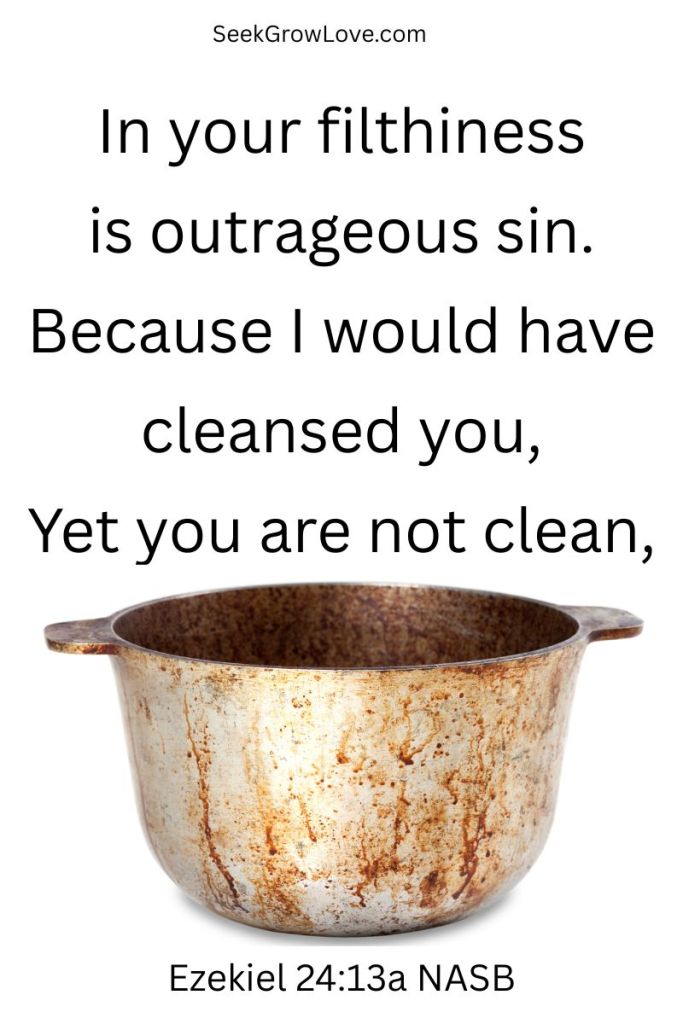
Today I scrubbed out our cast iron skillet. It would have been easier the night before, but I put this task off until today. It reminded me of our reading from Ezekiel 24. The parable for the Israelites contains a dirty, rusted boiling meat pot destined for cleansing by destruction. The pot was symbolic of Jerusalem. Ezekiel once again shares what the Sovereign LORD has said by telling his people this parable. The king of Babylon has laid siege to Jerusalem. The LORD shows the people what will happen if they continue in their evil practices. The LORD refers to Jerusalem as the city of bloodshed. When faced with a warning that severe negative consequences including death for many will follow their actions, we would think that they would stop sinning. We want the people to repent, to turn to God and accept His deliverance and His salvation. Unfortunately, they do not. 

That nasty stuff in the pot should have been removed long ago, but the people continued in their sins. We could compare the rust of the pot to the bloodshed that had taken place in Jerusalem. God had seen the killing and wounding of others in this city of blood. All the actions of the people were in full view for God. He also states that their impurity was lewdness. They did detestable acts and committed adultery. They chose indecent, obscene behaviors rather than allowing God to clean out all that crud.  They should have been filled with shame and repentance, but they openly committed their sins. The scripture tells us that the LORD tried to cleanse them, but they would not be cleansed. They were told, “You will be judged according to your conduct and your actions,” declares the LORD. 

The people of Jerusalem would not turn from their sin, but we can. We can recognize when we fall short and confess our sin. After all, He is faithful and just and will forgive us our sins and purify us from all unrighteousness. So God can make us a “vessel for honor, sanctified, useful to the Master, prepared for every good work.”

Reflection Questions

  1. What sins has Ezekiel mentioned in his book? What does God not like about them?
  2. Why do you think God is giving warnings before the punishment comes?
  3. What sins do you think God sees today – in you – that he would (or is) sending you a warning about? And what sins in the world around you?
  4. What would the cleansing process look like if we turn to God? What would the cleansing process look like if we don’t?

Hope in the Middle of the Ruins

Lamentations 3-5

Devotion by Dustin Farr (South Carolina)

The book of Lamentations is heavy. It is a raw, unfiltered look at grief. Jerusalem has fallen, the temple is destroyed, and the people are either dead, exiled, or living in deep suffering. The city walls have been torn down, homes burned, leaders captured, and the streets are empty. Hunger, fear, and loss have touched every household, and the once-proud city is now a place of desolation. Every chapter is filled with heartbreak, and the writer doesn’t shy away from addressing the pain.

But this is more than just a story of destruction. It’s an honest record of what it looks like when life falls apart. When the consequences of sin, both personal and collective, are unavoidable. The people knew God’s commands, and they chose to break them. Now they are living with the fallout, and it’s not pretty.

What stands out is how Lamentations holds both grief and hope at the same time. In chapter 3, right in the middle of all the sorrow, comes this anchor: “The steadfast love of the LORD never ceases; his mercies never come to an end; they are new every morning; great is your faithfulness” (Lamentations 3:22–23). It’s not spoken after things get better. It’s spoken in the middle of the storm. That’s what makes it powerful for us. We all face seasons that feel like ruins, and the truth is, they do not always get better. Our faith cannot rest on whether life is comfortable or whether blessings are obvious. It has to be steady, no matter the circumstances. Like Job, who said, “The LORD gave and the LORD has taken away; may the name of the LORD be praised” (Job 1:21), we are called to worship God whether life is full or stripped bare. The struggle may not lift quickly, but we can rest in the salvation we have through Christ and in knowing that our God is a Redeemer. Even when we cannot yet see it, He is at work.

Lamentations reminds us that it’s okay to be honest about our pain, but it also calls us to cling to God’s character in the middle of it. His faithfulness isn’t proven by how quickly He fixes things, but by His presence and unchanging promises even while we wait.

Reflection Questions

  1. Lamentations shows the people facing the full weight of their choices. How does acknowledging the reality of your own situation, without excuses, change the way you pray?
  2. The writer of Lamentations keeps talking to God even when he feels unheard. How can you practice staying in conversation with God when your prayers seem unanswered? 
  3. The book ends without a neat resolution, yet with eyes still turned toward God. How can you hold on to hope when you have no guarantee of when or how God will act?

(Thank you, Dustin Farr, for writing this week! Dustin is a first-time writer for SeekGrowLove and we look forward to hearing more from him. He is a recent Graphic Design graduate.)

The Problem – and The Solution

Isaiah 23-27

Isaiah 23-27 tells of God’s judgement upon the earth, the peace that comes from God, and the redemption that we find in Him. Though these may seem in opposition to each other, each of these elements is a key facet to the overall theme of these chapters. In chapters 23 and 24, we read about the suffering, desolation, and punishment which is a result of the people’s wickedness. Isaiah 24:5 says that:

              [5] The earth lies defiled under its inhabitants; for they have transgressed the laws, violated the statutes, broken the everlasting covenant. (ESV)

My mind immediately recalls Romans 3:23 which says, “for all have sinned and fallen short of the glory of God”. All of mankind have done things that are displeasing to God and are deserving of the punishment which is talked about in Isaiah 23/24. Often when we sin, there is a conscious knowledge that what we are doing is wrong, yet we continue anyways. Our sin pushes us away from God’s presence and leads us down into some very dark places where we try to cover up or escape the last bad thing we did. This cycle of sin continues, and we draw further away from God and for our unrighteousness, God will punish us. However, there is hope that for those who trust in God and repent from sin, he will save us and deliver us from destruction.

              [8] He will swallow up death forever; and the Lord GOD will wipe away tears from all faces, and the reproach of his people he will take away from all the earth, for the LORD has spoken. (ESV) – Isaiah 25:8

This passage gives me so much hope and encouragement for what is to come when there is no more pain, suffering, and death. Everyone at some point in their lives will experience hardship. Maybe that is the loss of a loved one, battling addiction, becoming seriously ill without any warning, or maybe going through a breakup. Maybe you’re in that time of life right now or maybe it is around the corner. Whatever it is, there is hope that someday, God will restore this earth to its rightful state, but in the meantime, we can set our eyes to the one who has the power to save and deliver.

Isaiah 26:3–5 says:

[3] You keep him in perfect peace whose mind is stayed on you, because he trusts in you. [4] Trust in the LORD forever, for the LORD GOD is an everlasting rock.

I’d like to end with this portion from our text as a final reminder to set your mind on God. This can be very difficult amidst the infinite distractions in our world, but when you set aside these distractions, you can see clearly through that business or pain and find everlasting peace.

Here are some application questions to ask yourself:

Are you building your life upon the God?

When was the last time you asked God to be your rock or firm foundation?

How can you encourage someone in your life and lead them to the hope of deliverance?

-Jeremiah Grable

A Man After God’s Own Heart

Ps 5, 38, 41-42

One Sabbath day, Paul came to a synagogue in Antioch (a city in modern-day Turkey) and sat down to listen to the law and scriptures. After the reading was down, Paul got up and gave a sermon. Nestled in the middle of his speech is this interesting passage, “After [God] had removed [Saul], [God] raised up David to be their king, of whom he testified and said, ‘I have found in David the son of Jesse a man after my heart, who will do all my will.” (Acts 13:22)

How amazing it would be to be known as a man (or woman) after God’s own heart! Of all the epitaphs that we could put on our tombstones, this would be the highest praise. 

But, we know that there is more to David’s life than just this statement. In fact, it seems a little incongruous to describe the man who sent Uriah to die because of his sin and who sent an Angel of the Lord on his people because of his decision to do a census as a man after God’s own heart. 

I think the Psalms we read today – the cries written from David’s own heart – show how he reflected the heart of God. 

In the Psalms, we see that: 

  • David understood that God loves righteousness and hates evil. David repeats the truth to himself that God does not delight in wickedness. When he comes to God in prayer, he describes his wickedness as wounds that stink and fester. This bleak picture demonstrates his view of sin: it is evil and something from which you should flee.
  • David understood the importance of confession. David’s harsh view of sin did not mean that he was blameless. We know that he slipped and fell multiple times and had to deal with the consequences of his actions. Still, when David veered from the good and right path, he recognized it and he turned back toward God. He didn’t minimize sin, and once he humbled himself, he didn’t stay in his sin. Instead, he confessed and repented. 
  • David longed for God. He longed for God’s temple, God’s favor, and God’s very presence. He longed for it as deer pants for streams of water. He describes his soul as thirsting for God. And we know that God is the author and sustainer of life. As the very best thing, he is the ultimate thing we should long for. 

To be a man after God’s own heart didn’t mean that David had to be perfectly sinless. No human is able to do that in this lifetime. Instead, being a man after God’s heart means that we are trying to make our heart – our priorities, desires, and understandings – match the heart of God. 

If we want to be people after God’s own heart, we should: 

  • Love righteousness, and hate evil 
  • Repent from our sins in humility
  • Place God as our utmost desire

How would you describe your heart today? 

-Cayce Fletcher

Cayce blogs at https://amorebeautifullifecollective.com about faith, family, and life. You’ll find encouragement for how to build intentional lives rooted in faith and beauty. Check out the latest post on the human nature of Jesus here

Reflection Questions

  1. David was anointed king after the downfall of Saul. How would you describe the difference between the heart of Saul and the heart of David? 
  2. What is your view of sin? How do you show your view of sin in your actions or your willingness to confess and seek repentance? 
  3. What does it mean to long for God ‘as a deer pants for streams of water’? Do you long for God in this way? How could you deepen your desire for God? 

SGL.2025.MayFullPageDownload

A Psalm of Repentance

Psalm 32, 51, 86, 122

Create in me a clean heart, O God, and renew a right spirit within me. Psalm 51:10 ESV

Yesterday, we looked at the narrative and the outcome of David’s tryst with Bathsheba. We see David essentially commit murder to cover up his affair, and we see the prophet Nathan come and confront David about the evil that he has perpetrated.

David could have been dismissive. He could have just shrugged off Nathan’s confrontation and said, “This is where my heart led me.” He could have said, “God wants me to be happy.” But he does not deflect. Despite his error, David still desires to do what God desires of him. He wants to be right before God, and when the clarity and gravity of his treachery sink in, he shows contrition. Not combativeness. Not excuses. Contrition.

David knows that what he has done is wrong, and he knows that he is not capable of fixing himself and reorienting his life and priorities alone. He cannot wash himself clean of his sin, but God can forgive him and cleanse him of the sin that has come forth from him.

David sees what would later be written: God does not desire sacrifice, but repentance. Not a cheap get me out of this mess offering, but a recognition of the sin done and the brokenness of recognizing the gravity of the separation from God that sin causes. God accepts sacrifices, but he accepts these sacrifices from a clear conscience; he doesn’t desire sacrifices from a guilty one.

-JJ Fletcher

Reflection Questions

  1. Why do we struggle to see the gravity of our sin?
  2. How can we truly show contrition, not just be sad that we’ve had our sin found out?
  3. What can we learn from Psalm 51, a psalm of repentance?

Wrong Place, Wrong Time

2 Samuel 11-12
1 Chronicles 20

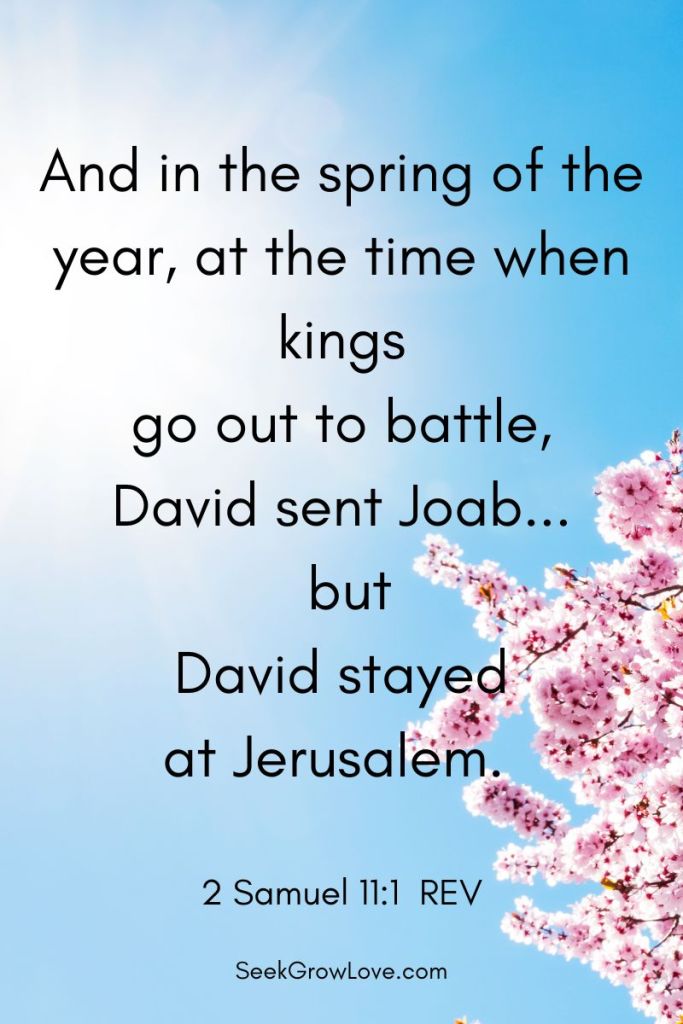
And in the spring of the year, at the time when kings go out to battle, David sent Joab, and his servants with him, and all Israel, and they laid waste the children of Ammon and besieged Rabbah, but David stayed at Jerusalem. – 2 Samuel 11:1 (REV)

                  In today’s reading, we see two realities. Both happened, but at different times and represent different things. In 2nd Samuel, we see David, king of Israel. Where do we see David? At home. Sitting on his keister and not doing what a king would normally be doing: overseeing his generals as they go out to battle.

                  David is not where he is supposed to be. He should be meeting with his generals. He should be motivating his armies. He should be praying and fasting and seeking out God’s direction for the safety and prosperity of Israel, but he’s back in Jerusalem. Twiddling his thumbs? Playing his harp? We don’t know what he was doing at all hours of the day when he held up in his palace.  We do, however, know what he was doing on one specific evening.

                  David is out walking on the roof, where he shouldn’t be, and he sees Bathsheba bathing. David does not turn away from seeing the nakedness of this woman whom he is not married to. He stares. He dwells. He obsesses. She’s beautiful. He needs to meet her. To be with her.

                  David ends up having her come into his home, and he has sex with her and gets her pregnant. We may have seen this story happen in the lives of some people we know, but this is high profile. This is a problem. A bunch of people are going to know what has happened, and this is going to be hard to explain to Bathsheba’s husband, Uriah, who is out at war, where he is supposed to be: fighting for the armies of the people of Yahweh. While the king is out preying upon the wife of his soldier.

                  David finds himself in a sticky situation, so he sends for Uriah and does his best to get Uriah to go have sex with his wife and cover his… keister. Uriah, however, cannot fathom such a thing while his comrades are off fighting a war. He refuses to even go visit his wife. This poses a major problem. People are going to know that Bathsheba is expecting, and they are going to know that Uriah hasn’t been with her in months, maybe longer. David tries multiple times, but no dice. Uriah is a man of honor and conviction, and that is not going to fly in this situation. David needs an out. David essentially puts out a hit job on Uriah. David cannot control his urges, so a good man dies.

The story unfolds. Uriah is dead. David marries his baby mama, and then the baby dies. Nathan the prophet comes to confront David and gets David worked up with a parable. David wants vengeance for the perpetrator in the story, but then the tables are turned when David is revealed to be the bad guy in the tale. David grieves, David repents, but the baby does not survive. It’s rough.

In 1 Chronicles 20, we see that it is the time when kings go out to war. And David goes out to war. And his armies thrive. He gets an awesome new crown. God blesses the armies of a king who acts in good faith. David is more than capable of doing the right thing, but even a man after God’s own heart can allow himself to fall off the rails.

Here’s the rub: Sometimes we get complacent. Sometimes we get lazy. Sometimes we do things, go places, consume content that we know we shouldn’t, but we’ve allowed ourselves to be in the wrong place at the wrong time, and we fall victim to the allure of the temptations of sin around us.

We’ve all allowed ourselves to be in bad situations that we could have avoided. Sometimes we may come out on top, but given enough opportunities to sin in the situations we create, we are bound to fall. We play with fire… and you know the cliché, but it’s true, we get burned.

-JJ Fletcher

Reflection Questions

  1. Can you recall some times you allowed yourself to be in a place you shouldn’t have been? What was the outcome? How could you have avoided putting yourself in that situation? What did you learn from it?
  2. What do you think of Nathan’s tactics of getting David to see the gravity of the wickedness that he had perpetrated?
  3. What does the story of David and Bathsheba teach us about grace, repentance, and forgiveness?
  4. If David can be forgiven for this travesty, who can you forgive that may have done much less harm in the way that they have wronged you?
  5. How does the contrast of 2 Samuel 11-12 and 1 Chronicles 20 sit with you? Does it give you any insight or change the way you perceive David’s sin?

More Sin and Straying

Judges 20-21

Judges 20-21 picks up where Judges 17-19 left off (and not in a good way). The Israelites assembled to discuss what had happened to the dismembered woman, and the Levite tells them his “truth.” He leaves out a few vital parts that may have drastically shifted how the Israelites handled the situation. He states that the men of Gibeah wanted to kill him and leaves out the part that his concubine was given to them (even though we see with hindsight the truth recorded earlier in 19:22-25). This false witness leads the Israelites down a dark path with lots of stumbling (as sin does to those who commit it and those around them). 

Instead of verifying the account of the Levite with even one or two more witnesses, they decide to confront and accuse the Benjamites. Unfortunately, the responses from the Israelites and the Benjamites reflected just how far they had strayed from God and the truth. The Israelites went to God, but not with a question about whether or not they should fight the Benjamites (or believe the Levite’s story), but with a question about who they should send first (20:18). The Benjamites, instead of searching for a way to settle things peacefully and purge the sin from among them, decide to go to battle as well (v.14). This doesn’t end well for the Benjamites. The Israelites (though experiencing their fair share of casualties) wiped out over twenty-five thousand Benjamites (v.35) and burned up their towns (v.48). However, it also doesn’t go well for the Israelites either. 

After realizing that they may have been a little harsh (or extremely harsh), they decide to find a way to help restore the tribe of Benjamin. Sadly, this only resulted in more death and suffering. People of Jabesh Gilead were killed (21:12), the Israelites grieved with and for the Benjamites (v.15), and the young women of Shiloh were caught in the crossfire (v.23). Israel had no king, no ruler, and they did as they saw fit. God was certainly in the picture for the Israelites but He wasn’t in the foreground (or close to their hearts and minds).

The consequences for sin aren’t anything to scoff at. In James 1:15 we read, “Then desire when it has conceived gives birth to sin, and sin when it is fully grown brings forth death.” Desire is where sin and death start, but it’s also where a Godly and Christ-centered life can begin. As a child, whenever I went to a Zoo or an Aquarium, I desired to be close enough to reach out and touch the animals God had created. However, as an adult, I understand why they took many precautions (such as very thick glass or bars) and certain animals were/are exempt from the petting zoo. Though I long for the day when “The infant will play near the cobra’s den, and the young child will put its hand into the viper’s nest,” (Isaiah 11:8 ESV) I’d like to keep my head, shoulders, knees, and toes intact in between now and then. God has given us desires, which, when handled appropriately, result in life to the fullest (both in this one and the next). However, when we place ourselves as a god, king, or ruler in our hearts and minds, we begin to live like the Israelites and lose God-given opportunities to live the way God intended for us.

-Jeffrey Seiders

REFLECTION Q’s

  1. The Levite told the Israelites his version of the truth and many people suffered. When you tell your version of the truth, is it aligned with God and His truth, purpose, and plan? If not, who can hold you accountable and help realign your truth with God’s?
  2. The Israelites eventually realized they had “gone too far” with the Benjamites. In what ways have you “gone too far” and realized you needed to do something about it? What did you do and could you have done more to prevent further pain and heartache?
  3. In James 1:15, we read about desire giving birth to sin, and sin bringing death. What desires do you have that have led you down a dangerous path? How can those desires, with God and His son in mind, be handled healthily for God’s truth, purpose, and plan in your life?

**Optional question: Some people look forward to seeing certain kinds of animals in God’s kingdom. What are you most looking forward to in God’s kingdom? Why?**