Don’t Withhold the Cure

Jeremiah 9-10 and Psalms 99-101

The Old Testament prophets who spoke for God, including Jeremiah, were entrusted with preaching a lot of doom and gloom. Because God’s children had strayed from his commands, judgment would be coming and the people needed to know. I loved Jeff Fletcher’s illustration in his devotion yesterday of a doctor who could be charged with malpractice if he knew the sick condition of a patient’s insides and knew how to fix it and what changes the patient would need to make in order to cure the potentially deadly ailment, and said nothing. This would be like the Christian who sees the broken sinful world and pretends everything is okay. Don’t withhold the cure.

Jeremiah paints a very vivid picture of a world that is not okay. Chapter 9 opens with the prophet mourning the sinfulness of God’s people. He would love nothing more than to pack up and go to a desert retreat where he could get away from and forget this crowd of unfaithful people. Can you relate? But, rather than abandoning the people in their sin, Jeremiah continues passionately speaking truth for God, over and over, even though his words often seem to fall on deaf ears. He still must speak and write and hold out the cure to these wayward people.

God has had it, too. He aptly describes the situation this way:

“It is not by truth that they triumph in the land. They go from one sin to another; they do not acknowledge me,” declares the LORD. (Jeremiah 9:3b NIV)

and again, “They have taught their tongues to lie; they weary themselves with sining. You live in the midst of deception; in their deceit they refuse to acknowledge me,” declares the LORD. (Jeremiah 9:6 NIV)

It sounds to me like God and Jeremiah are describing the sad state of affairs in 2021. So many lies and deceptions abound when attempting to justify and explain and even celebrate sin and sinful lifestyles that fester and grow when individuals and nations and societies have turned their backs on God.

It is as though God is left without a choice. “What else can I do because of the sin of my people?” (Jeremiah 9:7 NIV) “‘Should I not punish them for this?’ declares the LORD. ‘Should I not avenge myself on such a nation as this?’ ” (Jeremiah 9:9 NIV). God had drawn up the rules long ago with blessings promised to those who followed and curses to those who stubbornly disobeyed. Many chances had been given. Prophets had been sent to remind the people of the deadly disease and of the cure – repentance, turning away from sin and turning back to God. But these were a very stubborn people who took delight in continuing in their sin and lies and more sin and more lies.

God had given mercy. God had given reminders. God had given prophets. God had stretched out the cure. But, to no avail. So, God says – it is time. It is time to teach your daughters how to wail – death and destruction is coming. (Jeremiah 9:20,21).

Towards the end of chapter 9 an interesting section seems almost out of place…

 This is what the Lord says:

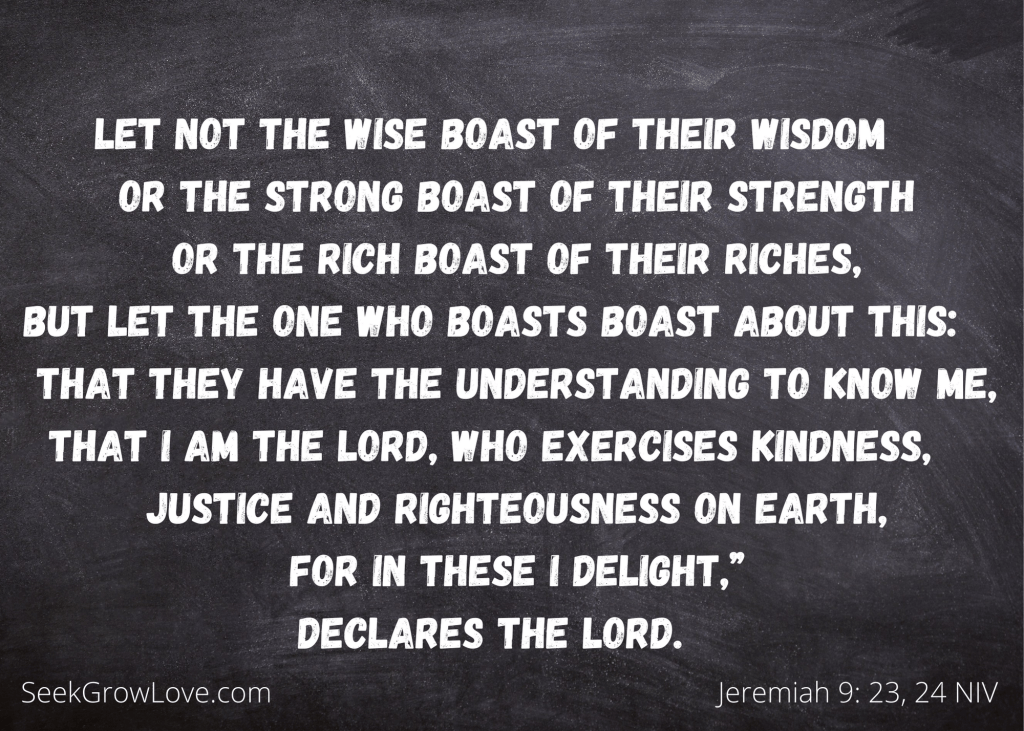
“Let not the wise boast of their wisdom
    or the strong boast of their strength
    or the rich boast of their riches,
24 but let the one who boasts boast about this:
    that they have the understanding to know me,
that I am the Lord, who exercises kindness,
    justice and righteousness on earth,
    for in these I delight,”
declares the Lord. (Jeremiah 9:23-24 NIV)

Perhaps it was written more for us who would be reading Jeremiah centuries later, to remind us of the choice we have. And, the great opportunity we have to boast about our God, our Creator, Our YHWH. He created the cure. His Son is the cure that was not yet available in Jeremiah’s day. Sin is the same and comes with the same consequences – death. People today need to know about the cure. They don’t need to hear you bragging about your dinner, your kids, your car, your job, your grades, your house, your ______ (on social media or at the checkout line). They need to know about the LORD our God who exercises kindness AND justice and always righteousness. The Psalms passages today have some great examples of boasting about our God while holding out the cure. How can you hold out the cure today to a nation and world that is unknowingly in the stages of the deadly disease of disobedience?

-Marcia Railton

Today’s Bible reading passages can be read or listened to at BibleGateway.com here – Jeremiah 9-10 and Psalms 99-101

Reminders

Isaiah 63-64, Titus 3

Life is so busy and complicated that I have to create lots of reminders for myself.  Fortunately, my phone and computer and watch all have features where I can set reminders for myself.  “Doctors appointment Tuesday at 3:00.  Take the garbage to the dump on the way to work in the morning.  Stop by the store after work and pick up some milk and bread.” I can even set reminders months or years in advance.  I can set alarms to remind me that in 2 hours I have a meeting.  In 1 hour I have a meeting.  In 15 minutes I have a meeting.  The Meeting is now starting.  Maybe I’m too busy or maybe I’m getting old, but I find myself more and more needing reminders.

Do you ever need reminders?  Little kids need to be reminded to brush their teeth, make their bed, do their homework.  What do you need reminders for?

The Apostle Paul thought reminders were important for Christians.  I guess he understood how easy it can be to forget what’s important when we are busy living life and doing  what’s necessary or urgent.  Do Christians ever forget important things about God, about Jesus, about how we are supposed to live?  Yep, we sure do.

In Titus 3 Paul tells Titus to remind the believers of some important things.

“Remind the people to be subject to rulers and authorities, to be obedient, to be ready to do whatever is good, to slander no one, to be peaceable and considerate, and always to be gentle toward everyone.” -Titus 3:1-2

Those reminders were important in the first century when Christianity was brand new and people were still learning the basics, but it’s been 2000 years.  We’ve certainly got being a Christian all figured out by now, don’t we?  Do we really need to be reminded to obey people in authority?  Do we need to be reminded to always be ready to do good?  Don’t all Christians always do what is good?   Certainly we never  slander or falsely accuse someone of wrong doing.  I’m always peaceable and considerate and gentle toward everyone, aren’t you? (My tongue is in my cheek- that means I’m kidding).

To tell the truth, I still need to be reminded all of those things.  Just because I’ve been reading the Bible for over 50 years doesn’t mean I always remember to do good.  I still need to be reminded to be considerate and gentle, and so do you.  That’s why Christianity was never designed to be lived in isolation, but in community.  We need each other.  There’s a passage in Hebrews (a different book from today’s reading,  but important) Hebrews 10:24-25 says that Christians shouldn’t get out of the habit of meeting together, because we need to encourage (I think Hebrews says “spur one another on”, like a rider spurs on a horse) each other.  

Following Jesus is hard some times.  Being obedient to God is hard some times.  Remembering to do good and be gentle is hard sometimes.  I need help, I need encouragement to keep on doing what is right.  I need you, and you need me, we need each other.

I’ve read the Bible many times in my life and I need to keep on reading it to help me remember all the important things I need to remember.  Today’s readings in Isaiah 63-64 and Titus 3 remind us both about God’s wrath and about God’s mercy.  God has both.  God hates sin, he hates it when his children are brutal to each other.  He hates it when his children fight and argue.  He hates sin because he loves us and he knows that sin hurts us.  We hurt each other when we sin.  No parent likes to see their children hurt each other.  We learned that from our Father, God.

So keep reading your Bible and keep coming to Church and meeting with other believers so that you can remind them and they can remind you to keep on following Jesus.

“Hey Siri  set a reminder for 7 a.m. tomorrow:  be considerate and gentle to everyone.”

“Alexa, remind me to get up for Church Sunday at 8:00.”

-Jeff Fletcher

Today’s Bible reading plan passages can be read or listened to at BibleGateway.com here – Isaiah 63-64 and Titus 3

Two Choices

Saturday – May 29, 2021

1 Kings 9-10, Acts 26

Solomon has finished the calling that God assigned to him. The temple was completed. In addition, Solomon has built an elaborate palace and pursued wisdom in his life. In 1 Kings 9, God appears to Solomon and makes a second promise to him. If Solomon commits to following after God and living by the commandments of God, God will build his kingdom and establish it. But, this promise presents a choice: either Solomon can have a kingdom established forever or he would have his kingdom ruined and removed. These consequences are contingent upon the actions of the Israelites outlined in Deuteronomy 30: “I have set before you life and death, blessing and curse. Choose life so that you and your descendants may live, love the Lord your God, obey Him, and remain faithful to Him. For He is your life, and He will prolong your life in the land the Lord swore to give to your fathers Abraham, Isaac, and Jacob” (v. 19-20). 

The Israelites could have life and blessings, but they needed to love God, obey him, and remain faithful to him. If they didn’t, they would live a life apart from God, full of troubles and difficult times. Even though the choice seems like a no brainer, generations of the Israelites still choose death, including Solomon. Because of their choices, they faced exile, famine, sickness, and death. 

We have the same choices today. We can choose life or death. I’ve always wondered why the Israelites couldn’t see the goodness that they were leaving behind because they chose to live a sinful life. However, when I look at my own life, I can understand why that path seemed pleasing to them. Sin feels good in the moment. It fills us up in the short term. But, as life continues and sin upon sin piles up, it turns out to be rotten. Like sweet cakes or soft drinks, it tastes good, but over time, too much leaves us feeling gross inside. Too much leads to death. To say no to sin requires self-discipline and sacrifice. We recognize that we are giving up something that may feel good now, because later on, we will have a better thing. 

Because of the sacrifice of Jesus, our consequences are not contingent upon all of our actions. We will not be judged by the law, because we have freedom in Christ – if we make one choice. If we choose to make Christ our Lord, we will have life in him. Today, choose life! Choose to live righteously and follow after Jesus, the perfect king. This choice and the sacrifice is so worth it!

~ Cayce Fletcher

Read or listen to today’s Bible reading at Biblegateway.com: Job 1-2 and 2 Corinthians 2 .

What are you asking for?

Wednesday – May 26, 2021

1 Kings 3-4, Acts 23

After Adonijah’s revolt, Solomon ascended to power, and in 1 Kings 3, Solomon began making decisions of what he should do as a king. 1 Kings 3:3 describes him when it says, “Solomon loved the LORD by walking in the statues of his father David, but he also sacrificed and burned incense on the high places.” Deuteronomy 12:1-6 specifically gave directions to destroy all the high places, but Solomon and the rest of the people went to worship there. In 1 Kings 3:1, one of Solomon’s first decisions is to make a treaty with Pharaoh’s daughter, going against Deuteronomy 17:16-17. Solomon seemed like he wanted to make good, godly decisions, but he didn’t know and apply God’s word enough to keep him from committing these oversights, these sins. 

Even so, in verse 5, after a large display of burnt offerings, God comes to Solomon and asks, “What should I give you?” This was a moment where he could have received so much from God – whether in power, wealth, status. But, instead, Solomon chooses to receive wisdom and discernment so that he could govern his people well. He recognized that he was a “youth with no experience in leadership” (v. 7) Solomon knew that he may have blundered in the past as he began to rule his kingdom. And so, he asked for the one thing that could truly help him to do better – discernment and wisdom from God. 

In our lives, we may feel that we are in situations that we have been thrown into. We may be overwhelmed. We may be trying to make the best decisions that we can. The thing that makes the difference in those situations is not how hard we work at them or the people that we impact or make happy. What we should pursue in those situations is the wisdom of God. That is the only thing that will help us to know what is right to do. It is the only thing that will help us to know how to keep ourselves on the righteous path and away from sin. 

What are you asking for from God? May we be a people who prays for the wisdom and discernment only God can give.

~ Cayce Fletcher

Read or listen to today’s Bible reading at Biblegateway.com: Job 1-2 and 2 Corinthians 2 .

Victorious

May 24, 2021 – 2 Samuel 23-24, Acts 21

When David came to power, he had his work cut out for him. Part of his legacy was fulfilling the calling that God gave to the Israelites when they first came to the Promised Land. He was charged with taking the land. He was supposed to be strong and courageous, and over his lifetime, he proved to be a man of strong military prowess who doubled the size of the kingdom of Israel. 2 Samuel 23 describes the men who helped David make that happen. These are his mighty men, the elite warriors who single handedly won battles against the Philistines with God’s help. One warrior killed 800 men at one time with a spear. Another group broke into an enemy stronghold just to get a cup of water for David. Repeatedly, these men are described as strong, fearless. They ‘stood their ground’ against their enemies. When they faced them this way, ‘the Lord brought about a great victory’ against their enemies. 

In Acts 21, Paul is facing strong and terrifying enemies. In fact, he is told what would happen to him by a prophet in verses 11-12 when the prophet describes how he would be tied up and delivered to the Romans in Jerusalem. The people are begging him not to go to Jerusalem, weeping for the bitter end that they knew would come to Paul if he decided to go to the city. Paul shows his determination and willingness to follow Jesus no matter what when he replies: “What are you doing, weeping and breaking my heart? For I am ready not only to be bound but also to die in Jerusalem for the name of the Lord Jesus.” What a mighty and fearless response! Paul may have not been marching into a war with spears and swords, but he knew the spiritual battle he was facing that would have real – and very dire – implications for his health and well-being. But, it didn’t matter – he would do anything for the name of Jesus. 

We need to face our everyday battles with the same determination and strength, resting in the knowledge that God will bring about the victory if we stand our ground. We need to be strong and courageous, because God is right there with us in our battles. We will emerge victorious!

~ Cayce Fletcher

Read or listen to today’s Bible reading at Biblegateway.com: Job 1-2 and 2 Corinthians 2 .

Numbers 25-26, Luke 3

Almost 40 years had passed, and the Israelites were nearing the time when they would enter into the Promised Land. A generation had died in the wilderness because they failed to trust that God would guide them, protect them, and give them the good things he had promised. God had used the Israelites’ wilderness wanderings to teach them about his holiness and to teach them to trust in him more. However, not all of the Israelites were sanctified through this time. 

In Numbers 25, the Israelites are staying in the country of Moab. Because of intermarriage and lack of loyalty, they turn away from God and begin to worship Baal, a pagan god. Leading the way in this idolatry are several leaders of the people. God sends a terrible plague among the people that eventually killed 24,000 people and orders Moses to strike the idolatrous leaders down. So, Moses and Aaron’s great-grandson, Phinehas, gather the people together. The people are in mourning for the loved ones they lost in the plague, and all gathered together at the tabernacle, they are mourning in supposed repentance. However, Phinehas sees one of the Israelites blatantly bring a Moab woman into the tent of meeting! While the people are weeping in repentance, this person acts in a way that would indicate that he was not repentant at all. He was going to continue in his sin. The repentance was only caused by the negative experiences the Israelites faced, but it wasn’t true, heart-changing repentance that would cause them to change their actions. 

Phinehas, in a zealous passion, takes a spear and kills both the man and the woman who are doing this. Because of that harsh measure, the plague stops and God promises the priesthood would continue with Phinehas for generations. This seems like a brutal action. But, the reason why God praised Phinehas for doing it was because this action shows (1) Phinehas understood the concept of the holiness of God and his tabernacle and (2) Phinehas recognized how sin has to be stopped so it won’t continue to do its damage. Sin spreads like a plague, which, once it gets started, is very difficult to eradicate. If we recognize the importance of holiness and trying ourselves to live a lifestyle of holiness, we cannot continue to allow sin to spread in our lives. We have to be willing to act zealously to snuff it out. 

In Luke 3, we read about the ministry of John the Baptist in his own wilderness. He cries out to the people to ‘Repent, for the Kingdom of Heaven is near!’ He urges those who come out to see him to “produce fruits consistent with repentance” because “every tree that doesn’t produce good fruit will be cut down and thrown into the fire” (Luke 3:8-9). Recognition of the severity of sin and true repentance from that sin are crucial to producing good fruit. If we do not recognize and repent from sin, we will not produce good fruit. We will not live lives that glorify God. 

Evaluate your life. Is it characterized by a right understanding of sin? Of an understanding of the importance of holiness? What about true repentance and good fruit? As John and Jesus said, “Repent! The Kingdom of Heaven is near!”

~ Cayce Fletcher

Read or listen to today’s Bible reading at Biblegateway.com: Job 1-2 and 2 Corinthians 2 .

Jesus is Greater : Priesthood, Covenant, Warnings

Hebrews 7-10


What is the theme of Hebrews? 


JESUS IS GREATER!

Today, we learn about two things that Jesus introduces that are greater than what came before.  In Hebrews 7, we are told that a greater priesthood is needed. It is impossible for people to be perfected through the Levitical Priesthood, the priesthood of the Old Testament. Something greater, a new priesthood, had to come to make all people perfect. Because Jesus offered himself as a sacrifice, his blood covers all those who come to God through him. Because Jesus lives forever, we need no other priest. Because Jesus has been raised and magnified, he is able to help us in our weakness. The priesthood of Jesus allows us to be made sinless.

 We can overcome sin through the power of Jesus. 
Because of this new priesthood, we can have a better covenant. This covenant is the way God interacts with his people. First, he gave commands to Noah, then to Abraham, then to Moses. He would say “I will bless you, watch over you, and save you, and you will do this for me” and give them rules for the best possible life. The covenant God gives to people in Jesus is the new and final covenant, the best way of any way to follow him, worship him, serve him, find salvation in him, and love others in him. We do not keep the Mosaic Law because the author of Hebrews tells us it has been superseded by the sacrifice of Jesus, a greater sacrifice. Jesus is the mediator of this new covenant. The sanctuary, the temple, the sacrifices are all perfected in Jesus, as he fulfills them through his death and resurrection to life. 


Because of all this, because Jesus is greater than Angels, Moses, and Joshua, because he institutes a better priesthood and covenant, in Hebrews 10:19-25, the author says “Let us, let us, let us”. The author is encouraging the readers to live out faith in response to the great message of Christ. 


This gets us into the last point I want to make today. Right after this encouragement, we read a warning in Hebrews 10:26-31 about willful sin. This isn’t the first warning. In Hebrews 2:1-4, 3:7-19, and 5:11-6:12(20), 10:19-39 and 12:14-29 are all warnings. (You can go read them.) As you go back and focus on these, they may stand out as strange. But again, the main theme of Hebrews is JESUS IS GREATER. The warnings in Hebrews say “Don’t turn away from the one who is greater, from the one who perfects, from the plan of God for the ages. There will be a day when the world will be made right, and you know the one who will hold you close and allow you to be made perfect! DON’T TURN AWAY FROM JESUS!” 


My brothers and sisters, along with the author of Hebrews, don’t turn away from Jesus. Remain faithful to the one who is greater!

-Jacob Ballard

Today’s Bible passage can be read or listened to at BibleGateway here – Hebrews 7-10.

Tomorrow we finish the book of Hebrews (chapters 11-13).

Not So Sweet and Mild Jesus

Matthew 23 and Luke 20-21

I have a confession to make. I really don’t like conflict and because of that I don’t always confront situations or people as I should or as is necessary. Now thankfully the Lord is growing me in this area because the reality is confrontation and conflict is necessary. Actually the New Testament teaches that there is a time and place for believers to hold each other accountable with regard to sin. Many Christians and churches struggle with this. It’s uncomfortable, awkward, and scary yet our Lord himself exemplified this in today’s chapter of Matthew 23 (read Matt. 18.15). 

Seven times in Matthew 23 Jesus says “woe to you” with reference to the Pharisees. “Woe” is a prophetic denunciation that the prophets in the Old Testament used to warn people that their behavior was not pleasing to God and if they didn’t correct their actions God’s punishment and judgement would come. 

The crime of the Pharisees was that they were so caught up in religious activities that it compromised true obedience God really desired. Jesus loves and forgives but he will not tolerate empty obedience and religious service. He will not be sweet to that which God hates and opposes. Likewise as followers of Jesus we must strive to become like him in all respects including standing up for the truth even when that means calling out sin and that which God hates. 

This must be done with great wisdom and care and love. I’ll include passages that speak to this theme. I’d encourage you to read them and get exposed to this New Testament teaching. We as Christians have a duty to lovingly hold other believers accountable with regard to sin. 

Passages for further study:

.Matt. 16.21-23

.Matt. 18.15-20

.I Cor. 5.1-5

.Gal. 2.11-14

.Gal. 6.1

.Eph. 5.11-14

.I Tim. 5.20

.Tit. 3.10-11

.Jam. 4.17

Jacob Rohrer

Today’s Bible passages can be read or listened to at Bible Gateway here – Matthew 23 and Luke 20-21.

Tomorrow we will read Mark 13.

His Touch

Matthew 8:1-13 & Luke 7- Jesus heals a man with Leprosy

Before we get into today’s story, we need to understand the Old Testament law dealing with leprosy.  Leviticus 13:1-46 talks in great detail about leprosy.  There, we find that leprosy is a skin disease that is more than skin deep, it’s highly infectious, it defiles a person, anyone with leprosy must cover their mouth (this sounds like a mask), be separated from other people (social distance), live outside the town (this sounds like isolation), wear torn clothes, and cry out, “Unclean! Unclean!”

In Matthew 8, we find the story of a man with leprosy.  Instead of staying away, we’re told, “A man with leprosy came and knelt before him [Jesus] and said, “Lord, if you are willing, you can make me clean.”  I believe this man had great faith.  He knew Jesus could heal him, he just didn’t know if Jesus would be willing to.  And he violated the law so he could get close enough to Jesus to find out.

Matthew 8:3 says, “Jesus reached out his hand and touched the man.  “I am willing,” he said, “Be clean!”  Immediately he was cured of his leprosy.”  I find this very moving.  Jesus demonstrated how much he cared for this man by not just healing him – which was astounding enough.  Jesus also touched him.  By touching the man, Jesus would have become defiled – made unclean himself.  And remember, since no-one could touch a leaper, who knows how long it had been since this man had someone actually touch him.  I can’t imagine what that touch meant to the man.

Matthew 8:4 goes on to say that Jesus told the man, “See that you don’t tell anyone…”  We find this same story in Mark, and we’re told in Mark 1:45, “Instead, he went out and began to talk freely, spreading the news.  As a result, Jesus could no longer enter a town openly but stayed outside in lonely places.  Yet the people still came to him from everywhere.”

In this story, I see that leprosy compares well with sin.  Sin runs more than skin deep, it is highly infectious, it defiles a person, and whether we admit it or not, it makes us unclean, and separates us from God.  When Jesus went to the cross, he took our sin on himself, causing him to be defiled.  But he demonstrated his obedience to God and his love for us by doing this anyway.  But Jesus’ sacrifice means nothing for us unless we each have faith in Jesus, come submit before him, and ask to be healed (forgiven).  Are you willing to get close enough to Jesus to find out what he can do for you?

Finally, at the end of the story, the man disobeyed Jesus’ direct command to him to tell no one.  Jesus commanded us to tell everyone.  How are you doing with that?

–Steve Mattison

Today’s Bible passage can be read or listened to at BibleGateway here – Matthew 8:1-13, Luke 7

Tomorrow’s reading will be Matthew 11.

Incident at the Pool

John 5 – The Healing at Bethesda

In Jerusalem there was a pool, called Bethesda, where blind, lame, and paralyzed people would gather.  My Bible has a footnote that says John 5:4 isn’t in the most reliable manuscripts.  John 5:4 says “From time to time an angel of the Lord would come down and stir up the waters.  The first one into the pool after each such disturbance would be cured of whatever disease he had.”  If this verse isn’t legitimate, the rest of the story doesn’t make sense, so I’ll assume it is valid.

Anyway, there was a man there who had been an invalid for 38 years.  Jesus asked him if he wanted to get well.  This seems like a strange question to ask someone who was an invalid.  But who knows, maybe he was making a good income begging, and wanted to stay in his condition.  

Instead of saying, “Yes!”, the man started making excuses – he replied that he didn’t have anyone to help him into the pool when the water was stirred, so he never got into the water first.

Jesus then told him, “Get up!  Pick up your mat and walk.”  At once the man was cured; he picked up his mat and walked.

This is a curious miracle.  The man didn’t ask Jesus to heal him.  The man didn’t have faith that Jesus could heal him – when asked, he didn’t even know who had healed him.  Also, there were many sick people there, and Jesus only healed this one man.  First, I do have to acknowledge this is a tremendous example of grace.  But I do have to wonder, why did Jesus heal this man?

If we keep reading the story, we find that instead of being happy for the man that had just been healed, the religious leaders criticized him for carrying his mat on the Sabbath.  He told them he was just doing what he was told by the man who had healed him.  When asked who that was, he didn’t know.

Later, Jesus found him again and told him to stop sinning or something worse would happen to him.  (We can assume Jesus meant the final judgement, but we’re not told.)  After this, the man went back to the religious leaders to tell them Jesus had healed him – on the Sabbath.

Now, I think we are finally at the point of understanding why Jesus healed this man.  I wonder if Jesus wanted to shake up the understanding of the religious leaders of his day, and this was a good way to get their attention.  He told them, “My father is always at his work to this very day, and I, too, am working.”   Notice that Jesus said “My father” instead of “our father”.

The Jews recognized that Jesus was telling them that He is the son of God.  In this chapter, He also called himself the “Son of Man”, which they would have recognized as a messianic reference from Daniel 7:13l.  They were furious that not only was Jesus breaking the Sabbath, he was claiming that He was (is) the son of God.  And they made the mental leap to say that if Jesus was claiming to be the Son of God, he was claiming to be equal with God.

They studied the scriptures regularly, and thought they would “earn” eternal life because of that.  Jesus pointed out, “These are the Scriptures that testify about me, yet you refuse to come to me to have life.” 

The religious leaders of Jesus’ day couldn’t accept what He was telling them.  Instead, they just wanted to kill Him.  What about you?  Do you acknowledge that Jesus is the Son of God who will one day judge the living and the dead?  To paraphrase James 2:19, the demons acknowledge this too – and shudder.

If you do acknowledge Jesus, what are you going to do about it?  I would encourage you to take a cue from the man who was cured, and obey what Jesus said.   No, don’t pick up your bed and walk – instead read your Bible to understand all Jesus taught about, and obey all of that.  Finally, we should all take to heart Jesus’ warning to the man, “Stop sinning or something worse may happen to you.”

Because, as we’re reminded in John 5:28-29, “… for a time is coming when all who are in their graves will hear his voice and come out — those who have done good will rise to live, and those who have done evil will rise to be condemned.”

–Steve Mattison

Today’s Bible passage can be read or listened to at BibleGateway here – John 5

Tomorrow we read Matthew 12:1-21, Mark 3, and Luke 6 as we continue in our Bible reading plan.