All Connected

Judges 1-2 and John 4

This year our Bible reading plan has included one Old Testament reading and one New Testament, Psalms or Proverbs reading every day. I’ve enjoyed the daily variety and I think rather than feeling disjointed, like I had feared, it actually helps me see the Bible more as a whole. There have been several times when one reading would refer to something in the other, if not from that same day then something recently read.

On Sunday our devotion was on Psalm 69, one of the most quoted and referenced Psalms in the New Testament. It portrays a zealous suffering servant of God who is surrounded by the enemy. And just 2 days later we read John 2 which included Jesus entering the temple and being shocked to see the disrespect and greed of the moneychangers and those wanting to make a quick buck selling animals for sacrifice rather than revering the house of the Lord and the holy God they should have been focused on. Jesus forcefully clears the temple, and John records, “His disciples remembered that it is written: ‘Zeal for your house will consume me.’ ” (John 2:17 NIV – quoting Psalm 69:9). Those disciples knew and loved the same book we just read! They saw connections and how Jesus fulfilled and carried out the Scriptures they were devoted to and knew well. That’s just one example of the many times it’s been exciting to see overlap and referencing reminding me of how precious this book is and how it all works together to show us God: His character, story, plan, majesty, and His Son and ultimately, what will our response be? As Joshua said (just yesterday), “Choose for yourselves this day whom you will serve…but as for me and my household, we will serve the Lord.” (Joshua 24:15 NIV)

As we see it all work together, woven together as one, it’s sometimes hard to decide which passage to write about. It’s exciting that God gave us SO much in His Word, we couldn’t possibly discuss it all thoroughly in one year of devotions. But every day we can increase our knowledge and understanding just a little, find a new thought or reference we hadn’t seen before, learning to love it and the God it reveals and putting His word to use to become more and more what He wants us to be and do.

And, today we read of the Samaritan woman by Jacob’s well in the land given to Joseph. This well is not specifically mentioned elsewhere in Scripture – but we did just read a lot about the land of Jacob’s sons’ families and we read of the tribes of Joseph’s sons (Ephraim and Manassah) receiving their inheritance and burying the bones of Joseph in his land. The Samaritan woman knew these stories and these families – and now she was going to meet the Messiah, the Christ, she has been waiting for!

That was a much longer introduction than I expected. No wonder we don’t have time to look closely at every passage every day. But, today I want to try something different. Instead of having you read any more of me than you already have, I want to give you some questions to consider for both the Old Testament and New Testament scripture – two excellent passages God wants us to consider. You could pick some of your favorite questions to think about today and even discuss with your family and circle of influence. Enjoy digging into God’s Word and considering what God wants you to see!

JUDGES 1-2

Judges 2 tells of the cycle of obedience and disobedience that Israel will fall into after the death of Joshua. Can you see in your own life, family, church, community, nation any similar cycles?

Have there been times when you have slipped away further from God? Any ideas what prompted that? What turned things around again?

How would you describe the difference between a life of obedience to God and one of disobedience? The results? (Use personal experience anytime you can)

Have there been times you have benefitted from having a strong Godly leader (like Joshua or one of the judges)? How so? What did they provide? What dangers do we need to avoid in regards to having (or losing) a strong leader?

How/when can you help others who are in a time of disobedience and trouble?

JOHN 4

What do we learn about Jesus in this passage? (especially verse 6, 9, 10, 13, 18, 26, 29, 34, 42, 53).

What did the Samaritan woman already know before meeting Jesus? What did she learn that day?

How would you describe Jesus as the Living Water? Would you say you have experienced him as living water, or will experience it, or have just heard about it? What does Jesus want to offer to the Samaritan Woman? To You?

What was the result of the Samaritan woman’s talk with Jesus?

Jesus said his “food” was “to do the will of him who sent me and to finish his work.” (vs 34) and then he asked the disciples to see the harvest work around them. What fills you up or have you been feeling a little starved lately? What can you do today to help you feel full and satisfied? What harvest work around you does Jesus want you to see and act on?

-Marcia Railton

Today’s Bible reading passages can be read or listened to at BibleGateway here – Judges 1-2 and John 4

Your Reputation

John 3

What’s your reputation? The Bereans were known for checking Paul´s words against Scripture. Thomas was the doubter. Saul had a reputation for persecuting the Christians before he became Paul. The Pharisees were hypocrites.

The Pharisees were the religious leaders of the day, and at the time were esteemed by many. But in the eyes of God they were dangerous men who didn’t get it. Matthew 16:12 ¨Then at last they (the disciples) understood that he wasn’t speaking about the yeast in bread, but about the deceptive teaching of the Pharisees and Sadducees.¨ What a common misconception, right? The Pharisees had all the knowledge of the scriptures and Jewish traditions and laws. They were the teachers and leaders of the Jews. Yet Jesus rebukes them because they were missing a love for God.

This type of thinking reminds me of chapter 5 of Matthew where Jesus keeps on telling the people  that they have all heard what the law says but Jesus comes along and ¨tightens¨ up the law, by changing the outward focus inward- off of the laws and onto the heart. The Pharisees had all the knowledge of the scriptures and Jewish traditions and laws but no matter how much they seemed to do they missed the point- following God, not just the laws.

 From what the Bible tells us about the Pharisees we see them continually trying to trick Jesus into messing up, or catch him red handed going against God´s law. They are the ones who plotted and killed Jesus! With the exception of Gamaliel and Nicodemus and Paul, the Pharisees are recorded as hypocrites, blind guides, lovers of  money, and a brood of vipers. (Matthew 23:23-24, Luke 16:14, 12:34) The Pharisees´ hated Jesus and everything he did and said.

In John 3 we see Nicodemus, a Pharisee, come to Jesus at night. Even to come at night had to have taken guts. But when Jesus tells him that one must be born again before they can see the Kingdom of God, he is stuck in his thinking as a Pharisee. But he knows Jesus is different from the rest of the Jewish teachers. Later on in John, Nicodemus makes steps in not following the Pharisees when he convinces his colleagues to allow a trial for Jesus, and when Jesus was laid in the tomb, it was Nicodemus who provided the myrrh and aloes and worked with Joseph of Arimathea to care for the lifeless body of Jesus.

What do you want to be known for? Nicodemus could have been a stereotypical Pharisee but he stepped out to learn from Jesus, the Son of God. He wanted to follow God instead of people. 

-Makayla Railton

Today’s Bible passages can be read or listened to at BibleGateway here – Joshua 23-24 and John 3

A Wedding

John 2

I can relate to Mary at the wedding in Cana. The proud momma wanting to show off her son. Here she is, celebrating at a beautiful wedding, eagerly pushing her talented son forward to perform and save the day, as she knows he can. He seems reluctant. The timing isn’t right. He isn’t ready to draw attention to himself yet. But she pushes ahead and doesn’t accept no for an answer. She is eager to show him off and watch him work. And, it just might be kind of advantageous for her when the neighbors find out what her son can do. It would be interesting to know if Mary had received a prompting from God that this was the time for Jesus’ miracles to begin, or if she was acting on her own.

I admire the servants. Even without knowing of the miracles Jesus would yet perform, they are quick to listen and obey, fully. They filled those jars with water – to the brim. And, then, not knowing how it would turn out – they followed his directions and brought some of this mystery liquid to the master of the banquet. I can imagine they were relieved to find the master was impressed. They sure had a story to tell their friends and family! I want to serve wholeheartedly like these servants, following Jesus’ every word even when work and risks are involved and the outcome is uncertain.

I have often felt the hesitation Jesus seems to show in this passage at the very beginning of his ministry. Perhaps unsure of the timing or his role? Should he listen to his mother or his gut instinct that said this wasn’t the time. Just like me and every other human, Jesus was not in control of his circumstances. Jesus had free will and made decisions and other people’s decisions would impact him greatly as well. Sometimes people cooperated with him and his plans and ideas and timing and other times they resisted and went their own direction – sometimes taking him on a path he did not choose for himself. But because of his strong connection to His Father developed through study of the Scriptures (knowing God’s words and thoughts and character and how he has acted in the past) and much time spent with God in prayer he carried out so beautifully the Father’s will, not necessarily his own, every step of the way.

Too often my own hesitation causes me to overthink and I end up not doing anything. I need to take more time in His Word and in prayer so I can more clearly see what opportunities God is putting in my path and make the most of them.

The end results of Jesus’ first miracle were the wedding guests continued their celebration and Jesus’ momma went home happy. But, more importantly, the disciples saw his glory – John did not say his deity – but his glory, his magnificence, his connection with his Father.

-Marcia Railton

Today’s Bible reading passages can be read or listened to at BibleGateway here – Joshua 21-22 and John 2

John 1

How many times does it take for a false statement to be repeated before it becomes true? Can you make a myth true if a lot of people believe it long enough?

What would happen if we read the Bible with no prior bias. What if we could vacuum out of our brain all knowledge and impact of the Apostles’ Creed which would be written hundreds of years after Jesus walked on earth? What if we could read John for what John wanted to say, instead of what the emperor and church leaders over 200 years later decided they wanted it to say?

John, the beloved disciple. He loved Jesus and Jesus loved him. Perhaps he knew Jesus better than anyone. He was there very near the start of Jesus’ ministry – the fisherman who with his brother James left their fishing nets to follow and learn more about Jesus. He heard Jesus’ teachings and was with him when he calmed the storm and healed the sick. His feet had been washed by his master, Jesus. That horrific day at the foot of the cross, Jesus entrusted to John the care of Mary, his mother. John ran to the empty tomb and saw with his own eyes the resurrected Jesus and spent 40 more days listening to and learning from his risen Lord and Savior. And, then Jesus was taken into heaven in the clouds and John and the others were told Jesus would return in the same way – but until then they were to be his witnesses. John had a job to do, to tell the world of Jesus. And so, before his death he carefully writes it down for all the future generations – and we have the New Testament book called the Gospel (good news) of John.

John specifically states near the end of his gospel what his purpose in writing has been. He says Jesus did much much more than could be recorded, “But these are written that you may believe that Jesus is the Christ (the Messiah, the Anointed One, the Chosen King), the Son of God, and that by believing you may have life in his name.” (John 20:31 NIV – parenthetical definition of “Christ” added). Obviously, it becomes very important for John to clearly represent Jesus if life and salvation come from believing in Jesus. We wouldn’t want to get that wrong, would we? And, we can expect that since this is John’s purpose statement nothing we read in the book of John will contradict what his mission is – to show us who the Christ, the SON of GOD is. Remember, we already cleaned out of our brain any future manipulation, twisting or reversal of this term that will develop centuries later. John, and the other New Testament writers (and Old Testament for that matter) never used the term “God the Son”. If it didn’t come from the Bible, where did it come from? It seems we should be concentrating on who and what John meant by the Christ, the Son of God, rather than trying to use this book to explain God the Son.

John would have been very familiar with Old Testament scripture which exalts and reveres the word of God – the words, plans, thoughts, intent, desire, ideas, as well as the actual spoken word of the Almighty God. The terms word of God and God’s word have also been used to refer to His written word, the Scriptures, in part or whole. Can we worship God, without knowing or trying to understand (to the best of our human ability) what His words, His thoughts, His desires are? It’s almost like voting for a president without having a clue what he stands for, what he has said in speeches, written in papers, what he thinks, believes and intends to do. It sounds dangerous to try to separate a candidate or a God from His words. We should view them as one – God and what He says/plans/intends/thinks/desires are the same.

It is also helpful to know that in Greek all words are assigned a male or female pronoun (similar to Spanish and many other languages in which every noun is known either as a she or a he) and the word “word”, in Greek “logos”, is assigned a male pronoun. It is interesting to note that 8 Bible translations written before the first King James version of 1611 did not use the Greek male pronouns (he and his) when referring to the word in John 1, but used “it” the gender neutral English pronoun given for all the other Greek nouns that were not people (he or she) but objects or ideas (its). Also, in the Greek language they did not use capitalization, so when John wrote “word” he did not write “Word”.

John also would have known of the use of personification in Scripture. For example, in Proverbs wisdom is often personified as a female who is calling in the streets or building her house. In a whole chapter devoted to ‘Lady Wisdom’ we read, “The Lord brought me forth as the first of his works, before his deeds of old; I was appointed from eternity, from the beginning, before the world began. When there were no oceans, I was given birth…then I was the craftsman at his side…” (Proverbs 8:22-24a, 30a). It is goes on. And, yet, no one has convinced too many people that God has two parts and one of them is a lady named Wisdom who existed before the world began and who created the world with Him. This theory would be called foolishness because of course we all know Solomon was using personification speaking of wisdom which comes from God.

So, now let’s read John with a brain cleared of all preconceived human ideas. We just want God’s inspired word. While we read, let’s try to think like John, the one who was at Jesus’ side for 3 years, knowing that logos – the word – of God does not have to be a person any more than the wisdom of God is a person. And, yet both the wisdom and the word of God can not be separated from God – they are God’s, or, you could even say, they are God.

So reading John 1, with simply removing capitalization and eliminating male pronouns (which was done in most or all other uses of the word logos) we now have something like this: In the beginning was the word, and the word was with God, and the word was God. The word was with God in the beginning. Through it all things were made; without it nothing was made that has been made. In it was life, and that life was the light of men. The light shines in the darkness, but the darkness has not understood it. (John 1:1-5 NIV but removing capitalization for “word” and replacing neuter pronouns for masculine).

Remember creation – God spoke His word and it came to be. This makes sense. God and His word. They are powerful. They are inseparable. They get the job done. They light up the world. “Let there be light.” That was God and His word! But, some will not understand – made me think of some biology professors who certainly don’t understand the power of God and His word.

Next, we see in verse 6 that God sent a man. “There came a man who was sent from God: his name was John.” (John 1:6 NIV) Yet, no one argues that John the Baptist pre-existed his birth. To be sent from God or come from God does not require pre-existence or to be part of God.

In verse 14 we have the plan of God, His design, His purpose, His word becoming flesh. Here we indeed have another man, in the flesh. This time it’s not John the Baptist. This time it is Jesus, the Christ, the Anointed One, the Chosen King, the One and Only Begotten (comes from), in flesh, Son of God. There would have been LOTS of ways John could have said that Jesus was God, if that is what he wanted to say. But, he didn’t say it because he knew Jesus as the SON of God, just as he said.

Not only did John not say it – but no other place in Scripture says God became a man. It is not in Scripture, but it is very common in mythology (which we are warned several times in the Bible to avoid). How did this idea get into so many Christmas songs, hymns, worship songs, and sermons if it did not come straight from the Bible? Could it be the false teachers that God’s word warns would sneak into the church to twist the apostles’ words and the God they served? This is something we don’t want to be wrong about. We need to be sure we are correctly handling the word of truth – God’s word – and not just what others hundreds of years later would teach about it.

We all like to be right (some of us more than others) so when we are approached with a “new” idea that would mean we have been wrong before it is easy to immediately discard it. But, this one is pretty important and could in fact mean life or death. If you have read this far, congratulations. I encourage you to do more seeking and searching. I recently listened to a podcast of a woman who was shocked to learn her grown son no longer considered himself a trinitarian. In the podcast she does an excellent job describing her thoughts and feelings as well as her search in the Scriptures for truth and what she found. If you would like to hear what this journey looked like for her, you can listen to her story here – Hildy Chandler (She tells her story to Mark Cain in 3 parts, I thought the second was the best but I linked the first hoping you can make time for all three valuable parts.) I love her heart for truth and her devotion to the Scripture.

I know I am not the best one to explain John 1, or probably any other passage in Scripture. But, as we continue with our reading of the Gospel of John, I pray we will all see more and more clearly the Jesus that John walked with on earth. The Jesus that died on the cross and that God rose from the dead. The Christ, the Messiah, the Anointed One, the Chosen King, the Son of God, the Jesus who showed us His father. God bless our journey reading and loving God, His word, and His Son.

Marcia Railton

Today’s Bible reading passages can be read or listened to at BibleGateway here – Joshua 19-20 and John 1

How do you fit into His story?

Luke 24

The Easter Story is one of the most beautiful stories ever written, and the best part is, it’s even true! It is a part of a plan written by God and fulfilled through Jesus by his obedience to death on the cross all those years ago. There was purpose in this suffering: so that the sins of the world could be forgiven. There is purpose in every season. Likewise there was purpose in his life of ministry and ultimately purpose in his resurrection. All the seasons of his life brought about God´s perfect and pleasing will. God can use anything and everything for His good. Even pain and suffering. Even a blood-stained cross. Even the death of His precious son.

Jesus knew what he was called to do and he followed through, he died on the cross for our sins. For three days the world was without hope. At the time they all believed that a Savior would come with sword and shield to bring victory over the Romans. It would then make sense that they would reject Jesus as their Messiah because his entire life and tragic death was the exact opposite as how they expected their Savior to come. Thankfully though, God gives us what we need not what we think we want. 

Although Jesus´ disciples were plainly told all the things that were to take place including the hope of Jesus´ resurrection, there was no anticipation of his return because they had forgotten that God´s plans are larger than life- even larger than death, Jesus´ death. They hoped that Jesus would be the one to redeem Israel. Not only did he redeem Israel, but the world, just not in the way they believed it would happen. 

Someone asked me recently what my passions were. But it got me thinking, how do my passions and talents fit together into God´s grand plan? How do I fit into His story? The women who first found the tomb empty were staying focused on doing their ministry. Likewise the disciples all took part in the Great Commission, being witnesses of all that had happened. After Jesus´ ascension they set out to spread the gospel even to the point of becoming martyrs. How can I use where I am in life and who I am in Christ to further God’s plan?

Jesus entrusted his entire life- even life itself- into God´s hands. And it wasn´t without God´s response to Jesus´ obedience. The process is like the call and response section in the back of the hymn books. Back and forth between God and His people. It started in the beginning with God when he created the world and everything in it and brought forth the plan of salvation. Jesus already did his part by dying on the cross, and is now continually interceding for us to God. It’s our turn to call on God and turn our life into a living sacrifice in order for Him to respond in immeasurable ways. Jesus submitted to God´s will and God answered by raising him from the grave. In the same way I believe we as Christians are expected to follow the example Jesus set before us of obeying God´s calling for our life. Use the God-given talents and the passions he has placed on your heart to live for Him, serving Him wholeheartedly. And in God´s timing, His will and His ways will prevail.

-Makayla Railton

Today’s Bible reading passages can be read or listened to at BibleGateway – Joshua 1-2 and Luke 24

Now What?

Luke 23:26-56

Imagine this: one day, a man approaches and asks you to follow him. Perhaps he astonishes you with a miracle or shows you undeserved kindness. Bewildered and intrigued, you leave everything behind to follow him. For three years, you have no home nor income, but you witness incredible miracles—from calming storms to raising a dead man to life. You yourself were given authority to drive out demons, cure diseases, and proclaim the coming Kingdom of God. This man turned your brokenness into purpose; finally you belong. Then, in a chaotic turn of events, the man is called a criminal and is nailed to a cross. You deny him and watch him die. 

But all those who knew Jesus, including the women who had followed him from Galilee, stood at a distance, watching these things. (Luke 23:49) 

The day following Jesus’s death must’ve been a quiet one for his followers. His body was still buried, lifeless. They were grieving for the man they loved, but also probably for the way their lives would inevitably change. They were left wondering, Now what?

That same question still applies to us today: Jesus died, so now what? Every year, we dedicate a weekend to remembering Jesus’s death and subsequent resurrection. We grieve the way he suffered and rejoice in his triumph over sin and death. Jesus’s sacrifice should change the way we live our lives! Yet, it’s too easy to forget about the weight of his suffering and significance of his victory as we return to our normal lives. 

As you await tomorrow’s celebration of Jesus’ resurrection, find a quiet moment to  reflect upon this question: 

“Is what you’re living for worth Christ dying for?” -Leonard Ravenhill

I have been crucified with Christ and I no longer live, but Christ lives in me. The life I now live in the body, I live by faith in the Son of God, who loved me and gave himself for me. (Galatians 2:20)

-Mackenzie McClain

Today’s Bible reading passages can be read or listened to at BibleGateway – Deuteronomy 33-34 and Luke 23:26-56

Funhouse Mirrors

Luke 23:1-25

Have you ever looked at yourself through the mirrors in a funhouse? Maybe they made your legs appear shorter or your figure much rounder. Of course, just because the mirror makes you look one way doesn’t mean that you actually look like that. Sometimes people seem to see us through funhouse mirrors; they get a distorted image of who we actually are. 

Jesus, too, was often seen through funhouse mirrors. Many people perceived him to be a traitor and criminal. Yet, standing in front of the mirror was actually the begotten Son of God, the promised Messiah. 

After Jesus’s arrest, he stood before government and religious officers, as was customary. Jesus was beaten by the guards, accused by the leaders, and ridiculed by the crowds. It’s a disgustingly difficult chapter to read because of the undeserved nastiness towards Jesus.  

So Pilate asked Jesus, “Are you the king of the Jews?”

“You have said so,” Jesus replied. (Luke 23:3)

Jesus didn’t deny Pilate’s allegations. If I were Jesus, I would probably burst into tears shouting, “It’s not fair!” After all, he had never sinned, nonetheless committed a crime worthy of death on a cross. Yet, he continued to refrain from defending himself. 

He (Herod) plied him with many questions, but Jesus gave him no answer. (Luke 23:9)

Jesus’ goal wasn’t to appease man but to please God. God already saw the real Jesus, the one standing in front of the mirror. Let us learn from Jesus’ example: You don’t have to get the last word. It’s okay to be misunderstood. There’s no need to get even. You have nothing to prove. 

Because God sees you—the real you. 

I’m an open book to you; even from a distance, you know what I’m thinking. You know when I leave and when I get back; I’m never out of your sight. You know everything I’m going to say before I start the first sentence. I look behind me and you’re there, then up ahead and you’re there, too—your reassuring presence, coming and going. This is too much, too wonderful—I can’t take it all in! (Psalm 139 from The Message)

-Mackenzie McClain

Today’s Bible reading passages can be read or listened to at BibleGateway – Deuteronomy 31-32 and Luke 23:1-25

Known & Loved

Luke 22:39-71

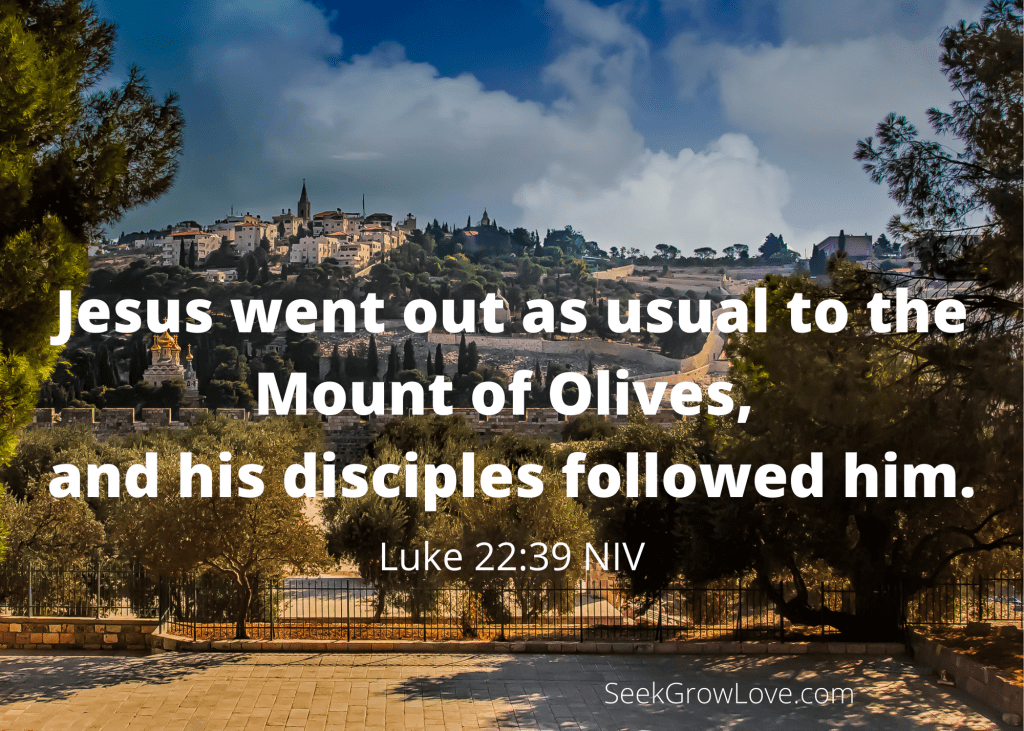
After Jesus finished the Passover meal with his disciples, he retreated to the Mount of Olives, which is just outside of Jerusalem, to pray. While there, he was arrested by a crowd led by Judas, one of his own disciples. Jesus’s choice to stay at the Mount of Olives was significant for two reasons: 

  1. Jesus knew Judas would betray him. 

In a previous conversation among the disciples, Jesus predicts that one of the twelve would betray him, even calling out Judas by name (John 13). The very night of the Last Supper, he makes a similar remark: 

“The hand of him who is going to betray me is with mine on the table” (Luke 22:21). 

  1. Judas knew Jesus would be at the Mount of Olives. 

During the week leading up to Jesus’s death, he and his disciples had spent every night at the Mount of Olives: 

Each day Jesus was teaching at the temple, and each evening he went out to spend the night on the hill called the Mount of Olives” (Luke 21:37). 

Judas surely knew where Jesus would be on this particular night, yet Jesus didn’t try to hide. 

Instead, Jesus invited Judas to his table to eat dinner together. 

Jesus stayed the night in the very place Judas knew he would be. 

You and I were a lot like Judas. We were full of ugly thoughts, misguided intentions, mixed-up priorities, and shameful feelings. Jesus saw our filthy sin, yet he invited us into his presence to give us freedom from it. The greatest irony is that the person who knows our flaws best, loves us the greatest. 

You are fully known, and yet you are deeply loved.

But God demonstrates his own love for us in this: While we were still sinners, Christ died for us. (Romans 5:8)

-Mackenzie McClain

Today’s Bible reading passages can be read or listened to at BibleGateway here – Deuteronomy 29-30 and Luke 22:39-71.

The Not Last Supper

Luke 22:1-38

God is an epic story-teller. One trick up every story-teller’s sleeve is repetition, only each new repetition brings a new twist. The story in today’s chapter is titled, The Last Supper, implying that other suppers preceded it. 

The first meal of this kind is found in Exodus; the Israelites were captive to Pharaoh in Egypt, who worked them ruthlessly.  God sent a series of plagues to convince Pharaoh to let His people go, which would culminate in the death of all firstborn sons—people and livestock alike. To save the Israelites from this horrific plague, God gave specific instructions to Moses and Aaron:

“On that same night I will pass through Egypt and strike down every firstborn of both people and animals, and I will bring judgment on all the gods of Egypt. I am the LORD. The blood will be a sign for you on the houses where you are, and when I see the blood, I will pass over you. No destructive plague will touch you when I strike Egypt.” (Exodus 12:12-13)

The Israelites with the blood of the lamb slathered on their door frames were safe, as the angel of death passed over their houses. God ordered the Israelites to commemorate the day God saved Israel, and they did so every year. 

Over one thousand years later, in the week leading up to Jesus’ death, Jesus celebrated Passover with his disciples in Jerusalem. This time, there was a new twist. Jesus gives new meaning to the emblems eaten that meal: 

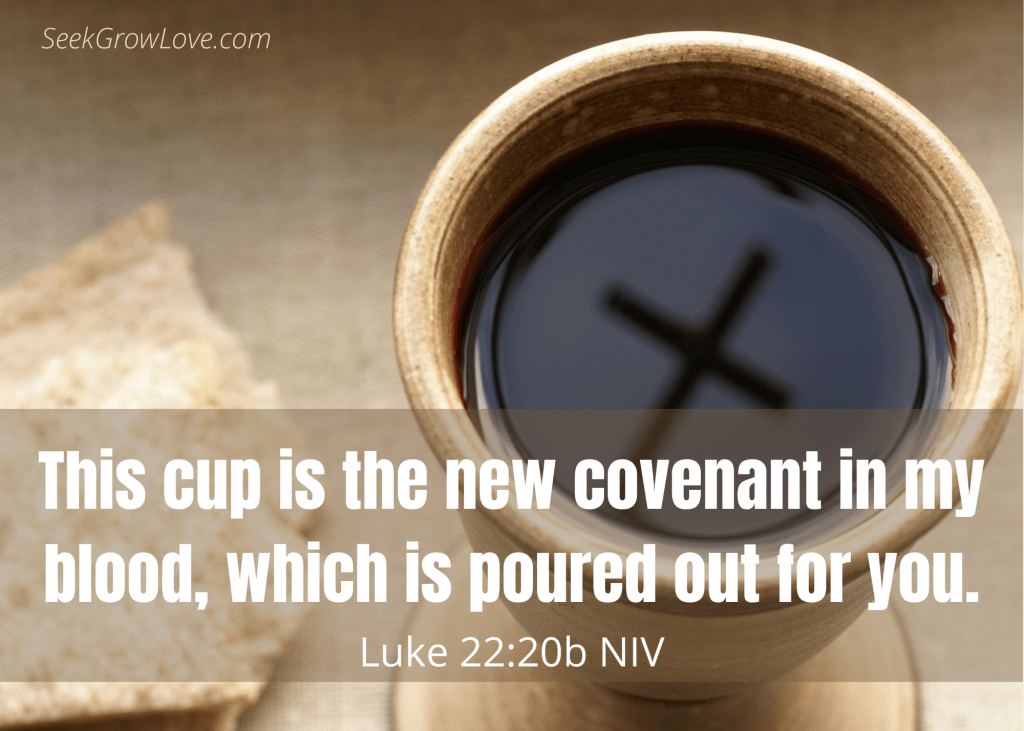
And he (Jesus) took bread, gave thanks and broke it, and gave it to them, saying, “This is my body given for you; do this in remembrance of me.” In the same way, after the supper he took the cup, saying, “This cup is the new covenant in my blood, which is poured out for you.” (Luke 22:19-20).

Jesus’s body was given for you, his blood poured out for you. His sacrifice marks a new covenant in which Jesus’ death atones for the sin of the world: 

Behold the Lamb of God who takes away the sin of the world. (John 1:29)

Have you ever read a story in the Bible with a hint of jealousy, wishing you, too, could have witnessed that moment? I know I have. I had a seat at that table with Jesus, eating and drinking, hearing his wisdom, and honoring his upcoming sacrifice. The good news for us is that “The Last Supper” isn’t really Jesus’s last supper: 

And he (Jesus) said to them (the disciples), “I have eagerly desired to eat this Passover with you before I suffer. For I tell you, I will not eat it again until it finds fulfillment in the kingdom of God.” (Luke 22:15-16)

It’s another feast with another twist. This time we’ll be eating and drinking in physical communion with Jesus, but in the Kingdom of God. I am excitedly awaiting that day, but in the meantime we have the honor of commemorating Jesus’ sacrifice regularly through Communion. The next time you take Communion, do it in remembrance—and in sweet anticipation—of all Jesus has done and is yet to do. 

-Mackenzie McClain

Today’s Bible reading passages can be read or listened to at BibleGateway here – Deuteronomy 27-28 and Luke 22:1-38

Sour Gummy Worms & Copper Coins

Luke 21

My young cousin got a bag of sour gummy worms for Christmas this past year. The following week, he carried the bag along everywhere he went, proudly savoring each lick. He loved those sour gummy worms! At the end of the week, he tried to give me his precious worms; of course, I declined because I don’t delight in stealing candy from children. As he was leaving my house, he hid the candy in my bedroom because he wanted me to have them. He didn’t have much to give, but he gave all he had and did so sincerely. 

Luke describes a similar encounter Jesus had with a poor widow at the temple: 

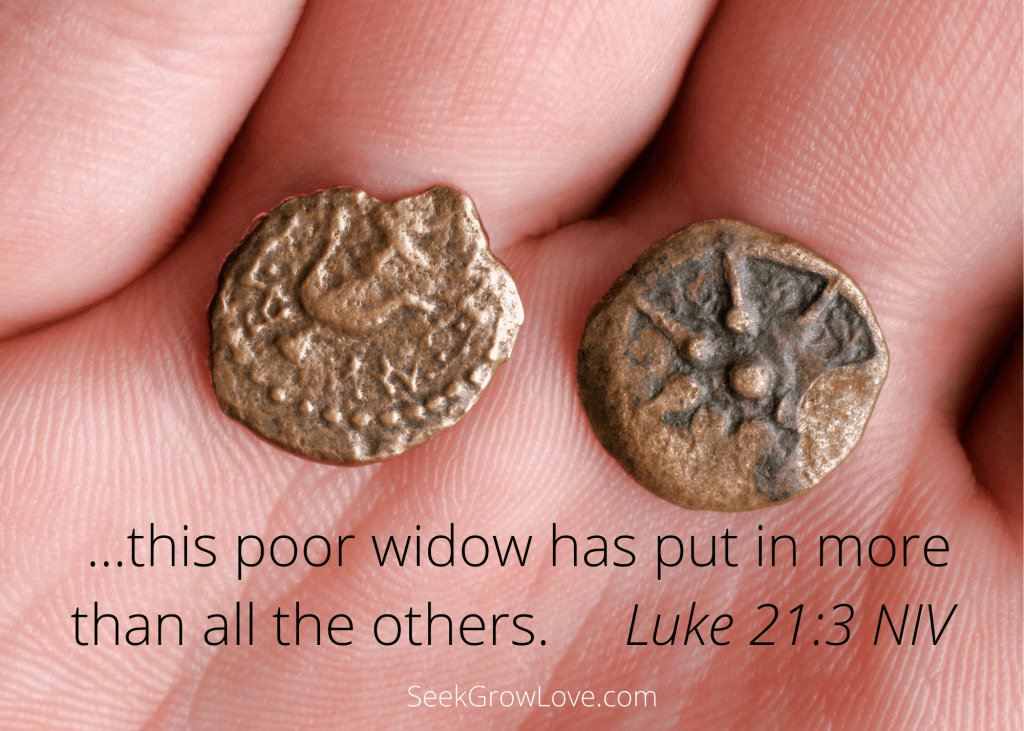
As Jesus looked up, he saw the rich putting their gifts into the temple treasury. He also saw a poor widow put in two very small copper coins. “Truly I tell you,” he said, “this poor widow has put in more than all the others. All these people gave their gifts out of their wealth; but she out of her poverty put in all she had to live on.” (Luke 21:1-4)

We know three things about the woman mentioned: she was poor, she was a widow, and she gave a small amount of money to the church. Her story isn’t flashy and her name isn’t even mentioned. Yet, she honored God by giving the little she had. And you know what? Jesus said her gift was greater than all the others. 

Jesus had spent the past day discussing the intricate details of religious rules and hypothetical situations. They were concerned with religion, but perhaps not the conditions of their hearts. Their attitudes are juxtaposed by the poor widow whose heart was generous and faithful. By the world’s standards, the poor widow’s actions were foolish. She should have used the money to feed her family and allowed the Jews with more money to support the church. In God’s eyes, her giving was a reflection of her faith, and I am sure her family didn’t go hungry that night.

To be clear, God doesn’t need your money—neither your time nor gifts. 

I could have bought my own bag of sour gummy worms at the gas station down the street. In the same way, God can accomplish anything and everything by his own accord. However, He still wants your sour gummy worms, copper coins, and anything you have to give. 

God wants your trust.

God wants you to participate in the mission of the Church. 

God wants to bless you. 

-Mackenzie McClain

Today’s Bible reading passages can be read or listened to at BibleGateway here – Deuteronomy 25-26 and Luke 21