Waiting is hard. We all know this. We have all had things we’ve prayed for, waited on receiving. Patience truly is a virtue.
Waiting is scary. It’s hard to be still. We feel we should be doing something. Sadly we don’t recognize waiting on God as something worth doing. We become anxious in those still moments God is building character. We begin to question, to doubt.
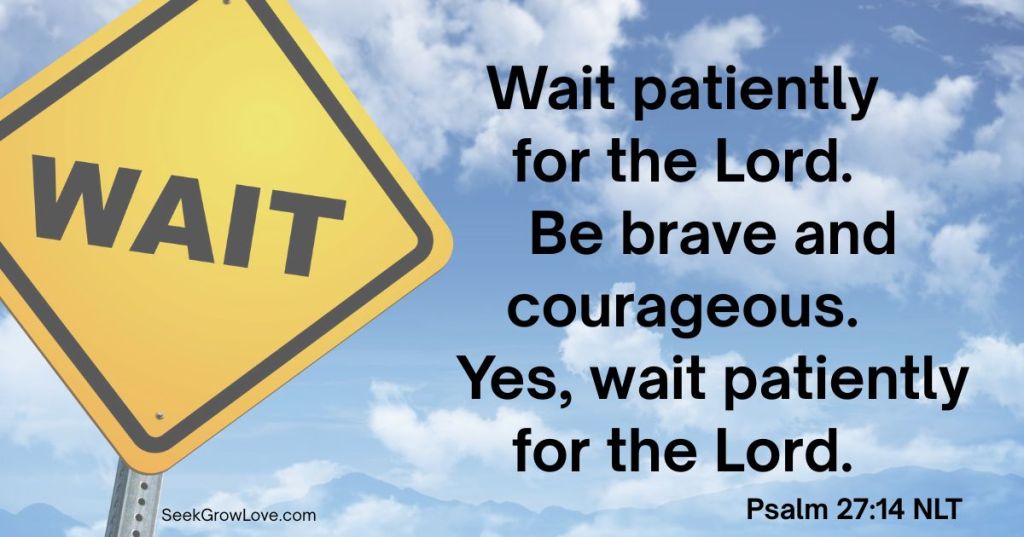
The end of Psalms 27 describes waiting as brave and courageous (v. 14 NLT). Sometimes being still is the bravest thing a person can do. It takes courage to put your trust in something other than what you yourself can produce.
Throughout various points in my life, God has called me to seasons of waiting. It’s hard. I never really thought of it as courageous or brave, just something I sadly had to experience. Had someone plainly told me back then, my decision to wait on God’s revelation was an act of bravery and not defeated surrender, I might have responded to those situations with more joy and hope.
And so, I’m keeping it short and simple, today. For those of you that find themselves in a season of waiting, take heart and hope from the words of David. Your decision to wait on God and trust in His timing is brave. You are not doing nothing. You are taking a courageous step of faith. Do not let the barren wasteland of waiting rob you of the hope and joy we have in our Awesome God.
Reflection Questions:
Think back to a season of your life where you were waiting. What difference would your response have been to that time if you had been told your waiting was an act of bravery and courage? Is there someone in your life today that needs to be told this?
Are you in a season of waiting? How is waiting brave? How is it courageous?
Check out the song “Take Courage” by Kristine DiMarco. I prefer the radio version found here: https://youtu.be/Ehw0FWFGl_A How does this song relate to our topic of waiting, today?
Prayer:
Dear LORD,
It is in You that I put my hope, my trust. Let me stand firm in the security of Your word, even during the uncertain waiting periods of my life. You are the one who delivers me. You will rescue me from my deep waters. Let me be still enough to hear You. Let me be brave enough to wait for You.
In the name of the one who delivers, Your son, Jesus Christ,
Have you ever been stuck in a difficult place? Feeling forgotten? Waiting for justice that doesn’t come?
That’s where Joseph was – again. The favored, pampered son of Jacob had been thrown into a pit by his brothers. Then sold by same said brothers. He becomes a slave in Egypt, far from home. Then falsely accused and thrown into prison. He had received a glimmer of hope of being remembered and saved, but two years later he was still a prisoner. Stuck. Forgotten. Unfair.
And then comes the call. Pharaoh is calling for the prisoner! Quick. Clean-up. Shave. Change clothes. Enter – Joseph.
I wonder if Joseph had played a similar scene in his mind many times over as he was waiting. Did he have dreams of being remembered? Was he still remembering his childhood dreams of his family bowing down to him, and wondering? Was this now finally his long awaited chance to shine? Would he be angry and resentful over the way he had been mistreated again and again? Would he lash out at the world?
Pharaoh explains to Joseph why he was called up out of prison. Can Joseph interpret the dream that no one else can? I love his reply: “So Joseph answered Pharaoh, saying, ‘It is not in me; God will give Pharaoh an answer of peace.'” (Genesis 41:16 NKJV) I don’t hear even a hint of anger, self-righteousness, resentment or giving up. Just humble truth. Not me, but God. Still relying on God. Not me, but God.
God was with him in his father’s house. God was with him in the pit. God was with him in his master’s home. God was with him in the prison. God was with him in the Pharaoh’s palace. God was with Joseph. Joseph was not forgotten. And Joseph did not forget God.
When you are stuck and feeling forgotten. Don’t forget God. It might take some time. Your circumstances might not change how or when you want or expect. You might face the pit or prison or both, and it won’t be fair. But you won’t be alone. It is recorded that just before Joseph was thrown into the pit he was 17 years old. When he stood before Pharaoh he was 30 years old. Those weren’t lost times in between. God was with Joseph. And Joseph did not forget God.
Reflection Questions
What characteristics do you see in Joseph that you would like to see in yourself?
In what difficult times have you experienced God with you?
When and how can you respond, “Not me, but God will…”?
Prayer
Dear Almighty, I thank you for not forgetting me. Thank you for being with me – on what looks like great days and what looks like difficult days. Help me to see You and Your loving care through each and every day. Thank you for using people to do things they could never do without you. Show me what you want me to say and do with Your knowledge, wisdom and words. Give me a faithful, patient, humble, true heart that gives all honor and credit and praise to You.
As I write these words to you now, I am sitting in the kitchen of my house on a pleasant morning. My wife is playing music in the background, and I am hearing all kinds of crazy sounds from my two cats who are chasing each other around the house. This is a great day, and God has blessed me so richly.
For me to get to this blessed moment in my life there was a cost – I had to leave a series of previous modes of life. I once lived with my parents and I had to leave their loving care to gain my education at the Atlanta Bible College. Eventually I had to leave college and close contact with some of my closest friends to marry my lovely wife.
In the same, but much grander way, humanity is promised a wonderful mode of life in God’s care, but to get there, the old way of life has to come to an end. We can’t enter into an age of life where there is no more sickness, death, or sin until those things are gone.
These chapters of Revelation teach us that before God can bring about His perfect salvation, He first needs to do away with this current age. This is why God is just, this is why God is devoting so much effort and energy into enacting His wrath against wickedness – so that the New Jerusalem can truly be ushered in for eternity:
“Then I saw a new heaven and a new earth, for the first heaven and the first earth had passed away, and the sea was no more. And I saw the holy city, new Jerusalem, coming down out of heaven from God, prepared as a bride adorned for her husband.” (Revelation 21:1-2 ESV)
We humans like to live in the known and are uncomfortable with giving up what we know for what we don’t. This is so true that we humans are even willing to remain in an unfavorable situation if it means not having to leave it behind and wander into uncertainty. But for us as Christians, we need to overcome this and completely forsake this age and any sin that we are holding onto and embrace what God has to offer us instead. Besides, God has even blessed us with letting us know ahead of time where we are going and what we are getting ourselves into, and it is perfect.
In this life we only have a taste of the goodness to come in God’s kingdom. Imagine every single moment of your life you are literally perfect, everyone you come across is also perfect in their own unique way. You have no need for medicines, hospitals, cemeteries, or even locks to your house. You can walk right up to the tree of life, which is everywhere you go. But most importantly, you can have communion with God Himself and His Son Jesus! This reality is what we are enduring and waiting for, and thank God He is one day going to cast away the trials, burdens, and hardships we suffer in this life and is walking us towards a future that is partially known, but is waiting to be better understood.
Reflection Questions
What are ways you can maintain God’s future hope in the forefront of your mind and heart?
In what ways should reading these chapters of Revelation motivate us to share the gospel with those around us?
I’m certain that there were many times in my childhood that I cried about things that I have no memory of anymore. Perhaps I lost a hot-wheel that I really liked? Maybe I got vanilla ice cream when I was really hoping for chocolate? I am sure that in the moment, they felt like the worst things ever – but they really weren’t. Eventually I grew up enough to realize that those things that threatened to break my heart were trivial and not worth prioritizing as highly as I once had. However, for the rest of my life I will certainly remember the heart break, sadness, and grief I felt from my grandfather, Rex Cain, passing several years ago. My heartbreak over his loss, and the lasting memory of him, reveal that my heart highly honors and loved my relationship and memories I had with him
Sometimes the most tangible and revealing way to discern what you truly love is to observe what breaks your heart. If you mourn over the loss or corruption of things that are holy, honorable, good, and live-giving – it shows what your heart loves to see and help sustain. If you mourn over the loss or corruption of things that are profane, dishonorable, evil, and exclusively self-serving – it shows what your heart loves to see and help sustain. We should want our hearts to break over that which breaks God’s heart because it reveals that our hearts are aligned with His. This is what Jesus teaches us in his famous sermon on the mount, “Blessed are those who mourn, for they shall be comforted.” (Matthew 5:4 ESV).
In these chapters of Revelation, John is taught about the rebellious and great city Babylon, depicted as a prostitute riding the wicked beast (read chapters 13-16). We also learn how Babylon’s judgment will come swiftly and full of irony, the very methods of prosperity and rulership with the beast will be its own ruin. The angel speaking to John also touches on all the various kings and merchants who built up their life of luxury by communing with Babylon and its wickedness. Naturally, all of the kings and merchants who benefited from Babylon wail and mourn over the loss of their beloved city:
All the kings of the earth…will stand far off, in fear of her [Babylon’s] torment, and say ‘Alas! Alas! You great city, you mighty city, Babylon! For in a single hour your judgment has come.” (Revelation 18:9a & 10 ESV)
Their own heartbreak is a song of condemnation. The fact that their heartbreak is due to losing the epitome of human wickedness and evil illustrates what their hearts truly loved – and it was certainly not God or His salvation. So in the end, God will let them have what they claimed to want, and allow them to experience the self-destructive ends it brings. Their mourning will prove fruitless as God will not comfort them.
Meanwhile, chapter 19 contains the praises and redeeming joy of all of God’s people whose hearts were breaking all throughout the tyrannical and wicked reign of Babylon. Their mourning will prove fruitful as God will comfort them.
These chapters serve as an opportunity to see the cosmos and our place in it at a lofty height and decide what our hearts truly love and care about. Whatever we choose to love, inherently means we also choose what to mourn. I urge you, as do these chapters, to not be like the kid who’s so fixated on the momentary and shallow pleasures of this life only to mourn over them when they are gone. Instead, make the presently painful and eternally blessed choice of having our hearts break over the corruption of this age. Our momentary heartbreak will turn into eternal joy one day.
Reflection Questions
Is there anything that you are mourning the loss of, or perhaps the lack of, that God does not mourn?
What are things you can do to help “rewire” your heart to love what God loves?
I have always wanted to witness the majesty of the Redwood and Sequoia trees in California. They have always captured my imagination and even their pictures blow me away. It’s amazing to do research on how they utilize the same good and life-giving sunlight, water, and soil that every plant needs. Yet, one thing that distinguishes them from almost any other plant life is how both trees have thick bark, high water content, and the ability to resprout from dormant buds. In other words, they are highly resistant to fire. When there’s a fire, it burns away a lot of other growth but not them, and the fire helps make the soil nutrient rich and ready for these giants to begin their long life.
These trees can relish in the peaceful times of God’s gifts of sunlight, water, and nutrients in the soil, and they can even thrive when the chaos of fire runs rampant in the forest. In a way these trees and their interaction with the environment are a perfect symbol for how you and I can imagine ourselves and our interaction with God and our world. We are like the trees, our current time is like the peaceful time with all of its normal troubles, and the forest fire is like the events we read here in Revelation eleven through thirteen.
God in His brilliant goodness and wisdom can use all things in a way that fulfills His good and perfect will. Even if Satan, the enemy of both man and God, is running rampant, God can play him like a master chess player who not only wins using His own chess moves, but even using his opponent’s plays. The consuming fire that Satan starts to eliminate his opponents ends God uses to consume him and bring about a rich new start for his children.
This truth should be clear to us as we read Revelation and particularly these chapters as well. The two witnesses, the pregnant woman, the messianic child, Michael and his angels, and believers who are marked by God rather than the beast are all like the Redwoods who grow taller and stronger than everything else under God’s loving and wise provision. Even though the fire is chaotic, hot, and effective at consuming everything else in the forest, the trees remain. Even though we read of the horrifying workings of the dragon and his beasts, every being under God’s care is rescued.
It is easy to read through Revelation and its “forest fires” and assume this is a book meant to warn us of an impending doom that we wish not to see. However, John wrote this book, under the instruction of God and Jesus, to give encouragement and hope. The dragon is fierce, but God is even more so, and we will bask in God’s victory one day. So prepare to endure the fire to come, because it will produce a rich soil for the sprouting of a new and perfect kingdom where we can grow taller than ever before.
Reflection Questions
How can these future revelations provide wisdom for the fires in our own lives today? How should our prayer lives be impacted by seeing how God uses even the fires to produce goodness?
Merry Christmas to all. This is the season to remember and celebrate the birth, the advent, the first coming of Jesus, who is the Christ, the Son of the living God! It’s fitting that we today begin reading and pondering the last book of the Bible, Revelation. This is the book that reveals amazing things about the second advent, the return of Jesus to this earth to establish the perfect age, the kingdom of God. This is a book of revelations, though at times it’s challenging, seems mysterious, difficult to understand and apply. In these first three chapters we find John’s opening comments, identification of the source and succession of the word and testimony he’s passing on, and then a letter from the Lord himself to seven churches in Asia Minor. The general flow of the letters is commendation of the church, any complaint that may need to be addressed, and the correction that’s then necessary. Anytime the Lord indicates a complaint, or really anytime anyone indicates a complaint against us, the hope and goal is always correction. We all have flaws, and should always seek to grow, to improve, to walk in truth, obedience, and love, as John stressed in the postcards we pondered the last couple days.
We’ll begin here with the introduction the author, the Apostle John shared. “The revelation of Jesus Christ. which God gave him to show his servants what must soon take place. He made it known by sending his angel to his servant John, who testifies to everything he saw – that is the word of God and the testimony of Jesus Christ. Blessed is the one who reads the words of this prophecy, and blessed are those who hear it and take to heart what is written in it, because the time is near.” Note that there’s a blessing for those who read, hear, and take to heart these words, whether we quickly understand it or not. It’s good to be familiar with it. Understanding will come as events unfold, if we’re familiar with the writings.
1:7 specifically makes reference to Jesus’ return, “Look, he is coming with the clouds, and every eye will see him, even those who pierced him, and all the peoples of the earth will mourn because of him!” This is a sure thing. Jesus is coming. I hope to see him with joy in my heart, rather than mourning that I’m not ready, not a believer, not prepared, not all in!
The rest of these first three chapters include letters the Lord sent to seven specific churches, with specific commendation, complaints, and correction. Read them devotionally, and with application. In other words, ponder such commendation, complaint, and correction. Do any of these apply to you? To your church? In fact, you might write a letter, as though from Jesus to you. What would he say? What would he commend? What complaints would he have? What corrections would he expect? How would you respond? Would you do as he says?
Reflection Questions
What are your thoughts and feelings about the book of Revelation? What do you think God wants us to think and feel about the book? Why was the book as a whole given to Christians?
How often do you think of Jesus’ return? How do you imagine you will respond when he does return? If you are celebrating Christmas today (and also, if you are not), how can you remember and share the words of Revelation and the great hope of the 2nd Coming of Christ the Messiah, the Son of God?
How do you typically give or receive complaints? Work through the great questions from John in the last paragraph above. And spend some time with God in prayer with the Son of God interceding on your behalf.
Hunger is a powerful thing. It can affect your mood, and it can cause you to make poor decisions. There’s the old saying, “never go shopping on an empty stomach”. You will buy stuff that you don’t really need because your mind is affected by hunger. I can relate to that. Once upon a time, while I was at the Bible college, a friend and I decided to go on a green tea fast. On the day that we broke the fast, I went grocery shopping and spent way more money than I should have on food, and I’m pretty sure most of it went to waste. I was buying out of hunger, not necessity. I’m sure you can relate to my bad habit of stopping and getting horribly unhealthy food because you were hungry, and it was quick and convenient. Maybe you decided to stop because it was a cheap option?
We see the miracle of Jesus feeding 5000. There were a lot of extra people around because Passover was coming up soon. They find themselves in the conundrum of not having enough food for all these people who are gathered to hear Jesus. They could perhaps go buy food, but that would take a lot of time, not to mention money. And how do you source food quickly for this many people? How many people would be required to carry it back? I don’t really think there’s an avenue for coordinating food for this gathering.
Jesus ends up telling the disciples to gather up all the food that the group has collectively. What they end up with is a boy who has five loaves of bread and two fish. This is a laughable amount of food for a group of 5000 plus. Jesus prays over the food, and they start passing it out, and they pass and they pass, and they pass and they end up having leftover food after everyone has eaten their fill. What a miracle. Jesus perceives that the people being moved by this miraculous action are going to try to grab him and make him king forcibly. It is not the proper time, nor is this the proper motivation. Jesus is king because God declares it himself, not because of this miraculous meal.
Jesus withdraws to be by himself. The disciples set sail across the sea without Jesus, but encountered him walking on the water. They are freaked out, but they’re glad when they see it’s him, and once he’s on the boat, all is well. But the crowds are hungry for more and start to search for Jesus.
The people want to see more miracles, but that is not the purpose of Jesus’ ministry; rather, an attestation of the power behind him. Jesus’ message of the Kingdom of God is truly powerful. Jesus says that the crowds are not seeking him, not even after the power behind the signs that they saw, but because they had been well fed.
The people bring up the desire to see miraculous signs and recall that their fathers ate manna in the wilderness. Jesus, comparing his role to that of Moses, says that it was not Moses who fed the Israelites in the wilderness, but that it was God. He warns them of seeking temporal comforts and satiety; rather, they should seek after the true life-changing and life-saving power of God. Jesus’ claim that he is the “bread of life” or “bread come down from heaven” is a claim that God has ordained, empowered, and approved his Kingdom ministry and his standing as the savior.
It is a long and winding road that leads to the cross. Many will reject the bread of life for the bread of satiety or comfort, or maybe bread leavened with the yeast of the Pharisees, but many do take Jesus up on his “the bread of life” offer and are the beneficiaries of God’s amazing power that was and is at work in the hearts of the redeemed.
Reflection Questions
What significance do you see in the contrast of Jesus’ miracle, the manna of the Exodus, and the Bread of Life that Jesus speaks of?
Does the metaphor of food effectively drive home Jesus’ emphasis on the importance of the Gospel for true life?
In what ways can you take Jesus’ words from John 6 and apply them you your life in a way that strengthens your personal ministry?
Haggai is a short, two chapter book, but it packs a lot. Haggai was a minor prophet who urged the Israelites to do four things – reflect on their priorities, work in hope during hard circumstances, be humble and pure in their intentions and actions, and remain faithful for the coming kingdom.
Have you ever been in the midst of tackling a massive project? Perhaps a work, home improvement or church project? Sometimes these endeavors can feel so tedious, can’t they? Like you will never ever be done with the task and the finished product is hard to even fathom, a pinprick of light at the end of a long tunnel. In the midst of it all you’re likely very weary. You’re even considering taking some shortcuts just to get the thing done! If you’re solely relying on your human limits, you’re not seeing past the long days to the end result, which sounded so promising in earlier days.
The Israelites felt the same. Before they even began rebuilding the temple, they weren’t focusing on what God wanted from them, instead zeroing in on selfish endeavors. When they decided to rebuild, with Haggai’s prompting, it was a major undertaking. They felt like their efforts were fruitless and the days were difficult. They gave little effort to what they were told God wanted for them. They weren’t choosing to humbly submit to God and make the daily choice of obedience to Him. They just didn’t feel His vision anymore.
What Haggai is driving at is this – God has so much for us. But we need to do our part, too. Furthermore, our choices really do matter. Our heart matters. God doesn’t just want us to blindly “do,” He wants us to want to obey His word. That’s how His work is done in the world. We are His hands & feet, working in humility and obedience to our Father to establish His perfect Kingdom.
Reflection questions:
What are you doing for God right now, or what is He calling you to do? What is your attitude about it?
What is one way that you can recast your vision for what God has in store? What can you do today to be obedient to Him?
The Israelites have been in exile for twenty-five years and it has been about fourteen years since the fall of Jerusalem. The prophet Ezekiel is in Babylon when he experiences visions of God. He is taken to a very high mountain in Israel and from the south side he sees buildings that look like a city. He is visited by a man whose appearance was like bronze, an angel. He is holding a measuring tool. He told Ezekiel to closely pay attention to everything he would show him and he was to tell the people of Israel everything he saw.
He was shown a temple complex. It was given with detailed and specific measurements and dimensions including outside walls, gates, alcoves, thresholds, porches, outer courts, rooms, etc. Some say this vision symbolizes an ideal temple where God’s presence resides and God is glorified. Others believe that it is a literal future temple that will exist in the Millennium. There is much discussion on this vision. For instance, if it is a literal temple in the 1,000 year reign of Christ, why are there offerings there? Are these only memorial offerings remembering the ultimate sacrifice that Jesus provided? Though we may not understand everything about the vision, we know that it showed the people of Israel that there would be restoration and reconciliation with the LORD. This vision gave the people hope. They viewed the temple as a place to worship and praise the LORD. They had the same desire that we do. We want to be in the presence of God. We want to experience Him. After all, He is amazing and we love Him. He desires to be with us as well. How blessed we are to know that the LORD is with us. As the apostle Paul states, “Don’t you know that you yourselves are God’s temple and that God’s Spirit dwells in your midst? And God’s temple is sacred, together you are that temple.” (1 Cor. 3:16&17b) How blessed we are to be so connected to the LORD.
(As editor, I had been concerned that we had a few weeks with no one signed up to write devotions – so I sent out several emails and God answered with not just one writer for today – but two! So, with no apologies, but many thanks to God and to both Rebecca and Daniel, here is your second for the day…)
Devotion by Daniel Smead (Minnesota)
Today’s text is the start of another of Ezekiel’s visions, in which he again visits his homeland of Israel. It takes place on a mountain by a city, which is presumably a way of referring to Jerusalem, and Ezekiel observes a new Temple. His guide in that building is a shining figure, who sounds something like the figures that moved God’s throne-chariot back in chapter one. This figure measures the Temple and declares the dimensions for Ezekiel to record, having calculated them using a stick a bit over ten feet long.
Interestingly, this vision is one of only two places where Ezekiel states the exact date an event took place, the tenth of Nisan, near the start of the Hebrew year that went from 573-572 B.C. The vision is twenty-five years after Ezekiel was taken from Jerusalem and Solomon’s Temple, and about thirteen years after the Temple’s destruction.
In its essence this vision allowed the exiles to look forward to a time when God’s people, again in the promised land, would have a renewed opportunity to worship God at a temple. The passage did not take shortcuts to describe this but went into minute detail. Rather than simply refer to the existence of a temple, we are told about its size and decorations as though the importance of fulfilling every detail is being emphasized. Using some effort, readers could put themselves in the scene alongside Ezekiel.
The building described in this text is quite large, and it is not a prophetic description of the Temple built in the time of Zerubbabel, after the Babylonian exile. Nor, apparently, did the returnees of that generation attempt to follow this design even when doing so would simplify their work. For example, 40:28-37 describes having three gates to the inner courts, and a Jewish Midrash says the second Temple had seven gates. In fact, the small number of gates, and the emphasis on large square rooms, raises the issue of the practicality of the design, and whether this was ever intended as a literal image of a building or just as a symbolic representation – the architectural equivalent of a parable, perhaps.
Ezekiel, as a priest who had ministered at Solomon’s Temple, would have a particular interest in the description this passage provides, whether it was symbolic or a future reality. But Ezekiel was not the High Priest, and even in his vision it seems that he does not enter the Holy of Holies, though he reports its dimensions (41:4). We hear nothing about the contents of that area.
I have written before about John’s measuring of the Temple in the book of Revelation, and how simple it can be for us when reading the figures in that passage to miss the time it would have taken to measure those distances. The same issue applies here. The long period when Ezekiel watched the shining figure go about this task, announcing number after number, can only have felt surreal. Obviously, this scene was leading somewhere, though learning what awaits tomorrow’s text. In the meantime, Ezekiel moved through a nearly empty building, large enough to hold thousands of people, simply recording its dimensions.
How often do you find yourself caught in a moment, feeling incomplete, unsure what comes next? At that time the exiles in Babylon were probably wondering what their next steps would be, and this vision was part of how God laid out expectations for them. Ezekiel, in his vision, must have found it obvious that what he saw was building toward a larger point, although he could have been recording measurements for hours. It may not always seem as obvious to us when God is at work in our lives, or how. But it is to be hoped that we can maintain trust that God is working. I don’t know how often we learn quickly or plainly what our next steps need to be. Sometimes Ezekiel waited years between his visions, visions that we can simply turn pages to link together. And the fulfillment of all that he saw in his visions waited far longer than a few years.
Regardless of all that Ezekiel went through, and how long it took, if the Bible revealed that somewhere along the way he decided not to pay attention to what God was doing with him, that it was not all worth it, we would consider him foolish. From our perspective in history such a choice would appear absurd. But sometimes we, and indeed sometimes I, need to be reminded of this same principle for ourselves. My trust, and my attentiveness for what interests God, need firming up. I can’t expect to maintain the same focus always and in every situation; no one can. Humans don’t have that kind of attention span and focus. I, and maybe you, need to be reoriented when necessary. At times we also need to realize that God still cares about us, continuing to be open and accepting despite our failings. The people God was telling about a new temple had their old one destroyed just 13 years earlier. God is open to offering forgiveness and acceptance, but more than being open to that, God strongly desires to provide it to us, in love.
Reflection Questions
What thoughts and feelings might Ezekiel’s original audience have had before Ezekiel’s temple vision – as they have been stuck in a foreign land far from God with no clear way to worship Him and even no temple to try to return to? Have you ever felt similarly?
What thoughts and feelings might Ezekiel have had as he was getting a tour of this temple? As he was sharing his vision? How might the people have responded?
In what ways might God be asking you to pay attention to what He has done, is doing and will do? Is there anything in your past that you didn’t understand at the time but you can see now how God was using it in preparation for your future?
When do you find yourself needing hope? What gives you hope?
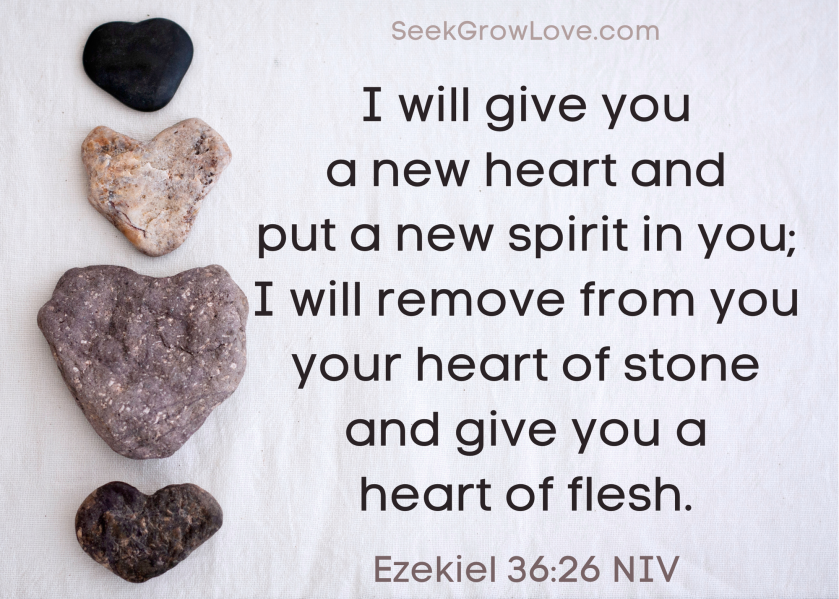
Ezekiel brings a message of future redemption for Israel. How does their redemption happen? By truly connecting with the LORD. “I will give you a new heart and put a new spirit in you; I will remove from you your heart of stone and give you a heart of flesh. And I will put my Spirit in you and move you to follow my decrees and be careful to keep my laws. Then you will live in the land I gave your ancestors; you will be my people, and I will be your God.” (36:26-28) What a beautiful picture of living in a loving relationship with God!
In our passage the LORD is providing everything that is needed to be with Him. Just as we look to our Heavenly Father every day for all that we need to truly be His obedient children. We need the heart that the LORD creates for us and we need the power of His Spirit to transform us. Our circumstances can often weigh us down, so we also need the encouragement that the LORD provides through His message. The people of Israel needed that encouragement from the LORD. They were discouraged – they were disconnected from the LORD and spiritually dry. But God promises restoration and life.
In chapter 37, the valley of dry bones illustrates that God will bring individual and national resurrection. His promise gives hope. The Sovereign Lord says: My people, I am going to open your graves and bring you up from them; I will bring you back to the land of Israel. Then you, my people, will know that I am the Lord, when I open your graves and bring you up from them. I will put my Spirit in you and you will live, and I will settle you in your own land. Then you will know that I the Lord have spoken, and I have done it, declares the Lord. (37:12b-14) God shows compassion on His nation and He will never forget His people. In the same way, He will never forget His children. When He is “proved holy through them in the sight of many nations,” may we also praise our Holy God.
Reflection Questions
In what ways did Ezekiel’s audience have a heart of stone? In what ways do you? What would be different with a heart of flesh given by the LORD?
What else does God say He will do for His people in today’s reading?
When have you felt like you were spiritually dry – in a valley of dry bones? When have you felt spiritually alive? What life has God given you now? What life will God give in the future?


 Seek Grow Love