We have used the word love to describe Jesus and his ministry many times in the last few days. And that is certainly true. But we would be creating a grievous error if we thought love was all that mattered to Jesus. Jesus’ ministry was about love and truth. Truth and love.
In Matthew 15 (and throughout the gospels) we don’t see a soft and cuddly pushover full of love and open arms. Indeed, Jesus is still love, but that includes love for the truth and love for those being led astray by deceit and human traditions. And sometimes love looks a little harsh when it is armed with truth.
The teachers of the law in Jerusalem were so curious about this Jesus. A delegation was sent to find him and question him. It would have been an 80-90 mile hike, or a 4-7 day journey from Jerusalem to the Gennesaret valley west of the Sea of Galilee. They were committed to this search for answers. How will they be received by Jesus?
There were a lot of Jewish laws and traditions about what to eat and not eat and what needed to be done surrounding the meal (like ceremonial washing of hands). The disciples and Pharisees were shocked to hear Jesus say that it wasn’t what goes into a mouth that makes you unclean, but what comes out of it. The disciples were also a bit surprised, I think, that Jesus answered the Pharisees the way he did, asking him, “Do you know that the Pharisees were offended when they heard this?” (Matthew 15:12). It is certainly NOT our purpose to try to be as offensive as possible when in religious discussion. And, it is wise to remember we don’t have all the wisdom of the Son of God. But, neither ought we be willing to keep the saving truth from those that might disagree with us, just because it would be more polite – or loving – to be silent.
How will you mix love and truth as Jesus did?
-Marcia Railton
Questions for Reflection and Discussion
Jesus warned against following traditions of men that lead you to break the commands of God. What are some examples of how this could happen today? What are the benefits and drawbacks to following the traditions of men? What are the benefits and drawbacks to following the commands of God? Which would you rather follow? What will that look like this week?
When is tradition a good thing? When is it a bad thing? Are there any traditions you are currently following that are not helpful in drawing you closer to what Jesus wants to see in your life?
How can you bring truth and love into the lives of your family and those you are closest to? How can you bring truth and love into the lives of those who may not understand you or may outright oppose you?
I believe Matthew 9 gives us an excellent glimpse into the heart of Christ. Let’s start at the end of the chapter. Matthew 9:36 tells us, “When he [Jesus] saw the crowds, he had compassion on them because they were harassed and helpless, like sheep without a shepherd.”
Remember these crowds were filled with tax collectors and sinners – people rejected by polite society – people rejected by the religious leaders of the day. And yet Jesus’ first instinct was that of compassion. To understand the significance of this, let’s remember that Jesus was the only sinless person ever to walk the face of the earth. One would naturally think that whatever sins cause us (sinful people) to cringe, would cause Jesus to be horrified. And yet Jesus had compassion because the people coming to him were harassed and helpless.
If we now back up to Matthew 9:35, we see what he did because of his compassion, “Jesus went through all the towns and villages, teaching in their synagogues, preaching the good news of the kingdom and healing every disease and sickness.” Jesus was interested in helping these people who were helpless in and of themselves. He first met their most basic need – their spiritual need – the need to be reconciled with God – by preaching the good news of the kingdom of God. If all Jesus cared about was people’s salvation, I suspect he would have stopped there. But in addition to preaching and teaching, he healed every disease and sickness. This again points out that Jesus was deeply concerned with the people themselves, and cared about what the people cared about – and solved the problems they faced. The only explanation is that Jesus genuinely loved these “unlovable” people.
Let’s look at some of the other stories in this chapter. The chapter begins with some men bringing a paralytic to Jesus. Jesus was so eager to help the man, he didn’t wait for anyone else to even speak, and just jumped in with, “Take heart, son; your sins are forgiven.” – almost as if Jesus just couldn’t wait to help the man. Jesus jumped right to the most important problem – reconciling this man to God. Then, to prove he had authority to forgive sins, he demonstrated his power again by completely healing the man. The crowds were in awe, and praised God.
The next section talks about Jesus’ calling Matthew, a tax collector, to follow him. Jesus didn’t only tolerate those society rejected, he actively sought them out. It was at Matthew’s house that Jesus’ enemies accused him of eating (coming in close fellowship with) tax collectors and sinners. Jesus’ response, in Matthew 9:12-13 was, “It is not the healthy who need a doctor, but the sick. But go and learn what this means: ‘I desire mercy, not sacrifice.’ For I have not come to call the righteous, but sinners.” Mercy. God desires mercy, and Jesus was demonstrating it. And I would argue that one cannot really demonstrate mercy without first loving the target of that mercy.
The chapter goes on to detail other miracles, including raising a dead girl back to life, healing a woman who had been subject to bleeding for 12 years, and healing two blind men. All in addition to the summary at the end, saying that he healed every disease and sickness throughout all their towns and villages.
For me, if I had to define Jesus with a single word, based on this chapter, that word would be Love. Love we can’t even fully comprehend. God-like love.
1 John 4:16 says, “… God is love. Whoever lives in love lives in God, and God in Him.”
John 5:19 tells us, “I tell you the truth, the Son can do nothing by himself; he can only do what he sees his father doing, because whatever the Father does the Son also does.”
-Steve Mattison
Questions for reflection & Discussion
Does Jesus care about the things that concern you? (Hint: read Matthew 11:28-30)
If Jesus loved the people of his day, how much must he love you?
How has he demonstrated his love to you?
What is your response?
If Christians are supposed to “imitate Christ” what would that look like in your life? (Hint: read John 13:34, Philippians 2:3-8, 1 John 2:6)
It’s only been 5 days, but so far I am enjoying the one chapter a day pace for 2022. It’s allowing us a bit more time to soak in the lessons of each chapter before rushing into the next. However, as we look at Matthew chapter 5 today I can’t help but feel that this chapter would be a good one to cover just one VERSE per day! Jesus knew how to stack a sermon with plenty to mull over on the way home. It is possible that Matthew included some bits and pieces from other sermons to lump them all together into what is now known as The Sermon on the Mount found in Matthew 5, 6 and 7. Whether it was all said by Jesus in one particular sitting, or spread out, or often repeated for various audiences, these words of Jesus are priceless and worthy of being read over and over again, finding something new and inspiring every time.
We will save a longer discussion on the Beatitudes for another day/week/month. Until then, watch your attitudes. The right ones, as judged by God and not man, will come with great reward.
It’s okay, even preferred, to be persecuted for following Jesus. Follow anyway. The reward is great. And you are not the first to endure such opposition.
Be different from the world. Keep your saltiness (preserving life, adding spiritual savoring, disinfecting worldliness). Keep shining in the darkness. Keep doing good. Represent your Heavenly Father well.
Keep the Old Testament – with a New Testament heart.
Jesus knew people would think that now that the Messiah was here the old laws and scriptures would be done away with. Laws aren’t a lot of fun, let’s just love instead. He saw it back then, we still see it today. But Jesus clearly stated, “Do not think that I have come to abolish the Law or the Prophets; I have not come to abolish them but to fulfill them” (Matthew 5:17). Jesus challenged those sitting at his feet and he challenges us today. Think of the BEST people you can think of. Who is known for being righteous? At that time it was the Pharisees and teachers of the law. But Jesus said, “For I tell you that unless your righteousness surpasses that of the Pharisees and the teachers of the law, you will certainly not enter the kingdom of heaven” (Matthew 5:20). Ouch! Did that say what I think it said? Read it again. But Jesus said, “For I tell you that unless your righteousness surpasses that of the Pharisees and the teachers of the law, you will certainly not enter the kingdom of heaven” (Matthew 5:20). Something MORE is needed. Following the Old Testament laws one by one to show the world how good you are doesn’t cut it. But that doesn’t mean we throw out the law and the prophets and the Old Testament. Rather than throwing it out, we add to it. We don’t need to add more laws, the Pharisees already tried that, too. Instead, we add to it the heart of Jesus – the New Testament heart. What does that look like? Jesus knew we would ask, so he gives us six examples in Matthew 5.
Don’t pat yourself on the back for not murdering anyone today. Add love. Control your anger toward others. Don’t let that put-down out of your mouth. Work at relationships. Forgive and ask for forgiveness. And still, don’t murder.
Don’t pat yourself on the back for not committing adultery today. Add love. Guard yourself from lust. Take it seriously. There are consequences. Show respect and responsibility. And still, don’t commit adultery.
Don’t pat yourself on the back for doing a divorce in a legal, friendly manner. Add love. Work at it again. Take it seriously. There are consequences for everyone.
Don’t pat yourself on the back for keeping one oath made to God. Watch your words. Take them seriously. Stop making promises. Realize God is so much greater than you. Realize there is so much beyond your control. Keep it simple. Watch for influence from the evil one.
Don’t pat yourself on the back for getting even. Add love. Add sacrifice. Add service. Add generosity. Even when it’s hard. Even when it’s not deserved.
Don’t pat yourself on the back for taking good care of people who take good care of you. Add love. For all. God knows. He’s got this. Don’t worry if it’s not fair now. You will see sunshine and rain. They (your enemies) will, too. It’s okay. Pray for them, even if they hurt you – or especially if they hurt you. Your actions and your prayers will show that you are God’s child. Work at being like Him.
Keep the commandments and add love.
Marcia Railton
Questions for Reflection and Discussion
Where is society trying to throw away the laws of God? What would they replace it with? Is this a good idea or a dangerous one? Why?
Do you more often focus on the law or on love? Think of a particular instance where you leaned one way or another. How do we do both? What could you have done in the example you thought of to add in more of the lesser ingredient?
What is the danger in weighing in too heavily in the law, neglecting love? What is the danger in weighing in too heavily in love, neglecting the law?
Have you ever been afraid of the dark? What about spiritual darkness? How important is light? And spiritual light? What dims your light? What helps it shine brighter? Do you feel more like a match or a floodlight? How can we remember to be a light and shine in the darkness?
In his final letter, John again expresses the joy he has knowing that young believers (“my children”) are “walking in the truth.” It is an important truth that godly parents want to see their children also pursuing the things of God. When we are young, we may think of all the accomplishments we could do in school, in sports, or in other extracurricular activities, but none of that can measure up to how proud a parent is when we do what pleases the Lord. We may not think that such things are all that meaningful when we are young compared to achieving awards, getting good grades, or winning a championship, but children who obey the Lord bring greater joy to their parents than all their other successes combined.
Another main point that John raises in his letter is the importance of hospitality, especially when it involves fellow believers. He instructs Gaius to continue to do what is “faithful” for the brothers and sisters, “even when they are strangers.” We don’t need to know who someone is in great detail before we offer them food, shelter, or aid. Christian believers should be apt to show hospitality to all people, but especially to those from the household of faith, even if they are strangers.
To be generous and hospitable toward someone whom you do not know and who is not able to repay you is a sincere demonstration of love. My father used to always say that I should leave someone better than when I found them, and I believe that is what John is expressing when he tells Gaius that he will “do well to send them on their way in a manner worthy of God.” That means giving them the best treatment and going to the furthest extent possible to assist them and prepare them for whatever comes next for them.
Whether it is giving someone a ride somewhere, dropping off a home-cooked meal, or helping with homework or other assignments and projects, no matter what it is, if we do it wholeheartedly as if we were serving the Lord Christ, then we can be confident that we will be sending our fellow brother or sister on their way “in a manner worthy of God.”
-Jerry Wierwille
Read or listen to today’s Bible reading plan passages at BibleGateway.com here – Hosea 12-14 and 3 John 1
John writes about those who have “come to know the truth” and that he is rejoicing to see some young family members “walking in the truth” (vv. 1, 4). This “truth” is not some list of doctrines or deep theology but a simple commandment: “that we love one another” (v. 5). Sometimes we can overcomplicate the “truth.” Now don’t misunderstand John; the truth in Scripture is very deep and has many levels. It is not merely comprised of this one commandment. We might say that whatever Scripture reveals on any subject can be constituted as “truth.”
As John wrote about in his previous letter (cf. 1 John 5), biblically speaking love is not predominantly this passionate emotion of desire as some might think of it. Rather, the love that John is talking about is intricately bound together with obedience. And therefore, this is why he says, “And this is love: that we walk according to his commandments” (v. 6).
Why is this so important to John that he is reiterating it again here in his 2nd letter? The reason is likely part of his subsequent warning about the “many deceivers” who are in the world (v. 7). There are many forces at work in the world vying for our attention and our devotion. John raises the danger about these “deceivers” and how they can lead someone astray from the truth, for he declares that “everyone who goes too far and does not remain in the teaching about Christ does not have God (v. 9).
We need to be aware and watch ourselves concerning those who do not “bring the teaching about Christ.” John is very stern about not entertaining deceivers in our homes. The adversary works in subtle ways and sometimes these deceptive influences can come from unlikely places and people who may not even be consciously or intentionally opposing God and the teaching about Christ, but nonetheless are stealthily subverting the message of the good news with criticism, skepticism, or mockery.
Let us be careful to recognize these evil works and not lose our focus on living according to God’s commandments.
-Jerry Wierwille
Read or listen to today’s Bible reading passages at BibleGateway.com here – Hosea 9-11 and 2 John
Our parents are a very important part of our lives, and it is a blessing to have earthly parents who are godly and care for us. But not everyone has such parents. Nevertheless, John says that everyone who “believes that Jesus is the Christ has been born of God” (v. 1). The greatness of that reality cannot fully be expressed in word. Figuratively, God has “given birth” to us as a parent gives birth to children. God is now our parent! And he is unlike any earthly parent. And since we have been born into God’s family, we are to love all of God’s children, for they are our brothers and sisters.
But what does it mean to love our brothers and sisters in the Lord? As John states, it is “when we love God and obey his commandments” (v. 2). What this means is that our expression of love within God’s family stems first and foremost from our love for God and our willingness to submit to his authority and obey his commandments. That might not be the way that some of us look at what it means to “love” one another perhaps because we have contrived an idea of what love means from our culture rather than from Scripture.
There’s no question about it, John gives us a clear definition: the love of God is that “we keep his commandments, and his commandments are not burdensome” (v. 3). Certainly, to love God entails many of the things we conceive of when we think about what it means to “love.” In his letter to the Colossians, Paul gives us a list of the commandments of God that we are to obey as his children:
“…but now you too must put away all these things: anger, rage, malice, defaming speech, obscene talk out of your mouth. 9Do not lie to one another, since you have stripped off the old self with its practices….12Therefore, as God’s holy and beloved chosen ones, put on bowels of compassion, kindness, humility, meekness, patience; 13bearing with one another and forgiving each other, if anyone has a complaint against another. Just as the Lord forgave you, so you also must forgive.” (Col 3:8-9, 12-13)
Many of these behaviors probably fit into our box of what “love” looks like, but our world is filled with contradictions and disagreements about how to practice it.
But John reassures us that we need not succumb to the pressures of the world when it comes to how to love, for as God’s children, we have overcome the world through our faith in Jesus, the Son of God (v. 5). Let us live with love that comes from a heart of obedience that is willing to surrender our desires to the Creator, knowing that if we love him properly, then we will love each other as well.
-Jerry Wierwille
Today’s Bible reading passages can be read or listened to at BibleGateway.com here – Hosea 7-8 and 1 John 5
This chapter starts out with an admonition to “test the spirits to see whether they are of God.” Not every teaching or spirit is true. There is a very important test which can be used to know if a spirit is from God, or not. “By this you know the spirit of God: Every spirit that confesses that Jesus Christ has come in the flesh is of God” (4:2). The test does NOT say:
that Jesus Christ has come in the flesh and yet is fully God
that God has come in the flesh as Jesus Christ, taking on a human nature
that Jesus Christ came from some pre-existent state into the flesh.
We must be very careful to read the text for what it says and not read into it what it doesn’t say! The phrase “come in the flesh” means that Jesus the Christ (Messiah) is a real human being, not just dressed up like one.
1 John 4 is actually the “love chapter” in the Bible as love is mentioned 26 times, almost three times as many times as in 1 Corinthians 13 (9 times). A friend once read this chapter as a devotional thought on Valentine’s Day, and it stuck with me as the “love chapter.” So much so that when I read it last February 14th, I thought that maybe the children’s song could also go “Yes, God loves me, yes, God loves me… the Bible tells me so.” Ultimately, it’s God’s love that ignites our love for others through His Son, Jesus the Messiah. A key verse that summarizes this chapter of love showing how love is of God is verse 9. “In this is love, not that we loved God, but that He loved us and sent His Son to bethe propitiation for our sins.”
God took the initiative, motivated by love, to remedy our sin problem.
Knowing that “God is love” (4:8,16) should motivate us to love others. But the author is not calling for a hippie kind of “All you need is love, love”. He is admonishing us to a love of other “brothers” who believe that Jesus, the human Jesus, is the Messiah/Christ (5:1). This admonition to love is a call for unity among like-minded believers, because they are family as the children of God. The way we love other like-minded believers whom we can see demonstrates how much we love God, whom we can’t see. And this commandment we have from Him, that the one who loves God should love his brother also (4:21).
Beloved, let us love one another, for love is from God, and whoever loves has been born of God and knows God. (4:7)
Bill & Stephanie Schlegel
(Originally posted for SeekGrowLove on Sept 17, 2019 – good enough to share again! Thank you Bill and Stephanie.)
Read or listen to today’s Bible reading plan chapters at BibleGateway.com here – Hosea 5-6 and 1 John 4
As we consider the second chapter of James today, the writer gives us another easily understood illustration, as he warns about an attitude of personal favoritism.
“My brothers and sisters, do not hold your faith in our glorious Lord Jesus Christ with an attitude of personal favoritism. For if a man comes into your assembly with a gold ring and is dressed in bright clothes, and a poor man in dirty clothes also comes in, and you pay special attention to the one who is wearing the bright clothes, and say, ‘You sit here in a good place,’ and you say to the poor man, ‘You stand over there, or sit down by my footstool,’ have you not made distinctions among yourselves, and become judges with evil motives? Listen, my beloved brothers and sisters: did God not choose the poor of this world to be rich in faith and heirs of the kingdom which He promised to those who love Him? But you have dishonored the poor man. Is it not the rich who oppress you and personally drag you into court? Do they not blaspheme the good name by which you have been called?” (verses 1-7)
We must note that James is not saying we should ignore the rich in our Christian outreach. But he is saying rich people should not be elevated above others because of their bank accounts.
The result of the sin of favoritism is found in verse 9. “But if you show partiality, you are committing sin and are convicted by the Law as violators.”
So what is the solution? Verse 8– “If, however, you are fulfilling the royal law according to the Scripture, ‘You shall love your neighbor as yourself,’ you are doing well.”
This is why I love the book of James. Simple and direct—easily understood.
A modern-day story I have heard several times fits right in here.
A Pastor transformed himself into a homeless person and went to the 10,000-member church where he was to be introduced as the head pastor that morning.
He walked around his soon-to-be church for 30 minutes while it was filling with people for service– only 3 people out of the 7-10,000 people said hello to him. He asked people for change to buy food — no one in the church gave him change.
He went into the sanctuary to sit down in the front of the church and was asked by the ushers if he would please sit in the back. He greeted people only to be greeted back with stares, dirty looks, and people looking down on him. As he sat in the back of the church, he listened to the church announcements.
When all that was done, the elders went up and were excited to introduce the new pastor of the church to the congregation. “We would like to introduce to you our new Pastor.” The congregation looked around clapping with joy and anticipation. The homeless man sitting in the back stood up and started walking down the aisle. The clapping stopped with all eyes on him. He walked up to the altar and took the microphone from the elders (who were in on this) and paused for a moment then he recited,
“Then the King will say to those on his right, Come, you who are blessed by my Father; take your inheritance, the kingdom prepared for you since the creation of the world.
For I was hungry and you gave me something to eat, I was thirsty and you gave me something to drink, I was a stranger and you invited me in, I needed clothes and you clothed me, I was sick and you looked after me, I was in prison and you came to visit me.
Then the righteous will answer him, Lord, when did we see you hungry and feed you, or thirsty and give you something to drink? When did we see you a stranger and invite you in, or needing clothes and clothe you? When did we see you sick or in prison and go to visit you? The King will reply, Truly I tell you, whatever you did for one of the least of these brothers and sisters of mine, you did for me.”
After he recited this, he looked towards the congregation and told them all that he had experienced that morning. Many began to cry, and many heads were bowed in shame. He then said, “Today I see a gathering of people, not a church of Jesus Christ. The world has enough people, but not enough disciples. When will YOU decide to become disciples?” He then dismissed service until next week.
I hope this story moves you as it moved me. And James reiterates these thoughts in verses 14-17.
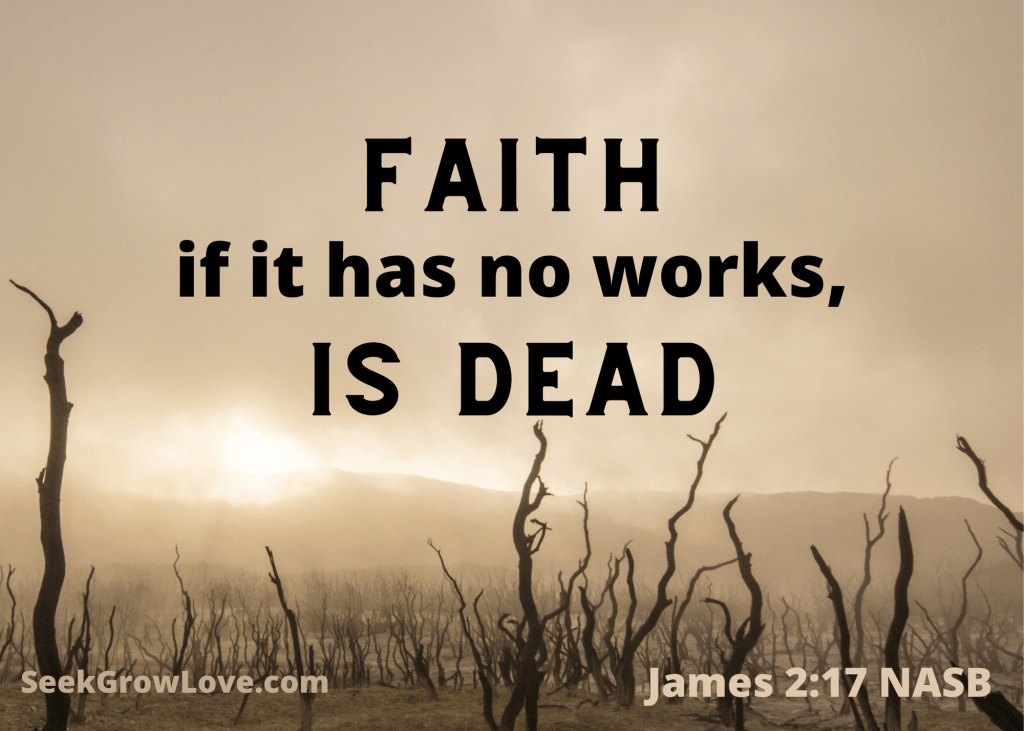
“What use is it, my brothers and sisters, if someone says he has faith, but he has no works? Can that faith save him? If a brother or sister is without clothing and in need of daily food, and one of you says to them, ‘Go in peace, be warmed and be filled,’ yet you do not give them what is necessary for their body, what use is that? In the same way, faith also, if it has no works, is dead, being by itself.”
Faith without works is dead. They go hand in hand, like salt and pepper, bread and butter, peanut butter and jelly. James’ impassioned words teach us that our faith should totally transform our lives and daily actions. Our faith should be reflected in the life we live. “Therefore if anyone is in Christ, this person is a new creation; the old things passed away; behold, new things have come” II Corinthians 5:17
James sums up his thoughts with two examples from the Old Testament, Abraham and Rahab. “Was our father Abraham not justified by works when he offered up his son Isaac on the altar? You see that faith was working with his works, and as a result of the works, faith was perfected; and the Scripture was fulfilled which says, “And Abraham believed God, and it was credited to him as righteousness,” and he was called a friend of God.” (verses 21-23)
We cannot imagine the agony Abraham faced on that mountain, preparing to sacrifice his beloved son Isaac. But he had ultimate trust, FAITH, in God and followed through with WORKS, laying Isaac on the altar before the ram was revealed for the burnt offering. “And as a result of the works, faith was perfected.”
Such an unfathomable example of faith and works, Abraham was called the friend of God, an honor bestowed on no one else in Scripture.
“In the same way, was Rahab the prostitute not justified by works also when she received the messengers and sent them out by another way?” (verse 25) The account of Rahab is found in Joshua 2. Rahab hid the two spies Joshua sent into Jericho. This daring deed brought a rewarding outcome for Rahab and her family, as they were saved when Jericho was defeated by the Israelites. Rahab’s faith and actions blessed her descendants as she is found in the genealogy of Jesus.
James concludes his thoughts with verse 26. “For just as the body without the spirit is dead, so also faith without works is dead.”
Without the breath of life, we are dead. Without a life of daily ACTIVE Christian living and service to others–our works— our faith is dead.
“In the same way, let your light shine before others, that they may see your good deeds and glorify your Father in heaven.” Matthew 5:16
-Paula Kirkpatrick
Today’s Bible reading passages can be read or listened to at BibleGateway.com here – Jeremiah 47-48 and James 2
Occasionally, in my work as a chaplain I meet an older couple who tell me they have been married a long time. A few say they’ve been married 50 years. Still fewer 60 years. I can only think of 1 or 2 that I’ve met that made it 70 or 75 years. Think about what it takes to be married to the same person for 75 years. You have to be married at a young age, you both have to stay healthy enough to live at least into your 90’s, and you have to be able to figure out how to get along with another human being for 75 years. Those are no small feats. Statistically in the United States only about 5% of marriages make it to 50 years and far less to 60 or 70 or more. According to the US census the average marriage lasts 8.2 years and the percentage of divorce is somewhere between 40-50% for all marriages.
Marriage is a covenant. A covenant is a faith commitment between two or more persons and God. God established the covenant of marriage to be between a man and a woman till death do them part. Because of human brokenness and our propensity to unfaithfulness, God made a provision for divorce in Deuteronomy 24. Divorce is better than murdering your spouse. Call it the lesser of two evils. But it was never God’s intention for marriages to end in divorce. It’s more of an accommodation to sin and brokenness than an ideal.
Yet, even God had to divorce his unfaithful wife. Woa, Nelly! What are you talking about? God never got married because, he’s… God, right? Actually, God uses the image of marriage to describe His relationship with Israel. God is the husband and Israel is His bride. It’s an image that appears in today’s reading of Jeremiah and it appears in many other places in the Old Testament. In fact, the book of Hosea is an entire book about this. God uses the image of an unfaithful bride because it brings an immediate, visceral response to the reader. Nobody like to be cheated on by the person that they love. It’s one of life’s most painful experiences. Go listen to Carrie Underwood’s song “Before He Cheats”. That pretty well captures the rage that comes when someone you love is unfaithful. Has anyone ever cheated on you? If so, you know how much it hurts. And God wants his people to understand how much they have hurt him by their unfaithfulness and idolatry. Read Jeremiah 3-4. That’s written from the perspective of a husband who found out that not only has his wife been cheating on him, but she’s a prostitute, selling herself out on the street. Ouch!
Jeremiah 3 begins: “If a man divorces his wife and she leaves him and marries another man, should he return to her again? Would not the land be completely defiled? But you have lived as a prostitute with many lovers— would you now return to me?” declares the Lord. -Jeremiahs 3:1
Most men in that situation would say “heck no” (or something even stronger).
And yet…even with all of that hurt and rage and betrayal and pain, God is still willing to take his bride back.
“If you, Israel, will return, then return to me,” declares the Lord. “If you put your detestable idols out of my sight and no longer go astray, and if in a truthful, just and righteous way you swear, ‘As surely as the Lord lives,’ then the nations will invoke blessings by him and in him they will boast.” –Jeremiah 4:1-2
That’s what you call mercy. That’s what you call grace. That’s what you call undeserved favor.
God called his people to a true change of heart.
The original sign of the covenant in Israel was circumcision. God told Abraham and his descendants to physically circumcise every male born in Israel as a visible sign that they were part of the covenant people of God. They were uniquely in relationship with God and offered their exclusive allegiance and worship to God. But far too often these people who were in that covenant relationship with God had hearts that were far from God.
So God spoke to them through the prophet Jeremiah:
“Circumcise yourselves to the Lord, circumcise your hearts, you people of Judah and inhabitants of Jerusalem, or my wrath will flare up and burn like fire because of the evil you have done— burn with no one to quench it.” –Jeremiah 4:4
Back in the time of Moses God spoke to Israel and said that they were to Love Him with all their heart. (Deuteronomy 6:5). What does any husband want? His wife’s whole heart. Just as any wife wants her husband’s whole heart. That’s why unfaithfulness is so painful and leads to so many broken hearts and broken marriages. God wants those in a covenant relationship with Him to give Him their whole hearts.
God criticized Judah for failing to return to God wholeheartedly: “her unfaithful sister Judah did not return to me with all her heart, but only in pretense,” (Jeremiah 3:10). God is NOT interested in our half-hearted repentance, our half-hearted worship, our half-hearted service, our half-hearted relationship. God wants our whole-hearted love.
God created us in His image. We love, we hurt, we get jealous and angry. That means that God also loves, God hurts when betrayed, God gets jealous and angry. Jeremiah shows us how heartbroken God was with his faithless bride:
“Your own conduct and actions have brought this on you. This is your punishment. How bitter it is! How it pierces to the heart!”
Oh, my anguish, my anguish! I writhe in pain. Oh, the agony of my heart! My heart pounds within me”- Jeremiah 4:18-19
And yet, God loves us so much, he invites us to return to Him.
“Return, faithless people; I will cure you of backsliding.” Jeremiah 3:22
Have you been giving your heart to someone or something instead of to the God who loves you?
Of course we can love other people, parents, spouses, children, friends. We can love our jobs and love our homes, we can love pizza and love a pet. But no love should come before that one true love, that love above all loves, the one with whom we’ve entered a covenant, God.
David loved God and wrote many love songs to God. Here’s one:
“It is good to praise the Lord and make music to your name, O Most High, proclaiming your love in the morning and your faithfulness at night, to the music of the ten-stringed lyre and the melody of the harp.” -Psalm 92:1-2
How will you love God today?
-Jeff Fletcher
PS- In November my wife and I will celebrate 37 years married- we’re almost halfway to 75!!
You can read or listen to today’s Bible reading passages at BibleGateway.com here – Jeremiah 3-4 and Psalm 92-93
Today’s passages seem to have some different main themes, so while all of these are valuable, we will be focusing mainly on 1 Timothy 1 for the purpose of keeping this devotional to a reasonable length
1 Timothy 1 is written by a very dedicated and enthusiastic believer, Paul. Paul is a very impressive man with an incredible testimony (that we get to see a little bit here) and clearly has a passion for the Kingdom. This is why I sometimes have to re-read his messages to better comprehend just how deeply he cares for people and soak up all the energy for spreading the gospel he has! Paul tells Timothy that God’s plan operates by faith (v. 4) and that our role as believers is to have love that comes from a pure heart, a good conscience, and a sincere faith (v. 5). I LOVE that description of who Christians should be in the world! Loving, Good, and Sincere. Do you think the world today has that view of Christians? Or do you think that unfortunately, the world has the view of Christians who turn to fruitless discussions regarding the law (v.6-7)?
It can be hard to swallow verses like 1 Timothy 1:9 where it says “the law is not for the righteous, but for the sinful”, if you are a sinner and know a Christian who has fruitless discussions about the law. However, if more Christians today took their righteousness and expressed the “glorious gospel” that has been entrusted to them (v. 11), I have a feeling that it would be much easier to reach those who do not know the law! The implied context in this passage is not expressing the idea that once you are a believer you don’t have to follow the law, but rather that once you are a believer your focus should shift off yourself and your “good works”, and move towards reaching others who need to know the law. Paul models a great example of how to approach others about Jesus, by telling them that Christ came to save ALL sinners, including the worst of them all, which was himself! (v.15) When we openly share the impact Christ has in our lives and humbly recognize that we are all sinners, it becomes much easier to reach those who need salvation just as much as we do.
This is not to say that discussions of the law should not happen amongst believers! Paul tells Timothy to strongly engage in battle to avoid having a shipwrecked faith (v. 18 -19). To be prepared for battle, it’s important to know what you are up against and how to combat it! What is key here is that our battle is not one meant to destroy arguments or put down people by boasting of our own righteousness, but rather our battle is against the evil one who is dedicated to keeping people out of the Kingdom. Our battle is fighting for the citizenship of an eternal Kingdom, for ourselves and for everyone we meet. The law is one tool we use to win that battle! Another tool is our own testimony, another is the story and purpose of Jesus’ life, death, and resurrection, and yet another is simply sharing how amazing our God truly is.
Isaiah 40:28-31 provides a great passage to reach others with; I encourage you to memorize it for the sake of winning the battle!
“Do you not know? Have you not heard? Yahweh is the everlasting God, the Creator of the whole earth. He never grows faint or weary; there is no limit to His understanding. He gives strength to the weary and strengthens the powerless. Youths may faint and grow weary, young men stumble and fall, but those who trust in the LORD will renew their strength; they will soar on wings like eagles; they will run and not grow weary; they will walk and not faint.”
-Sarah (Blanchard) Johnson
Today’s Bible reading plan passages can be read or listened to at BibleGateway.com here – Isaiah 39-40 and 1 Timothy 1