Independence or Dependence?

Isaiah 37-39
Psalm 76

Isaiah 38:2 – “Remember, O LORD, how I have walked before you faithfully and with wholehearted devotion and have done what is good in your eyes.”

My 21-month old nephew is already practicing his independence. Just the other day, my brother shared in our family chat a video of the little guy outside on their patio, in his diapers, figuring out how to make the sprayer on the lawn hose work. It was amazing to see him inspect the sprayer as he held it in his hands. He eventually discovered that if he applied enough pressure on the handle, water would come out. And then he went to town spraying everything on the patio, including the arcadia door where my brother was on the other side capturing the moment. 

As amazing as it is to watch a child grow and develop, they are still very much dependent on the adults in their lives for providing for all of their basic needs. And if those needs are not met in a timely manner…cries and tears are bound to surface.

As an adult, I’d like to think that I’m more mature than a child, but in all reality, I’m not. I am independent to a fault until something doesn’t go my way or I need help. And even then, I’m reluctant to admit as much. Life is great…until I’m criticized…until my supervisor decides to take an alternative course of action after I have spent hours preparing for something different…until money that I’ve saved up for a vacation has to be spent on expensive AC repairs…until I cut my foot by dropping a plate on it and the ability to walk or drive inhibits my mobility. It’s only then do I pout and admit that I can’t do everything on my own; I need assistance, from my family, from friends, from my heavenly Father. 

As I read through Isaiah chapters 37-38, I couldn’t help but notice that when King Hezekiah was in dire straits, he immediately turned to God and worshiped Him, and made his case for why God should show His mercy and grace. This is exactly what God desires from His children. He longs for us to depend on Him for all of our needs, from daily and minor inconveniences to the major and potentially life changing circumstances. 

However in Isaiah chapter 39, King Hezekiah’s attitude is much different. Life is good; in fact he gets a bonus of 15 more years to live! He’s so confident in his situation that he becomes arrogant and shows off all of the kingdom’s wealth and prosperity to mere strangers. Where has his dependence on Almighty God gone? And for the king’s actions, the prophet Isaiah gives him a heads up that trouble will indeed come. But does Hezekiah care? Nope. He’ll be dead by then and it will be someone else’s problem. Whaaaat??? How is this even the same guy?

But before I become too critical, I have to remember that my human tendencies can easily do the same thing. 

So how can we avoid the temptation to rely on our own wits and wisdom? Jesus gives us a clue in Luke 9. “Then he said to them all: If anyone would come after me, he must deny himself and take up his cross daily and follow me. For whoever wants to save his life will lose it, but whoever loses his life for me will save it.” (v. 23-24)

It’s this daily submission that keeps us humble and dependent upon our heavenly Father for all of our needs. So whether it is a dire diagnosis, threats from an enemy, or even on the best of days when everything is running smoothly, we would do well to remember that it is God who is to be remembered, praised and given all the glory. 

Reflection Questions:

When faced with unexpected hardship or crisis, what is your first instinct – independence or dependence?

When life is going smoothly, what helps you stay grounded in humility and gratitude rather than slipping into self-reliance?

What does “taking up your cross daily” look like for you right now? What small act of surrender can you practice today that will remind you of your dependence on God?

-Bethany Ligon
The Eternal Rock

Isaiah 13-17

Isaiah 13-17 is a series of prophetic messages of judgment and warning given to the nations surrounding Judah. These chapters out of Isaiah are fairly harsh at first glance, filled with pronouncements of destruction and wrath. However, there’s a deeper trend running through them: God is not just the God of Israel. He is the God of all nations and all the Earth. 

In Isaiah 13-14, Babylon, a powerful and arrogant empire, is judged for its pride and cruelty. God promises to bring it low. In Isaiah 15-16, Moab weeps and wails as its strength fails. In Isaiah 17, Damascus and Ephraim (the northern kingdom of Israel) face ruin because they have forgotten their God in turn for idols. 

Over and over, Isaiah reveals that every nation, every empire, and every people group is accountable to God. No political power, cultural tradition, or military strength can protect a nation from the consequences of pride, injustice, and idolatry.

But there’s hope, too. Mixed into the warnings is the idea that God’s justice is not random or cruel-it’s righteous and serves a purpose. His discipline often carries a redemptive purpose. Nations fall, but God remains. Pride crumbles, but God’s kingdom stands. We must then reflect on our own senses of self. Are we keeping the statutes of the Lord instead of those of the world? Do we carry ourselves in humility? Do we anchor ourselves with the Eternal Rock and the fortress of God? In the end the control belongs not with us, but with God. He is our refuge. 

I close today’s devotion with Isaiah 16:5, a verse that reminds us what will one day replace a world so wicked and so unjust:

“In love a throne will be established; in faithfulness a man will sit on it— one from the house of David— one who in judging seeks justice and speeds the cause of righteousness.” (‭‭Isaiah‬ ‭16‬:‭5‬ ‭NIV‬‬)

-Colby Leggitt

Reflection Questions

  1. After reading the chapters (Isaiah 13-17), what stood out to you most from Isaiah’s prophecies to the nations?
  2. Why do you think pride is such a significant theme in God’s judgment of nations like Babylon and Moab?
  3. In what ways are you tempted to rely on your own strength instead of relying on the Eternal Rock?

He’s a Leper!

2 Kings 16 & 2 Chronicles 26

In our house, we’re movie nerds, and one of our go-to movies is “The Lorax,” based on the story by Dr. Seuss. In the movie, the Lorax is an orange furry mythical creature who tries to protect a forest full of adorable animals from a character called the Once-ler. Now, the Once-ler is a young man who is full of dreams. He wants to do good things, find success, and make his family proud. At first, he does just that! He has a successful start to his business, and things are looking great. However, in his arrogance, he goes back on his promise not to destroy the forest and begins chopping down trees, all while singing a very catchy song called “How Bad Can I Be?” The Once-ler is so blinded by his ambition that he can’t see the wrong he is doing.

The Once-ler and King Uzziah have a lot in common. He became king at a young age and sought out God’s wisdom to establish his reign. He fought to give his kingdom success, and he made his people proud. He even gained fame beyond his borders for his strength and valor. However, this fame and strength went to his head and corrupted his heart. He became proud and arrogant and dismissed the law. In 2 Chronicles 26:16, we see him enter the temple of God and burn incense on the altar of incense. It was not his right or place, even as a king, to do this. In verse 18, Azariah and eighty of his fellow priests enter the temple and rebuke him for these actions. And yet, Uzziah did not listen and repent. Instead, he was enraged and defiant, so God struck him with leprosy on his forehead. Only then did King Uzziah rush to leave God’s temple.

King Uzziah, much like other kings we have read about, started with great intentions and ambitions. Yet because of his pride, he lived the rest of his life in a separate house infected with leprosy, while his son Jotham took over running his house. Don’t follow the Once-ler and don’t follow King Uzziah. Seek and listen to wisdom.

-Lacey Dunn

Reflection:

• If you’ve never seen it, check out “The Lorax” and see if you think King Uzziah and the Once-ler led a similar life.

• Imagine you are one of the priests confronting King Uzziah. Close your eyes and picture the temple around you and breathe in the scent of incense. How does it feel to confront the king? Do you have the courage to stay and rebuke the king as Azariah did? 

Not So Amazing

2 Kings 14 & 2 Chronicles 25

Everyday when I get home, my sweet dog Brynleigh greets me at the door. She usually gives me a few little barks of hello and then follows me around as I settle in. This darling little corgi is so full of love and devotion, but I am not the object of her affection. When she greets me at the door, she has her orange and blue ball either in her mouth or very close by. While I’m settling in, she’s not worried about me being comfortable. She’s impatiently waiting for me to drop everything and play ball with her. She is 100% devoted to her ball and loves it more than anything or anyone on the planet. Sure she loves me or at least tolerates me in her way, but she practically worships her ball.

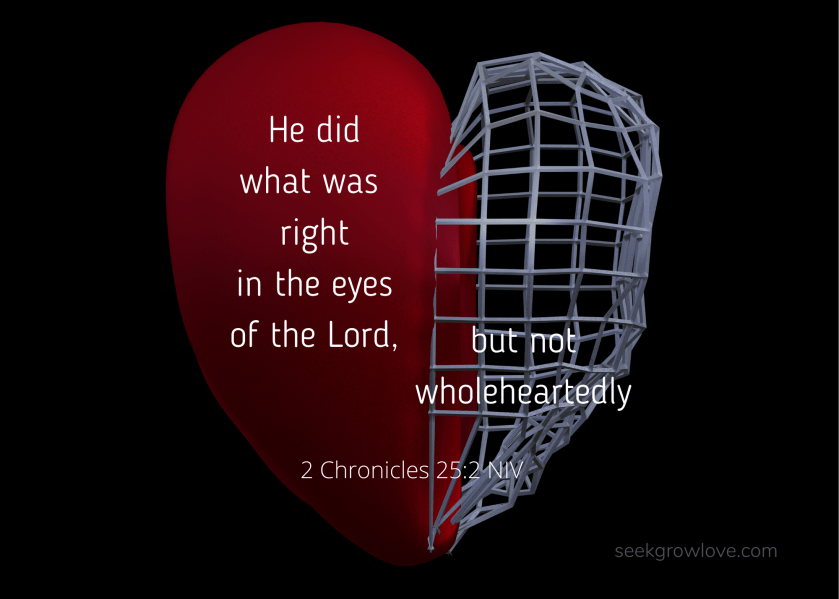
King Amaziah is not so different from my beloved corgi. When I see the name Amaziah, I correlate it to the word “amazing,” but we find that he wasn’t the amazing king we would hope for. It says that although Amaziah generally did right in the sight of God, he didn’t do so with a full heart. We see him go through the motions and even make some good decisions, but because his heart is not completely rooted in being a faithful follower of God, we see him fall away. We see him become proud and seemingly believe that he is, in fact, an amazing king.

After Amaziah and his army came home from battle, he didn’t give glory to God or seek His wisdom. Instead, he brought home idols that represented the gods of the sons of Seir. He didn’t just bring them home as plunder or decoration though, he actually started worshiping them. God sends a prophet who confronts him and asks in 2 Chronicles 25:15, “Why have you sought the gods of the people who have not delivered their people from your hand?” But, the amazing king just tells the prophet to stop talking. He didn’t want to hear wisdom and he certainly didn’t want to make any changes in his life.

At the pinnacle of his reign, Amaziah decides to pick a fight with King Jehoash of Israel. Jehoash dishes some major shade his way in return. Here is how I would imagine part of Jehoash’s response if it were in modern times. “Look, thanks to your massive ego, I know you think you are amazing and unstoppable but why don’t you just stay home and polish your trophies. I could crush you and all of Judah too, so don’t embarrass yourself.” In truth, I don’t know if King Jehoash’s reply to King Amaziah was meant to be as sarcastic as I’ve implied or if it was meant to be a more sincere rebuke but either way, the amazing king didn’t listen. His army was defeated, his city was plundered, and he was captured. He really should have just stayed home.

Before we start pointing a finger at King Amaziah’s downfalls and inflate our egos, let’s take a minute to see how similar we might be. Are there times that we go through the motions but don’t give our whole selves to God? Have we ever pushed away wisdom and then suffered the consequences? Of course we have. We have all fallen short, just like the amazing king.

Unlike Amaziah, my hope is that when we fall short that we would seek wisdom. When an idol gets between us and our relationship to God, my prayer is that we would be rooted firmly enough in God’s love to cast it aside. Let’s strive to be whole heartedly devoted to God who truly is amazing.

-Lacey Dunn

Reflection Questions:

• If you were King Jehoash, how might you have responded to King Amaziah’s message?

• What is a potential idol that you might have? How did it become an idol and what can you do to remove it?

• What does it look like to give your whole heart to God? Set aside some time to dig in to scripture, meditate, or have a discussion with a Godly friend about what it means to give your whole heart to God. 

Affirming Voices

2 Chronicles 10-12

You may be familiar with the book The 5 Love Languages by Dr. Gary Chapman, which gained some notoriety around the turn of the millennium. The premise is that each of us feels and expresses love primarily through one of five ways, and it benefits us not only to understand ourselves but also to learn how our spouse, family, and coworkers prefer to receive love and encouragement.

My love language happens to be “words of affirmation,” meaning I feel loved when people offer praise, encouragement, or a thoughtful compliment. While offering this kind of edification should be part of how we love others at some level, our attraction to affirmation can sometimes replace truth with feeling. When that happens, we may reject godly wisdom in favor of voices that echo our pride.

In 2 Chronicles 10–12, we revisit the story of the rhyming rulers: Jeroboam and Rehoboam. In yesterday’s account from Kings, we focused on Jeroboam’s role in rebelling against Solomon’s successor. Today, we focus on the critical crossroads of the kingdom, seen in Rehoboam’s response to the people’s request: “Please, lighten the load” (10:4).

At first, it appeared Rehoboam had inherited his father Solomon’s wisdom—he asked for time and consulted seasoned advisers. These elders urged compassion and mercy, suggesting he serve the people in order to win their loyalty. But Rehoboam rejected their counsel (10:8), choosing instead to listen to his inexperienced peers—yes-men and blowhards who flattered him for their own gain. He sought affirming voices, not truthful ones, and chose pride over prudence.

Let’s take a moment to reflect on the voices we allow into our ears.  When we struggle in our Christian walk, do we welcome critique from a brother or sister in Christ who lovingly holds us accountable? Or do we prefer the reassuring voice of a coworker who says, “You’re doing fine—no one can live like that all the time”? When God’s Word convicts us, are we willing to change? Or do we search for justifications that let us edit the commands of our Heavenly Father? Are we allowing ourselves to be sharpened by iron, or do we dull the blade with confirmation bias?

Spiritual maturity means knowing the voice of the Shepherd and following only Him. His voice convicts us through the Living Word, speaks to us through the faithful message of a pastor or prophet, and often appears in a candid conversation with a friend. Ready yourself to listen to the voices that challenge your sin, confront your plans, and redirect you toward obedience. God will be there in the battle to meet you, as he did a humbled Jeroboam, with a greater grace and divine deliverance.

“In the end, when Rehoboam and the leaders of Israel humbled themselves, they declared, ‘The Lord is just’ And the Lord, seeing their humility, relented: ‘Since they have humbled themselves, I will not destroy them but will soon give them deliverance’” 2 Chronicles 12:6, 7

-Aaron Winner

Reflection Questions

  1. From above “…do we welcome critique from a brother or sister in Christ who lovingly holds us accountable?”
  2. “When God’s Word convicts us, are we willing to change? Or do we search for justifications that let us edit the commands of our Heavenly Father?”
  3. “Are we allowing ourselves to be sharpened by iron, or do we dull the blade with confirmation bias?”
  4. What roles do pride and humility play in today’s passage? What roles do they play in your life today? What will it look like and sound like and feel like for you to humble yourself before God today?

Not God

1 Chronicles 23-25, Psalm 131

We are going to be in the Psalms today.  [Personally, I did not pick either of my children’s names from the Chronicles reading, but if you are looking for some unique names, there are lots of options here!]

I have been reading a book with my small group looking at the concept of how we are not like God, and how that is a good thing.  There have been a variety of topics related to this, but one thing that has been a common theme is how we humans strive after some of God’s attributes, and that when we do so, we inevitably fall short, and often these shortcomings lead to issues when we think we should have been able to do it.  And I think that is pride.  We pride ourselves on being able to take care of ourselves, to know things, to understand things, to create things, to do X, Y, and Z, but we cannot do things to the extent that God does.

1b 
I do not concern myself with great matters
    or things too wonderful for me.
But I have calmed and quieted myself,
[…]

Israel, put your hope in the Lord
    both now and forevermore.

Instead, we can rely on God to lead those things that are too great for us, we can find rest and comfort in Him.  We can be content and thankful of our limitations because we have an amazing Father with no limitations.

I actually wrote a devotion on this Psalm a couple of years ago, and it was interesting to see how my perspective has changed based on what I am going through, what other things I am reading, etc.  Some of my thoughts are similar, but some are focused on another area.  And that reminded me of another thing from the book – how because of God’s limitlessness, we always have more to learn about Him, from Him.  We can keep reading through the Bible over and over and there is always more for us to glean, always room for us to grow closer to God.  We need to view ourselves with humility to realize we aren’t done growing – there is always room for improvement.

And I think you balance that with contentedness of being ok with our place as limited humans while still trying to grow closer to our great God.  We can be content while still seeking to become more Christ-like as Jesus was and is God’s reflection to us.

~Stephanie Fletcher

Reflection Questions

  1. What are some of God’s amazing attributes that you enjoy and strive for in your own life?
  2. Where have you seen your own growth: in learning about God, drawing closer to Him and emulating His attributes? How would you like to grow next? What can you do to help you with that growth?
  3. What contentment do you find knowing you can rely on God to be God and you can’t and don’t have to? Enjoy relying on Him today!

A Change of Heart

OLD TESTAMENT: Isaiah 51 & 52

POETRY: Psalm 107

*NEW TESTAMENT: James 4:1-12

In the margins on my Bible, I had the following notes for this section (presumably thoughts on a sermon or lesson I heard in the past):

  1. We cannot underestimate the seriousness of sin
  2. Jesus calls us to mourn our sins in acts of genuine repentance
  3. If our natural reaction isn’t to mourn, we should pray for God to change our hearts
  4. Our God deserves our full-hearted obedience & worship.

#3 stuck out to me as I was reading – are there times that we don’t mourn our sin?  We try to make excuses for it, why it is ok for us to do it (and maybe not for someone else). 

Usually, we try not to think about our own sin.  But we do need to take time to reflect on our lives so that if we do have sin, we can repent and be forgiven.

I think in doing that, it can lead us better into #4.  If we are mourning our sin, repenting, and asking God to change our hearts, that can help mold us to what God desires which obedience comes from and further leads us into a deeper worship.

In reading through these verses, I see how our selfishness and self-absorbedness can cause fights among one another, can lead us to seek out worldly pleasures, and to think too highly of ourselves.

Instead, we need to humble ourselves and work on selflessness as we turn to God.  And there are some wonderful promises in this!

“Come near to God and he will come near to you…Humble yourselves before the Lord, and he will lift you up.” (vs 8 & 10)

I want to draw nearer to God, and He wants that too.  He isn’t looking for ways to avoid us – He is looking for us to come to Him, and He will be right there with us. 

~Stephanie Fletcher

Reflection Questions

  1. Consider where in your life you have been/are friends with the world – thus making you an enemy of God. Are there times that we don’t mourn our sin? What excuses have you made for your sin?
  2. Where would you rank yourself on a selfishness meter – 10 being always selfish, 1 being always selfless? How is pride and humility related to selfishness and selflessness?
  3. What heart change might God be looking for from you? Will you pray for it?
  4. How can you work at submitting yourself to God? How can you work at resisting the devil?

Inside vs. Outside

Old Testament: Micah 5-7

Poetry: Psalm 137

New Testament: Matthew 23

We are all concerned with how we look to others on the outside, and that is a good thing.  The outside is all the stuff people can see about us.  It is how we physically look, the things we own, the words we say, our actions, our reputation, etc.  It might sound a bit vain to be concerned about what others think about us, but it is ok to want to be accepted by others and you will have more influence with others if they like you and respect you.  The inside is all our thoughts and desires, and others cannot hear our thoughts or know if we are being honest about our desires.  We can hide our true thoughts and desires from those around us, although nothing is hidden from God.  Which is more important?  The way others see us on the outside or what we are thinking on the inside?

I think they are both important and we should be concerned about both.  But what happens if we concentrate on only one or the other?  In Matthew 23, Jesus talks about a group of people that were only concerned about the outside.  The Pharisees and teachers of the law were overly concerned about what other people thought of them.  They made their phylacteries (boxes containing scripture verses worn on their forehead and arm) wide and the tassels on their garments long for people to see.  They loved places of honor at banquets and the most important seats in the synagogues.  They loved to be greeted with respect and to be called ‘Rabbi’ by others.  They gave a tenth to God’s work, but they neglected justice, mercy, and faithfulness.  They appeared to be righteous on the outside, but they were full of hypocrisy and wickedness on the inside.  Jesus detested the way they lived because it was not honest, and they only did it to impress others.  They were arrogant hypocrites, and that’s not a good look on the inside or outside.

Similarly, if we are ultra concerned about how our bodies look, the clothes we wear, the car we drive, the house we live in, etc., we are concentrating on the wrong things because we are trying too hard to impress others so we can feel good about ourselves.  That is also not a good look reputation-wise because we are lacking humility.  On the other hand, please brush your teeth, take a shower, and take care of your house and yard enough so others won’t think you don’t care.

So, what happens if you only concentrate on the inside?  I love what Matthew 23:25-26 had to say about this.  Jesus was ripping on the Pharisees and teachers of the law again by saying they clean the outside of the cup and dish, but inside they are full of greed and self-indulgence.  He goes on to tell them to first clean the inside of the cup and dish, and then the outside will also be clean.  That is brilliant!  If you concentrate on your thoughts and desires on the inside that others can’t see, it will affect how you look on the outside to others.  In other words, focus on the inside and the outside will take care of itself.

If you love God and love others on the inside, your words and actions will look beautiful to others because of your love for them and because you are not putting yourself first.  Verse 12 says, “For those who exalt themselves will be humbled, and those who humble themselves will be exalted.”  It is important to look good on the outside and inside, but you need to focus on getting the inside right, not the outside.  The better you look on the inside, the better you will look on the outside as well.  You will be a truly humble and loving person, rather than an arrogant hypocrite.

Reflection Questions:

Should we be concerned about what others think about us?  Why or why not?

What are some practical steps we can take to “work on our insides”?

-Rick McClain

Refocus

Old Testament: Obadiah

Poetry: Psalm 132

New Testament: Matthew 18

Who is the greatest?  The GOAT (is that still a thing)?  This is what the disciples come to Jesus asking at the beginning of Matthew 18.

Jesus doesn’t answer them directly, per usual.  Their question isn’t even worth answering.  It doesn’t matter who is the greatest.  That comes with the wrong focus.  Instead Jesus tells them:

And he said: “Truly I tell you, unless you change and become like little children, you will never enter the kingdom of heaven. Therefore, whoever takes the lowly position of this child is the greatest in the kingdom of heaven. 

Your position is not important.  Rather, not viewing yourself as the greatest will put yourself in a better, more humble position.

There are several parables in this chapter, and I think you could probably tie them all to humility in some way, but I want to look at the last section.  It starts with:

21 Then Peter came to Jesus and asked, “Lord, how many times shall I forgive my brother or sister who sins against me? Up to seven times?”

22 Jesus answered, “I tell you, not seven times, but seventy-seven times.[g]

That is going to require humility.  When someone sins against us, we probably feel we are in the right to be angry or to hold a grudge.  After all, they sinned against me.  But Jesus’ instructions don’t allow for this kind of pride.  Instead, we are to go on forgiving our fellow Christians time and time again, swallowing our pride, pushing it aside, for the sake of forgiveness.

We might think this is unfair, but through the parable Jesus tells of the unmerciful servant, we can see that God forgives us so much!  For us to accept God’s forgiveness for our own sins, but to hold another’s sins against them is prideful.  It is saying that you deserve forgiveness more than them, or that your sins weren’t as great.

Instead, Jesus wants us to humble ourselves, to admit that we are just as low, or even lower, than others and offer the grace to others that we have been given.

Humility is a topic that has come up often in my discussions and readings the last few months.  It is hard – it is against our human nature.  But I really believe it is one of the most important things for us to focus on.  And likely, it isn’t a one-time thing.  We need to constantly be reminded and refocus on humility to make sure that pridefulness doesn’t seep into our lives, because pride does come naturally.  But humility is key.  It is key to forgiveness, to serving others, to spreading the gospel.  Your message will be better received if it comes from a place of humility rather than pride.

~Stephanie Fletcher

Reflection Questions

  1. What does pride look like? What does humility look like? Why do you think Jesus teaches humility? Which type of person do you prefer to be around? 
  2. When and how does pridefulness seep into your life? What has helped you remember and practice humility?

The Search for Knowledge?

Old Testament: Amos 7-9

Poetry: Psalm 131

New Testament: Matthew 17

Our Psalm reading starts today with this verse:

My heart is not proud, Lord,
    my eyes are not haughty;
I do not concern myself with great matters
    or things too wonderful for me.

When reading through this, I had two thoughts on this first verse from different perspectives.

  1. Do we sometimes try to understand things that we just really can’t understand?  There are some people who want to know the answer to everything.  And searching for knowledge isn’t inherently bad.  But does it become so much of a priority that it is leading you toward pride?
  2. On the other hand, do we let this become an excuse to just say “well, I guess we can’t know” and give up on the pursuit of truth and knowledge?

I think there probably has to be a balance between these two things.  When I don’t know the answer to something (that I believe to be unanswerable – not like a math problem that has a clear answer), it just doesn’t bug me.  I know other people who just have to know and they spend so much time searching and studying and still not finding answers which frustrates them.  But I do let that be an excuse at times to not search for an answer and give up on something that I could know more about.

The passage goes on to say, “But I have stilled and quieted my soul […] O Israel, put your hope in the LORD both now and forevermore.”

That’s the key.  Our hope shouldn’t be found in knowledge.  Our hope should be in the LORD.  We should be at peace with the things that are above our understanding.  But I also think we should try to know the LORD as best as we can with our human minds.  In John 17:3, it says, “Now this is eternal life: that they know you, the only true God, and Jesus Christ, whom you have sent.”  Eternal life is to know God and His Son Jesus.  And we can’t know Him if we don’t spend time pursuing Him even if we can’t have all the answers.

So we should be doing what we can to know and understand God, but also let go of our desire to have the answer to everything, humble ourselves, and live in peace knowing that God’s ways are greater than our own.

~Stephanie Fletcher

Reflection Questions

  1. Is there some information you are content not knowing? Like what?
  2. Have you ever found yourself struggling with pride because of what you do know? How can you practice humility instead?
  3. What do you think God wants us to know about Him and His Son?
  4. Do you ever misplace your hope and put it in yourself and all you know and can do – instead of in God? What is the remedy?