
John, Jesus and the Spirit of God

Old Testament: Joshua 19-20

Psalms: Psalm 103

New Testament: Luke 3

Did you know that cities of refuge were first established by God? Did you know that everything good and just has its origins from our God? Our God performs righteous deeds and judgments for all who are oppressed. Our God establishes mercy and justice, and desires that from those who fear him. But often we do not. Instead, we pervert his ways. We do what Romans chapter one says and distort his good gifts and his good intentions for us.

We don’t get what we deserve. We deserve death, or at the very least, a reprimand, like the one God gave through his prophet John the Baptist to the crowds coming to him to be baptized.

Luke 3:7-8 (NASB) 7…“You brood of vipers, who warned you to flee from the wrath to come? Therefore bear fruits in keeping with repentance.”

Psalm 103 tells us that our God 10 “has not dealt with us according to our sins, nor rewarded us according to our iniquities” (Psalm 103:10). If he did, none of us would be here.

Instead, 12 “as far as the east is from the west, so far has he removed our transgressions from us.” (Psalm 103:12). We must remember that. He pardons, he heals, he redeems. He’s compassionate and gracious, slow to anger and abounding in lovingkindness. In our New Covenant, he does this through his son Jesus. That is the God we serve. But we must also remember that he will not strive with us forever.

Can you imagine the impact our modern Sanctuary Cities would have if they functioned with God’s definition of mercy and justice at the helm? One day they will, assuming we still need them, when our righteous ruler, King Jesus returns. In the meantime, we can be Jesus’s hands and feet to the oppressed by asking our Lord Jesus what we can do.

Before the people asked Jesus what they should do, they asked the one who prepared the way before him, John the Baptist, knowing that a man from God had the authority to teach them and tell them what to do. He responds with justice because he knew what to say through the holy spirit.

His responses sound very familiar, like the responses Jesus gives during his ministry. I believe this is because it is the same spirit that is within John the Baptist that is then placed fully upon Jesus at his baptism, but to an even greater measure than it was placed on the highly respected John the Baptist. It reminds me of Elijah, being full of the holy spirit, who went before Elisha, who received an even greater measure of spirit from his God. In fact, the word tells us that John the Baptist came in the spirit of Elijah. Jesus goes so far as to tell us that John the Baptist “is” Elijah who is to come. Of course, not literally; all in spirit.

The people were amazed by John. They, 15 “were in a state of expectation and all were wondering in their hearts about John, as to whether he was the Christ.” (Luke 3:15). Of course, he was not, and made sure the people knew that the one they were looking for would not baptize them with water, but with the holy spirit.

It is Jesus whom we should look to with our questions. In Jesus we find all the fullness of the spirit of God, without measure, because God gave all power and authority to his son, with whom he is well pleased, until all enemies are made his footstools for him in the end. It is Jesus who is our salvation, a man who is mightier than John the Baptist; A man who eventually gave us the holy spirit, the power and presence of God, so that we could “be Jesus” to those who are oppressed in our day.

Unfortunately, as we look to the perverted justice system in our society, we see that there is much work to be done before our life race ends. It will never be fully just until Jesus returns and makes all wrongs right, but if we have the power now, in an even greater capacity than even Jesus was given, because now the holy spirit is given through Jesus post his death on the cross, we can keep doing the work he left for us to do.  

God told us what he desires from us throughout scripture. Everything he wants for us he wants because it is good for us, and it culminates in Jesus. If we are going to stop perverting God’s words and his will, we must repent and ask God through his son what we must do! He has made known his ways through Jesus in the New Covenant. Remember his precepts through Jesus Messiah and do them. Remember what he did through Jesus and remember what Jesus chose to do for you and I often. Jesus’s yoke is easy. Serve him by doing his will, which is God’s will. And bless the Lord oh my soul for his everlasting lovingkindness!  

-Juliet Taylor

Questions

  1. What does it mean to bear fruits in keeping with repentance?
  2. Why do you think God chooses to work through his son? In turn, why do you think Jesus chooses to work through us?
  3. What work do you think Jesus wants you to want to do for him in your life race?
Preparing Your Conscience: Seeking Forgiveness

*Theme Week – Jesus: Matthew 27

Old Testament: Joshua 3 & 4

Psalms Reading: Psalm 96

Let’s face it. We’ve all done things we have felt guilt over. Accepting responsibility for our actions is one of the most difficult lessons to learn. 

We see in this account of Jesus’ arrest and subsequent torture and death a few different takes on acknowledging wrong done and accepting, or denying, blame. 

Judas’ guilt is overwhelming. So much so, that he no longer knows how he can go on living. We don’t know what Judas said to God in his final moments or whether he sought forgiveness. But rather than trying to find repentance in living a Godly life, he decides to take his own. 

The Jewish leaders who paid Judas to betray his rabbi and Christ acknowledged that the money Judas returned to them was blood money. If that isn’t a confession of some form of guilt, I’m not sure what is. And yet they, too, choose not to repent. Instead they continue on with their mission. 

Pilate, warned by his wife, knows that the man before him is not guilty of any crime worthy of death. He gives the people several outs, including offering over a known, terrible criminal. But rather than stand up to the crowd, he proclaims himself guiltless and allows them to take away to torture and kill a man he knows is innocent. 

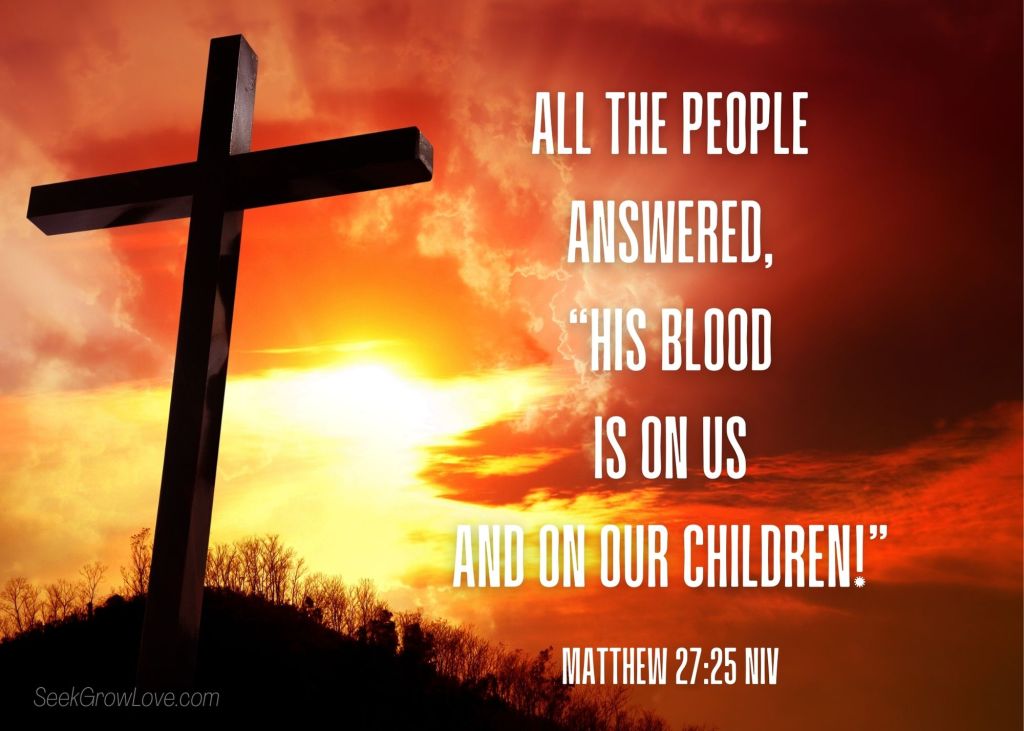
And the Jewish crowd. This one hurts me most of all, because in true mob mentality, they flippantly ignore their consciences, ignore God’s presence, and accept all guilt of Jesus’ death. And they do it without second thought, it seems. They accept the blame not only on themselves, but on their children as well! 

Our savior stood before all these people, blameless and betrayed, and said not a word of condemnation or defense. How many sins have we committed that have been laid upon his shoulders? 

Isaiah 53:6-8 says: 

We all, like sheep, have gone astray,
    each of us has turned to our own way;
and the Lord has laid on him
    the iniquity of us all.

He was oppressed and afflicted,
    yet he did not open his mouth;
he was led like a lamb to the slaughter,
    and as a sheep before its shearers is silent,
    so he did not open his mouth.

By oppression and judgment he was taken away.
    Yet who of his generation protested?
For he was cut off from the land of the living;
    for the transgression of my people he was punished.

For our transgressions, to take care of our guilt, he was punished and died. 

Today is Good Friday, the day we remember Christ’s sacrifice. Take some time with me today to prepare yourself by seeking forgiveness. Ask yourself:

What sins have I committed that I have laid on my Messiah’s shoulders? There are so many, but which have I not sought forgiveness for? 

Are there sins that I’m not sure how to handle, and that seem hopeless, like Judas’? How can I turn them over?

Are there sins that I’m choosing to ignore, like the Jewish leaders? How can I repent and turn the other way?

Are there sins that I could avoid or turn a blind eye to like Pilate? How can I call them out for what they are and act against them?

Are there sins that I’m willingly accepting blame for but I’m determining them inconsequential so I can continue doing them like the angry mob? How can I fully realize and accept how they are affecting my life in a negative way?

I pray that today as you meditate with me and observe Jesus’ sacrifice for all our sins, we are able to call out our sins for what they are and spend time with God seeking forgiveness and redemption. His son suffered and died for us, to cleanse us of those sins. Today is a day for reflection and repentance, so please take the opportunity for it. 

We mourn the suffering of our savior today and the fact that we, and our sins, are the cause of it. But because our God is good, we know that our sin and that cross are not the end of the story. 

Jenn Haynes

The Weight of Unconfessed Sin

Old Testament Reading: Exodus 7 & 8
Psalms Reading: Psalm 32
New Testament Reading: Romans 2

The weight of unconfessed sin is heavy. Today’s passage in Psalm 32 helps us to see that unconfessed sin takes a spiritual, emotional and physical toll on us. David mentions that his body was wasting away under the burden of his unacknowledged sin.

Psalm 32

3 When I kept silent about my sin, my body wasted away

Through my groaning all day long.

4 For day and night Your hand was heavy upon me;

My vitality was drained away as with the fever heat of summer. Selah. (NASB 1995)

When we confess our sins to God and repent of them, God is faithful to forgive. Many times we can be like Adam and Eve clamoring to find our leaves to cover our shame and nakedness. It is futile to try and conceal our sin from an omniscient, omnipresent God.  

5 I acknowledged my sin to You,

And my iniquity I did not hide;

I said, “I will confess my transgressions to the Lord”;

And You forgave the guilt of my sin. Selah. (NASB 1995)

I hope the admonition in verse 6 was not lost on you. 

6 Therefore, let everyone who is godly pray to You in a time when You may be found;

Surely in a flood of great waters they will not reach him. (NASB 1995)

This verse reminds me that we do not have unlimited time and opportunity to right our wrongs with the maker of the Universe. There will be a time when God can no longer be found, so if you are bearing the weight of unconfessed sin, what are you waiting for?

Romans 2 reminds us of some of the amazing attributes of God’s character: kindness, patience and tolerance. However, it also warns us not to take those attributes lightly.

4 Or do you think lightly of the riches of His kindness and tolerance and patience, not knowing that the kindness of God leads you to repentance? (NASB 1995)

Meditating on how amazing our Heavenly Father truly is and how much He loves us should compel us to repent and to reconcile with Him. However, we are not special and there is a limit to His kindness, tolerance and patience. He is also a God of justice. We read in verse 11 of Romans 2, “For there is no partiality with God.” (NASB 1995) The subsequent verses make it clear what the outcome will be if we remain stubborn and unrepentant.

5 But because of your stubbornness and unrepentant heart you are storing up wrath for yourself in the day of wrath and revelation of the righteous judgment of God, 6 who will render to each person according to his deeds: 7 to those who by perseverance in doing good seek for glory and honor and immortality, eternal life; 8 but to those who are selfishly ambitious and do not obey the truth, but obey unrighteousness, wrath and indignation. (NASB 1995)

I would like to circle back to the Psalm 32 passage of how David’s unconfessed sin was causing his body to waste away.  We see a similar concept in Romans 2 and how our conscience accuses our thoughts and wears on us if we do not confess and repent of our wrongdoing. 

14 For when Gentiles who do not have the Law do instinctively the things of the Law, these, not having the Law, are a law to themselves, 15 in that they show the work of the Law written in their hearts, their conscience bearing witness and their thoughts alternately accusing or else defending them, 16 on the day when, according to my gospel, God will judge the secrets of men through Christ Jesus. (NASB 1995)

It all comes down to our hearts. In verse 29 of Romans 2, we see that our circumcision should be of our hearts. If we are a people after God’s own heart like David, we will inevitably have ‘the work of the law written in our hearts’ and our priority will be pleasing God and not man. That means confessing our sins and returning back to God while He still may be found.

29 But he is a Jew who is one inwardly; and circumcision is that which is of the heart, by the Spirit, not by the letter; and his praise is not from men, but from God. (NASB 1995)

-Kristy Cisneros

Reflection Questions:

  1. Are you currently bearing the burden of unconfessed sin? Enlist God’s help in confessing and freeing yourself of this burden. Go a step further and ask God to help you alter your course so that you aren’t falling into the same sin traps over and over that continue to get in the way of your relationship with God.
  2. In reflecting on your life, does it seem to show more of an effort toward pleasing man or pleasing God?
  3. What does God reveal about Himself in today’s Bible reading – and why does it matter?

Look Inside

Luke 5

Monday, December 13, 2022

Looking outward rather than inward is a common tendency among mankind. I cannot stress the importance of making the decision to accept our downfalls and repent instead of continuing on in a faux form of oblivious happiness. It’s difficult in our fast-paced, always moving lives to make enough time to stop and reflect on some of the crucial lessons given to us on this topic throughout Jesus’ ministry, and Luke 5 has so many of them.

In verses 1-11 we see Jesus go before Simon Peter and his fishers who had no luck with catching fish all night. Jesus commands them to cast their nets again and a miracle occurs where every net is filled so heavy the boats began to sink. While this is an extraordinary story and example of Jesus’s ability to perform miracles and convert crowds, there’s a powerful underlying message within the conversation between Simon Peter and Jesus. When Simon sees the miracle, his first reaction wasn’t to shout in joy or surprise at the amount of fish he was just blessed with. It was to repent. Simon Peter acknowledged at that moment the truth of God and the fact that Jesus was the Messiah, and found himself unworthy. Jesus, however, does not judge or criticize Simon Peter, but instead gives him a purpose and a promise; the promise of the kingdom as long as he followed him and made fishers of men. Many times we come to expect blessings from God without realizing the greatest reward is already promised. In the same way, Simon Peter understood how he was not worthy of the miracle granted to him, and repented.

We too must come to understand the price of our sins and how we are unworthy of God’s grace. Without repentance of our sins, we can never truly come to accept why we’re unworthy of this reward, and why Jesus died on the cross for our sins, forming a New Covenant under which all our sins are freely forgiven. So in all that we do, repent and show thanks to God for the sacrifice of Jesus and the promise bestowed upon us.

-Isabella Osborn

Reflection Questions

  1. What can you learn from Peter in Luke 5:1-11? What can you learn from Jesus in this passage? Which message did you most need to hear today?
  2. What do you see when you look inward? How does it make you feel? What does it make you want to do? Pray about it?
  3. What purpose and promise do you think Jesus sets before you?