Create in me a clean heart, O God, and renew a right spirit within me. Psalm 51:10 ESV
Yesterday, we looked at the narrative and the outcome of David’s tryst with Bathsheba. We see David essentially commit murder to cover up his affair, and we see the prophet Nathan come and confront David about the evil that he has perpetrated.
David could have been dismissive. He could have just shrugged off Nathan’s confrontation and said, “This is where my heart led me.” He could have said, “God wants me to be happy.” But he does not deflect. Despite his error, David still desires to do what God desires of him. He wants to be right before God, and when the clarity and gravity of his treachery sink in, he shows contrition. Not combativeness. Not excuses. Contrition.
David knows that what he has done is wrong, and he knows that he is not capable of fixing himself and reorienting his life and priorities alone. He cannot wash himself clean of his sin, but God can forgive him and cleanse him of the sin that has come forth from him.
David sees what would later be written: God does not desire sacrifice, but repentance. Not a cheap get me out of this mess offering, but a recognition of the sin done and the brokenness of recognizing the gravity of the separation from God that sin causes. God accepts sacrifices, but he accepts these sacrifices from a clear conscience; he doesn’t desire sacrifices from a guilty one.
-JJ Fletcher
Reflection Questions
Why do we struggle to see the gravity of our sin?
How can we truly show contrition, not just be sad that we’ve had our sin found out?
What can we learn from Psalm 51, a psalm of repentance?
But the Israelites broke faith in regard to the devoted things: Achan son of Carmi son of Zabdi son of Zerah, of the tribe of Judah, took some of the devoted things; and the anger of the LORD burned against the Israelites. Joshua 7:1 (NRSV)
As God promised, He led the Israelites to victory over Jericho. It is to be ransacked and destroyed, and there are to be none left alive, aside from Rahab and her family. There were specific items (gold, silver, etc.) that were taken from the rubble that were to be set aside and placed in the treasury of the house of the Lord.
After this great blessing of victory, one would assume that everyone would honor the directives of God and be obedient to him, but alas, we’ve been here before. Despite God proving himself time and time again to be a God of his word, both in blessing and in punishment, this knucklehead named Achan decides to take a heap of these goods for himself, and he buries them underneath his tent.
The stuff is hidden, there was so much of it, no one is going to know. The only one that this affects is him, and he’s going to keep it a secret. Maybe, eventually, it will just seem like this is some of the swag that was received from the Egyptians as they sent their ancestors out of Egypt. I don’t know what exactly was going through Achan’s mind, but I’m sure we’ve all been there, deceiving ourselves, justifying the stupid decisions that we have made to disobey or to take something that we have no business possessing.
As I sit here, I am reminded of an instance where one of my brothers took something that did not belong to him. This would have been sometime in the mid to late 90s and I’m a little fuzzy on some of the peripheral details. But we get home after a trip to the grocery store (Bohning’s in Ponchatoula, LA, I believe), and we discover that my brother has in his possession a whistle pop. After further investigation, it is discovered that he has many of them; in fact, he has a FULL BOX of whistle pops. At some point while we were standing in the check-out line, he grabbed the box off the candy shelf and shoved it under his shirt or down his pants. Now, I’m assuming that my mom took him back to Bohning’s to return it, as had happened when other contraband candy items had “shown up” in our house.
Now, a 5-year-old is not going to get arrested for petty theft and is probably going to get some sort of punishment for their misbehavior, but that action did not just affect him. There is embarrassment when a parent brings their child in to cop to a misdeed, apologize, and return the uneaten contraband. The stakes are low in this situation, but the principle is there: sin and error do not just affect the perpetrator.
Israel is feeling a kind of high as their God has just handed their enemies to them, and they are going to press forward into the land. They go make military advances on Ai, but they are driven back; they do not experience deliverance against their enemies; they are driven back and several dozen of their comrades fall to the enemy.
How? Why? Why would God deliver them a fortress and then allow them to fall to a less powerful fortification?
Because sin doesn’t happen in a vacuum. Sin affects everything. You don’t have to sin against someone for them to be affected; there are plenty of indirect effects of sin. We don’t have to go into a laundry list of sins, but different sins can cause us to behave and think in certain ways that harm others. Sin can lead to anger. Sin can lead to spousal abuse or neglect. Sin can lead to broken relationships. Sin can lead to more and more sins being perpetrated. Sin can break hearts. Sin can put a wedge between a person and God, and I’m not talking about the person that sinned.
Achan’s sin caused God to be furious, and he withheld his blessing and protection from Israel. Achan’s misappropriation of riches, which had nothing to do with the battle against the people at Ai, led to the loss of a battle. The sin affected all of Israel. In this case, Achan lost his life because of his sin.
So, if there is unrepentant sin in our homes, in our churches, in our relationships, and our individual hiding places, we can expect that it is going to affect others in one way or another. Sin cannot be reconciled with good. Jesus died to free you from sin, not to free you to sin. Yes, sin is crouching at our door; your enemy, the devil, is on the prowl like a lion to devour you with temptation that leads to sin (1 Peter 5:8). But when we sin, we are not to try to justify it or explain it away. I’ve cited it already this week, but here it is again:
“If we confess our sins, he is faithful and just and will forgive us our sins and purify us from all unrighteousness”1 John 1:9 (NIV)
Achan confessed his sin, but the damage had been done. He waited till he had been found out and others had suffered extreme loss due to his actions.
When we fall short, it is best to confess quickly before it becomes a bigger mess in our lives and the lives of those we love (or don’t even know).
-JJ Fletcher
Reflection Questions:
Why is it so easy to overlook God’s commands?
Is it difficult to read about the punishment for sin that is described in scripture? Does it lead you to a greater appreciation for the New Covenant in Christ’s blood?
What thoughts did you have on Achan’s sin as you read through today’s reading in Joshua 5-8?
Why is it easy to be blind to the way that our sin affects others?
The biblical holidays are wonderful and believe me, I knew almost nothing about them growing up in Indiana until I lived in Israel. 🙂 I bite my tongue from saying, “Jewish” holidays as they are biblical holidays. So much meaning behind them, more so than most pagan based American holidays. One of the harder parts about leaving Israel was leaving the holidays.
In our passage today many sacrifices are named with the holidays, which no one is doing now. Also, the holidays were days of rest, set apart from other days. These holidays are still celebrated without sacrifices but with rest, stores close down!! I’m going to briefly give you a taste of these biblical holidays and how they’re celebrated today.
Shabbat: Late every Friday afternoon public transportation, sport games, and stores CEASE, yes, the MALL included, to usher in the shabbat a day of REST. Families eat a nice meal together having leftovers for the next day so no one has to cook/work.
Passover: Feast of Unleavened bread is the first month of the biblical year, which makes sense the new year starts in the spring with new growth blooming. It’s the oldest holiday still celebrated in the world, over 3,400 years! And it’s the BIGGEST holiday, (like Christmas is in America).
Feast of Weeks: Seven weeks after Passover the firstfruits are celebrated. Kids wear white and carry a small decorated basket of fruit to share with others.
Day of Blowing: People blow shofars (ram horns) throughout the day. It’s a warning to repent for the next 10 days before the Day of Atonement.
Day of Atonement: A day of repentance with fasting. The whole country SHUTS DOWN, no flights, vehicles on the highway, EVERYTHING is CLOSED… to REPENT. It’s quite amazing to experience such a national “holiday.”
Feast of Booths: A week long holiday of eating and sleeping in a booth outside. Kids often decorate them with paper chains and pictures.
God appointed these holidays for a reason and for our good. Take a moment to reflect on them. It’s hard to implement them in a society that doesn’t acknowledge them, but it’s still good to be aware of these biblical holidays and their meaning. Maybe the modern sacrifice would be to take time out and rest on these holidays and think about and thank God for what He has done. The first three have been fulfilled in the first coming of Jesus, and the last three with his second coming!
“For the Lord himself will descend from heaven with a cry of command, with the voice of an archangel, and with the sound of the trumpet of God.” 1 Thes. 4:16
-Stephanie Schlegel
REFLECTION QUESTIONS:
1. Which holiday do you like the best? Which one would you like to celebrate?
2. What’s one way your Shabbat rest day could be changed/improved to make it more restful?
3. A holiday of repentance and fasting?! Maybe pick a day within the next week that you could fast a meal and pray for forgiveness to God and others possibly offended.
Shalom from Tennessee! This is Stephanie Schlegel writing this week as we continue through the Bible. We lived in Israel for 25+ years where our five children were born and raised. So I’ll be adding in some extra thoughts and pictures from and about Israel. 🙂
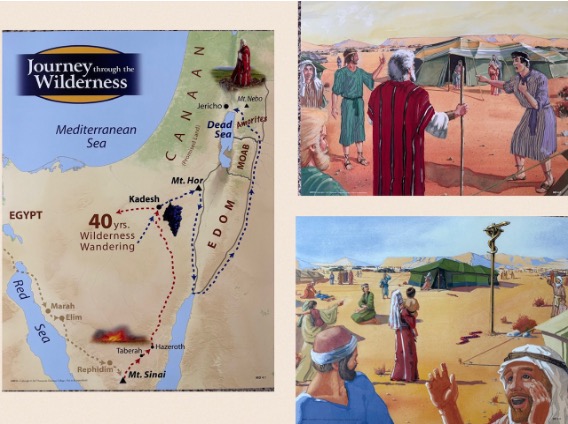
The first verse of Numbers 21 caught my attention as it still relates to today! The king of Arad fought against Israel and took some captives! :0 I’ve been reading the news of the current captives slowly being released and talk of what to do with Gaza. Surprisingly, three times in chapter 21 Israel fought against their enemies and destroyed their cities and took possession of them. For a LONG time Israel has had to contend with those against them, including up to today!
In their travels they got thirsty, hungry, and cursed the manna God provided for them! It also says they spoke against God and Moses, their leaders. Thus, God sent fiery serpents among them, in which many were bitten and killed. So they asked forgiveness, and that Moses would pray to God to remove them.
Included is a picture from the ABEKA Bible Flash-a-Card Series 3 of the life of Moses. These sets have many great pictures of Bible stories not normally seen in children’s books. We used them in our congregation’s children classes in Israel as they were taught in Hebrew. They’re great for home use as well for children and grandchildren.
Complaining about what one eats is a good lesson for all ages! Bites from deadly snakes is a rough punishment in the desert. There was a period of time while raising our children that if they complained about the food I made for dinner then they’d be doing the dishes afterwards! The complaining stopped quickly! Actually, I wasn’t even sure if they liked what I made or not as they ate it with no comments. Haha! Occasionally, after a new recipe I’d let them vote after dinner on the count of three with a thumbs up or down (or sometimes in the middle), so I could get some feedback. 🙂
One of the teachers/moms in our children’s class in Israel made a “bronze serpent” on an upside down mop with paper twisted around the top of it and then covered with duct tape and spray painted it bronze. It was a good visual aid for the kids! (I couldn’t find a picture of it since it was before the days of cell phones).
Jesus recalled this incident in John 3:14,15, “And as Moses lifted up the serpent in the wilderness, so must the Son of Man be lifted up,that whoever believes in him may have eternal life.” Thankfully, we can look to Jesus during troubled times and after we’ve failed and need forgiveness. May God help us not to complain but to repent and give thanks.
“So, whether you eat or drink, or whatever you do, do all to the glory of God.” 1 Cor. 10:31
-Stephanie Schlegel
REFLECTION QUESTIONS
1. What was the Israelites punishment for complaining? Did the punishment seem just or too harsh? What are some things that you’re complaining about that perhaps need to be addressed?
2. How does complaining against God, leaders, and food hurt us? What’s something we can do to change that?
3. The bronze serpent that they looked at to be saved eventually became an idol! Is there something in your life that has helped you that now has turned into a negative effect that maybe you should break away from? We can pray and ask God to show us and help us to turn from it.
We have finally come to the end of Leviticus and I hope that you’ve gained an appreciation for this “skipped-over” book: there is much we can learn about our God and how to serve Him within these pages, even if some of the specific details are different now under the new covenant with Jesus. One thing that will never change about our heavenly Father is something described in chapter 26: He blesses obedience and punishes disobedience.
Like most kids, I disobeyed my parents often when I was younger. If I was told not to do something, that’s immediately where my mind gravitated towards, even if there was the threat of punishment. I was also stubborn (and still am sometimes), and continued my disobedience even if the punishment was dealt out, until the punishment grew to a severity that wasn’t worth it anymore. A time-out from television didn’t mean much to me: neither did the extra chores that I was given. However, when those things didn’t work out and I was grounded from seeing my friends, I began to shape up and ask for forgiveness. My parents weren’t thrilled about punishing me, like most parents: they just needed to do something to get my attention and create an obedient spirit within me (probably the hardest job of a parent).
God as our heavenly Father is much the same way, and it is shown in Leviticus 26: He will punish the disobedience of His children until they shape up and realize the error of their ways. In this chapter, He gives the Israelite nation FIVE chances to change their ways and start listening to Him again, with increasing punishments: they unfortunately proved to be very stubborn and continued their disobedience until their nation was completely driven away from the Promised Land (which did happen). Although God warned them ahead of time, and gave them multiple chances to change, they kept acting out and disobeying until God had to go to extreme measures to get their attention.
However, despite all the disobedience and the punishments in this chapter, God says that if they will confess their sins and repent of their ways, He will forgive them (just like a good parent). He promises to bring them back to the Promised Land, restore the covenant that He made with their forefathers, love them again, and even dwell with them again: all they have to do is repent and start obeying Him again, because He knows what’s best for them.
We would do well to remember this lesson above all else: God blesses obedience, not disobedience. Far too often Christians have chosen to disobey God’s instructions and immediately expect His forgiveness because Jesus died for us. However, we cannot miss the most important part of receiving forgiveness: repentance.
“It is not those who are well who need a physician, but those who are sick. I have not come to call the righteous but sinners to repentance.” – Luke 5:31-32 NASB1995
Do you want to live a good life full of blessings? Then obey God’s instructions.
Have you disobeyed God’s instructions and are suffering for it? Ask for forgiveness and repent.
God is willing to work with us and forgive our sins, but we must do something about it. Like a good Father, He is expecting obedience and a change of heart. We cannot simply “skate by” in our Christian walk, expecting forgiveness when we have no change in our lives. We have to obey Him if we want His blessings.
-Talon Paul
Reflection Questions
How is God similar to your parents? How is God different from your parents?
What blessings does He give that make you want to obey Him? What punishments does He give that make you want to not disobey Him? If you want to obey God how do you learn what His instructions are?
Confession – yesterday we talked about Christ’s sacrifice replacing the Old Testament offerings. In those sacrifices, it was just that, a sacrifice – the people had to give something that they could have enjoyed because of their sin.
Even though there was a loss, the people had no clear way to alleviate the weight of guilt and find forgiveness in their lives. God has provided another way to help with that – Confession.
Confession is something that is hard to do. Many lie, deny and push blame on others just to avoid confessing. It is something that God asks of us not for his benefit but for ours. I remember being told often as a kid the only way to fix a problem is to realize there is one. And that is what confession is.
Further, confession gives a proper view on sin, God and ourselves.
The punishment for sin is death – we need a proper view of sin. I have often heard of people talk about their sin as “Not that big of a deal.” Sin is just that, SIN. If it is wrong, we shouldn’t do it. Sin that is not confessed and not repented of leads to missing out on the Kingdom.
God cannot be in the presence of sin – we need a proper view of God. Our God is a holy God. He expects purity not just in our actions but also in our hearts. (Matt. 5:8 says the pure heart will see God.)
We cannot do it on our own – we need a proper view of ourselves. We often try to fix our problems on our own. Sin is not something we can fix on our own or earn enough to repay the debt. We need a savior and Christ is willing to step in on our behalf.
A couple tips on confession:
Confess immediately – when you know you have done something wrong do not push it off. It is easy to push it off.
Confess specifically – I hear a lot of prayer that vaguely ask for all sins to be forgiven. Make it personal and specific.
Confess honestly – Take it serious and do not make promises you know you will not keep.
Confess to someone else – this is something I push in the church. For some reason people are afraid of letting others know about their sin. Most will acknowledge they are a sinner but would never discuss their struggles for fear of other’s judgement. Find someone you trust and create an open discussion and ask for accountability.
John Wincapaw
(Originally posted February 14, 2020)
Reflection Questions
What are you guilty of? What have you tried (lie, deny, blame, etc…) to avoid correctly addressing the problem?
How does not confessing hurt you? What are the benefits of confession?
What has God been waiting to hear from you? Talk to Him today.
Do you have an accountability partner? If not, who do you know who would make a good accountability partner?
It’s my absolute favorite time. I love the snow falling from gray skies. The world turned crystalline with ice. Warm homes with twinkling lights and fireplaces burning, keeping the dark days bright.
But notice, all the things I am speaking of are the current time of the year. I could be speaking of “the holidays,” a societal collection of days starting usually on the Wednesday before Thanksgiving and going to about January 1st. I’m not speaking of those days. Thanksgiving is a great reminder to give thanks to God, New Year’s is nice to think about the way we want to live differently and better in the year ahead. But the only holiday in “the holidays” that matters is Christmas, its twelve days beginning on December 25 and going on until January 6th! Before this time of Christmastide, we can celebrate Advent (meaning “coming”) about the coming of Jesus. Advent starts four Sundays before Christmas, meaning the first advent Sunday was yesterday.
Though the weeks of Advent are based around familiar themes (hope, peace, joy, love), Advent should also be a time of solemnity. Why? It’s more fun to focus on the love of God and the peace toward men of good will, hope and joy given to those who see the babe in the straw.
Why is the babe in the straw? “Behold the Lamb of God, who takes away the sin of the world.” In Advent, similar to Lent (the days before Easter), though not as intense, the Christian world is encouraged to remember our sins and to confess them to God. Daniel, in Daniel 9, embodies this for us well.
Daniel prays to God, but he does so with all the parts of his body. He covers himself with ashes, a symbol of mourning, and itchy sackcloth, and to show his total dependence upon God, he fasts, refraining from food. He claims responsibility for his own sin and for the sin of his people. “We have sinned and done wrong and acted wickedly and rebelled.” (9:5) He recognizes that God is righteous (9:7), merciful and forgiving (9:9), but for the people of God he knows that they are shameful in their disobedience. He recognizes that he and all God’s people transgressed and disobeyed the law, the voice of God.
When was the last time you laid out your sin before the Lord and repented of it? Maybe you do this every day, and recognize those things in you that need to change and course correct at the end of each day. That’s awesome. But maybe it’s been longer than a day, and during this time of Advent, when we consider that Christ had to come to save us from our sins, you can say “God, I’m sorry for the mistakes I’ve made.” If you have never given your life to Christ, that is necessary for forgiveness and hope. We trust that God is merciful, as Daniel says in Daniel 9:18 “For we do not present our pleas before you because of our righteousness, but because of your great mercy.”
And because he is, forgiveness is quick to be given, and hope is not scorned, because we are not calling on a vindictive God but on a loving Father. Gabriel tells Daniel “as soon as you began to pray, a word was sent out.” Daniel gets a visionary message in answer to his prayer… but notice his prayer will be answered! We know now that it was answered. When we come to God and confess, he is faithful and just to forgive us of all sins and cleanse us of all unrighteousness. (1 John 1:9)
So today, take the time in this Advent season to confess your sins, to course correct because you want to please the God who saves you and wants to bless you. But do so because of what Advent will receive, and what the season is Hope, Peace, Joy, and Love.
Merry Christmas, and God bless us, every one.
-Jake Ballard
Reflection Questions
What makes the Advent season so special? How can you celebrate it in a way that brings honor to God and to the gift of His Son Jesus Christ?
What role does confession play in your relationship with God? What do you notice in Daniel’s prayer? What does he acknowledge? What are his requests? When was your last prayer of confession?
perhaps you may be hidden on the day of Yahweh’s anger.”
Psalm 119:1-3 (LEB):
“Blessed are those whose way is blameless,
who walk in the law of Yahweh.
Blessed are those who keep his testimonies,
who seek him with their whole heart,
who also do no wrong,
but walk in his ways.”
Revelation 16:9 (LEB):
“And they were scorched by the fierce heat,
and they blasphemed the name of God who had power over these plagues.
They did not repent and give him glory.”
In Zephaniah 2, we find a poignant call to repentance directed at the humble of the land. The prophet urges them to seek Yahweh, emphasizing the importance of righteousness and humility in the face of impending judgment. This call serves as a reminder that, even amidst God’s warnings, there is hope for those who choose to align their hearts with His will.
The notion of seeking righteousness and humility resonates deeply with our spiritual journey. In a world often driven by pride and self-sufficiency, we are invited to recognize our need for God. This scripture challenges us to reflect on our own lives: Are we seeking the Lord earnestly? Are we embracing humility in our daily interactions? God promises that those who earnestly seek Him may find refuge from His anger, providing comfort amidst the chaos.
Psalm 119 begins with a declaration of blessing for those who walk in God’s ways. This passage emphasizes the joy and fulfillment found in obedience to His law. As the psalmist notes, seeking God with our whole heart leads to a life marked by righteousness.
This reflection encourages us to evaluate our own walks with God. Are we wholeheartedly pursuing Him? Are we actively aligning our lives with His commandments? The blessings promised in this passage are not just for a select few but are available to all who earnestly seek the Lord. As we immerse ourselves in His word and strive to live according to His teachings, we open ourselves to experiencing His goodness and grace in profound ways.
Revelation 16 depicts the severity of God’s judgment as the plagues are poured out upon the earth. Despite experiencing intense suffering, the response of many is to curse God rather than repent. This stark portrayal highlights the hardness of the human heart when faced with divine discipline.
As believers, we are reminded of the importance of humility and the willingness to repent. God’s judgment serves as a call to return to Him, to acknowledge our sins, and to seek His forgiveness. The refusal to repent leads to separation from God and the continued cycle of rebellion. This passage compels us to reflect on our own hearts and our responses to God’s correction. Are we quick to recognize our failings and turn back to Him, or do we resist His call to repentance?
-Jeff Ransom
Reflection Questions:
What does it mean for you to seek Yahweh with humility? How can you cultivate a humble heart in your daily life?
Reflect on the blessings promised in Psalm 119. How can you actively pursue a deeper understanding of God’s law?
In what ways have you experienced God’s correction in your life? How did you respond, and what did you learn from that experience?
How can you prepare your heart to be more receptive to God’s call for repentance and change?
In the margins on my Bible, I had the following notes for this section (presumably thoughts on a sermon or lesson I heard in the past):
We cannot underestimate the seriousness of sin
Jesus calls us to mourn our sins in acts of genuine repentance
If our natural reaction isn’t to mourn, we should pray for God to change our hearts
Our God deserves our full-hearted obedience & worship.
#3 stuck out to me as I was reading – are there times that we don’t mourn our sin? We try to make excuses for it, why it is ok for us to do it (and maybe not for someone else).
Usually, we try not to think about our own sin. But we do need to take time to reflect on our lives so that if we do have sin, we can repent and be forgiven.
I think in doing that, it can lead us better into #4. If we are mourning our sin, repenting, and asking God to change our hearts, that can help mold us to what God desires which obedience comes from and further leads us into a deeper worship.
In reading through these verses, I see how our selfishness and self-absorbedness can cause fights among one another, can lead us to seek out worldly pleasures, and to think too highly of ourselves.
Instead, we need to humble ourselves and work on selflessness as we turn to God. And there are some wonderful promises in this!
“Come near to God and he will come near to you…Humble yourselves before the Lord, and he will lift you up.” (vs 8 & 10)
I want to draw nearer to God, and He wants that too. He isn’t looking for ways to avoid us – He is looking for us to come to Him, and He will be right there with us.
~Stephanie Fletcher
Reflection Questions
Consider where in your life you have been/are friends with the world – thus making you an enemy of God. Are there times that we don’t mourn our sin? What excuses have you made for your sin?
Where would you rank yourself on a selfishness meter – 10 being always selfish, 1 being always selfless? How is pride and humility related to selfishness and selflessness?
What heart change might God be looking for from you? Will you pray for it?
How can you work at submitting yourself to God? How can you work at resisting the devil?
I used to think that Hebrews chapter 10 was the scariest chapter in the whole Bible because it contains the scariest verses—about those willful sins that are committed. I missed the whole point of this beautiful chapter.
I missed that Jesus doesn’t have to make a sacrifice for us yearly like the priests of old did to cleanse the flesh of sin committed that year. His one-time sacrifice takes away sins for all time, cleansing the flesh and the conscience. That’s perfection that the old law could never do. Through Jesus, God’s children no longer needed that reminder that we’re slaves to sin, because we’re not anymore. We are free in Christ. We are perfect, but we have to choose to remain perfect by doing God’s will.
I missed that where there is forgiveness of sin (because of Jesus’s obedience to always do God’s will), an offering for sin is no longer required to enter the holy place of God. His role as high priest of the New Covenant is different than that of the Levitical high priests. He’s always available to save if you draw near to him; to intercede on our behalf when we sin, as opposed to sacrificing himself by dying again and again and again when we sin.
An animal sacrifice for sin is no longer required under the New Covenant law, but drawing near to Christ is required when dealing with my sin. I still need to bring a sacrifice, but it’s of repentance; a contrite heart. And I don’t have to wait outside a tent or a veil, I go right into the heavenly tabernacle where Jesus is and ask for forgiveness in his name. God will be faithful to me when I draw near to him through his son in this way. This is required of me if I entered the New Covenant with God through Jesus. I did, when I was baptized into the name of Jesus. Praise God.
The word says that by one offering (Jesus’s literal sinless body), he perfected for all time those who are sanctified. Those who are sanctified are those who have put the laws of God in their minds and have written them on their hearts because they chose to do God’s will out of love for God and others (just like Jesus did).
Now for those scary verses:
26 For if we go on sinning willfully after receiving the knowledge of the truth, there no longer remains a sacrifice for sins, 27 but a terrifying expectation of judgment and the fury of a fire which will consume the adversaries (read through verse 31 if you want to see how scary this section is).
There no longer remains a sacrifice for sins, but what does remain is something better – drawing near to Christ through repentance when we sin. I think this is true for most sins, even willful sins IF we desire to repent of them because we know how much better God’s ways are for us and desire to get back on track.
If we don’t have that desire and don’t enter the holy place through Jesus’s torn body veil, what should we expect? If we don’t, we should expect just judgment. If we don’t, it means we are choosing to willfully bind ourselves to sin again and remain in it. It means we aren’t looking for forgiveness, because we think it was better when in slavery to sin than being freed from it (and slavesto serving God by doing his will that is good for us).
This reminds me of the children of Israel in Massah and Meribah, complaining in the wilderness, wishing they were back in Egypt. They were slaves there, and perhaps they’d die, but at least they weren’t going to die of hunger or of thirst like they would in the wilderness serving God, so they grumbled. They tested Yahweh God, as they had no faith that God would provide for them as he promised (“Is the LORD among us or not?”). This willful sin, this lack of faith that God would be faithful to do what he said he’d do for them in a time when they were enduring trials and hardship, eventually got them destroyed. The reality was that though God was faithful to uphold his end of the covenant he made with them, they weren’t willing to uphold theirs because they didn’t trust him.
The testing of God’s faith is what I believe the scary section in Chapter 10 is referencing. If we sin because we don’t believe God is faithful to do all he promised for us, especially when times get tough, and we think it was better living the old way when slaves to sin as opposed to being slaves to God, then our entrance into the Kingdom of God is in jeopardy. It’s like saying to ourselves, “We’re slaves to sin, but at least we won’t die hungry or thirsty living in sin.”
Unfortunately, choosing to live like Christ now does come with pain and suffering, because of the consequences of the past and present sins of all people. Not everyone chooses to do what God says is good for us, so our world becomes more and more corrupt. So do our bodies. It’s hard to live for Christ in a world like that. There’s also so much confusion about what’s right and wrong, even among his followers, and so we get hurt. And of course, there is Satan, walking around like a roaring lion, trying to get us off track.
The Hebrews were reminded of their former sufferings for Christ and commended for enduring it with joy because they once knew they had something better awaiting them. Though I’ve been through trials, I’ve never had to go through the trials that the Hebrews here had to go through for Christ. It says that they “32 …endured a great conflict of sufferings, 33 partly by being made a public spectacle through reproaches and tribulations, and partly by becoming sharers with those who were so treated. 34 For you showed sympathy to the prisoners and accepted joyfully the seizure of your property, knowing that you have for yourselves a better possession and a lasting one.” The Hebrews were being exhorted. The writer is pleading with them to behave how they once did, and to stop looking back at their old way of life.
If the people of God who went through this type of hardship needed an exhortation to get back on track, what of us? What of me?
Now that we’ve got the kick in the pants we needed to stop being babies, we can apply this information to do better with some application from the writer:
“19 Therefore, brethren, since we have confidence to enter the holy place by the blood of Jesus, 20 by a new and living way which He inaugurated for us through the veil, that is, His flesh, 21 and since we have a great priest over the house of God, 22 let us draw near with a sincere heart in full assurance of faith, having our hearts sprinkled clean from an evil conscience and our bodies washed with pure water. 23 Let us hold fast the confession of our hope without wavering, for He who promised is faithful; 24 and let us consider how to stimulate one another to love and good deeds, 25 not forsaking our own assembling together, as is the habit of some, but encouraging one another; and all the more as you see the day drawing near.”
-Juliet Taylor
Reflection Questions
1. Notice that we draw near to Jesus in the throne room of God, which is God’s throne room in heaven. We do this in spirit. The bible uses figurative language like this a lot. What other figurative language do you notice in this chapter?
2. How can you encourage one another in love and good deeds through their hardships?
3. How do you live by faith as it says in Hebrews 10:38 (quoted from the old; applied to us in the new)?