Lost

Old Testament: Hosea 6-8

Poetry: Psalm 78

New Testament: Luke 15:8-10

It is fairly maddening how quickly I can lose an object. I will set down car keys to load a child into the car and they are gone.  I can be in the middle of a text conversation, get up for a drink, and my phone disappears. Parking passes, debit cards, proof of insurance, checks, grade verifications, etc – there is no limit to what I can lose. My students will even tell you that I don’t collect work directly into my hands because if I touch it, I’ll subconsciously place it near my next conversation. It is infuriating to lose items so important, but each time, I rise to the occasion to search with determination that matches the importance of what is missing.

When we consider those who have not yet heard the Good News of Jesus Christ, what responsibility do we have to recover the lost?  If it is gauged upon the importance of the object, and we are searching for those who were paid for with the blood of Christ, then it requires all the strength we can muster.  We do not sit patiently in our homes and churches, waiting for our doors to be darkened by their presence. If we do this, then the searching is being done by the wrong party. We are to turn on the light, get our butts moving, and carefully search each room where our feet land.

Fallen out and forgotten, lost in the shuffle, moved out of place, and never properly cared for are the people of God we are looking for. They are every bit as equal in value, but they need to be found with the Gospel in hand. It is possible that they choose to remain wherever they are.  Unlike lost coins and keys, there very well may be a struggle. Like a teenager who slips back under the covers on a school morning, they too may crawl back into the couch cushion or make a home with the dust bunnies.  No matter, our role is the same in the search, to find them and expose them to the Light.

God remains steadfast in his desire to continue the search despite Israel’s determination to commit to being unfaithful. While Israel acknowledges guilt and recognizes revival is needed, their actions do not yet match their lips,“Come, let us return to the LORD. He has torn us to pieces but he will heal us; he has injured us but he will bind up our wounds.” They continue to reject what is good and are forced to deal with the consequences of a rebelling nation.

“We will not hide them from their descendants; we will tell the next generation the praiseworthy deeds of the LORD, his power, and the wonders he has done” – Psalm 78:4

Whether it is with a coworker, an acquaintance, a straying brother or sister in Christ, or our own children, we do not simply wait patiently, but continue to pursue the lost coin.  We share our own experiences of feeling lost.  We share the consequences of our own rebellion against God.  We share our testimony and the promises of God, not hiding our faith for the sake of relationship.  We cannot simply pick them up and place them in our pocket, but we can surround them in love and prayer.  We extend the love of God to them determinedly and unconditionally. No one is less valuable in the eyes of God. Ultimately, we hope to rejoice and reap a return, giving praise to our gracious God who has searched for all of us with salvation’s plan.

-Aaron Winner

Reflection Questions

  1. What does Hosea, the woman searching for her lost coin, the writer of Psalm 78, and the heart of God have in common?
  2. Do you most often sit and wait for the lost to come find you and the gospel message – or do you spend time and effort seeking out the lost?
  3. “No one is less valuable in the eyes of God.” Do you believe this? Can you find Scriptural evidence to support it? Do you live like this is true?
  4. What lost coin can you pursue this week? Why? When, where and how? Pray for God’s heart, guidance, wisdom, words, and love.

Seeking Shepherd

Old Testament: Hosea 3-5

Poetry: Psalm 77

New Testament: Luke 15:1-7

I have a free pizza awaiting me today. I couldn’t be more excited. Every year around my birthday, as a reward for not dying, I redeem a voucher for an entire pie of my choosing at my favorite pizzeria. There is something more satisfying about good food when you haven’t paid for it, although I’m not advocating for dining and dashing, simply making friends with chefs, restaurant owners, or in this case, signing up for an email newsletter.  As I read for today, and I think about greasy-cupped pepperonis, I can’t help but think deeper about redemption. 

Befriend a realist, and it won’t be long before you hear the wisdom, “nothing is free.” Redemption rings true to this adage because by definition it means that the price or obligation has already been fulfilled. Therefore, you receive the reward without the typical settling of debt.  The dough, the cheese, the sauce, and the toppings have already been purchased, but I wasn’t the buyer. In a more significant example, enslaved men and women could be released of bondage, receive paperwork, and be transported to the North due to the fundraising efforts of American abolitionists.  In the Old Testament, God’s laws command redemption of property, or giving back land, houses, animals, and freedom, to the impoverished when they sell as a last resort to make ends meet, with the buyer gaining nothing in their return (Lev. 25:25-55). But in a much greater way than any of these examples, we have redemption through Christ.

There is absolutely nothing we can do to deserve the Love of God, yet it is poured out upon us as an abundant gift. God demonstrates His love and redemption in Hosea’s actions in redeeming Gomer in the midst of adultery, “The LORD said to me, ‘Go, show your love to your wife again, though she is loved by another man and is an adulteress. Love her as the LORD loves the Israelites, though they turn to other gods’” These words tell us that God does not simply pine for relationship with us while we are in sin, but that He actively pursues in the midst of our fall. God hates sin, but He is unrelenting.  His grace goes farther than the guilt, and hopefully, guides us back to Him.


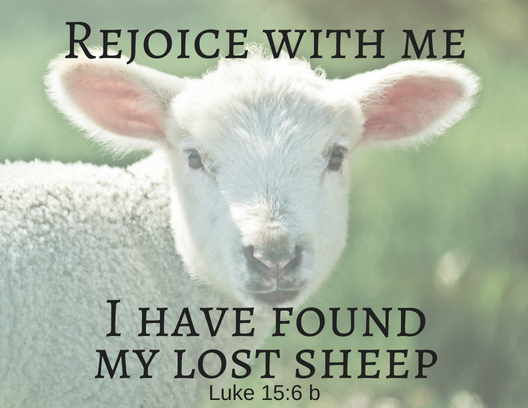
In the same manner, Jesus demonstrates this as the Good Shepherd watching over His flock. “Suppose one of you has a hundred sheep and loses one of them. Doesn’t he leave the ninety-nine in the open country and go after the lost sheep until he finds it? And when he finds it, he joyfully puts it on his shoulders and goes home.” Again, Jesus illustrates the commitment of the Father and His love for all within the body. It says heaven rejoices, but aren’t we too supposed to rejoice in the redemption?  As those who already know Christ, we should not be lining up for apologies, but instead extending the hands of grace.  If we were robbed by the redeemed of our possessions, our time, or our emotions, they have all become forfeit for the sake of redemption.

Despite our own unfaithfulness and wandering, God’s love has found us and refuses to let go.  He has already executed the campaign to offer you an eternal reward far greater than we could ever imagine (and I can imagine quite a bit of pizza).  Therefore it is our job to continue the work of Jesus, tending to His sheep.  We search the fields for the lost one, giving constant and enduring love to those failing to be victorious over temptation. It is simply put, but the practice is daunting. It is having an awkward conversation at the gas station with someone who hasn’t been to church in a few years.  It is  offering a listening ear to someone in distress, possibly never knowing if you have heard the truth.  It is showing kindness and compassion at business close when all you wanted was to get home to relax. Every act of love is a step toward spiritual restoration, not only for others, but ourselves, because we too have hope in life eternal at the expense of the Creator through His Seeking Shepherd.

-Aaron Winner

Reflection Questions

  1. What similarities do you find between the lives of Hosea and Gomer and the parable of the lost sheep?
  2. What lost sheep have you seen restored?
  3. What sheep do you know who are still lost? What acts of love can you be a part of to demonstrate the Father’s love to them?

A Radical Relationship

Old Testament: Hosea 1-2

Poetry: Psalm 76

New Testament: Luke 14:25-35

Since the pandemic, mental health has become an important topic that has not only been destigmatized, but has rapidly appeared in popular culture.  Looking at the vocabulary passed along in social media, I’m sure you’ve seen a quote or two referencing toxic behaviors, triggers, gaslighting, or keeping some type of balance.  The vast majority of those offering this advice are not certified to give it, but many have the ability to identify, and for the most part avoid, unhealthy relationships and behaviors that would emotionally exhaust us. So I, as one not certified to give advice, offer some advice, albeit unpopular and radical wisdom for the day and age we live in: God asks us to form addictive, dependent relationships in abandonment of self.

When the LORD began to speak through Hosea, the LORD said to him, ‘Go, marry a promiscuous woman and have children with her, for like an adulterous wife this land is guilty of unfaithfulness to the LORD’” (Hosea 1:2, NIV)

In a very specific instance, God instructs Hosea to marry Gomer, taking on an unhealthy relationship, knowingly to a woman who would be unfaithful to him. Not only a symbolic representation, but a real life metaphor, Hosea’s heart mimicked that of the Most High who was heartbroken by Israel’s infidelity. Yet in the same way, Hosea’s persistent love and commitment would mirror God’s unwavering love for His people. In spite of our own betrayal, God beckons us to return to Him and be restored.  This is a promise for Israel but truly, for each one of us.

Jesus also speaks directly to the demands of this type of abandonment in relationships.  Conversely, His focus is the reciprocation of God’s reckless love to us.  In the same manner, we prioritize Him above all else, even above family and possessions. In maybe the toughest pill to swallow in the ministry of Jesus, he states in Luke 14:26, “If anyone comes to me and does not hate father and mother, wife and children, brothers and sisters—yes, even their own life—such a person cannot be my disciple.”  Jesus double-downs on this statement, saying that we each must carry our own cross to follow Him. The demands of following Christ are toxic to self and most indeed will destroy us.

But this is the very cost of knowing Christ. If we were not aware of it before, be reminded of it as you read and re-read these words today. There must be a willingness to give up everything that hinders our relationship with God, and not only accept this, but embrace the sacrifices of discipleship.  No doubt there could be a growing dissonance in our minds. If this is the case, it could be that we are trying to preserve the self that remains instead of running to our relationship with the abandonment of Hosea, and ultimately, our Heavenly Father.  True discipleship demands more than superficial commitment. It requires a deep and wide devotion to Jesus, the same dedication He showed to His Father and to us.

Although we have lived in a manner that made us unworthy, God’s love for us is restorative and sufficient for any loss. The Church of God is His bride in the coming kingdom, and it matters not our history before coming to Him. We must no longer accept Jesus, for this implies He is tolerated. We must make a covenant with Him, becoming one. He has fully demonstrated His love for us, so we must embrace the cost of this radical relationship that continues to transform every aspect of our life.

-Aaron Winner

Reflection Questions

  1. “True discipleship demands more than superficial commitment.” Where else can you see this principle taught and illustrated in the Bible?
  2. How deep does your commitment to God go? What do you find gets in the way of diving deeper into commitment?
  3. How would you describe God’s love? What is your response to His love for you? OR – asked another way – What is God asking of you in your relationship to Him and to His Son? And what does He offer in return?

Invitation

Old Testament: 2 Kings 15-17

Poetry: Psalm 75

New Testament: Luke 14:15-24

And so it begins. The words of Amos fell on deaf ears.  Time and again, the northern kingdom of Israel fails to commit to repentance, leaving the high places standing against the Most High God’s repeated warning. Through the course of 2 Kings 15-17, Israel unravels, becoming a nation of idolatry and insolence.  The very things that the previous generations had fought to keep out became the way. The Creator’s voice was ignored.

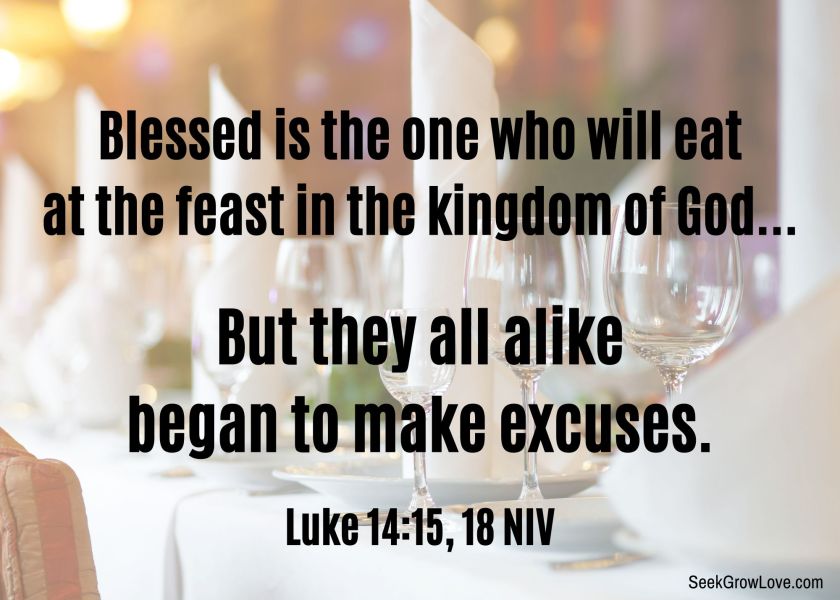
This is the exact picture painted in the “Parable of the Great Banquet.”  In the same manner, a certain man extends an invitation to friends for a great feast.  Every RSVP is returned with an excuse. Work, family, and other obligations trump taking the time to attend. In a move that represents both social and fiscal wisdom, the host extends the invitation to those who will actually show up – no questions and no excuses.  When the party is well under way, those initially invited become indignant when they realize they no longer can attend.

While these words are meant specifically for the audience in front of Jesus with allusion to the historical context of Kings and Amos, we can most definitely apply them to the invitation that has been extended to each one of us.  We are invited into conversations through reading and prayer.  We are invited to be with our church body to commune in worship and fellowship. We are invited to take on baptism, fasting, and other spiritual disciplines.  Life gets understandably busy, and so we ignore the greatest invitation we could receive: to sit down at the table with God – far more incomprehensible. And so, our place within God’s plan awaits our seating.  We tend to our field, try out our purchases, and busy ourselves with another accolade, leaving our food growing cold and the high places standing.

The words are a sobering reminder to prioritize God and His kingdom above everything else.  Our bodies, beings, and calendars should be given to Him first. Accepting His invitation to Sunday morning worship doesn’t make you a follower, but constantly rejecting it does mean you follow someone or something else. Volunteering to give your time to a mission or ministry doesn’t make your efforts an act of service, but never doing this most certainly makes you self-serving.  Likewise, neglecting baptism, Bible study, and evangelism means we have placed our efforts and urgency somewhere else, making an offering of excuses instead of accepting the gracious offer in return for our small sacrifice.

Finally, we should reflect that this invitation is not exclusive to us.  There are no country club, buyer’s membership vibes, or secret handshakes. It is now open to the general public.  The overlooked and marginalized have every right to participate, and frankly, might have a more open social calendar if they just received the word. God invites all to sit at His table.  We are to embody the generosity of our host as conduits of His call.  There will always be excuses, but if we continue to ignore our invitation or fail to invite others, we could find ourselves on the wrong side of the door after the celebration has begun.

-Aaron Winner

Reflection Questions

  1. What excuses have you used when God has invited you to come sit at His table? What do you think God thinks of your excuses?
  2. Aaron wrote, “We are to embody the generosity of our host as conduits of His call.” How can you put God’s generous call into practice in your life? Who is waiting to hear about their invitation? How can you deliver the invitation to them?
  3. What is the difference between being invited to the party and actually attending the party? Where are you? Where will you be? Can you be a church attender who is ignoring God’s invitation? What might that look like?
  4. What is your greatest priority? What should be your greatest priority?

Posts and Planes

Old Testament: Amos 7-9

Poetry: Psalm 74

New Testament: Luke 14:1-14

“This is what he showed me: The Lord was standing by a wall that had been built true to plumb, with a plumb line in his hand. And the LORD asked me, “What do you see, Amos?” “A plumb line,” I replied. Then the Lord said, “Look, I am setting a plumb line among my people Israel; I will spare them no longer.” Amos 7:7-8

 Three summers ago, I took on the task of building 300 or so feet of fence in my backyard to enclose the wandering space of two quickening toddlers.  I am far from a carpenter by trade, so in every way, it took me significantly more time to get the job done; however, I was committed to doing it right, building something that had some staying value. It was my Great Wall.  After doing some YouTube research, I knew even the smallest deviation, a single degree to the left or right on a plane, could have pretty severe consequences.   If you can’t imagine the measurements of fence posts, an example more relevant might be one drawn from James Clear in Atomic Habits.  He asks his reader to imagine an airplane taking off from California destined for New York. Just after takeoff, the heading is adjusted by the smallest degree shift.  This unnoticeable change, if never corrected, will have you arriving in Florida, not New York, roughly 1000 miles away from your destination.

Whether it is posts or planes, we can see that God is using a measure for Israel and us, that is making sure that we are vertically aligned with Him.  Amos alludes to the scattering of Israel and a final judgment at the return of Jesus. Unchecked cultural allowances passed from generation to generation compound their effect and become paradigm shifts.  While Israel was at the height of its economic and political power, seemingly built on a great foundation of previous generations, small allowances and leanings away from God, moves Israel away from God’s chosen, eventually leading to their conquered and scattered status in the 1st century.

Additionally, at the beginning of Luke 14, Jesus reminds us of the measure we should use. The Pharisees took great pride in regularly measuring themselves to a standard.  Unfortunately, the rules they followed were often legalistic, self-imposed, and focused solely on their status with one another. Taking seats of honor, refusing to help on the Sabbath, and blessing only those who can repay you are incorrect measures that can skew the outcome of your vertical alignment more quickly than one or two poles being out of line.  Jesus gave them the measure, “but when you give a banquet, invite the poor, the crippled, the lame, the blind.” Alignment with God means blessing those who cannot return the favor.  Simply put, this is the Father’s love shown through Jesus Christ paying a debt we could never repay.


So how do we combat these leanings that will make our defenses weak? First, we are encouraged to regularly check our progress or face being cut out of the plan of God.  Here’s a quick check-in: the average American takes in 100,000 words a day through conversation and content. Reading a Bible study like this is 2,000 of those, solely if you stick to the plan and stay away from devotional.  Over the course of a year, not reading a daily Bible plan misaligns you by 800,000 words, roughly 8 full days within a year without God’s presence.  This is only a single, simple action, which does meet the requirements of the plumb line alone in isolation. Giving up a hundred words here and there may seem harmless, but they add up, and could place us far from our destination in a matter of months. 

Start today with something small to plumb. Pray for patience over your first cup of coffee.  Offer a line or two of a worship chorus when you hear the rain. Thank God aloud whenever you arrive home safely. If we check in with this single task daily, how much more aligned would our life be to Christ’s in a few months?  We cannot spare any more time without God’s presence beckoning the standard in Christ and shoring up our shortcomings. Daily measure against God’s standard and build your life with eternal value.

Reflection Questions

  1. What steps do you want to take to be well aligned with God? What practices and habits do you need to remove and replace because they are pulling you away from proper alignment?
  2. How does being just a few degrees off over time take you where you do not want to go?
  3. What does God’s standard look like? How can we follow it more closely?

Seeking God & Standing Firm

Old Testament: 2 Samuel 23-24

Poetry: Proverbs 8

New Testament: Ephesians 6:1-9

The world’s most powerful navigational tool, the compass, has been around in some form for over 2000 years.  Originally used in divination, it found its way to navigation a few centuries before the age of exploration. When blinded by snow, when tossed at sea, when wandering through a dense forest, it works without fail for all who seek direction. When unobstructed by friction or gravity, the magnetized metal responds in the same true way to of the Earth’s gravitational field, aligning with poles of the Earth.  This means that a compass is actually influenced by two directions at once, polar opposites. It seems silly to say, but you cannot travel in the direction of north and south at the same time. All of these elements ring true in our faith.

“To fear the Lord is to hate evil; I [Wisdom] hate pride and arrogance, evil behavior and perverse speech. Counsel and sound judgment are mine;  I have insight, I have power.” – Proverbs 8:13-14

It is equally foolish to say that we can move in the direction of God and evil and be on the same course. They are truly polar opposites.  To love God is to hate evil (Psa 97:10).  To honor God is to give up pride (Jam 4:6). To pursue God makes the pursuit of anything else secondary (Matt 6:24).  We can acknowledge the fact that our journey will not be perfect, but the direction we are pointed is true, faithful, and unchanging.  It doesn’t adjust with time or relativism (Isa 40:8).  Be conscious of the friction and the pull that is in the present evil age that will skew your target.  Chart a course from God’s word and prepare yourself because there is more than one force at work.

“Finally, be strong in the Lord and in his mighty power. Put on the full armor of God, so that you can take your stand against the devil’s schemes. For our struggle is not against flesh and blood, but against the rulers, against the authorities, against the powers of this dark world and against the spiritual forces of evil in the heavenly realms.” Ephesians 6:10-12

The military command of “standing firm” is far from passive (Eph 6:13). In 2 Samuel 23, we see a captivating glimpse of David’s mighty warriors. Many of them, like Eleazar (v. 10), are not commended for their brilliant offensives, but holding their ground to the very end to eliminate enemy forces. Likewise, the grace we accept from God is through faith, not deed (Eph 2:8-9), and by seeking and finding Him, we have already arrived at the destination in some sense (Eph 2:19-20). Therefore, we cannot rest our laurels because there are all-out assaults coming. It is not a battle of mortality, flesh and blood, but a battle against rulers, authorities, powers of darkness, and even spiritual forces for the spoils of eternity. We are to armor ourselves with truth, peace, faith, salvation, righteousness, holding close to the Spirit and ready to wage war until the end.


In conclusion, today’s lesson is two-fold.  First, make sure that you are allowing God’s direction to guide you as you move.  Know that when you are moving towards God, you are fleeing from evil influence, relative morality, and sin and towards a loving God and restored perfection (2 Tim 2:22).  Second, once we arrive in grace, our job is to stand our ground.  We are to set a fortress around our hearts (Pro 4:23), as both a guard and a vigil, petitioning for God to intercede and help us withstand the battle.  Like Paul, our prayer should be for fearlessness (Eph 6:20), eyes-locked on the prize , so we can stand firm in the truth of the Coming Kingdom.

-Aaron Winner

Reflection Questions

  1. Towards God or towards evil? What does each path look like? What is at the end of each path? Which direction are you pointed?
  2. What or who has turned you around before, pointing you in the wrong direction? What are you leaving behind you when you move towards God?
  3. What acts as your compass? How valuable is your compass to you? Have you ever been lost without it?

Photoreceptors

Old Testament: 2 Samuel 22

Poetry: Proverbs 7

New Testament: Ephesians 5

A few weeks back my children were very excited to have me read a new book they checked-out from the library.  Not yet mastering the alphabet, their choices are often from the featured book table, typically the flashiest cover; however, the book they chose did not meet my expectation. Their choice: The Worm.  The title wasn’t a metaphor. Not a how-to on dance moves. Not a fictional story of a kid-turned-wrestler.  It was literally a picture book just about worms, and so we began to learn everything I never wanted to know about these three phylums of the animal kingdom.  Did you know that worms can be over 100 feet long? And there are people around the world who eat worms? Or that worms are hermaphrodites? Probably the most relevant fact to today’s devotion is that most worms, including the earthworm, don’t have eyes. This doesn’t stop them from knowing when they are exposed to light. Built into the skin of earthworms are photoreceptors which work as light detectors. These creatures of darkness cannot exist in the light. Being caught above the surface trying to do your same wormy thing equals starvation, dehydration, or becoming prey.

Looking at today’s Proverb, we can see that the speaker is specifically warning his son about infidelity and adultery.  If we use a broader brush with this wisdom, and extend the metaphors and figures of these proverbs as is often done, we can bring our own struggle with sin into the picture.  “Do not let your heart turn to her ways or stray into her paths.  Many are the victims she has brought down; her slain are a mighty throng. Her house is a highway to the grave, leading down to the chambers of death. (Prov. 7:25-27).” Don’t stray into the path of lust, pride, greed,or being obscene (Eph 5:1-3).  A knock on the door soon becomes a visit. A visit becomes a stay.  When you stay long enough, it is where you live (James 1:14-15). Like a worm, deeper and deeper you dig yourself into the ground, making your bed and lying in the grave.

You may not have heeded the warning up to this point, so here is the wake-up call to all of us worms trying to hide from the light, whether it be for a day or decades,“But everything exposed by the light becomes visible—and everything that is illuminated becomes a light.  This is why it is said, “Wake up, sleeper, rise from the dead, and Christ will shine on you (Eph 5:13-14).’” When we are exposed by the light of God, we shrivel up and die.  This can be tremendous or tragic. Waking up today means we die unto ourselves and become a new creation in Christ.  We are covered, cleansed, and made pure through God’s grace given to us through the blood of the Lamb.  If our dry bones do not rattle and we die in our darkness, there is no rebirth. Only an eternal separation, a scorching from the Light, because, “For of this you can be sure: No immoral, impure or greedy person—such a person is an idolater—has any inheritance in the kingdom of Christ and of God.  Let no one deceive you with empty words, for because of such things God’s wrath comes on those who are disobedient. Therefore do not be partners with them (Eph 5:5-7).” 

You may have fallen victim to a snare, directly disobeying the commands of God. Don’t sleep on this. Restore your relationship with the One True God, and in the midst of the distress, ask for help and He will answer, not letting you become a victim to the grave (2 Sam 22:5-7). God has given us a path to repentance and an amazing grace. It is time to put your photoreceptors to work, find the surface, and enter again into His marvelous light.

-Aaron Winner

Reflection Questions

  1. What sins have seduced you? What was enticing about this sin? Have you gone in for a visit, or a stay, or is that where you live now?
  2. What do you know about God’s wrath? What do you know about God’s grace? How does God decide which worm gets the grace and which worm gets the wrath? Which worm are you right now?
  3. How active have your photoreceptors been? Do you recognize the difference between light and dark? Unlike the worm, do you seek the light? How?

Unity

Old Testament: 2 Samuel 20-21

Poetry: Proverbs 6

New Testament: Ephesians 4

After the attacks on September 11, 2001, President George W. Bush spoke to the emergency workers in Ground Zero through a megaphone, finding a response that resonated with the entire country and even more, the world, “I can hear you. The rest of the world hears you. And the people who knocked down these buildings will hear all of it soon.” A historical 92% of the country approved of the job he was doing, bringing together a country that was fraying at the seams in the previous election cycle. It is hard to imagine something similar happening today; no matter who is the president-elect in November, half of the country will be instantly dissatisfied with the results.  These are typical terms we accept in our government, but also this “majority rules” culture has historically found its way into boardrooms and even churches. Let me quickly lower the tension by stating that today’s devotion is not about politics or presidents.  It does not upend or chastise any church form of government. Its sole purpose is to examine the expectation of unity laid out for the church body, as it might be equally unimaginable. 

This spirit of unity was on the mind of Jesus before being arrested in the garden of Gethsemane. He prays for his disciples and all believers when he leaves us the following words, “Holy Father, protect them by the power of your name, the name you gave me, so that they may be one as we are one. (John 17:11b)” Jesus knew his departure to the cross would scatter His apostles, create infighting, and feed doubt. Fortunately, with the exception of Judas, each of them found their way back to a unified front. Having seen Jesus Christ raised to life, they each waited for the Holy Spirit at Pentecost.  They each dedicated their lives to sharing the Good News of the Kingdom of God. They each shared in martyrdom or exile for the sake of Christ.

In the same manner, I have seen churches unite during revival, when facing tragedy, or during persecution from the outside. It is easy for the dross to fall away when the metal is hot, but what about when the metal starts to cool? What does unity look like in maintenance mode? Within the day-to-day routine of uniting relationships, mulling through ministries, and discerning what is best for a body of believers? In Ephesians 4, Paul describes this as “walk[ing] in a manner worthy of the calling, with all humility and gentleness, with patience, bearing with one another in love, eager to maintain the unity of the Spirit in the bond of peace.”

While there could be a devotion on each of the elements of this verse, let’s quickly unpack the key points given to Ephesus. First, walking implies that it is not a quick process, but instead requires some dedication to go the distance (Eph 2:10). Next, humility is the acknowledgement that self-reflection should be the first step in the process, making adjustments and amendments when necessary (Matt 7:3-5; Phil 2:3), and gentleness is the grace that is extended to my brother and sisters during this same process, as imperfect people try to discern the will of God (Col 4:6). Additionally, we are required to commit to patience and love, easily spoken but in reality, conflict makes us more unbearable to one another (Col 3:12-14; Matt 18:15-20). In the body of believers, this is similar to taking the last rep of weight training, it burns the most, but it is the one that produces the result. Finally, eagerness to maintain unity means we stay focused on what unites us (Rom 14:19), defending against the six things the Lord hates (Prov. 6:16-19), and keep our mission far away from doctrinal nuances or extra-biblical preferences.

Unity takes far more work than building a majority.  It isn’t a compromise or consensus because there are no losers. We grow as one together. We move towards one another as we move towards our Heavenly Father. Today, let us be extra mindful in our prayer time to dwell on the topic of unity and ask God to reveal our vision and repair divisions that may exist.  May we live out the prayer of Jesus and the petitions of Paul to become one like our God and His Son, Jesus Christ.

-Aaron Winner

Reflection Questions

  1. Where and when have you experienced or seen the beauty of a united church body?
  2. Dedication, humility, gentleness/grace, patience, love, focused on what unites. How can you exhibit these qualities today? How can you use them to increase the unity of your church? What can happen when just one is missing?

Leading Through Hardship

Old Testament: 2 Samuel 18 & 19

Poetry: Proverbs 5

New Testament: Ephesians 3

As President of the United States, Abraham Lincoln is uniquely positioned in American history as the only leader of a broken country.  No matter who he chose to serve in his cabinet, how empathetic his staff was to his role, how much they helped to shoulder the load or strengthened his areas of weakness,  no one can truly understand the weight borne by the Commander-in-Chief, whose presidency was the bookends to rebellion. A great example of this can be seen in Vicksburg, a Union siege took out the Confederate stronghold on the Mississippi which was a key route for reinforcement and supplies.   While this battle represented a great public triumph for Lincoln’s side, it also held personal tragedy.  Lincoln received the report that his brother-in-law, a Confederate general, was killed in battle.  It was stated by those surrounding him they never saw the president more moved during the war than when he received this news.

Likewise, David’s emotions in victory are complex. Tens of thousands of men look to their king to champion their victory, no doubt hearing stories of how he famously danced in the streets as the Ark made its way into the city.  Instead, they see the lament of a father’s cry.  Great leaders, more than anything else, are human; however, the weight of leadership will undoubtedly tip the scales in favor of fostering commitment, vision, and hope for followers, rather than abandonment trials and tragedy. Joab’s words seem insensitive, “You love those who hate you and hate those who love you. You have made it clear today that the commanders and their men mean nothing to you. I see that you would be pleased if Absalom were alive today and all of us were dead. (2 Sam 19:6) ” but they are actually encouragement to a leader who has made a personal sacrifice to acknowledge that tens of thousands of others had done the same.

The words of Jesus could be thought equally cutting and unfeeling, “Let the dead bury their own dead, but you go and proclaim the kingdom of God. (Luke 9:60).” Our ministries do not stop because we face conflict or personal tragedy.  Conversely, I would say this is when our ministry and testimony are spotlighted. By the standards of the world, this conflict provides permission to act selfishly, but when we bear our burdens with the Kingdom of God at the forefront, we lean on God and lead others to the Good News.  Paul makes mention of this in Ephesians 3.  He tells the church at Ephesus not to worry about his suffering, because it is for their sake and to the glory of God.  The same circumstance is both a victory yet a personal hardship. Paul instead lifts those he leads in prayer, asking for the strength of the Holy Spirit to guide those for whom the letter was intended, and likewise, encourage us today.   No matter what scale Paul used, no matter what was placed in the balance, the weight of the Kingdom of God far outweighed any loss. This sentiment is again echoed from his prison cell to the church at Philippi when he states:

“What is more, I consider everything a loss because of the surpassing worth of knowing Christ Jesus my Lord, for whose sake I have lost all things.  I want to know Christ—yes, to know the power of his resurrection and participation in his sufferings, becoming like him in his death, and so, somehow, attaining to the resurrection from the dead.” –  Phil. 3:8,10

While we may not be ready to ask for suffering like Paul, tragic circumstances are the nature of this world. It may be an unfamiliar posture, but our grief, our battle, and our dire circumstance is an opportunity to demonstrate the assurances we have, to revel in the joy and love of God. We must look for opportunities to pray for and encourage others who may be participating in the same battle, asking God to give them the strength to see the victory too.  Yes, we must bear, and even welcome, hardship for the sake of the Kingdom of God because, with the help of God, we can lead within it, bringing others to the saving knowledge of Christ Jesus.

-Aaron Winner

Reflection Questions

  1. What do you learn about leadership from David? From Paul?
  2. What do you think of the statement: “No matter what scale Paul used, no matter what was placed in the balance, the weight of the Kingdom of God far outweighed any loss.” Do you see this in Paul’s life? Do you see this in your own life?
  3. Who will you pray for strength to see the victory?

Unwavering Integrity

Old Testament: 2 Samuel 16 & 17

Poetry: Proverbs 4

New Testament: Ephesians 2

As someone who recently dipped my toe in the job pool for the first time in roughly a decade, my curiosity led me to search for job traits of the highly-sought after employees.  I wanted to know what to stress in order to make me the most marketable candidate to separate myself from the pack. I have a number of traits which I feel are valued in the workplace.  I am creative, a troubleshooter, I work well with others, I am honest, a great listener, a quick learner, have pretty good credentials, and can feign intelligence.  While many of the attributes showed up on the Family Feud board, they were not the number one answer.  So what is the most highly sought after trait? Dependability. A CEO, an administrator, a middle-manager are all looking for predictable actions from their employees in order to make schedules, projections, or take calculated risk. I really had to reflect on my dependability. What would be my Vegas odds? For showing up on time?  Seeing things through? Using my work time ethically? Giving my best effort on all aspects of my job?  Are stress, weather, or home field advantage influential factors?

It is not just employers looking for our dependability, or more accurately, unwavering integrity.  Proverbs 4 insists that seeking wisdom and counsel in the word of God is a critical aspect. When we are guided by God’s wisdom, no matter the circumstance, we are found along a straight path and we do not stumble. (4:11,12)  On any other path we find ourselves arriving late, giving up when the situation becomes pressed or less advantageous, we may steal time for ourselves, or phoning in the work of God.

In a continuation of the challenge to the throne of the king that occurs in 2 Samuel, David is cursed by Shimei, who is ready to watch David receive his just desserts for the damage done to the house of Saul. David doesn’t defend himself and halts a rushed retribution ready to be delivered by Abashai. A quick note about the irony here, Saul impulsively chucked literal spears at David, a far less-measured approach.  David. however, acts in faith, knowing that the words may be from God, and he might need to heed them, and if not, God will deliver justice and redemption in His time.  David proves again to be a level-headed leader, but furthermore, a dependable agent of God.

Likewise, in the moments we are called out or we are tossed by a rough crosswind, (Mark 4) our true measure of our dependability is on display. Do we really continue walking on a straight path when it seems like each step becomes more rocky, the ground shifts, or we hear the thunder clapping above? It is easy to become reactive, volatile, and abandon our posts. Ephesians 2 speaks of the origin of grace, but far too often we forget to continue to read on to understand why the grace of God is extended: “For we are His workmanship, created in Christ Jesus for good works, which God prepared beforehand, that we should walk in them.”  We should continue to take faithful steps because our works, our way, and our walk have been prepared beforehand by our God.  This is the only integrous act if we have accepted the grace of God and the anointing (chosen by God) knowledge of Jesus Christ (1 John 2:20).

When your name makes a run through the mud, be dependable.  When someone uses their power to persecute you, be dependable. When it seems you are deserving of fairer weather, be dependable. When you are called to move on faith alone, be dependable. Ultimately, God will have an answer waiting in the wisdom’s walk.  Better yet, God has promised to reward those who live with this integrity to the good work they are called to, giving eternity to those who depend on the Lord for their steps today. 

-Aaron Winner

Reflection Questions

  1. If you were applying for a job doing the good works God has prepared for you to do, could you truthfully list “dependable” on your resume? In what instances have you been less than dependable? Have there been times when your integrity wavered? What got in the way?
  2. How can you work towards boosting your unwavering integrity score? What could/should you add in to your life? What could/should you take away? What do you think helped build David’s integrity at this point in his life? Are there any attitude shifts you might want to work on?
  3. What good works do you think God has prepared for you to do? Are you doing them – dependably?