

Subscribe to continue reading
Subscribe to get access to the rest of this post and other subscriber-only content.
Subscribe to get access to the rest of this post and other subscriber-only content.

Devotion by Rachel Cain (Ohio)
What a true idiom. I never cease to be amazed at how large a small minority can seem when given a message and a platform. The media spins the truth to sway unsuspecting observers one way or another, leading us to disregard critical thinking and become emotionally attached to the perceived (and sometimes invented) injustices. We begin to see this small, vocal group as representative of the entire population. This happens on both sides of the political spectrum. Even niche groups can seem large if they’re loud and persistent enough.
In Luke 23 it seems like “everyone” wants Jesus punished! The chapter begins with an emotional interaction between the Sanhedrin (the religious court) and Pilate, the governor of the Roman province of Judaea. The very first verse indicates that “the whole Sanhedrin” brought Jesus before Pilate, hoping for a death sentence. A text note in my Complete Jewish Study Bible for Jews and Christians (p 1513) clarifies that “this literally means, ‘the multitude of them’- namely, the whole of those present… this reflects not the whole of the Jewish people but instead some members of the religious court…”
This small-but-loud crowd succeeded. Even though Jesus had been healing multitudes, teaching with authority, and relating the people to God in no way they had ever experienced before, all it took was a small, mad mob to fuel the emotional fire that would cause the crowd to exclaim, “crucify him!” and end Jesus’ life.
We all know these actions fulfilled God’s plan; this is how it had to happen, but that doesn’t mean we can’t learn a lesson from the chaos. We need to be aware of fallacies in arguments that aim to sway us away from God’s Truth. We must be watchful to notice the sly work of the deceiver who “masquerades as an angel of light” (2 Corinthians 11:14). We should constantly compare the cries of the culture to the ways of God so we will not be conformed to the world, but “test and approve what God’s will is” (Romans 12:2). It would behoove us to remember the words of Jesus, that his life-giving way is straight and narrow, not the broad path that leads to destruction (Matthew 7:13-14).
So, as Christians, let’s be the WD-40 on the “squeaky wheels” that are leading people astray from God. We must help encourage other Christians to stand for what is right, even when it seems like we’re standing alone. Also, we should be a different kind of “squeaky wheel”: unashamedly sharing God’s love to the world around us and shining His light everywhere we go. The world is watching.
How have you been influenced by the world around you – or resisted that influence and stayed true to your faith?
In what ways can you be WD-40? Or be the squeaky wheel for Jesus?
In Jesus’ time, crucifixion was reserved for the worst of criminals. The torture a person endured on a cross would last for hours, and killing Jesus in this manner likely appealed to the religious leaders who hated Him so deeply. In an effort to hide their move against Jesus from His many supporters, the Jewish leaders arrested and tried Jesus in the middle of the night. When Jesus was brought before Pontius Pilate—the only one with authority to order a crucifixion—it was still early in the morning (Matthew 27:1–2). When Pilate presented Jesus and Barabbas to the people, the chief priests whipped the crowd into a frenzy, encouraging them to call for Barabbas’s release (Mark 15:11). When Pilate asked what they wanted done to Jesus, the crowd, again influenced by the chief priests, shouted, “Crucify Him!” Pilate, the people-pleaser, gave them what they demanded. He had Jesus flogged and then turned Him over for crucifixion. After the scourging, the entire battalion of soldiers gathered around this faint and bleeding man, put a scarlet robe on him, pressed the weight of a scarlet robe onto his torn shoulders, set a reed in his right hand, knelt down before him, and mocked him, “Hail, King of the Jews.” They struck him with their hands. They spit on him. They wove a crown out of thorns—probably not the kind of thorns you see on rose bushes, but the longer kind that are more like needles. Then they not only put the crown on his head, but hit him over the head—to drive the thorns into his skull (Mark 15:17-19).
At the beginning of the week, there was a crowd in Jerusalem celebrating Jesus as the Messiah; by Friday, there was a crowd crying, “Crucify Him!” The incredible change of the people naturally causes some confusion. It’s good to remember that not everyone at the Triumphal Entry was celebrating Jesus. Most of the city was puzzled: “When Jesus entered Jerusalem, the whole city was stirred and asked, ‘Who is this?’” (Matthew 21:10), and the Jewish leaders were resentful (verse 15). Some of the same crowd who shouted, “Hosanna!” may also have been part of the crowd shouting “Crucify Him!” but we can’t be sure. If some people did join both crowds, it may be because they had grown disillusioned with Jesus when they discovered he was not going to set up the kingdom immediately—or perhaps they disliked Jesus’ insistence that they repent. Also, it’s quite possible that the crowd gathered before Pilate at that early hour had been assembled secretly to do an unlawful thing by the Jewish leaders.
In the end, it wasn’t the crowd’s cries of “Crucify Him!” that put Jesus on the cross. Our sin did that. From the very beginning, when Adam and Eve disobeyed God, the Lord had promised to send a Savior who would crush the reign of sin and death (Genesis 3:15). Throughout the ages God worked His plan to send a Savior, and that plan culminated in Jesus Christ: God’s own Son who became the perfect offering so he could take upon himself the punishment for sin. Although wicked men were involved in Jesus’ death on the cross, His sacrifice was ultimately the will of God (Isaiah 53:10; John 10:18). The shedding of Jesus’ blood fulfilled God’s promise to mankind to provide a Savior and sealed the New Covenant (Luke 22:20). Jesus would then defeat the power of death and the grave by rising again three days later and ascending to His Father’s right hand in heaven.
Do you feel the heaviness of his death? Do you understand that he died for you so you may have a chance at a new life? My hope and prayer for you this morning is that you have accepted Jesus Christ as your Lord and Savior. That because of his death you live for him. Your sin killed Jesus. But his righteousness saves you. May that truth motivate you and give you peace of mind knowing that God loves you so much that he gave his son to die for you. What will you do with this information?
-Andy Cisneros
Friday, December 17, 2022
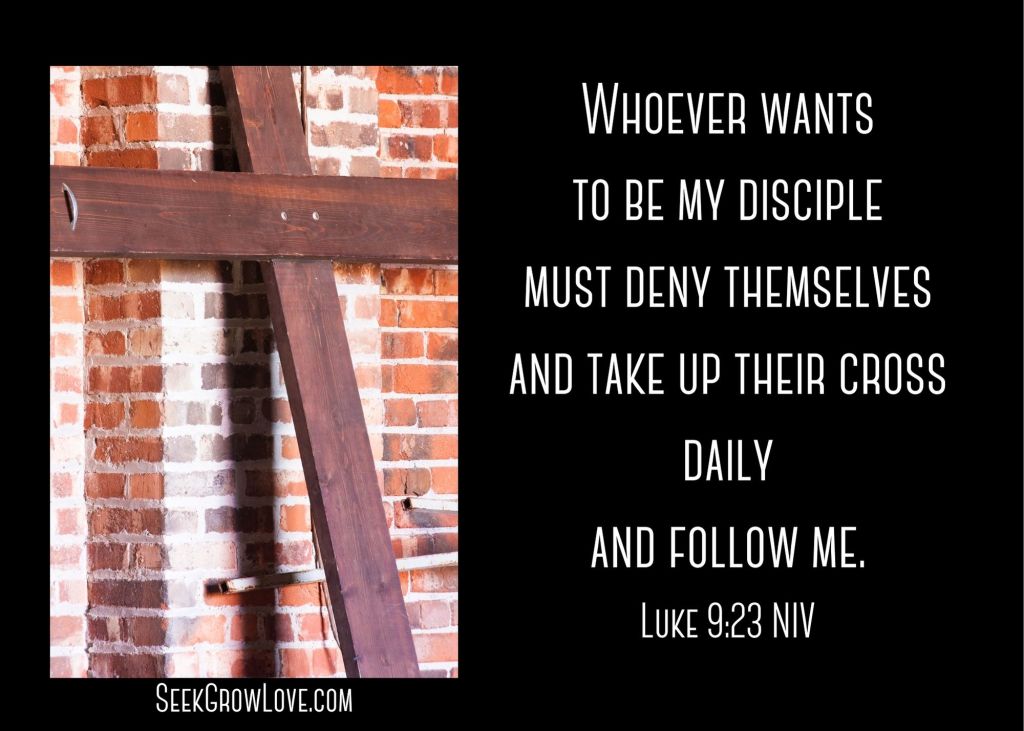
“Then he said to them all: ‘Whoever wants to be my disciple must deny themselves and take up their cross daily and follow me. For whoever wants to save their life will lose it, but whoever loses their life for me will save it. What good is it for someone to gain the whole world, and yet lose or forfeit their very self? Whoever is ashamed of me and my words, the Son of Man will be ashamed of them when he comes in his glory and in the glory of the Father and of the holy angels.” – Luke 9:23-26
What does the cross mean to you? Today, it is often seen around us as a symbol of Christianity, a beacon of hope, and a reminder of God’s love. Sometimes in our culture, it is even used in fashion and design outside the church for its aesthetic appeal. It’s “cool.”
But in ancient times, under the Roman Empire, it was feared. The cross was a means of torture and death. To hear their Lord say, “Take up your cross daily” was a terrifying concept. Early Christians died for the cross; for what it meant. Sometimes they even took up their cross literally. They denied themselves at all costs to take up their cross and be a true disciple.
To take up your cross is the noblest thing you can do. Jesus was a cross-bearer, leading the way for all who wish to follow him. He took up the ultimate cross, and denied himself in the ultimate way, giving up his entire life for a world of undeserving people. Following in his footsteps doesn’t mean giving oneself up for crucifixion, but being willing to deny your own wants and desires and follow God’s calling for your life daily, no matter what that is.
-Isabella Osborn
Chapter 15 of Mark reaches the climax of the story of Jesus, but of course not the end. It’s the pivotal part where the prophecies he had been teaching of his death and sacrifice for our sins will come to fruition. No doubt, you’ve heard this story a thousand times, and for good reason. This event, the sacrifice of the lamb, is the only reason we are allowed to undeservingly reach salvation. What’s more impressive is that this story, just like virtually every other parable and sermon Jesus gave, can be interpreted to apply multiple lessons to our lives.
For instance, when bombarded by accusations and insults from the chief priests, Jesus stood firm in his teaching of remaining non-confrontational. “But Jesus still made no reply, and Pilate was amazed.” Mark 15:5. Jesus is able to remain non-confrontational when all he had to do was respond with a single truthful testimony. He refrained, knowing that all of humanity needed his sacrifice, as God willed it. Could you remain truthful and non-violent when the worst of life is hurled at you? How about when what’s being said is so obviously false, yet they won’t back down?
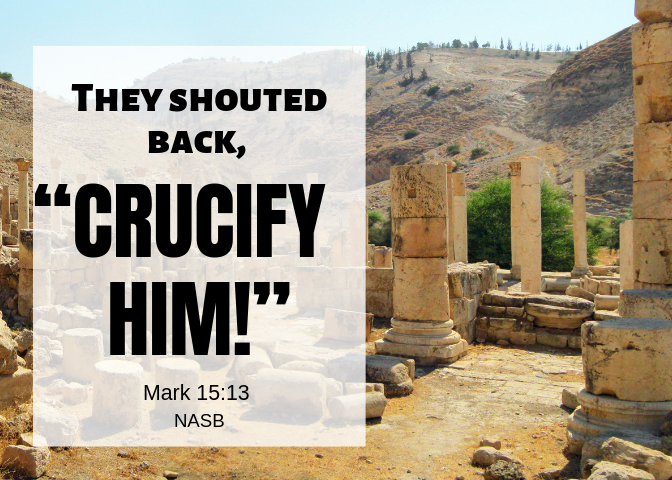
“’What shall I do, then, with the one you call the king of the Jews?’ Pilate asked them. ‘Crucify him!’ they shouted. ‘Why? What crime has he committed?’ asked Pilate. But they shouted all the louder, ‘Crucify him!’” Mark 15:12-14. Here, the people are accusing Jesus only on the basis of rage. There is no reasoning behind their decision, only malice. They refuse to listen to any voice of reason, as they are blinded by their own lust for destruction. Don’t be deceived by the masses and be sure to think critically for yourself. Never take someone else’s words as absolute truth without a grain of salt.
Nowadays, especially with the internet, people are more connected than they have ever been in all of human history. We see news quicker, respond quicker, think less, and react according to what we think other people would want. Whose opinion is the only one that ultimately matters? God’s, of course. Just like the members of the court who accused Jesus in an effort to please themselves, we lose sight of the only thing that matters. What’s worse is that we mock Jesus in our stupor as well; just like the court of those who crucified Jesus.
“They put a purple robe on him, then twisted together a crown of thorns and set it on him. And they began to call out to him, ‘Hail, king of the Jews!’” Mark 15:17-18. They mock him for they do not know who they mock. Do you mock Jesus with your words or actions?
Mark 15:31-32 says, “In the same way the chief priests and the teachers of the law mocked him among themselves. ‘He saved others,’ they said, ‘but he can’t save himself! Let this Christ, this King of Israel, come down now from the cross, that we may see and believe.’ Those crucified with him also heaped insults on him.” They mock the power of Christ because they do not believe what they cannot see. Even other people condemned to die with him are heaving insults at him because they cannot see beyond themselves or their own understanding. And look what it did—it sent our only hope of salvation into the most miserable state a person can physically endure.
“And at the ninth hour Jesus cried out in a loud voice, ‘Eloi, Eloi, lama sabachthani?’—which means ‘My God, my God, why have you forsaken me?’” Mark 15:34. They sent Jesus into this state, and it is by their actions that they will be condemned. Jesus was blameless and had every right to scream from the depths of his soul at the nature of his torture. Do you ever feel that God has forsaken you? Sometimes it seems like He has left us because we don’t see His guiding hand. Be thankful for the things that you have and do not need and be thankful for the things you do not have but do rightfully deserve as a result of your sins.
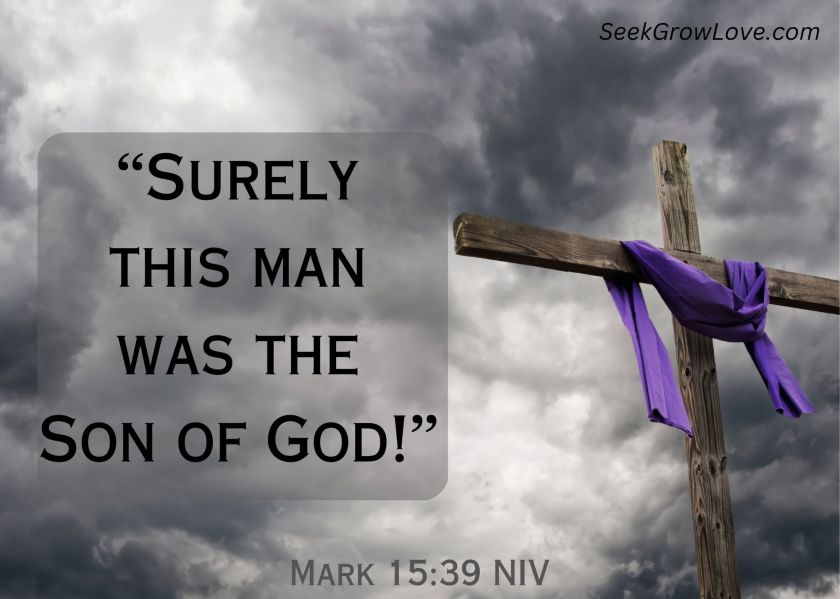
Mark 15:39 says, “And when the centurion, who stood there in front of Jesus, heard his cry and saw how he died, he said, ‘Surely this man was the son of God!’” Only after seeing it can they believe, because although they see, they do not look. Remember not to be led in your thinking by the masses, for they do not know the manner of which the things they speak. Take heart in your suffering, for the true prize still awaits.
-Mason Kiel

Ever have a bad day? Maybe there were relationship troubles. Maybe a conflict or difficult day at work. Maybe all the little things just added up to having a no fun day. I know I’ve had days like that. But, when I read Psalm 22, I realized maybe my days aren’t that bad.
I’ve never been poured out like water with all my bones out of joint. There have never been lions and bulls all around me. ALL the people that saw me didn’t mock me and hurl insults at me. I have never been encircled by a pack of villains that pieced my hands and feet. Now, granted, the lions and dogs and bulls are metaphors for the enemies, but I wouldn’t describe the boy in kindergarten who told me I couldn’t cut well, or the girl who pushed me on the playground, as bulls or lions.
According to the notes in my study Bible, this psalm is the most quoted psalm in the New Testament. And, it fits Jesus’ circumstances, hence Jesus quoting the first part of it while on the cross. He was tortured and tormented for things he didn’t deserve, and I’m sure it hurt more than rude kids on the playground.
This psalm goes on, with David mentioning many hardships, but he doesn’t just ask God to magically fix his circumstances instantly. Instead, the end of the psalm talks about praising the LORD. That’s pretty impressive, and I think it should be a goal of mine, to take hard situations and continue to praise God and tell others about Him.
I’m going to use this psalm as a reminder of the no pain, no hardships time of the Kingdom. And to go about my days, whether difficult or seemingly easy, praising God and knowing that it’ll just get better in the Kingdom, because of what Jesus did for us and the plan God has for us.
-Moriah Railton

Each year, we talk extensively about Jesus’ death on Friday and resurrection on Sunday. The in-between often gets skipped in our remembrance, those long hours of grieving—and for Joseph of Arimathea and Nicodemus—burying Jesus’ body.
Later, Joseph of Arimathea asked Pilate for the body of Jesus. Now Joseph was a disciple of Jesus, but secretly because he feared the Jewish leaders. With Pilate’s permission, he came and took the body away. He was accompanied by Nicodemus, the man who earlier had visited Jesus at night.
Joseph of Arimathea and Nicodemus were both secret disciples. They feared making their public allegiance to the controversial Jesus. Both were members of the Sanhedrin, the highest Jewish council—the same institution that crucified Jesus. They used their status as religious elite to approach Pilate and ask for Jesus’ body to bury properly.
They used to follow Jesus in hushed voices and under the veil of night. Now, they are boldly professing their faith in the same circle they once feared persecution.
Nicodemus brought a mixture of myrrh and aloes, about seventy-five pounds.Taking Jesus’ body, the two of them wrapped it, with the spices, in strips of linen. At the place where Jesus was crucified, there was a garden, and in the garden a new tomb, in which no one had ever been laid. Because it was the Jewish day of Preparation and since the tomb was nearby, they laid Jesus there. (John 19:38-42)
Although Joseph and Nicodemus were an unlikely pair to care for Jesus’ body, they were chosen by God for two apparent reasons.
First, belief in the resurrection hinged on the testimony of those who witnessed Jesus’ lifeless body. Joseph and Nicodemus weren’t one of Jesus’ ragamuffin friends whose testimony would likely be questioned. No, they were respected and trusted as members of the religious elite. In this way, Joseph and Nicodemus were two of the first agents of Christian apologetics.
Second, ordinarily, crucified criminals like Jesus would have been buried anonymously in a field. Joseph, however, brings the body to his own designated tomb. This fulfilled the prophecy that Jesus would be buried with the rich (Isaiah 53:9)
He was assigned a grave with the wicked, and with the rich in his death, though he had done no violence, nor was any deceit in his mouth. (Isaiah 53:9)
Ultimately, God positions people for His purposes. Joseph and Nicodemus were perfectly positioned for this holy task, which begs the question: what has God positioned you to do?
Child of God, you are chosen and well-equipped.
-Mackenzie McClain

Theology is one of my favorite things to study. It’s fascinating because people have read the same 66 books for 2000 years and have created millions of different explanations for how it all fits together. For example, there is a belief in certain Christian groups that has been labelled “Christus Victor” or “Christ is the conqueror”. This view believes that our sin was atoned for by Christ being the ransom for our sin. By being killed and rising again to life – sin, death, and the devil lost all right to those who trust in Christ. This view has some strong language of support (Matthew 20:28, Mark 10:45, 1 Timothy 2:6). And of course, Christ’s victory is made clear in John 16:33.
It’s important to note the situation Jesus is talking about here. He is letting the disciples know that he is going to die. (John 16:16) Moreover, he is letting his disciples know that he is going to the Father. (John 16:28) And for the first time, the disciples get it. They are finally understanding what he is telling them. But he lets them know, “You will all desert me.” But even knowing they will all leave him, he has been telling them all these things, about the Counselor coming, about Jesus being the vine and the branches, about Jesus and the Father and the Spirit abiding in believers, he is telling his disciples this so that they would have peace.
The words of John are in Greek, but he thought like a Jew. In the Hebrew language, “peace” is shalom. Shalom is not an absence of conflict, but a flourishing of life (usually accompanied by an absence of conflict!). Jesus even makes this case himself, “so that in Me you may have peace. You will have suffering in this world.” Right there back to back, we have peace and suffering. Shalom and conflict. Jesus is letting us know that we will have struggles. I may sound like a broken record with yesterday’s reading, but it’s important. When those people hate you for doing what is right and for trying to be like Jesus, then we need to find our shalom in him. We are called to take courage in him.
Why?
Because Jesus has overcome.
And this is before the resurrection.
The Messiah has beaten the system. Jesus in the Gospel of John is different, in some striking ways, from the Jesus of the synoptics in regard to his death. He insinuates that he is willingly going to the slaughter. He tells the people that he will lay down his life (John 10:15) and take it back up (10:18), as that is the missions given to him by his Father. Jesus is not afraid to die, asking God for it to pass, but knows that no one takes his life from him by force (19:11) but that he lays it down (15:13). Jesus knows that he is going to win; he says “if I am lifted up, I will draw all people to me.”(12:32) In this Jesus makes a pun about his own death: “lifted up” in the Greek could mean the metaphorical “lifted in Glory and honor” and also the literal “raised up, i.e., on a cross.” Jesus knows that his crucifixion, far from being the moment of defeat, is the moment of triumph and success. In his crucifixion, he removes sin from his followers as a sacrifice and he buys us, the slaves of Satan, as a ransom to become children of God.
I am not asking you to have the same unadulterated confidence; that would be too much. I am asking you to trust in the one who we already know was victorious. Jesus was asking his disciples to trust in him as he was about to be sentenced to death. How much more should we trust that Jesus will care for us knowing that he has been raised to life.
If you are going through a trial, something that the world is throwing at you, keep this in mind: Jesus has already won. Not could win, not even will win. JESUS HAS ALREADY WON.

Society is filled with people who have no forgiveness. We judge, ridicule and try to come up with the next sarcastic zinger to roast someone. Escalation of situations that could have been resolved in their infancy are full blown Hatfield and McCoy level feuds because people did not possess the unceasing ability of Jesus to forgive. Jesus was able to forgive even in the midst of extreme situations like being on the cross:
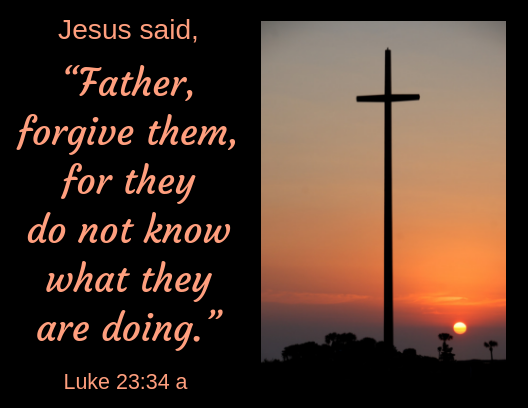
Luke 23:34 NIV Jesus said, “Father, forgive them, for they do not know what they are doing.” And they divided up his clothes by casting lots.
Jesus found the strength to forgive even though he had been mercilessly mocked, beaten and ultimately murdered! Meanwhile we struggle to forgive people for minor infractions like not liking our outfit, or denying the fact that we are the greatest spike ball player on the planet. Seeing how Jesus was able to forgive his persecutors who had done much more to him than anyone else has experienced convicts us as Christians to be able to forgive others who have wronged us regardless of our situations because Jesus was able to forgive in situations worse than us.
-Zack Dylewski
 Seek Grow Love