In Acts 18 Luke mentioned several workers active in the Church with Paul, giving background for some. It may miss our attention at first, but we don’t know if Aquila and Priscilla were already Christian disciples when they were exiled from Rome (v. 2-3). They were not just fellow tentmakers with Paul, he highly praised them, and a church met in their home (Romans 16:3-5). We know that Egyptians and Romans were present for the Pentecost event (Acts 2:10), so we should expect that some from those areas were present at every festival Jesus attended and perhaps learned from him all along. Logically people from those areas were present during the time John the Baptist ministered as well. There could have been people with imperfect understandings of God’s plans scattered across the empire, and outside it, waiting to encounter disciples. Alexandria was the second largest city in the empire (next to Rome) and had a very large Jewish population. No Bible book relates events there, so it basically disappears from our awareness. Apollos, from Alexandria, knew about Jesus, his identity and resurrection, but he missed some details involved with serving Jesus – particularly not having been baptized into Jesus’ death and resurrection. Fortunately, Apollos met Priscilla and Aquila and they were able to take him aside and help him by explaining “the way of God more accurately.” This allowed Apollos to then be of great use to those who believed, through grace (v. 27-28).
It is hard to visualize quite what version of belief Apollos was getting by with before he met Priscilla and Aquila. He still valued his understanding as coming from God, and wanted to share it, as John the Baptist had done. We know he was teaching accurately “the things concerning Jesus,” but what does that leave out? Was he still depending on the Law to carry him along? He understood the idea of repenting, but did he have an idea of how he was supposed to arrive at forgiveness? Perhaps Apollos simply trusted God and moved forward, expecting things to become clear. We can be thankful that he did.
Dear Lord, thank you that as your servant I am not left uncertain about being forgiven. Please help me not to put any of the old weight of sin back on myself, let me accept that the past is in the past. Thank you for the opportunity to serve you, in whatever way it comes. Please help me to grow, not to accept staying as I am, but to seek to be more useful for you and for your people. Prompt me to accept the opportunities that come to me which are within my capacities. Help me to recognize your will. In the name of your son, Jesus, Amen.
-Daniel Smead
Questions:
What do you think it would mean for someone to try to live their life as a Christian aware of Jesus, and having repented, but without the Spirit? Do you think there is a limit on how long that would be able to last, or what a person could face and still attempt it?
Does it surprise you that Apollos was trying to spread the news he had, even though it was incomplete?
What do you see represented in the fact that Priscilla and Aquila “took Apollos aside and explained to him the way of God more accurately”? How do you visualize that event taking place? How long do you think it took, for example? How do you think they introduced themselves?
How often do you think about the fact that on a given day your situation may not be the most important, but someone else you are interacting with may greatly need your attention?
Do you think much about the idea that people today are trying to serve God with what they understand, and they are waiting to encounter someone willing to help them see the truth more clearly? Are you living in a way where you would feel open to speaking for Jesus if you meet one of those people?
(Sorry this wasn’t sent out til now…I thought it was posted this morning but it appears I shut my computer lid too quickly, or some other technical issue…here’s another try…)
From the assortment of proverbs that we find in chapter 11, I want to select one proverb for us to deliberate on in more detail. Let’s consider Proverbs 11:14, “Without wise guidance, people will fall, but with a multitude of advisors, there is deliverance.” Part of the context that must be inferred is who is the one needing “wise guidance” or else they will fall? Presumably this would be a king or governmental official of a city or nation who is in need of counsel in order to make good choices.
The metaphor “fall” can refer to any number of detrimental circumstances such as the decline in the local economy, the failure to enforcement of civil policies, or worse, being conquered and destroyed by an invading enemy army. Most likely the last circumstance probably forms the best background with which to interpret the proverb since the terminology of “deliverance” often refers to being saved from the threat of defeat in battle.
The parallelism structure of the proverb is antithetic where the two lines express opposing ideas. The first line says that if you don’t listen to “wise guidance” then you will experience a “fall,” but if you listen to a “multitude of advisors,” then you will have “deliverance.” The first line offers a negative outcome, while the second a positive one. These outcomes are intended to motivate the reader to understand that in order to not “fall” and in order to have “deliverance” one must listen to counsel and instruction from trusted individuals. To ignore “wise guidance” will result in failure (i.e., defeat), but with the wisdom that comes from many advisors, there will be victory/safety. Thus, the proverb is exhorting the reader to listen to and learn to follow sound advice in order to make better decisions.
We may not be fighting battles where the quality of our military strategies can result in either being conquered or successfully defending a territory, but we are faced with difficult decisions every day about situations that can result in potentially negative outcomes. Think about a time when you made a decision, only to find out later that it wasn’t a very good decision because you realized something that you didn’t know beforehand, and then you thought to yourself, “If I only knew this at that time, I would have decided to….”
We probably have all had that thought—and perhaps some of us (like myself) have it quite often. If we ask for advice from others, oftentimes they can see things in a situation that we are blind to, or their experience from a similar situation can help steer you away from making a foolish decision. Whatever the case may be, we are better suited to make a smart choice if we gather “wise guidance” from others. Remember, “None of us is as smart as all of us!” So, don’t resist listening to the counsel of others, because to think that we know better is to prepare ourselves for a “fall.” And believe me, falling hurts!
-Jerry Wierwille
Reflection Questions
When was a time that you “fell” because you tried to figure it out without hearing the wisdom of others?
Who is currently in your list of people you turn to when you need advice? Do they provide wisdom and guidance?
Things don’t always go as planned. The Israelites thought taking the ark of the covenant with them into battle against the Philistines would cause them to win, except the ark was captured and taken by their enemies! For 7 months the ark remained with them. They said, “The ark of the God of Israel must not remain with us, for His hand is harsh toward us and Dagon our god.” (1 Samuel 5:7) God sent deadly destruction in their cities and plagues of tumors. The Philistines sent the ark back on a cart. It was the wheat harvest when the people of Bet-Shemesh rejoiced to see the ark’s return. EXCEPT, the LORD struck many who looked inside to see what was in the ark of the covenant. And the men of Bet-Shemesh said, “Who is able to stand before this holy LORD God? And to whom shall it go up from us?” (6:20) Thus the Israelites in Bet-Shemesh were ready to depart with it also! God is all powerful and holy and should be treated as such.
Here is a picture of Bill teaching students (20+ yrs. ago;) on Bet-Shemesh with the valley in the background where the ark of the covenant would’ve come up from the Philistines. Also, one can see how there would’ve been wheat fields nearby. (The hometown of Samson is on the hill in the distance). It’s so neat how most of the biblical sites still hold their same name today, 1,000s of years later! It’s evidence to show these are real events that occurred.
Some of these rarer Bible stories are found in the Arch Book children’s series, and they’re even written in rhythm. There are 134 different volumes. I don’t have all of them but many over the years. They can make nice gifts to family or friends. 😊
“Take firm hold of instruction, do not let go; keep her, for she is your life.
Do not enter the path of the wicked, and do not walk in the way of evil.”
(Proverbs 4:13,14)
“My son, give attention to my words: incline your ear to my sayings.
Do not let them depart from your eyes; keep them in the midst of your heart.
For they are life to those who find them, and health to all their flesh.
Keep your heart with all diligence, for out of it flows the springs of life.”
(Proverbs 4:20-23)
-Stephanie Schlegel
Reflection Questions:
Are their areas of our lives we need to reexamine that we’ve slacked off on?
Maybe certain instructions we’ve slowly been letting go of that we need to take ahold of again?
Are their others we need to forgive that we haven’t? On the cross Jesus prayed, “Father, forgive them, for they do not know what they do.” (Luke 23:34)
As was discussed in two previous days’ devotions, Psalm 116 is another of the Hallel (literally, “Praise”) Psalms that are particularly associated with joyous events for Jews. They are prominent in the liturgies of the primary seasonal festivals such as Passover, and Psalm 116 is additionally part of the “Egyptian Hallel” subset of Hallel psalms. Psalm 116 does not make specific reference to Egypt, Passover, or the Exodus of Israel, but it is very straightforward to adapt its structure into a prayer of praise for the salvation of the nation of Israel. By connecting the psalm to that event, it is easily transformed into a pedagogical device that teaches the listener to acknowledge God for His grace toward Israel.
The Psalm is most naturally structured into three parts, but let us draw out the first two verses as an introductory dialogue (ellipsis of psalm text in bold):
I love the LORD. Why? Because He hears my voice, my supplications. Because He has inclined His ear to me. How should I respond? …. I shall call upon Him as long as I live.
The psalmist has provided a simple justification for the reader, all of us, to reverence and petition God: Because He hears me; the implication is that God answers those petitions. And because He hears me I should not fail to call on Him again and again.
Beginning in verse three, the psalmist builds upon the introductory dialogue to stretch and flesh out what could be the reason for calling on God and a more specific supplication: Cords of death wrap around me; the terror of the grave has come upon me; I found distress and sorrow. It is easy to see how this text was associated with Passover and the exodus: these words could be those of enslaved Israel, looking for deliverance from Egypt. Now look at verse four: Then I called upon the name of the LORD… “Save my life!” Taken in association with the enslavement in Egypt, these are the collective words of Israel, longing for deliverance, longing for God to “Hear my voice and incline His ear to me” (v 1). Verse four ends the first part of the psalm.
The second part of the psalm does not begin with a description of the salvation desired by the writer (later usage: the nation of Israel), but instead utilizes another introductory statement: Gracious is the LORD .. our God is compassionate … the LORD has dealt bountifully with you. (vv 5-7). Only in verses 8-11 is the desired salvation described. The psalmist acknowledges God for who He is before getting to specifics about what He has done. Cast as part of the Hallel, we have Israel 1) acknowledging God as LORD and 2) thanking God for salvation from Egypt. To see a record of a similar acknowledgment, take a look at Exodus 15, a poem or song of adoration sung by Moses and the Israelites after passing through the sea.
Finally, beginning in verse 12, the psalmist builds out eight verses to answer the question What shall I render to the Lord? It is the question that must be asked after reflecting and acknowledging what He has done. And the answer, given in the text, is a catalog of options for worship and reverence toward God.
When the psalm is sectioned as outlined here, one can see how it was adapted for the celebration of Passover. It provides context (terrible circumstances, like Egypt) and a call for salvation, it identifies the LORD God as the agent of deliverance, and then provides options for adoration of God. Imagine sitting around a table, each member of a family saying or offering (perhaps competitively?) an option for active reverence: “I shall lift up the cup of salvation” (the mealtime allusion is especially apt in relation to Passover), “I shall pay my vows to the LORD” and “I’ll pay my vows in the presence of all His people.” The point is that the reverence, acknowledgment, and worship derive directly from the active role that God takes (took!) in deliverance from the circumstances of verse three.
Psalm 116 is a wonderful outline of one context for the why and what of thankfulness toward God: I may be in terrible circumstances, but the God that is gracious and compassionate can and will rescue me. In response, I bow to Him in reverence and worship, declaring my thankfulness to Him in the presence of others.
-Dan Siderius
Postscript
The Psalms, as poetry, always carry some underlying structure, though perhaps lost in the translation from Hebrew to English. One of the features of many psalms that I appreciate is doublet structure, in the form of question-and-answer. For example, Psalm 116:1:
Question: I love the LORD
Answer: Because He hears my voice
These doublets can be used to impart rhythm to the reading of certain psalms. One way to take advantage of the inherent rhythm is to speak the psalms antiphonally, where one person reads the first part of the doublet and a second person reads the response. Another option is to incorporate movement, by walking through the first half of the doublet, pausing, and then resuming with the second half. It can greatly liven the Psalms! If you are interested in reading the Psalms whose translation purposefully retained rhythmic and melodic elements, I encourage you to use the Coverdale Psalter (e.g., Psalm 116: https://psalter.liturgical-calendar.com/en-emodeng/Coverdale/116) or its newer revision, the New Coverdale Psalter (available for viewing online: https://bcp2019.anglicanchurch.net/index.php/downloads-pdf/).
Reflection Questions
How would you finish the sentence/poem/song which begins, “I love the LORD because…”? Think on it, write it down, share it with the LORD. Who else could benefit from hearing your testimony of why you love the LORD?
What are some options for how you can respond to the LORD? Write them down as well. Some responses, perhaps some we do most often, are not very good responses – if your list includes any poor responses you can cross them out now. Put a star next to a response you will work on today.
God had given Jesus the ability to perform miracles and the capability to be the “one Teacher” (Matt.23:8) who revealed important messages from Him. In his teachings, we learn the Great Commandment of loving God with all that we are, among other truths of loving our neighbor as ourselves, going into the world to preach the gospel, and so much more. And he didn’t just want us to be aware of these commands, he wanted us to put them into practice. His teachings were to be the foundation on which we build our lives.
The miracles and teaching were attracting a crowd. In Luke 7, we see that people were seeking out Jesus. Each person was very different from the other, but they shared a common need that Jesus could fill. A centurion is seeking healing for his servant, a widow needs resurrection power for her son, a prophet needs reassurance that Jesus is the one, and a sinful woman needs to be assured that her sins are forgiven. But even beyond the glaring needs presented to Jesus, we can see how those in Christ’s presence are being changed. Just think about all the lives that are influenced and thus transformed because of interactions with those who have interacted with Jesus.
I imagine that the elders of the Jews were praising God when their plea for healing was granted along with the centurion’s friends and the crowd that followed Jesus. The crowd along with a large funeral procession are awestruck and praised God for resurrecting the widow’s son. What a scene that was! Going from mourning to praise. And of course, I imagine the disciples of John would never forget the message they were given. “Go back and report to John what you have seen and heard: The blind receive sight, the lame walk, those who have leprosy are cleansed, the deaf hear, the dead are raised, and the good news is proclaimed to the poor. Blessed is anyone who does not stumble on account of me.” We can only guess at the large amount of people that were strengthened in the faith because of the imprisonment and execution of John. This event still impacts followers today. Encouraging us to show others our love for Christ even in the middle of some of life’s dismal circumstances.
And last, we look at Simon the Pharisee. I would imagine that he was forever changed by having dinner with Jesus and by the interruption of the sinful woman. He learned that those who are aware of their great need for forgiveness have a great appreciation for the forgiveness they have received. Being truly forgiven, makes us want to express our thankfulness and love.
When these people entered into his presence, their minds, hearts, and lives are ultimately changed to reflect him more fully. When we enter into the presence of Jesus, we can expect that our lives will be changed, too. Sometimes our desires may be fulfilled, but even more than that, we will have our hearts changed to desire what God has for us.
Enter into his presence today and experience the change that comes from spending time with Jesus. May this change create a ripple effect that will transform your family, friends, coworkers, and community.
-Rebecca Dauksas and Cayce Fletcher
Reflection Questions
Has your life been changed by Jesus? If so, how? If not, why?
Of the people Jesus interacted with in Luke 7, which one are you most like? What do you share in common? What do you think this person would have told their friends, family, coworkers, community about Jesus following the events of Luke 7? What do you have to tell about Jesus?
What does God reveal about Himself and about His Son in our Bible reading today?
It was the spirit that led Jesus into the wilderness to be tested. It was the devil who tempted him. God does test us, like a father tests his children, allowing us to make a choice between his will and our own, but he does not tempt us to do evil, nor can he be tempted, as everything already belongs to him and therefore wouldn’t be tempting.
God does not tempt with sin, but he does test his children so that they can learn obedience, to overcome sin and become people of character, for their own good, for their survival and for other good things he desires for us. We’ll pass the test every time if we choose his will over our own, just like his son Jesus did.
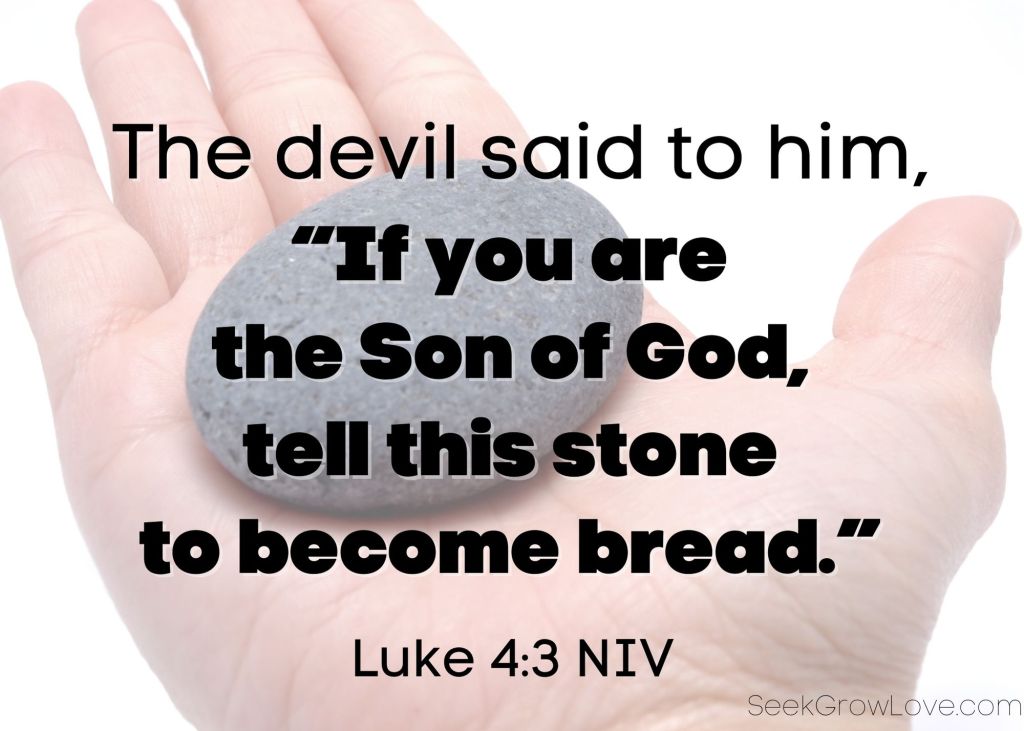
The devil’s temptations to cause Jesus to sin were cunning. With the first temptation, (Luke 4:3 “If You are the Son of God, tell this stone to become bread.”) the devil raises doubt about Jesus’s identity. He then targets Jesus’s need, his hunger, as a result of his fasting. When you are so hungry and deprived of your need to eat, it can be the most powerful time in your life because you have no choice but to cry out to God for help.
This was a very crafty temptation for Jesus, because both he and the devil knew who he was. He was the Son of God. God had already granted him authority and power, which he continued to grow in, which he could have used to meet his hunger need by performing a miracle for himself at his will. But he didn’t. Instead, his response was God’s will (Luke 4:4: And Jesus answered him, “It is written, ‘Man shall not live on bread alone.’”).
The temptation was taken right out of God’s playbook, when he tested his firstborn son, the children of Israel in the wilderness. What is new is knowing the devil’s part in this temptation towards Jesus. Jesus goes straight to God’s will in the matter, referencing Deuteronomy 8:1-10 with his response. The testing was meant to test obedience and build the character trait of humility, as is clear from that passage.
Keep in mind though that it looks like God’s testing came after his firstborn son already tried to put him to the test by blaming him for their hardships and lack of needs in the wilderness. God is Israel’s father. He is going to take care of his children, but they needed to learn to obey and trust him. Our good God sent them bread from heaven despite their evil response because he loved them. It didn’t always fare so well in God’s response to their constant rebellion, but you can see throughout scripture that God was patient and long-suffering with his people.
The second temptation was tempting because the devil was offering the world as Jesus’s kingdom right then and there, if only he’d worship him. Satan is called the god of this world, which meant that he had the power to give Jesus the kingdom. Jesus knew through scripture that through serving God, he was going to gain the whole world and more, but he had to die first. It would have been very tempting for him to set up his kingdom straight away, without having to die first. But his response was to serve God by carrying out his will for him in his plan of salvation (Luke 4:8 8 Jesus answered him, “It is written, ‘You shall worship the Lord your God and serve Him only.”).
Jesus’s response came from Deuteronomy 6, where God gave the children of Israel the first and great commandment, which is to listen; Yahweh is God, Yahweh alone. Love Yahweh God with all your heart, soul, and might. They were told to do this so that they would remember him, fearing him only, and worshipping him, and swearing by his name (Deut. 6:13). They were to remember what Yahweh did, bringing them out of slavery and into the promised land to serve him. He told them these things for their good always and for their survival (Deut. 6:24).
Jesus trusted his father. He knew that God was faithful to do what he said he’d do, and he loved his father. He also knew from scripture that he had to die to be able to bring us with him. He chose us. He chose God’s will.
With the third temptation, the devil tries to provoke Jesus to prove that he is the Christ on his terms. He quotes from Psalm 91, telling Jesus that God will protect him if he performs the miracle that he wants him to do to show everyone that he is indeed who God said he was.
This is tempting because proving that he is the Son of God, the Messiah, could remove a lot of suffering from his life. Picture Jesus performing the miracle from the temple pinnacle in Jerusalem, in front of all the religious leaders. If they saw him doing this act, in front of everyone, from that location, they all would have known for certain that Jesus was the Christ. They probably would have set him up as their king, rather than trying to continuously kill him. Because Jesus chooses not to reveal his identity to anyone, except on God’s terms, it appears that like David, Jesus was always “on the run” from his enemies, because they doubted that he was the Messiah. Falsely claiming to be so was an offense worthy of death to the Jews.
But Jesus wasn’t really just “on the run” from his enemies. He was choosing to do God’s will at every step in his ministry. For the most part, he was on the move because his father told him to preach the kingdom of God to the various cities he was sent to.
The life Jesus chose was hard. He told us often that he spoke his father’s words, not his own. His father’s words were met with resistance and hate from most, except from those to whom it was given to know the things of God. Jesus’s response was the harder, but better route. He chose God’s will. He said, 12”…It is said, ‘You shall not put the Lord your God to the test.’”
This quote comes from Deut. 6:16. It references the bread incident from the first temptation. Again, we’re told what this was all about in Deut. 8:1-10. God does things his way for our own good, for our salvation, and to give us good things. But we have to trust him by doing it his way, even if his ways are harder than what we think ours will be.
If Jesus would have performed the miracle that the devil tempted him with, he would have been no better than God’s firstborn son, who put him to the test in the wilderness. They remembered their former slavery to Egypt, thinking it was far superior to their journey in the wilderness on the way to God’s promised land. The wilderness was hard. Many of them died there, never getting to see the promised land.
Similarly, if Jesus had proved to all that he was the Messiah by choosing his own will over God’s, the seemingly better route to go, he too would have put God to the test. Instead, he never blames God for his circumstances. He endures, looking at his hope, and thinking about all those he will save by choosing God’s will.
The devil left him, but only until another opportune time. Many of the things he said to Jesus make their comeback through the lips of religious leaders, as we’ll see through their interactions with Jesus in the rest of Luke’s narrative.
There were people who admired Jesus, but still doubted his identity. There were people, particularly those in his hometown, who asked Jesus to heal and perform miracles. When they don’t receive what they want from Jesus, which looks like a request for proof because of their doubt that he was the Messiah, they are denied, and they hate him for it. They attempt to push him off a cliff! Jesus doesn’t budge in following his God’s will, despite the consequences from men.
It is interesting that after the devil’s temptations, that Jesus quotes from scripture in Isaiah 61. We’ll eventually read in the rest of Luke’s narrative that Jesus lives out these proclamations from Luke 4:18-19.
Mixed in the quote is a quote from Isaiah 35 (recovery of sight to the blind). Jesus will indeed perform this miracle too. He’s even going to do it in Jerusalem, proving that he is the Son of God for many to take note of, but it will be on God’s time, and it is to the people God chooses for Jesus to reveal himself to as the Son of God, for God’s own purposes. When you read about this, and the other “Messiah” miracles, be careful to investigate the details so that you will know the exact truth about the things you are learning.
-Juliet Taylor – It’s been a joy to write again for SeekGrowLove.com and I’ve grown tremendously from doing it, so thank you Marcia! Hello Seekers! I am a Biblical Unitarian (BU) living in Tennessee with my husband, Wes Taylor, and our two boys, John and James. God has given me a BU church (Higher Ground), the best BU friend (Amy Swanson) to go through this race to the Kingdom with, an online church to fellowship with (Allegiance to the King), and a profession (Behavior Analyst/Sleep Consultant) that allows me time to study God’s word. God is good!
Questions
God cannot be tempted, because there’s no way to get him to desire anything that he doesn’t already have or will have at his will, as he’s the creator of all. But he can be tested (although we shouldn’t, knowing the consequences). In what ways do people test God in our time?
Similarly, God does not tempt us to sin, but he does test us like a father tests his child for her own good. In what ways do you think God has tested you?
What other “Messiah” miracle does Jesus perform in Jerusalem (hint: it’s mentioned in Isaiah 35).
As I carefully investigate Luke’s narrative, I take note of the encounter between Zacharias, the father of John the Baptist, and the angel of the Lord, including where the angel stands, and what he says.
I take note of Zacharias’s position and heritage, being a Levitical priest under the Division of Abijah, meaning that it is his duty to serve in the temple in Jerusalem in the 8th division, which was at the conclusion of the Feast of Passover.
I take note that Zacharias and Elizabeth are living in the hill country, perhaps the same hill country described in our reading in Joshua wherein Jabin prepared the way for Joshua’s coming as conqueror, in the same land that became Judah’s inheritance, where Mary, the mother of our Messiah Jesus, dwells (with them) for the first 3 months of her pregnancy with her baby Jesus.
I take note of the life of John the Baptist, sent by God to prepare the way for the Messiah Jesus, relating it to Moses, preparing the way in the wilderness for Joshua to take over and lead his people into the promised land.
After all that detail, likely there to teach us that Jesus is indeed the Christ, born under the law, in the way that God prophesied, with all the Old Testament parallels, I take note of where I think Luke wants our focus, after all the knowledge is obtained.
It is the character of the two women of God that causes me to pause.
God chose to prepare the way for the Lord Messiah through two birth miracles, because two women of God chose to be faithful and humble in the presence of Yahweh God through his agent angel Gabriel.
The details are so important, but it is the character of the women of God, Elizabeth, the mother of John the Baptist, and Mary, the mother of our Lord Messiah, that we should rest our focus on after knowledge is obtained.
There is a stark contrast between the character displayed by the priest, who should have been first to bear the image of God in his response to the word of God, and the women of God in God’s presence.
Zacharias the priest is slow to be faithful, despite the significant circumstance he found himself in (despite a miracle). The angel Gabriel reminds Zacharias that he is one who stands in the presence of the Lord God, reiterating to him that his position deserves reverence and faith because of who he works for and of whose words he’s reiterating to him.
But to the woman, the angel of Yahweh, Gabriel, found the response that God desires from his people. From Elizabeth, we see faith and thankfulness. From Mary, we see faith and humility. We then see what follows women favored by God. When the two meet, Elizabeth is filled with the holy spirit after her baby, filled with the holy spirit, leaps in her womb! She prophesies regarding Mary’s response to the word of God:
Luke 1:45
“Blessed is she who believed that there would be a fulfillment of what had been spoken to her by the Lord.”
Mary’s response to this is praise to God her Savior, magnifying her Lord God through song and prophesy. Her response sounds familiar, much like some of the psalms of David, her likely ancestor.
What follows the people of character, the character of the people that God has always wanted, is exalting the Lord God, the receiving of the holy spirit (and all that comes with that), and joy!
But I take note still. There were consequences for the servant priest’s character flaw. Because of his unbelief to the angel’s words, which were God’s words, he was made unable to speak until the day when the things spoken by God’s agent angel were fulfilled.
This gave opportunity for Elizabeth to continue her faithful stance as servant to the words God spoke. It may be difficult for us to imagine how hard it would have been for her to oppose those in the temple, who chose to disrespect Elizabeth by clinging to tradition in naming the child over her words, which were God’s words. She stood firm in her faith. The people diverted their attention and respect to Zacharias, her priest husband instead.
Thankfully, the consequence from the angel led Zacharias to repentance and faithfulness. When he told the people that the child would be called John (Yahweh gives grace), the name given to him by God through his agent angel, his consequence ceased and his tongue was loosened. His response after repentance was praise to God. He too received the gift of the holy spirit and prophesied, speaking words of salvation.
But fear overtook all those in the hill country of Judea who heard of these things, perhaps due to unbelief. I imagine the fear being like the fear that overtook the people living in the hill country centuries prior, when King Jabin proclaimed the fearful news that Joshua was coming to conquer.
The details are so important, but if they don’t lead people to change, to conform to people bearing the image of God, which becomes conforming to the image of his Christ, all knowledge gained is null and void.
Let our character be the character that God has always desired, like the women, and be faithful and humble servants of the word, to believe in all the words the Lord God has spoken, which are eventually spoken through his Messiah Jesus.
-Juliet Taylor
Questions
What are other important details that Luke gives us in chapter 1?
In Luke 1:7, an Old Testament scripture is applied to John the Baptist. What did John do to “7…turn the hearts of the fathers back to the children, and the disobedient to the attitude of the righteous, so as to make ready a people prepared for the Lord.”?
My favorite part of Mary’s response, after Elizabeth prophesies to her is, “My soul exalts the Lord” (Luke 1:46). What characteristics of the Lord did Mary find worthy of exalting? What’s your favorite part of Mary’s response?
Before I knew the significance of what God did through his people of old, that everything done points to his Messiah, Jesus the Christ, Joshua was my favorite Old Testament “character.”
It was Joshua who was met by the captain of the Yahweh’s army. It was Joshua who led the children of Israel into the promised land. It was Joshua who fought the battle of Jericho, blowing trumpets and shouting as the walls came tumbling down. It was Joshua the Lord helped using hailstones to defeat his enemies, and it was Joshua, a man, whom God listened to, to make time stand still.
And yet, Joshua cannot compare to our Lord Jesus and what God has done and will do through him.
We mustn’t be foolish. We must know and understand what the prophets said about Jesus to fully understand how significant he is to us. Praise be to God through him that we can gain that wisdom through the help of the holy spirit that was poured out by him because he earned that right. Now everything made new is through him.
Jesus himself taught these things about himself after his resurrection to the men on the road to Emmaus. Beginning with Moses, he explained to them the things concerning himself in all the scriptures.
I’m going to begin explaining some things I’ve learned about him and God’s plan of salvation, beginning in Joshua.
As Joshua, the son of Nun, conquers the land promised by God, he is met with a people who are not the children of Israel, but fear Yahweh and believe that he will do for Israel what he has said, by destroying all the inhabitants of the land to give it to God’s chosen people.
These people were the Gibeonites. They deceived the leaders of the children of Israel into making a covenant with them to save their lives. The terms of the covenant granted them life as slaves in exchange for not being destroyed.
It was a mistake to not seek the counsel of Yahweh prior to entering this covenant, but we see that God continues to work with his people through their failures. They continue to break the terms of their own covenant with God time and time again, but God is forgiving and merciful, just like he is with us after we entered the New Covenant with him through his son Jesus.
Watch the parallels of this story with end time prophesy. It’s quite remarkable.
The people of Gibeon, now servants to the children of Israel, called on the name of their leader Joshua (same name as Jesus) to be saved when they came under attack by the current King of Jerusalem, Adoni-Zedek (meaning Lord of justice or Lord of righteousness; yet he was not really THE lord of justice -that is reserved for the true Lord of Righteousness, our Messiah Jesus) and the other 5 Kings of the Amorites.
God saves Joshua’s servants (Gibeonites) through Joshua (Jesus). . In a similar manner, he will save the gentiles, us, who were not God’s people, but are His after we become the servants of his Son Jesus. He confuses the enemy as Joshua pursues them and He sends hailstones to give Joshua (Jesus) the victory.
To the five Kings who went up against him, he kept them in caves covered by a large stone, sealing them in until the time is right for his people to put their enemies under their foot (literally).
On the day Joshua (Jesus) defeats the Amorites, he, a man, asks God to make time stand still, and God listens. There was never a day like it before or since the time of the writing of Joshua, a day when the LORD (Yahweh) listened to a human being. Surely the LORD (Yahweh) was fighting for Israel!
One greater than Joshua, and all those God answered in the past, is now seated at the right hand of God! Because of this, we can come to the throne room of God in his son Jesus’s name and have confidence that he will hear us, humans, too.
We are privy to know and understand the gospel as recorded in our bibles in the New Testament, which is something Jesus’s own disciples, who walked with him on earth, didn’t have.
Let us do our part in understanding the scriptures (the Old Testament) and the words of our Lord Jesus (the gospel; the Much of the New Testament) through the spirit, to hear the words he spoke, that all things which are written about him in the Law of Moses and the Prophets, and the Psalms must be fulfilled (Luke 24:44).
Let us pray to the God of Jesus that we would not be foolish and slow of heart to believe in all that the prophets have spoken, rather, let our hearts burn within us. “Thus it is written, that the Christ would suffer and rise again from the dead the third day, and that repentance for forgiveness of sins would be proclaimed in His name to all the nations, beginning from Jerusalem (Luke 24:46-47).
Praise be to God that the servants of his son Jesus (Gentiles) can be forgiven because God listens to a man (our Jesus), and accepts us through him.
We were a people who were not God’s people, but were grafted in through God’s son, a man whom he chose to save us through, as the mediator of a better covenant, with better promises.
I cannot wait for God to listen to the man Jesus of Nazareth again, our better Joshua, our Messiah, to make time stand still for us in the Kingdom of God.
-Juliet Taylor
Questions:
What parallels do you see between Joshua in chapters 9 and 10 and Jesus regarding end time prophesy?
Why is it important to know all that is spoken about Jesus Messiah in scripture?
How do you feel knowing that God listens to you, a human, when you come to him in his Son’s name?
Life is hard. There are terrible things that all people, even Christians, experience simply because we live in a fallen and sinful world. Some of the hard things people experience are because of their own poor choices, others are because of someone else’s poor choices, and still others are simply things that cannot be controlled. Financial stress comes to those who are unwise with their money, car accidents happen when people are paying attention to their phone instead of the road, sickness such as cancer can occur in the healthiest and best people. Life is hard.
This Psalm (88) is written by Heman the Ezrahite, and unlike most other laments in Psalms, it doesn’t end on a positive, hopeful, note. Instead, it concludes with darkness. This psalmist equates his life’s troubles to nearing Sheol (v.3). He feels weak, overwhelmed, desperate, rejected, and lonely. Heman writes that his eyes are worn out from crying out all day long (v.9).
If you’re like me, you may be wondering why in the world this Psalm is included in Scripture… it offers no hope and seemingly no connection to an amazing God. Why would this be allowed in the Bible?? Doesn’t it turn others off our faith to have someone just writing about how hard life is, even after worshiping God? How does this chapter bring me anything for my faith walk if it’s just about sadness?
Well, despite being credited as one of the saddest psalms, after some prayerful consideration I also see how important this psalm can be. Throughout the psalm Heman writes about coming to God, crying out to Him, raising his hands to the Lord, and continually praying (vv.1, 9, 13). It seems that even with his world crashing down around him and when he feels like he is drowning, his first reaction is to reach out to God. What an example of faithful living!
The life of a Christian is never stated to be easy. In fact, there are times in everyone’s life that I would expect them to be in a similar place as Heman was when writing this psalm. Overwhelmed, exhausted, alone, in the dark. If God ‘allowed’ this psalm to be part of his God-breathed Scriptures, then we have to believe it holds value for our lives. There must be value in the pain and hardship that Heman describes, and the pain we still go through in the modern day. The lesson we can take away from Heman’s writing is that in all the pain, we can always come to God. Whether it’s through prayer or simply crying out, God is there to hear us no matter where we are in our life.
Questions:
Heman wrote this psalm long before Christ came around. While he had hope of a coming Savior, our hope resides in a Savior who came, and is coming again. How does this change our laments or prayers to God?
Balancing hopeful positivity and the real difficulty of life is truly an art. How does what we know about God impact this balance in your life?
What did God reveal to you about his character in this passage?
Prayer:
Lord, we live in a broken, sinful world. This life is hard. Today we pray for you to comfort those who are struggling, to give strength and hope to those who need it. But we also pray that no matter what life circumstances they are in, they ultimately know that they can go to you in any form. God, thank you for the hope we have in Christ Jesus. We are excited for your Kingdom to be brought to earth where there will be no more suffering. We longingly look to that day. Amen.
People have been messing up by accident (or on purpose) for our entire existence… in Deuteronomy, we see a few different ways that God helped set up processes for when people are people and mess up.
In Deuteronomy 19 God has already established laws to follow, but He knows people will still mess up unintentionally, and so He takes the time to establish ways of showing justice and grace in those random, accidental sins. Killing people will always equal sin, yet God creates a safe haven to run to for those who commit this sin unintentionally (v. 4). Put yourself in that world and think of the magnitude of this gracious retreat to a neighboring city instead of facing death… in a culture where the governing law is “life for life” (v.21), having the opportunity to flee to a nearby city shows just how loving our God truly is. No murder (or sin) is exempt, but God makes a way out of the death penalty that someone should be subject to… sound familiar?
In Deuteronomy 20 we get a GREAT “refrigerator” verse: “…for the LORD your God is the one who goes with you, to fight for you against your enemies, to save you. (v.4)”. God knew the Israelites weren’t strong enough to defeat their enemies on their own, He knew He had to go with them and fight FOR them. God uses the priests to weed out those who are not confident in His power, because He knows that a smaller, faithful army is stronger than a larger, cowardly one. And He knows that there are plenty of cowards and uncommitted people in His people! God knew that His people were easily influenced, which is why He tells them to utterly destroy their enemies, so that there is zero chance His people can be pulled away from Him in that way (v.17-18). God also knew that His people would get rid of good things when they shouldn’t, which is why He clearly states to leave the trees that can feed His people (v.19). He covered everything the Israelites needed, just because He is a Good God, who loves His people. Again… sound familiar?
-Sarah Blanchard Johnson
Questions:
Where do you feel in your life God has covered you like He covered the Israelites?
These chapters give us several examples of God revealing His character. How many words can you come up with using just these passages that describe God? I came up with 6…
Prayer:
Lord, we praise you because you are a Good God. Thank you for the way you have always covered your people even when we mess up. God, thank you for the gift of your son and the safe haven he is for our sins. I pray that today we all feel your grace covering us, and that we show everyone around us that same grace – ultimately, being a light for you and for your glory. Amen.








 Seek Grow Love