Egyptian Hallel

Old Testament: Judges 15 & 16

*Poetry: Psalm 114

New Testament: Luke 14

In yesterday’s devotion, we learned that Psalms 113-118 comprise the “Hallel,” or praise. These verses are recited or sung together at Jewish observances such as Passover. These specific verses are called the “Egyptian Hallel” to identify them from two other passages in Psalms also referred to as “Hallel.” Today, our reading brings us to Psalm 114, which focuses on praising God’s rescue of the nation of Israel from Egypt and contributing to the moniker “Egyptian Hallel.”

Instead of focusing on a detailed account of the exodus from Egypt, Psalm 114 uses beautiful language to focus the reader on the majesty of God displayed throughout that time period. It centers on the miracles that God uses to fulfill His promises to His people. In the eight short couplets, we get a sense that all things, including nature, are under God’s control.

Israel was never meant to make Egypt their home. In fact, in the first two verses, we read, “When Israel went forth from Egypt, the house of Jacob from a people of strange language.” It is a recognition that they did not belong there and were being delivered from their oppressors.

Throughout the remaining verses, we read about miracles performed during the exodus from Egypt and while Israel wandered for forty years. While in the desert, God performed miracles, such as bringing forth water from rock, to provide for His people. The verses also refer to “the mountains skipped like rams,” which happened when the Lord descended to Mount Sinai (Exodus 19). The psalmist shows how even the earth obeys God’s word and reacts to His mighty power.

By stating, “The sea looked and fled, Jordan turned back,” the psalmist encapsulates the beginning and end of Israel’s journey. He refers to the parting of the Red Sea (Exodus 14) and the crossing of the Jordan under Joshua’s command (Joshua 3). He shows the completion of the work that began in Egypt. It’s affirmation that God sees all things through to completeness and within His time.

Though these verses are used in the Passover feast to remember the exodus and thank God for His miracles, I feel that they are also a promise to us. Like the nation of Israel living in Egypt, we too are a people living among “people of a strange language.” As sin grows within our world today, it becomes increasingly challenging to adhere to our faith and follow God’s word. But like Israel laboring within Egypt, we must labor within this world, holding fast to the promise that God has something much better in store for us. John 17:14-16 says, “I have given them thy word; and the world has hated them because they are not of the world, even as I am not of the world. I do not pray that thou shouldst take them out of the world, but that thou shouldst keep them from the evil one. They are not of the world, even as I am not of the world.” This is not our home. We must keep our eyes focused forwards on the Kingdom of God.

Isn’t it beautiful to think about the coming Kingdom? As a child, I always wondered when it would be established. In my lifetime? After my death? We will never know the exact time, but that’s not what is important. What is important is that God will fulfill His promises, just like He brought His promises to Israel to completion.

Just like within the exodus, even nature will obey God’s commands. Psalm 114 states, “Tremble, O earth, at the presence of the Lord.” In Revelation, we read about several earthquakes that will occur in the end times (during the opening of the seals and the bowls of God’s wrath), as well as other natural events that will reveal God’s power to the inhabitants of the earth.

To me, it is interesting how Psalm 114 mirrors our own wait for the promise of the Kingdom and the events that will lead to its establishment. As we go throughout this week, let’s reflect on what we are doing to prepare. Are we being faithful like the Israelites in Egypt? Are we prepared spiritually to endure a wait? Are we thankful for the promises that will be fulfilled?

~Jen Siderius

Reflection Questions

  1. Spend some time considering the questions at the end of today’s devotion.
  2. Consider your view of God – are there any areas where your view does not completely match the God we see in our Bible reading? Any areas where your view is too small, too powerless?

What does following Jesus look like?

Old Testament: Judges 5 & 6

Poetry: Psalm 109

* New Testament: Luke 9

In Luke 9, Jesus sends out the twelve disciples. He gave them power and authority to drive out all demons and to cure diseases, and they were to proclaim the kingdom of God and to heal the sick. They went from village to village, proclaiming the good news and healing people everywhere. That sounds amazing, but later Jesus explains that there is a lot more to being his disciple. There is sacrifice. We must be willing to offer up our own lives-our desires, our agenda- in the service for God. Jesus told them all that whoever wants to be his disciple must deny themselves and take up their cross daily and follow him. Notice that we do it daily. Our sacrifice is about gaining life, a better life, an eternal life. As Paul would write, “I urge you, brothers and sisters, in view of God’s mercy, to offer your bodies as a living sacrifice, holy and pleasing to God—this is your true and proper worship.” (Romans 12:1)  Jesus told them that “whoever wants to save their life will lose it, but whoever loses their life for me will save it. What good is it for someone to gain the whole world, and yet lose or forfeit their very self?” (Luke 9:24 & 25)

Jesus assures us that what we are giving up and what the world offers us is nothing compared to what he has in store for us. Even though we must go through many hardships to enter the kingdom of God (Acts 14:22), Christ wants us to fully rely on him every day. May he give us the strength and encouragement to always Follow Him.

-Rebecca Dauksas

Reflection Questions

  1. How can you proclaim the Kingdom of God and help heal the sick?
  2. What have you given up in order to follow Jesus? What are you still hanging on to too tightly? What might taking up your cross daily look like today? And tomorrow? And Saturday? Etc…
  3. What do we learn about who Jesus is in Luke 9? What did Peter not say? Why is what he did say important?

Good News Today

Old Testament: Judges 3 & 4

Poetry: Psalm 108

New Testament: Luke 8

I was having a phone conversation with someone who had been serving in their local church. The topic of the Kingdom of God came up and she asked me what is the Kingdom of God?  She said she really didn’t know about that.

I was thrilled to answer her question with scriptures about the Kingdom and I sent her lessons and lists of verses. Of course, I had to be selective because there is so much about the Kingdom in the scriptures.

In Luke 8, we discover that Jesus is traveling from “one town and village to another, proclaiming the good news of the Kingdom of God”. It was good news in the time of Jesus and it is good news today. The Kingdom message offers hope and eternal perspective.  Jesus and his followers lived in the real world, too. They faced difficulties as we can see from this brief description of the women who followed him and also financially supported Jesus’ ministry. The women “had been cured of evil spirits and diseases”. They had experienced first-hand the blessings of being spiritually and physically healed by Jesus. Now they could also support the Lord Jesus as he shared the good news of the Kingdom of God with others.

Jesus used multiple parables or short stories to illustrate the importance and astounding value of the Kingdom (see Matthew 13 for more).  The parable of the Sower is presented to show that a person should receive the word of God and produce good fruit. We are so blessed that Jesus also shares the explanation of the parable in the following verses. As Jesus told his disciples the knowledge of the secrets of the kingdom of God have been given to you.  We see that the word of God is offered freely, but some allow it to be snatched away and others fall away when the going gets tough. Some let life’s worries, riches and pleasures take over and there is simply no room for it in their lives. Now of course our hope is to be those with noble and good hearts, that hear the word, retain it, and by persevering produce a crop. From season to season, I have been amazed by some plants that produce like crazy. When you have a harvest of “get me another basket”, the garden work is worth it.  So keep planting and watering and sowing those good news seeds so God can produce His kingdom fruit through you.

-Rebecca Dauksas

Reflection Questions

  1. What do you know about the Kingdom of God? What does Jesus want people (then and now) to know about God’s Kingdom? Why do you think it was what he spoke about? Is it what your church talks about?
  2. Look again at Luke 8 at the types of soil the seed – word of God – landed on. Can you think of an example of each – what causes the seed/plant to NOT grow healthily? What is needed for it to be healthy and growing/producing? How healthy is the word of God in your life? What is interfering with its health?

Your Part in God’s Plan of Salvation

Old Testament Reading: Joshua 7 & 8

Psalms Reading: Psalm 98

New Testament Reading on Jesus: John 20

Remember what Jesus accomplished today and all that that entails. Remember his faithfulness to finish the work God gave him on earth.

Now remember what God did. Remember that it was God’s plan of salvation to save us through his son. His right hand and his holy arm have gained the victory for Him!

God has made known to us our salvation!

The Seas and all that is in them know it and resound! The rivers know it and clap! The mountains know it and sing together for joy at his marvelous works!

Do we know it?

Do we realize that God’s plan of salvation is fulfilled through Jesus? Do we fully grasp what that means?

It means that if we are his, we are kingdom bound, and no one can snatch us out of his hand.

Salvation has been made known by God, and he’s done it through covenants. God offers the opportunity for his people to be saved by remaining faithful to the covenants he makes with them. The last, final, “goal” covenant God has made, and will make with his people, is the New Covenant through Jesus.

Before Jesus’s covenant, bringing the hope of entering into the Kingdom of God, God worked through other covenants with his people to give them good things.

It is no surprise to me that God chose Joshua (Jesus), whose name means, “Yahweh is salvation,” to bring his children into the land promised. Although it was Moses who was the mediator of the covenant that God made with them, the plan of salvation for Israel was fulfilled through Joshua.

Just prior to delivering Jericho over to them, God made another covenant with his people through Joshua. This covenant involved being faithful to refrain from taking the devoted things from the city, so that God’s people would not covet. If they violated this command, God said they would have trouble.

One man did violate this covenant, and through this one man’s sin, all the children of Israel were held liable for destruction (hmmm, sounds familiar).

God was faithful to do what he said he’d do regarding the breaking of this covenant. He turned away from his people because of the sin of one man amongst the many, and trouble ensued. But another man, Joshua, led the people to repent (hmmm, this also sounds familiar). God accepted this repentance through Joshua’s leadership, but with requirements to destroy the sin and the violator of the covenant.

After sin was removed from the people, God told his people to consecrate themselves. If they were devoted to him, he would be devoted to them (covenant language). The plan of salvation was restored for a time.

Eventually, the covenant through Moses, and most of the additional regulations that came to be through others came to an end because the people continued to violate God’s covenants over and over again. Every time God offered to make a covenant with his disobedient and obstinate people, it was an act of his mercy and grace because they rarely remained faithful to it, and he knew that. All of God’s covenants were grace covenants out of his love for his people and his desire for all to be saved.

But because of man’s constant violation of his free gift, their unfaithfulness to the covenant, or their unfaithfulness to fulfill their part of the plan, God made a New Covenant, with all mankind, with better promises, that would be fulfilled through his son, Jesus. That is what we are celebrating today.

But remember. God’s plan of salvation through the blood of Jesus is the last covenant he will offer to mankind.

To partake in the plan of salvation, we must freely choose to enter the covenant through Jesus and remain faithful to our part in the plan, as Jesus was faithful to his.

Our part in the plan is to imitate our Lord and Savior, Jesus Messiah, by keeping ourselves free from sin, and repenting when we do sin, so that we can live out a life of self-sacrifice of our will, to whatever extent is needed to save others, just as our leader Jesus did, which is God’s will.

If we do that, we will be one (in the plan of salvation) with Jesus and God. To be one with God and Jesus means that you know your role in the plan of salvation, and you remain faithful to it. Be devoted to him through his son. He will be devoted to you.

I’ve come to realize that most people don’t know the plan of salvation that God has revealed, at least not in its entirety.

There was a time when Jesus’s own disciples did not fully grasp what the plan of salvation was. In John 20:9-10, we’re told that his disciples did not even understand from scripture that Jesus had to rise from the dead, even though he had been telling them all along!

Jesus revealed this part of the plan plainly by first showing himself in his resurrected state to Mary Magdalene. He then told her more about the plan and told her to go and tell his brethren.

She was faithful to believe and do whatever her Lord required of her. Remember her character.

Jesus then revealed his resurrected self to his disciples. When those who saw him finally understood this part of the plan, they rejoiced!!!

Jesus instructed and empowered his disciples through the gift of the holy spirit to fulfill their part in the plan of salvation, which includes forgiveness of sins.

God’s plan of salvation begins in Genesis and ends in Revelation. It is fulfilled through our Messiah Jesus.

The people who know the plan of salvation live it out and preach it, so that all may be saved. They join in the purpose and plan of God through his son to save humanity, by choosing God’s will over their own.

Remember Jesus today, and that God’s plan of salvation is through him.

Let’s shout!!! Hallelujah to our God, and Hosanna to our King!

-Juliet Taylor

Question 1:  Do you know your role in the plan of salvation?

Question 2:  What other parallels between Joshua and Jesus do you see, especially related to the covenants God made with them?

Question 3:  Look into the phrase, “One with God.” Do you think it means what I think it means (one in understanding and fulfillment of the plan of salvation)?

Tough Times Ahead

Luke 21

Wednesday, December 28, 2022

            Most people are a bit apprehensive about living in the end times.  In Luke 21, Jesus described many things that are going to happen, and quite frankly, most of them don’t give us the warm fuzzies.  There will be a lot of death and suffering, but Jesus gives us some good advice on how to approach those days.

            I don’t want to freak you out but there will be wars, disturbances, earthquakes, plagues, famines, terrors, great signs from heaven, persecution of Christians, family and friend betrayals, some will be put to death, you will be hated by all, roaring of the sea, men fainting from fear, and the powers of heaven will be shaken.  It is safe to say that these will be scary times for Christians, and for non-Christians as well.  Therefore, you might think the word to describe the end times is “hopeless”, but quite the opposite is true according to Jesus.

            In verse 9, he tells us not to be terrified.  He tells us in verse 28 to straighten up and lift up our heads when these things begin to take place because our redemption is drawing near.  He continues in verse 31 saying that when we see these things happening, we will know the kingdom of God is near.  These are actually going to be pretty exciting times for Christians because we know the start of the kingdom is right around the corner.

            Jesus also gives us some advice on how to handle the end times.  In verse 34, he tells us to be on guard so our hearts will not be weighted down with the worries of life, and to be on guard so it does not surprise us like a trap.  He instructs us to stay alert in verse 36, and to keep praying that you will have the strength to escape all these things.

            However, the most surprising and interesting part of this chapter to me was verses 13 to 15.  “It will lead to an opportunity for your testimony.  So make up your minds not to prepare beforehand to defend yourselves; for I will give you utterance and wisdom which none of your opponents will be able to resist or refute.”  I surely wasn’t expecting that guidance.  We’re not supposed to be preparing beforehand to defend ourselves because we could potentially have a chance to give our testimony to those who we would be defending ourselves from.  We could help someone be saved at this last hour by talking to them, with the words and wisdom given to us by Jesus, rather than fighting against them.

            If you are alive during the end times, it will be difficult to watch what will be happening all around you.  Nevertheless, you need to remember that we already know who wins in the end, and it is not the bad guys.  Some that are weak will lose faith, but those who understand what is happening will be glad that the kingdom is near.

-Rick McClain

Time to ponder:

Do you worry about what is going on in the world today?  If so, do you not believe that God is in control and those who put their trust in Him will live happily ever after?  Ask God for a big dose of peace that only comes from Him during these difficult times.

How can you prepare today for the end times?  How should we not prepare (verse 13)?

Why is it important to study what is going to happen in the future?  What could happen to you during the end times if you are not aware of what is happening?

Your Banquet Invite

Luke 14

Wednesday, December 21, 2022

As life grows busier by the day, holidays grow nearer, preparations for travel are made, deadlines for school are due, or you find yourself putting in those time and a half hours at work, it is so easy to become all consumed in your own day to day life. The same was true in the parable told by Jesus in Luke 14, The Parable of The Great Banquet. As Jesus gathered around the table with the Pharisees and experts in the law, he spoke to them on humbling themselves and serving in the here and now, even when they are giving all and receiving none. He says that their payment will be paid at the resurrection of the righteous. At the mention of the resurrection, one man calls out, blessed is the one who will eat at the feast at the Kingdom of God. Jesus replies with a parable, explaining that a great feast has been prepared for many guests. When word spread that the feast had come, and that it was time to join, many of the guests were found to be caught up in their own world and did not attend with urgency. Excuses were made and the banquet was pushed off. “I just bought a field that I must go and see.” “I bought five yokes of oxen, I must go try them out.” “I just got married, I can’t come.” As a result, each of these guests lost their place in the banquet as they were not ready, not prepared, and were not willing to attend at the call of the host. 

This parable serves as a wake up call to many as it is important to work hard each day and do your best with what has been bestowed upon you, however this life is temporary and our focus should always be on what is yet to come. In the meantime, we need to make sure that we are pursuing our faith, building a relationship with our heavenly father, and implementing spiritual disciplines daily so that when the banquet, otherwise known as the Kingdom of God draws nearer, our hearts will be prepared and our focus will be set on the right priorities. 

As we enter into a busy holiday season, may we be present in the why. Why we celebrate, why we serve, why intentionality matters. Let’s not be a people who become so caught up in each day that we do not humble ourselves before the Lord and serve His great name, no matter the cost. 

Luke 14:11 

“For all those who exalt themselves will be humbled, and those who humble themselves will be exalted.” 

– Kayla Elwell

Reflection Questions

  1. What does it mean to you that the invitation to the banquet in the Kingdom of God has been extended to everyone in the roads and country side? Who had been included in the original invitation – did it include you?
  2. What excuses have you used when you were neglecting the most important things of God?

It All Adds Up

2 Peter 1

Wednesday, October 12, 2022

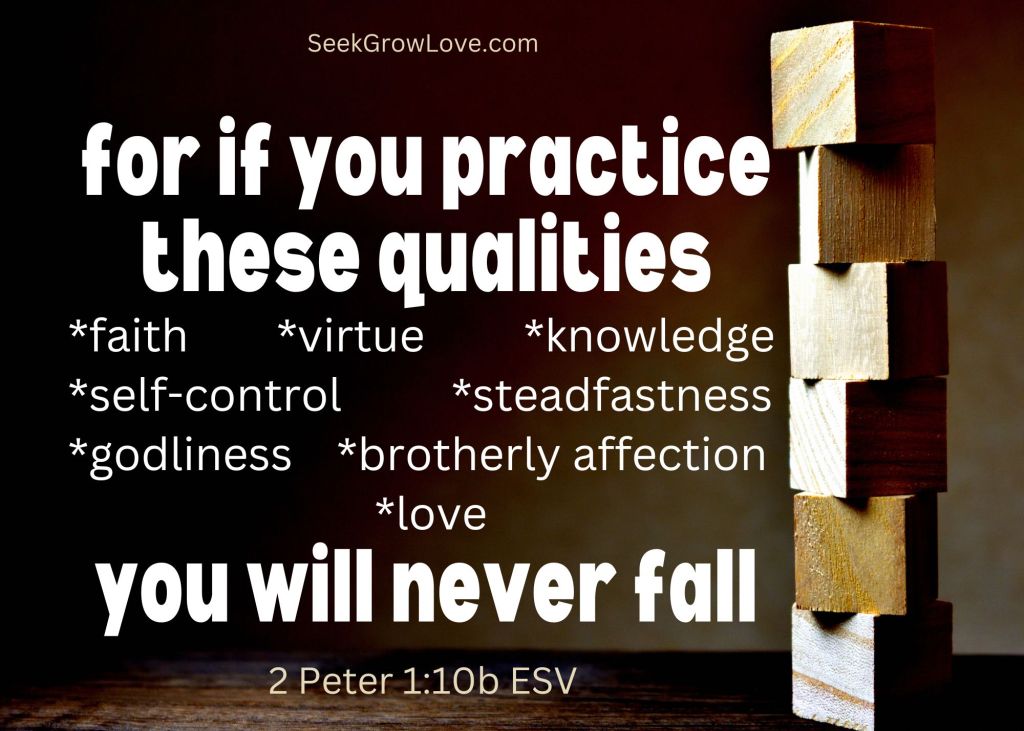
“His divine power has granted to us all things that pertain to life and godliness, through the knowledge of him who called us to his own glory and excellence, by which he has granted to us his precious and very great promises, so that through them you may become partakers of the divine nature, having escaped from the corruption that is in the world because of sinful desire. For this very reason, make every effort to supplement your faith with virtue, and virtue with knowledge, and knowledge with self-control, and self-control with steadfastness, and steadfastness with godliness, and godliness with brotherly affection, and brotherly affection with love. For if these qualities are yours and are increasing, they keep you from being ineffective or unfruitful in the knowledge of our Lord Jesus Christ. For whoever lacks these qualities is so nearsighted that he is blind, having forgotten that he was cleansed from his former sins. Therefore, brothers, be all the more diligent to confirm your calling and election, for if you practice these qualities, you will never fall. For in this way there will be richly provided for you an entrance into the eternal kingdom of our Lord and Savior Jesus Christ.” (2 Peter 1:3–11 ESV)

We have great and precious promises that have been made that will enable us to become partakers of the divine nature! As Jesus put on a new nature in his resurrection from the dead, so shall we when through faith, we endure through life’s many challenges and inherit the promise of the coming Kingdom of God.

Hebrews 11:1 says that “…faith is the assurance of things hoped for, the conviction of things not seen.” As we have faith that God will restore all things (Acts 3:21), upon our faith we must add virtue: meaning good quality of life or uprightness – not simply believing but living out our lives as something that reflects the nature of God’s goodness, justness, and righteousness. After believing and living a changed life, we are to add knowledge to that; we should always be striving to learn from God’s inspired word and learn from his spirit as it is active in us… And more than that, seek after his spirit that we might become more in line with his will and come to a greater understanding of its importance and how beneficial it is to us to walk in his ways.

Following the call to add knowledge, we encounter again the call to be self-controlled! It really does seem that much of what we read in scripture hinges on self-control and that circles back to our need to not stifle the spirit in our lives. If one of the elements that the fruit of the spirit brings forth in our lives is self-control, then we ought to do whatever it takes to drive away any behaviors that might cause God’s spirit to depart from us (Judges 16, 1 Samuel 16). Self-control allows us to endure – to stay on the course – as Paul might say, “to run the race”. We have to endure through all of the challenges and temptations that life throws at us, and we must allow the motivation of our hope, our uprightness, and the self-control that we are enabled to have through God’s spirit carry us through.

As we endure, we ought to have a reverential feeling or devotion to God, that’s what the Greek work translated godliness indicates. As we experience God’s goodness and see how His spirit works in us, we should feel more and more awe and reverence to our creator… After all, He put the plan into place that leads us into a life that transcends the brokenness that sin imparts on our lives – even though we sin and are affected by sin, God’s directives lead us onto a path that (through Jesus) casts that sin aside and draws us into community with him.

And as all these things are ingrained into our life, the part that affects others the most is the cherry on top… We are to have brotherly affection (love) as a defining characteristic in our lives! Love and care for one another as believers will lead us to speak into one another’s lives and help us when we hit rough patches. Even the most spiritually minded people hit dark periods in their lives (google the dark night of the soul). If we love our brothers and sisters in Christ, we will take the time to come alongside them, to care for them, to call them out, to admonish and encourage – brotherly affection means being intimately involved in the lives of our faith family – not being apathetic or half-hearted. We need to invest in each other as Christ has invested in us through his sacrifice (sometimes we must be self-sacrificial).

These qualities keep us from being ineffective witnesses and fruitless workers. We must be bearing the fruit of the word implanted in us (James 1) and strive to be effective ministers to the lives of those who are hurting and struggling. Peter says that whoever lacks these qualities is so nearsighted that he is blind! Yikes… lacking these qualities as I read this means that we cannot see beyond ourselves, and that it a tremendous problem when one of our chief goals is to preach the gospel to all creation.

If we take these qualities to head and practice them diligently it says we confirm our election (or being chosen out) into beneficiaries of the grace of God. Also, it says if we practice these things we will never fall. So, practice these things so that you may have entrance into the eternal kingdom of our Lord and Savior Jesus Christ (v11).

-J.J. Fletcher

Reflection:

1. Think about how Jesus exemplified all these characteristics listed in verses 5-7. If he had not exemplified all these things, would he have had the wherewithal to endure through his father’s plan of salvation through him? How can we expect to live exemplary lives if we do not take these characteristics to heart.

2. Think about the first 6 items listed (faith, virtue, knowledge, self-control, steadfastness, and godliness) and the final one: brotherly affection/love. What do the first 6 produce without the 7th? We’re designed (as individuals and as a church body) to be in community, how might we be rendered fruitless and ineffective if we excel at the 6, but lack the 7th?

An Even Better Story Coming

1 Thessalonians 4

Wednesday, August 31, 2022

I have always enjoyed reading the Chronicles of Narnia.  As I read them, I love to compare the story to what is written in the Bible.  Of all the books in the series, my favorite is The Last Battle.  I love seeing the old characters, the Pensieves, returning to the series.  1st Thessalonians 4 is describing the time when people come back into the story, just like the Pensieves coming back into the Chronicles of Narnia.


Verse 17 says, “Then we who are alive and remain will be caught up together with them in the clouds to meet the Lord in the air, and so we shall always be with the Lord.”  Can you imagine being able to see the dead in Christ?  There will be the reunions to loved ones and the meeting of the heroes of faith.  In The Last Battle, those who were still alive at the very end are excited to meet Lord Diggory and Lady Polly because they were in Narnia in the very beginning.  But, even more, they loved meeting their old relatives and friends.


While seeing the dead in Christ will be great, there is an even better promise in verse 17: “We shall always be with the Lord.”  We get to spend eternity with the Lord!  That is a great promise that we can look forward to the fulfillment of.  We know that when the kingdom comes, it will be a life beyond comparison.  A life that none of us will ever be able to even start to imagine.  


The Last Battle ends with these few sentences: “[T]he things that happened after that were so great and beautiful that I cannot write them.  And for us this is the end of all the stories, and we can most truly say that they all lived happily ever after.  But for them it was only the beginning of the real story.  All their life in this world and all their adventures in Narnia had only been the cover and the title page: now at last they were beginning Chapter One of the Great Story which no one on earth has read: which goes on forever: in which every chapter is better than the one before.”


The lives of Peter, Edmund, and Lucy as they were written in the earlier books, with the amazing adventures in the land of Narnia, was nothing to compare with their life in the new Narnia.  They were beginning an even better book which no one on earth will ever read, where life just gets better and better.  We have this to look forward to where we also will have such amazing lives in the kingdom that they will be nothing to compare to this life.  There is an even better story coming that we can’t even begin to fathom!

-Kaitlyn Hamilton

Questions to Discuss and Reflect Upon

  1. What order of events does Paul relate to the Thessalonians in chapter 4 so that they will not be, “uninformed about those who sleep in death” (verse 13) ? Is this the same or different as what you hear at most Christian funerals? Could it be there are many today uninformed about those who sleep in death?
  2. What are you most looking forward to at the time of Jesus’ return? Remembering this, how will it change your day today?
  3. After telling the Thessalonians what they have to look forward to, Paul said to, “Encourage one another with these words” (vs 18). How can you do that today?

Not as Unwise but as Wise

Ephesians 5

Thursday, August 18, 2022

A few years ago the term YOLO became popular and used as a reason to partake in some very reckless behavior. If you’re not familiar with the acronym, it is an abbreviation for You Only Live Once. It drives me bananas when I observe others taking unnecessary risks because of this attitude.

I admit that I tend to be cautious. I’m not a huge risk-taker. I prefer to know possible outcomes before making a decision. I have the mindset that it’s because I only live once (this side of God’s Kingdom) that I want to be prudicious with my choices. 

As I approach the half-way mark of life, I am even more aware of how precious my time, energy, resources and relationships really are. Knowing and respecting my priorities helps me make decisions that align with the kind of life that I believe God is calling me to live. 

As we continue through the letter to the Ephesians, Paul is instructing the new believers in the local church to evaluate their life choices. The way that they used to live is no longer in alignment with a holy lifestyle. To live carelessly and without regard to the purpose for which they were saved is a waste of time. 

We too need to be self-controlled and alert. We need to know who we are in Christ and make decisions accordingly. Living in these times requires us to use our resources of time and energy wisely so that we can make an impact and a difference for the Kingdom of God. 

Sometimes, this way of living does mean that we will take risks and might look foolish to the world’s way of thinking. But if we are obedient to God, those risks will pay huge dividends because others will have an eternal benefit. 

So as you go about your day, your week, your month, and even the rest of this year, be strategic; be careful; be wise about how you live your life in Christ.

Once again, I’ll ask:

What should you continue doing?

What should you stop doing?

What should you start doing?

-Bethany Ligon


Questions for Reflection and Discussion

  1. Do you consider yourself to be living life wisely? What adjustments might Paul suggest to you?
  2. What should you continue doing? What should you stop doing? What should you start doing?

A Deposit

Ephesians 1

Sunday, August 14, 2022

Living in Arizona, there is no shortage of Mexican restaurants. One of the best parts of eating at one is the delivery of warm crispy tortilla chips and moderately spicy salsa within minutes of being seated. Each restaurant’s chips and salsa are different and wonderfully delicious. You can get a hint of the caliber of your main entree by the quality of this appetizer. If the chips and salsa are especially tasty, I will fill up on that by the time my chicken chimichanga is brought to the table. 

As I read the first half of this first chapter in Ephesians, I am struck by this phrase in verse 14, “who (the Holy Spirit) is a deposit”. Wait…a DEPOSIT?!?! You mean there’s more to be expected? It’s a very crude comparison, but it’s almost like the chips and salsa…it’s so good all by itself. But I know that something even more wonderful is coming.  

I guess somewhere in my understanding, I have KNOWN that when the Kingdom is established on the earth, that it will be more than whatever it is that I can possibly imagine. But I hadn’t ever made the connection that the Holy Spirit is the deposit to my FULL inheritance in Christ.

Usually, a deposit is a fraction of the full amount in order to hold an item on your behalf. So if the Holy Spirit is a deposit to hold my spot in the Kingdom…how much more will the full experience of the Kingdom really be? 

Back in Acts 1, Jesus tells his disciples that the Holy Spirit will empower them to be witnesses. Likewise, as believers, we also are given the power of the Holy Spirit so that we can do great and mighty things for the coming Kingdom of God. This is the same power that raised Christ from the dead and seated him at his right hand in the heavenly realms (Eph 1:20). 

Unlike eating chips and salsa, which I tend to not want to share, we are meant to do something for others with this deposit. We are meant to minister and serve. We are meant to teach and show hospitality. We are meant to impart compassion and discern wisdom. We are meant to pray for and encourage others. We are meant to give and sacrifice our time, energies, and resources. 

I recently wrote in my journal three questions. I’ll conclude by asking you the same as you consider this deposit of the Holy Spirit.

What should I continue doing?

What should I stop doing?

What should I start doing?

-Bethany Ligon

Application Questions

See above. 🙂