Holy Holidays

Numbers 28-30 

The biblical holidays are wonderful and believe me, I knew almost nothing about them growing up in Indiana until I lived in Israel. 🙂 I bite my tongue from saying, “Jewish” holidays as they are biblical holidays. So much meaning behind them, more so than most pagan based American holidays. One of the harder parts about leaving Israel was leaving the holidays.

In our passage today many sacrifices are named with the holidays, which no one is doing now. Also, the holidays were days of rest, set apart from other days. These holidays are still celebrated without sacrifices but with rest, stores close down!! I’m going to briefly give you a taste of these biblical holidays and how they’re celebrated today.

Shabbat: Late every Friday afternoon public transportation, sport games, and stores CEASE, yes, the MALL included, to usher in the shabbat a day of REST. Families eat a nice meal together having leftovers for the next day so no one has to cook/work.

Passover: Feast of Unleavened bread is the first month of the biblical year, which makes sense the new year starts in the spring with new growth blooming. It’s the oldest holiday still celebrated in the world, over 3,400 years! And it’s the BIGGEST holiday, (like Christmas is in America).

Feast of Weeks: Seven weeks after Passover the firstfruits are celebrated. Kids wear white and carry a small decorated basket of fruit to share with others.

Day of Blowing: People blow shofars (ram horns) throughout the day. It’s a warning to repent for the next 10 days before the Day of Atonement.

Day of Atonement: A day of repentance with fasting. The whole country SHUTS DOWN, no flights, vehicles on the highway, EVERYTHING is CLOSED… to REPENT. It’s quite amazing to experience such a national “holiday.”

Feast of Booths: A week long holiday of eating and sleeping in a booth outside. Kids often decorate them with paper chains and pictures.

God appointed these holidays for a reason and for our good. Take a moment to reflect on them. It’s hard to implement them in a society that doesn’t acknowledge them, but it’s still good to be aware of these biblical holidays and their meaning. Maybe the modern sacrifice would be to take time out and rest on these holidays and think about and thank God for what He has done. The first three have been fulfilled in the first coming of Jesus, and the last three with his second coming!

“For the Lord himself will descend from heaven with a cry of command, with the voice of an archangel, and with the sound of the trumpet of God.” 1 Thes. 4:16

-Stephanie Schlegel

REFLECTION QUESTIONS:

1. Which holiday do you like the best? Which one would you like to celebrate?

2. What’s one way your Shabbat rest day could be changed/improved to make it more restful?

3. A holiday of repentance and fasting?! Maybe pick a day within the next week that you could fast a meal and pray for forgiveness to God and others possibly offended.

Unleavened

Old Testament: Joshua 11 & 12

Poetry: Psalm 50

New Testament: 1 Corinthians 5

As is frequent with God’s word, we see connections, themes, and promises fulfilled which transcend centuries, and today’s readings are an example of this. From our Old Testament reading of Joshua we see a thorough purging and annihilation of pagan people who were not followers of God in the land God wanted inhabited by his chosen people. Terms like “captured”, “struck every person”, “no survivor”, and “utterly destroyed” used more than once paint a pretty clear picture of what Joshua and the Israelites were busy doing. But, why? That is also repeated throughout, and while it could be summed up as “God said so”, it seems more beautifully stated in Joshua 11:15,

“Just as the Lord had commanded His servant Moses, so Moses commanded Joshua, and so Joshua did; he left nothing undone of all that the Lord had commanded Moses.” New American Standard Bible (La Habra, CA: The Lockman Foundation, 2020), Jos 11:15.

Over a thousand years later, our New Testament reading in 1 Corinthians written to the church in Corinth also references instructions on purging out the evil. And just like the pagan people and cultures surrounding and within the promised land in the time of Joshua, Corinth was certainly a place full of evil. A city known for immorality (not immortality as I just accidentally typed!), for all varieties of sexual sins and deviance, statues and idols of lovely false gods like Aphrodite and none other than a thousand prostitutes kept busy at the temple. One could imagine as new converts came out of this culture to Christianity, and for the existing church functioning within that society, there were some things that needed cleaned up. And then there were some things that just straight up needed called out, purged, and done away with. Finding ourselves progressed another couple thousand years from there, I think we can relate.

Tomorrow, the Jewish people and those celebrating Passover will be starting their remembrances and celebrations. I really like that the Jewish holidays have Biblical and spiritual meanings, and Passover is directly mentioned in our New Testament reading today. One instruction the Hebrews were given for the Passover was to remove the yeast/leaven from their homes on the first day. Today, there are all sorts of traditions on how to do this for Passover including varieties of special cutlery and cleaning to remove every speck of potential leaven from  cookware to corners of homes and cabinets. Even the kids are apparently often helpful at finding those hard to reach remnants. As Christians according to 1 Corinthians 5, we know Jesus is our Passover lamb, which brought about a huge culture change, and one I am incredibly thankful for because I absolutely do not want to be doing anything with the blood of lambs or goats! But, while Jesus’s sacrificial life and death is a tremendous gift and blessing that reconciles us with God, scripture also tells us we can’t just be thankful for Jesus and leave whatever filth we have in our lives, homes, and churches.  Leaven is often correlated to sin in scripture, and today’s reading is very clear. Leaven is not good in this case. It will creep into every corner of the loaf. It contaminates. If we tolerate evil, we will contaminate ourselves and the body of Christ if we are a member of it. If we ignore it and don’t even look for the small hidden pieces of leaven in our lives, the leaven is very efficient at growing, attracting bugs, and all the rest.

We are forgiven and cleansed through our Messiah who took the place of the Old Testament sacrifices. We also know we are human beings living in another Corinth, and it is easy to be deceived when society is screaming “that’s not leaven, that’s just fine”.  May we all prayerfully consider the internal, spiritual leaven within ourselves along with any other things we might be cleaning up this spring. While smudges on windows, crumbs under the stove, and dead leaves in landscaping simply do not matter in the big picture, the spiritual stuff is a life and death matter. I love these verses in Psalm 19: 12-14 which talk about intently looking for the hidden pieces of leaven in our hearts.

But who can discern their own errors?

Forgive my hidden faults.

Keep your servant also from willful sins;

may they not rule over me.

Then I will be blameless,

innocent of great transgression.

May these words of my mouth and this meditation of my heart

be pleasing in your sight,

Lord, my Rock and my Redeemer.

-Jennifer Hall

Questions:

1. What similarities do you see between the culture in Joshua’s day, the city of Corinth, and today?

2. Have you ever seen someone’s sin in the body of Christ negatively impact others in the church family?

3. What challenges do you and the church face in identifying sin and right/pure actions from a Biblical worldview in today’s society?

The Hope of the Passover Fulfilled

OLD TESTAMENT: EXODUS 11-12

POETRY: PSALM 23

NEW TESTAMENT: MATTHEW 21:28-32

One of my favorite movies growing up was Dreamwork’s The Prince of Egypt. I loved the music and the story, though it was slightly embellished for dramatic effect. In the movie, Moses and Rameses are the best of friends in addition to being brothers. As plagues ravage Egypt, Moses and Rameses face off against each other, asking each other “Is this what you wanted?” The Bible never talks about Moses and Rameses being close or caring for one another. But, I do think the movie captures what happened to Egypt. 

Egypt destroyed by the plagues in Dreamwork’s Prince of Egypt

As the Israelites gathered up their belongings after the Passover, they walked through a city in complete ruins, statues falling over and temples broken. God had triumphed over Pharoah and the Egyptian gods, and now the Israelites were on their way to freedom. 

The Passover lamb (another sheep reference) is a preview of both the law and the sacrifices that would be required for our sins and the ultimate fulfillment of the law in the sacrifice of Jesus on the cross. Our Matthew readings for the week show Jesus as he grows nearer to the time of the cross. In fact, Jesus enters Jerusalem in Matthew 20 to celebrate the Passover. 

In Matthew 26:17-30, Jesus celebrates the Passover with his celebrates. He breaks bread with them and then tells them that he will not have the Passover banquet again until the kingdom of heaven (Luke 22:14-18). The wedding banquet of the lamb is the hope that we have in the Kingdom (Revelation 19, Matthew 22) – that are sins are passed over forever, as we are raised up incorruptible in a new heavens and a new earth (1 Cor. 15:52). The Passover was a sign of salvation to the Israelites, a testament that they were to observe for generations to come. We can read about the Passover today and be reminded of what is to come in the kingdom. 

We should want to shout in jubilee, believing in the miracle of God rescuing us from the bondage of sin and shame. 

Matthew 21:28-32 leaves us with a caution. As we look forward to this coming kingdom, we want to be the ones who are faithful to the end. The parable draws a distinction between the brother who said he was going to work and the brother who actually worked. In the grand scheme of things, it doesn’t matter how much you talk about Jesus if you don’t actually follow him. You have to leave your life in bondage to sin and go forward to your new life in Freedom. Your life must change. The new focus of your life should be to work for the good of the kingdom of God. 

Psalm 23 ends in this way, 

“You prepare a table before me

    in the presence of my enemies.

You anoint my head with oil;

    my cup overflows.

Surely your goodness and love will follow me

    all the days of my life,

and I will dwell in the house of the Lord

    Forever.”

We see another table set, another banquet, a foreshadowing of the Passover fulfilled, the marriage feast. David trusts completely in God, even in the midst of his enemies. The final words – the sweet hope of David – is to dwell in the house of the Lord forever. The desire of David’s heart is not those green pastures, those quiet waters. The true desire is to be in the presence of God, and the beautiful thing is that being in the presence of God leads to places of beauty and comfort – maybe in this life but definitely in the kingdom. 

May that be the desire of our hearts: To long for the marriage supper of the Lamb. 

~ Cayce Fletcher

Cayce writes about discipleship, productivity, and homemaking at her blog https://amorebeautifullifecollective. You can find her latest post on creating a theme of the year here. You can also listen to A More Beautiful Life Collective Podcast on Apple Podcasts, Spotify, YouTube, or wherever you listen to podcasts. 

REFLECTION QUESTIONS

  1. How do you think the Israelites felt as they left Egypt? How do you think the Egyptians felt? 
  2. Which brother are you in the parable of the two sons? The worker or the talker? 
  3. What do you hope for most in the coming kingdom? What are you most excited about? 

SGLCalendar2024DOWNLOAD

Forevermore!

Old Testament: Judges 13 & 14

Poetry: Psalm 113

New Testament: Luke 13

Psalms 113-118 are known as “Hallel,” which means praise. These Psalms are recited, either in unison or responsively, in Jewish observances such as Passover and Hanukkah. This specific passage of Psalms is a prayer of thanksgiving and praise to God for the blessings He poured out on Israel during the Exodus from Egypt. Though “Hallel” typically refers to Psalms 113-118, two other sections of Psalms are also referred to as “Hallel.” Thus, Psalms 113-118 are also specifically referred to as the “Egyptian Hallel” due to recounting of the Exodus story in Psalm 114.

In Passover remembrances, the Hallel is used within both the temple and homes. Before the Passover meal, Psalm 113-114 would be sung together. Most scholars believe that Jesus and his disciples would have sung these verses together while gathered for the Last Supper. When you read the verses of Psalm 113 closely, they seem a fitting hallmark to Jesus’ ministry.

In verses 7-9, we read, “He raises the poor from the dust, and lifts the needy from the ash heap, to make them sit with princes, with the princes of his people. He gives the barren woman a home, making her the joyous mother of children.” Throughout Jesus’ ministry, his work angered many because he focused on the ones that others forgot or ignored. Just like the words of the Psalm, he shook social norms. How many instances can we recount of him healing the less desirable, such as the woman at the well, or socializing with sinners, such as Zaccheus? Jesus acknowledged in words and actions that all will be made equals in God’s kingdom? 

In today’s New Testament text, we read another example of Jesus lifting the needy, while others found fault. In Luke 13: 10-13, we read, “Now he was teaching in one of the synagogues on the sabbath. And there was a woman who had had a spirit of infirmity for eighteen years; she was bent over and could not fully straighten herself. And when Jesus saw her, he called her and said to her, “Woman, you are freed from your infirmity.” And he laid his hands upon her, and immediately she was made straight, and she praised God.” Later in the text, we read how the Synagogue leaders were indignant that Jesus healed on the Sabbath, causing Jesus to rebuke them. He had once again turned expectations upside down.

While reciting this Psalm during their Passover meal, did any of Jesus’ disciples connect his ministry to the words they were singing? It’s also poignant to think that despite his imminent betrayal and death, Jesus could recite this prayer of praise and thanksgiving from the Psalm. “Blessed be the name of the Lord from this time forth and for evermore! From the rising of the sun to its setting the name of the Lord is to be praised! The Lord is high above all nations, and his glory above the heavens!” 

When we are faced with trials, can we do the same as Jesus? These verses remind us that in all things, the Lord is worthy of continual praise. It does not instruct us to be thankful once. Rather, it is imploring us to offer thanks “forevermore.” God is unchanging and there will never be a time in which we cannot offer homage to Him. 

My daughter’s teacher has her students complete a daily task in their agendas. At the end of each school day, the students are tasked with reflecting on the day and writing down two positives that happened to them. The teacher is striving to enable a mindset of gratitude and positivity within her class.

Could we take on the same task in order to offer continual praise to God? At the end of each day, let’s take time to reflect on that day. What can we praise God for? Perhaps your day at work was rough. But could you thank God that you had a job to go to that will provide for your needs such as food and shelter? This week, I challenge you to find at least two things in your day for which you can offer God praise and thanksgiving.

~Jen Siderius

Jen Siderius is a member of the Fair Oaks Community Church of God in Virginia. She and her husband Dan live in Maryland, where she works as an elementary school media specialist. When she’s not busy being entertained by the antics of their 9-year-old daughter, she loves to read, run, knit, quilt and try new crafts.

Reflection Questions

  1. Where do you see Jesus upsetting social norms? What was his purpose in doing so? Where have you – and can you – follow Jesus’ example?
  2. How would you rank yourself in the thankfulness category? Do you daily praise God for what He has done and who He is? How can you work at increasing your spirit of thankfulness?
  3. What did you see about God in today’s reading that you will praise Him for? What is Jesus revealing about His Father and God that we can praise God for?

The Saving Blood of the Lamb

Exodus 12

February 11

It’s a beautiful thing to read of the Israelites’ obedience regarding the Passover meal and God’s subsequent command to continue observing it through the generations and to teach their children about the significance of it.

24 “Obey these instructions as a lasting ordinance for you and your descendants. 25 When you enter the land that the Lord will give you as he promised, observe this ceremony. 26 And when your children ask you, ‘What does this ceremony mean to you?’ 27 then tell them, ‘It is the Passover sacrifice to the Lord, who passed over the houses of the Israelites in Egypt and spared our homes when he struck down the Egyptians.’” 

It is a powerful story of salvation and it is worth telling and celebrating. I love that we as Christians can mirror this celebration of God’s beautiful provision of salvation through the observance of Communion. The salvation at the original Passover was temporary and specific and only pertained to being shielded from that particular plague of death at that specific point in time. Thanks be to God that the salvation offered through the Passover Lamb Jesus Christ is not limited to a specific group of people in a specific time in history. It is a free gift with an eternal reward that is open to all of mankind who choose it. 

While God’s provision for salvation is so beautiful and worthy of celebration, we would be remiss if we did not recognize those who fall in the shadows outside of God’s protection of salvation. I can’t help but imagine what a terrifying time it was for the Egyptians as the angel of death struck the households that were not protected by the blood of the Passover lamb. Verses 29-30 give us a glimpse of the sounds of that night,

29 At midnight the Lord struck down all the firstborn in Egypt, from the firstborn of Pharaoh, who sat on the throne, to the firstborn of the prisoner, who was in the dungeon, and the firstborn of all the livestock as well. 30 Pharaoh and all his officials and all the Egyptians got up during the night, and there was loud wailing in Egypt, for there was not a house without someone dead.

As I read that passage and experienced compassion for those not covered by the blood, I couldn’t help but be reminded of the pressing urgency there is to reach out to those today who are not covered by the blood of the ultimate Passover Lamb Jesus Christ. As the Israelites were instructed about how to avert sorrow and disaster being brought upon their household by covering their doorposts with blood, we need to help others find the way to salvation by being covered with the blood of Jesus. 

May we be challenged to revisit the story of the Passover with a new set of eyes and a heart full of compassion for those who need to hear the greatest story ever told.

-Kristy Cisneros

Questions for Reflection and Discussion

  1. Do you feel a sense of urgency for the lost? If so, pray to God to instruct you on how to increase your effectiveness in reaching others. If not, pray to God that He will change your heart in this regard and give you a newfound sense of urgency and compassion for the lost.
  2. The Israelites were saved from what by the blood of the Passover lamb? Describe as fully as you can. Christians are saved from what by the blood of Jesus? Describe as fully as you can.
  3. How can we make sure we are covered by the blood of the Lamb? How will we make sure we – and our children – do not forget? Who do we know who is not covered by the blood of Jesus?

Tomorrow – Exodus 14

Memes and Remembrances 

Matthew 26

January 26

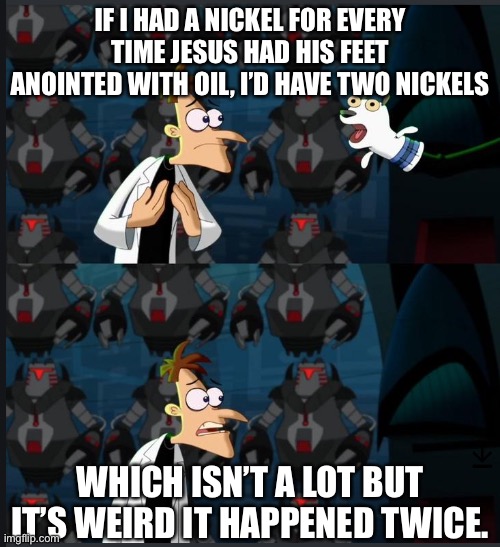
At this point in our reading, things start to get serious, so before we get into that I’d like to give you this meme for your sharing pleasure. I hope that you can enjoy the humor, because the stories and questions today should give us time to pause and think, to pray, and to trust in the grace of God. 

We start with this meme because of the story in verses 6-13. While there are multiple proposed solutions to how many times Jesus was anointed (see note), at this point I lean to the idea that Jesus was anointed with oil in two different scenarios, the one recorded in Luke, and the one recorded in Matthew, Mark, and John. In Matthew a woman pours very costly perfume on Jesus, and the disciples were livid. “HOW MUCH GOOD COULD WE HAVE DONE WITH THAT MONEY?!” They all berate the woman. But Jesus recognizes the act of utter worship and adoration that this woman desired to give him.

When Jesus said “you always have the poor with you” was he saying that we shouldn’t give to the poor? After all, if we give to the poor person in front of us, won’t there be another the next day, right? For the latter question, yes there will always be another poor person. But for the first question, Jesus was referencing Deuteronomy 15:10-11 “Give generously to him, and do not let your heart be grieved when you do so. And because of this the LORD your God will bless you in all your work and in everything to which you put your hand. For there will never cease to be poor in the land; that is why I am commanding you to open wide your hand to your brother and to the poor and needy in your land.” Jesus wasn’t saying “don’t give” but instead “if you are so concerned about the poor, you will be able to give to them with OTHER gifts.” In fact, Judas was berating the woman because he would have had access to the funds for himself, as he stole money from the group. Maybe other disciples were upset that this woman was showing greater devotion for Jesus than they were willing to show. Jesus is, in effect, calling their bluff : “If you truly want to serve the poor, you’ll be able to do so the rest of your life. She is choosing to serve me now!”

The rest of the chapter is full of familiar stories that we remember during the Season of Lent, Passover and Easter/Resurrection Sunday every year. 

Jesus at this time institutes the act of communion, a time to remember what Christ has done for us. To be fair, Jesus does not begin something new, but changes the focus of something ancient. Passover is a holy Jewish meal that signified God’s redemption of Israel from Egypt. Jesus says it’s no longer just about that. Now, this bread that was about fleeing slavery is about the body broken for us to free us from sin. The wine is now about the blood of Jesus spilt for the forgiveness of our sins. 

Judas decided to betray Jesus and feigns offense when Jesus accuses the disciples there is a betrayer in their midst. Jesus knows what he has decided and is not fooled by his act. But we shouldn’t miss that Peter ALSO betrays Jesus. Judas desired money. Some postulate that Judas was trying to force Jesus and God to bring the Kingdom now. But whatever his motives, the betrayal was still evil and unjustified. But the betrayal of Peter was just as significant and just as thorough. Peter’s betrayal was fueled by self-preservation and fear. Both denied their Lord, their Savior… their friend. 

Jesus is broken hearted by what is happening to him. He knows that the woman who anointed his feet just days before was preparing him for burial, but still he did not want to die. He asks God if he can be spared, not only from the pain of death, but the rejection he is about to receive from God on behalf of all people. Jesus is about to have all sin heaped on him. God is about to cut all ties from his Son, and their connection will be severed so sin can be destroyed. Jesus, in his love for all of us, decided to follow the plan of God. He decides that he will drink the cup of the wrath of God, so that those who trust in Christ will not have to drink that cup themselves. 

While we began with a meme, we need to take time for serious remembrance of what Christ decided to do for us. 

Let us remember the anointing and worship of the woman. 

Let us remember the poor that Jesus calls us to serve. 

Let us remember Jesus by taking communion as we are able. 

Let us remember Peter and Judas so that we may not betray Jesus like they did. 

Let us remember a savior who was willing to die for us, who was willing to take the cup of wrath, and was willing to do the will of God so that we may have grace and peace and life. 

-Jake Ballard

Questions for Reflection and Discussion

  1. Are we willing to anoint the feet of Jesus with everything we have? Are you willing to give extravagant worship to Christ that others call outrageous, because you know how you have been forgiven? How deep does your love and worship go?
  2. Go back to yesterday’s question 3 (are you taking care of the least of these?) Ask yourself those questions again. Are you serving the poor, giving to them no matter how many there will be in the land? Or is your heart hardened by the reality of this world? Will you ask God to change your heart and make you love the poor?
  3. Have you participated in the grace of communion recently? The next time you do, take a moment to reflect on the thousands of years that the faithful people of God have celebrated this meal and emblem, first as freedom from slavery in Egypt, and now, through Christ as freedom for slavery from sin. How does it make you feel that you participate in thousands of years of history along with all of God’s people?
  4. In our sin, do we betray the savior who loves us? In what ways can we overcome the sin we have so we do not betray and deny our savior and lord?

Note: For an explanation of multiple ways of interpreting the passages see: https://answersingenesis.org/contradictions-in-the-bible/how-many-times-was-jesus-anointed/ AIG believes there were THREE events, but I think that even that would be a bit of a stretch. 

The Not Last Supper

Luke 22:1-38

God is an epic story-teller. One trick up every story-teller’s sleeve is repetition, only each new repetition brings a new twist. The story in today’s chapter is titled, The Last Supper, implying that other suppers preceded it. 

The first meal of this kind is found in Exodus; the Israelites were captive to Pharaoh in Egypt, who worked them ruthlessly.  God sent a series of plagues to convince Pharaoh to let His people go, which would culminate in the death of all firstborn sons—people and livestock alike. To save the Israelites from this horrific plague, God gave specific instructions to Moses and Aaron:

“On that same night I will pass through Egypt and strike down every firstborn of both people and animals, and I will bring judgment on all the gods of Egypt. I am the LORD. The blood will be a sign for you on the houses where you are, and when I see the blood, I will pass over you. No destructive plague will touch you when I strike Egypt.” (Exodus 12:12-13)

The Israelites with the blood of the lamb slathered on their door frames were safe, as the angel of death passed over their houses. God ordered the Israelites to commemorate the day God saved Israel, and they did so every year. 

Over one thousand years later, in the week leading up to Jesus’ death, Jesus celebrated Passover with his disciples in Jerusalem. This time, there was a new twist. Jesus gives new meaning to the emblems eaten that meal: 

And he (Jesus) took bread, gave thanks and broke it, and gave it to them, saying, “This is my body given for you; do this in remembrance of me.” In the same way, after the supper he took the cup, saying, “This cup is the new covenant in my blood, which is poured out for you.” (Luke 22:19-20).

Jesus’s body was given for you, his blood poured out for you. His sacrifice marks a new covenant in which Jesus’ death atones for the sin of the world: 

Behold the Lamb of God who takes away the sin of the world. (John 1:29)

Have you ever read a story in the Bible with a hint of jealousy, wishing you, too, could have witnessed that moment? I know I have. I had a seat at that table with Jesus, eating and drinking, hearing his wisdom, and honoring his upcoming sacrifice. The good news for us is that “The Last Supper” isn’t really Jesus’s last supper: 

And he (Jesus) said to them (the disciples), “I have eagerly desired to eat this Passover with you before I suffer. For I tell you, I will not eat it again until it finds fulfillment in the kingdom of God.” (Luke 22:15-16)

It’s another feast with another twist. This time we’ll be eating and drinking in physical communion with Jesus, but in the Kingdom of God. I am excitedly awaiting that day, but in the meantime we have the honor of commemorating Jesus’ sacrifice regularly through Communion. The next time you take Communion, do it in remembrance—and in sweet anticipation—of all Jesus has done and is yet to do. 

-Mackenzie McClain

Today’s Bible reading passages can be read or listened to at BibleGateway here – Deuteronomy 27-28 and Luke 22:1-38

God Guides

When you Look for It

Numbers 9-10 and Psalm 40-41

I always love a good celebration with my friends and family!  The Israelites had a number of different celebrations, but arguably the most important one to them was the Passover.  The Passover was in commemoration of God sparing the Israelite firstborn sons during the tenth and final plague to free the Israelites from Egypt.  All of the Israelite households who spread the blood of the lamb on their doorposts had their firstborn sons spared, but everyone else did not.  In chapter nine of Numbers, God instructs the Israelites, through Moses, to celebrate the Passover.  This is a vital celebration that the Israelites struggled to remember to celebrate later on.

It would be cool to see the whole nation of Israel gather together to celebrate the Passover.  Truth be told, there are a ton of events recorded in the Bible that would be flat out awesome to see firsthand!  Of all the awesome things to see, Numbers chapter 9 records one of the top 10 things that I would have liked to have witnessed firsthand – maybe top 5.  That awesome thing recorded is the pillar of fire that guided the Israelites where to go at night.  During the day, a pillar of cloud guided them, but at night it had the appearance of fire.  How cool would it be to see the pillar of fire in the sky at night?!  I would say top 10 throughout the whole Bible!  Our God is incredible, and he is capable of some awesome feats.

I don’t think many of us are going to be led by a pillar of cloud or fire.  However, similar to the Israelites, we can and should still be guided by God.  There’s a very good chance that the guidance that God provides you will not be as obvious as the pillar of cloud or fire.  Therefore, we really need to be in tune with God and keep our eyes, ears, heart, and mind open to His guidance.  There are a number of ways in which God can lead us, so we should be ready at all times.  If we are actively seeking God’s guidance, then we are much more likely to see it.  That has to do with our Reticular Activating System in our brains.  If you don’t know what that is, then look it up on Google or YouTube.  You’ll be amazed.

 I would encourage you all to pray to God to help you become susceptible to God’s guidance.  You may be surprised with all the ways that God attempts to guide you.

A note from Psalm:

“Blessed is the one who considers the poor!  In the day of trouble the LORD delivers him,” Psalm 41:1.

Let this serve as a reminder to be generous with everything that God provides us with.  If we consider the poor with our resources, then God will deliver us!

-Kyle McClain

Links to today’s Bible verses – Numbers 9-10 and Psalm 40-41

The Exodus: Starting a new thing

We have been building up in the last couple of chapters to bigger and bigger plagues and displays of God’s might and power over the gods of Egypt, and finally we are coming to the climax of that story.  God is about to unleash his judgement on every firstborn in Egypt, but he will spare the people of Israel if they will sacrifice a lamb and put its blood around their doors.  

3 Tell the whole community of Israel that on the tenth day of this month each man is to take a lamb for his family, one for each household. 

4 If any household is too small for a whole lamb, they must share one with their nearest neighbor, having taken into account the number of people there are. You are to determine the amount of lamb needed in accordance with what each person will eat. 

5 The animals you choose must be year-old males without defect, and you may take them from the sheep or the goats.

6 Take care of them until the fourteenth day of the month, when all the members of the community of Israel must slaughter them at twilight.

7 Then they are to take some of the blood and put it on the sides and tops of the doorframes of the houses where they eat the lambs. 

8 That same night they are to eat the meat roasted over the fire, along with bitter herbs, and bread made without yeast. (Exodus 12:3-8)

The meat of a lamb that you had taken care of for a week and that was cooked with bitter herbs and unleavened bread would not be a special feast that you would enjoy.  Emotionally this would be difficult, and the food would not taste that great.  This is to show the people of Israel that sacrifices and victories are not always joyous or exciting, but come at a personal cost.  For Moses it was seeing the Egyptians, the people he grew up with and who he cared for still, devastated and suffering.  This judgment was difficult for God as well since we know that he does not wish that any should perish, but he needed to show his people that the Egyptian gods they were following were powerless so that he could start to build them into his own people.

12 “On that same night I will pass through Egypt and strike down every firstborn of both people and animals, and I will bring judgment on all the gods of Egypt. I am the Lord. 13 The blood will be a sign for you on the houses where you are, and when I see the blood, I will pass over you. No destructive plague will touch you when I strike Egypt. (Exodus 12:12-13)

God is starting to prepare the Israelites to be his people so that one day he can have Jesus, his son, die for all sins as the ultimate sacrificial lamb whose blood will cover our sins. They have a long ways to go before they are really the people of God, but we can skip ahead to Mark 3 and start to see another major change that is being initiated.

Jesus went into the synagogue again and noticed a man with a deformed hand. 2 Since it was the Sabbath, Jesus’ enemies watched him closely. If he healed the man’s hand, they planned to accuse him of working on the Sabbath.

3 Jesus said to the man with the deformed hand, “Come and stand in front of everyone.” 4 Then he turned to his critics and asked, “Does the law permit good deeds on the Sabbath, or is it a day for doing evil? Is this a day to save life or to destroy it?” But they wouldn’t answer him.

5 He looked around at them angrily and was deeply saddened by their hard hearts. Then he said to the man, “Hold out your hand.” So the man held out his hand, and it was restored! 6 At once the Pharisees went away and met with the supporters of Herod to plot how to kill Jesus. (Mark 3:1-6)

This is very near the start of Jesus’ ministry and we see that he is running into a ruling group who have hard hearts and are therefore unable to follow God’s will.  Sadly this time it is the very teachers of the law that we will see Moses give later this week that are wanting to kill a Godly man.  

The biggest thing stopping God from working strongly in our lives is our own hard heart, and sometimes it can take a really major event in our lives to break down the walls that we set up around our heart, but I encourage you to take the first step and prayerfully listen to what God is trying to tell you.

I really enjoy the story of the Exodus and I hope you enjoy walking through this next chapter in the story of the Israelites and also in the early stages of Jesus’ ministry.  

Chris Mattison

Links to today’s Bible reading passages Exodus 11-12 and Mark 3

Light Dawns on the Dark Night of the Soul

Exodus 10-12

Exodus 10 1 2 NIV

As we go through life, there are times when it seems like God is very active and involved in our day to day lives and we sense God’s love, nearness and active interest in our lives.  However, if we are honest, there are other times when life seems to just move along and God doesn’t seem to be saying much or doing much on our behalf.  The technical term for this awareness of God’s absence is called “the dark night of the soul.”  Many growing Christians have and do experience times of God’s apparent absence in our lives.

As we read through the Bible it becomes apparent that there are times when God gets actively involved with His people.  God was there in creation, making the earth, making the plants and trees, making the animals, making Adam from dirt and Eve from Adam’s rib.  God was there in Eden talking openly and directly with Adam and Eve.  God was there asking Cain about his brother Abel.  But then we don’t hear much from God.  We know that people like Enoch “walked with God”, but we’re told very little about what God is up to for hundreds of years, as the population of earth increases and also the sin of humanity increases.  There is a long period of God’s apparent absence from history until the days of Noah when God appears to Noah and tells him to build the Ark because a flood is coming.

After the flood there appears to be more years of silence, until the Tower of Babel gets built and God comes down and confuses people’s language.  Then there is more silence from God until he calls Abraham.  And so on and so on…There are intermittent times where God is active and involved and times when God seems silent throughout the book of Genesis.

At the end of Genesis God saves Abraham’s family from famine by bringing them down to Egypt.  At first, all is well as Joseph, Abraham’s great grandson is the second most powerful man in all of Egypt.  But Joseph eventually dies, and he is no longer able to protect his family from the powerful Pharaoh, and eventually the descendants of Abraham are enslaved by the Egyptians.  This lasts for a period of roughly 400 years.  During that 400 years it seems that God is once again silent.

During that time Israel is growing from a few hundred people, to millions of people.  Millions of men, woman and children living in bondage in a foreign land.  Perhaps stories about God and their ancestors Abraham, Isaac and Jacob were passed along by word of mouth, but we might imagine that so many years of silence may have left the nation of Israel in a permanent Dark Night of the Soul.  But then… out of the darkness and silence, Moses is born and becomes a member of the Egyptian royal family.  God is at work, but he’s not quite ready to make himself fully known to Israel.  Moses kills an Egyptian and flees to the wilderness and it seems that the darkness continues and the voice of God remains silent…until God appears to Moses in the burning bush and tells him to go back to Egypt.

In Exodus 10-12 the time has come for God to make himself known to His people… and to Egypt. Exodus 10:1-2 – “Then the Lord said to Moses, “Go to Pharaoh, for I have hardened his heart and the hearts of his officials so that I may perform these signs of mine among them that you may tell your children and grandchildren how I dealt harshly with the Egyptians and how I performed my signs among them, and that you may know that I am the Lord.”

Here, God tells Moses that He’s about to make his presence known in a powerful way.  God’s about to show up, the darkness is ending, the silence is over.  And show up He does!  God shows up in a profound and powerful display of his power and might.  Bear in mind, Egypt was, at the time, the most powerful empire in the whole world.  Pharaoh was the most powerful person in the whole world.  Pharaoh had been exerting his power in a ruthless way over God’s chosen people for hundreds of years.  Lord Acton once said “Absolute power corrupts absolutely.”  In the United States we live under a Constitutional system that intentionally balances power among three different branches of government- Executive, Legislative and Judicial.  This is to prevent any one person from having too much or absolute power.  These lessons were learned after observing thousands of years of kingdoms.  Pharaohs and other absolute monarchs have historically used their power in destructive and unjust ways.  And with such unmatched power comes hubris.

The Poet Percy Bysshe Shelly captures the hubris in his powerful poem Ozymandias:

I met a traveller from an antique land,

Who said—“Two vast and trunkless legs of stone

Stand in the desert. . . . Near them, on the sand,

Half sunk a shattered visage lies, whose frown,

And wrinkled lip, and sneer of cold command,

Tell that its sculptor well those passions read

Which yet survive, stamped on these lifeless things,

The hand that mocked them, and the heart that fed;

And on the pedestal, these words appear:

My name is Ozymandias, King of Kings;

Look on my Works, ye Mighty, and despair!

Nothing beside remains. Round the decay

Of that colossal Wreck, boundless and bare

The lone and level sands stretch far away.”

Pharaoh, like Ozymandias in the poem, was filled with hubris over his unmatched power.  He believed himself to be king of kings.  He needed to be taught a lesson in humility by the true King of Kings.  God showed up.  Ten plagues later and all of Egypt was brought to their knees.  Meanwhile, the people of God began to see first hand just how great and powerful their King, the true God, YHWH really was.  That story has been told for thousands of years, and today, the people of Israel continue to sit down and eat bread without yeast and drink wine and remember the Passover and how powerful their God really is.

Sometimes, God seems to be silent, but make no mistake, God is still there and God is still powerful and in the end, God will show himself to be greater than all human opposition.  May you know the true God.

Jeff Fletcher