Today we are going to look at two different groups of God’s people: those in Jerusalem at the time of Isaiah’s writing and those in Colosse at the time of Paul’s writing. Which will you be?
In many of the previous chapters of the book of Isaiah we read about God’s coming judgments on Israel and Judah’s neighbors and sometimes her enemies. It’s not all bad reading what disasters are coming to your wicked neighbors. Yay, God! Go get em! Show em who’s boss! But, it gets downright personal in chapter 22 as the prophecies of judgment and doom now center on Jerusalem, God’s Holy City. What did they do to deserve this? Well, much. Other scriptures tell of Jerusalem’s idol worship and shedding of innocent blood and even sacrificing their own children. But specifically in Isaiah 22 we are told of their pride and arrogance, their celebrations and their disregard for God. When they saw danger on the horizon they did everything in their own power to protect themselves, including tearing down houses to strengthen the wall and building reservoirs. “But, you did not look to the One who made it, or have regard for the One who planned it long ago” (Isaiah 22:11 NIV). What would have changed if they had only called out to God for help?
God was waiting for His people to seek Him, to turn to Him, to cry out to Him, to confess and mourn and repent. But, instead, they were too busy. Busy with their preparations to save themselves. Busy with their sins. Busy with their celebrations and feasting and misplaced joy. Busy in their “town full of commotion…city of tumult and revelry.” (Isaiah 22:2 NIV).
They had abandoned God first. He was still calling out to them on that day (Isaiah 22:12). But, they were busy. They drowned out the sound of God’s voice with their sinful busy-ness and celebrations. So, His holy and righteous judgement was coming.
Contrast this tragic picture with what we read in Colossians 4 as Paul is closing out his letter to the church in Colosse with his final instructions and greetings. He urges the church, “Devote yourselves to prayer, being watchful and thankful” (Colossians 4:2 NIV). And, while he’s got the people praying – he says pray for me, too. Paul requests prayers for open doors (not to physically get out of house arrests, but open doors to reach more people), for opportunities to proclaim Christ and for clear communication in his ministry. And further on, I love his description of Epaphras, “a servant of Jesus Christ…He is always wrestling in prayer for you, that you may stand firm in all the will of God, mature and and fully assured” (Colossians 4:12 NIV). These people are busy, too – in prayer – in seeking God and in ministry . They are praying for their spiritual leaders and churches and those who will hear God’s message, and asking for prayer. Rather than ignoring God and drowning out His voice, they are seeking God regularly and whole-heartedly, coming to Him in prayer, always desiring to do more for Him and His Son.
Which group are you more like today?
Do you have see any similarities between yourself and God’s people in Jerusalem? Are you surrounded with so much commotion that you miss God’s voice calling out to you? Is he asking you to mourn when you are busy celebrating and feasting? Are you so caught up in your self-preservation preparations that you have neglected to call out to God? Do you rely on yourself instead of on God? When you see trouble coming do you invest time in creating a longer to-do list, throw a party, or fall to your knees before God? What would be different in your life and in your community if you called on Him in prayer instead of trying to do it your own way?
Do you see any similarities between yourself and God’s people in Colosse? Are you devoted to prayer, being watchful and thankful? Are you praying for open doors – not to get ahead or out of a jam – but to advance God’s gospel message? Are you busy praying for your Christian brothers and sisters and leaders and missionaries? Are you asking others to pray for your ministry? What would it look like if you spent time today wrestling in prayer?
Praying for you today – to Stand Firm in God’s Will, mature and fully assured
-Marcia Railton
Read or listen to today’s Bible reading plan passages at BibleGateway here – Isaiah 21-22 and Colossians 4
Paul is one of the few people who can write “Finally” and continue on writing for the same length that he had just written! He writes two chapters, puts “finally” and writes two more. Inspired as he is, obviously Paul thinks of most of what he writes from Philippians 3:1-4:7 as all one idea. To be fair, as you are reading today, he uses “finally” in chapter 4 as well. It reminds me of a “midwestern goodbye;” he keeps trying to end his conversation but doesn’t want to say goodbye just yet.
While Paul starts his writing in verse one on the happy note of “rejoice” in the Lord, he quickly moves to talk of things that we need to beware of and, I think, overcome. That means we need to live differently, have victory over, and to not be defeated by.
Overcoming Others
In two places in this chapter, Paul discusses two kinds of unfaithful people and the way they live. First, there are those whom he calls “dogs” and “evil workers”. These are both the Jews and the Judaizing Christians who believe they follow God because they are circumcised on the outside and think all must follow them. However, their pride and focus on the law is actually showing that they have a false circumcision (3:2). Paul says that we are the ones who truly follow God, who follow him with a “circumcised” (or pure) heart.
Secondly, there are those who have never come to faith of any kind. Instead of even trying to honor God through false rules and regulations, they focus on fulfilling their own desires, whether that is food, drink, or sex. They worship those desires as their god. Even, (maybe especially) in our world there are those who glorify their appetites that they indulge as “healthy”, “not-repressed”, and “liberating”. However, Paul weeps knowing that their end is not life, not joy, but destruction. (3:18-19)
Overcoming Ourselves
We need to not be like either of those groups, but that means overcoming ourselves. True, we need to overcome the teachings of those who say following God is keeping a bunch of rules and regulations, but it is easy to feel good about ourselves because we did keep God’s word. It would be easy for Paul, for example, to glory in who he is. (3:4-6) He fulfilled all the credentials of what a successful Jew would be. But he considers it “dung” (skubala) if he might instead have Christ. He would count all these things rubbish in order to have the far greater, far surpassing righteousness of Christ. (3:7-9)
Once we know that our best attributes are only dung in comparison to Christ, we may say we might as well live terribly because we can never measure up. But Paul encourages us to strive to live rightly. Ever upward into the call of God in Christ. He says, though we will never be perfect, let us keep living by the same standard to which Christ has raised us. (3:12-16)
How to Hupernikao (Overcome)
How are we to overcome? How are we to not fall into the traps of being legalistic or being completely wild with our living? We need to live LIKE CHRIST! That should sound familiar! If we live like Christ, forgetting what lies behind and pressing on ahead (12-16) then we will be conformed to him. We will suffer the way he suffered, being mistreated on both sides. We will sound to0 gracious to the “judgmental” and too judgmental to the “gracious”. We won’t look like those who are legalistic and believe that rule following will save them. But we also won’t look like those who believe that everything is OK and permissible.
But this is the way Jesus lived. He was a friend of tax collectors and sinners and yet told them they needed to stop sinning. If we live like him, we will face the suffering he faced, we may even be conformed to him in death. (3:10) But the GLORIOUS news is that if we are connected to him, believe in him, and live like him, we will ALSO be raised with him. If we die with him, we will also live with him. (3:11, cf. 2 Tim. 2:11-13)
It is because we have a savior who will raise us up, and glorify us as he rules over all things that Paul can say, in Philippians 4:1 “Therefore, my beloved brethren whom I long to see, my joy and crown, in this way stand firm in the Lord, my beloved.” Because we have a savior who will redeem us, we can rejoice in the Lord and we can be the joy of those who have trained us in the way we should go.
May you, my brothers and sisters, overcome those who tell you to be more strictly following all the right rules that only they seem to know.
May you overcome those who say live with abandon and do whatever it is that makes you happy and fulfills you.
May you overcome the desires in yourself that push in you in those directions.
May you instead be conformed to the life, suffering, death, and ultimately resurrection of Christ, as you seek to live like him.
May you forget what lies behind, press on ahead, and retain the standard, while only trusting in Christ’s sacrifice to save you.
Amen
-Jake Ballard
Read or listen to today’s Bible reading plan passages at BibleGateway.com here – Isaiah 13-14 and Philippians 4
I’m not gonna lie to you : it’s been a bit rough. Since March of 2020 until now, we have seen a pandemic that caused suffering and panic across the globe, racial and political division across the US, an even greater erosion of trust in our institutions of power, particularly of the media, and financial and political instability the world over, as well as claims from some that some or all of these issues don’t even exist!
We need to know how to respond to these situations. The Bible doesn’t have a “read this passage in case of global pandemic and division” section, but there are multiple places that describe the appropriate attitude to take in the midst of suffering.
In the book of Philippians, we see Paul in the midst of suffering. In 1:12-13, we learn of Paul’s predicament. He is imprisoned, probably in Rome or Ephesus. (You can read more about Paul’s imprisonment for the Gospel in Acts 25-28.) He seems to believe that he may be going to his death, though he would love to both visit the Philippians again, and to go on to Spain. He wants to continue to do God’s will, but he recognizes that death may be a better alternative, as he would finally rest and have peace in Christ. (1:21)
“To die is gain” is a strange statement from the same man who said “the last enemy to be destroyed is death.” (1 Cor. 15:26) Is death a gain or an enemy? As we said before, Paul is suffering. Being in prison isn’t a cakewalk. But he is not only experiencing suffering for the sake of Christ, but telling the Philippians they will suffer for the sake of Christ as well. (1:29-30) If all this is true, then what should our response be? Gloom? Doom? Wailing and mourning?
ABSOLUTELY NOT! The letter of Philippians is drenched in a word : Joy, or rejoice. This is the theme that pervades the thought of Paul in Philippians, using the word 16 times and talking about joy throughout the letter. He says that he offers his prayers with joy because of the Philippians and what they have done for him (1:4). Paul rejoices over the fact that Christ is preached and that the Philippians will bear Paul up in their prayers. (1:18-19)
How can Paul have joy in the midst of suffering? What is the joy that Paul talks about? Answering these questions and more like them is the goal of this week. Over the next few days we will be walking with joy. Tomorrow we will see how joy is used in the rest of the New Testament to know what Paul means by joy. Then we will see the joy of being like Christ and the joy of overcoming sin. We will discuss what it means to rejoice always. Finally, we will look to the end of the age and try and rejoice in the joy that we will experience forever.
Today, my brothers and sisters, may you begin to be excited about the joy that Christ brings. May you taste the joy on this beautiful day, and may it carry you through this week.
-Jake Ballard
Read or listen to today’s Bible reading plan passages at BibleGateway here – Isaiah 7-8 and Philippians 1
“All this I observed, applying my mind to all that is done under the sun, while one person exercises authority over another to the other’s hurt.” (Ecc 8:9)
As you are all aware, the United States has a deep and dark history with slavery. Generations of family wealth were built on the blood, sweat, and tears of slaves. We abused our power and took advantage of others for our own gain. Thankfully, although through great struggle, we abandoned the practice.
But we still feel the ripples of our past today. Slavery ended, but it took many, many years before everyone could say they had the same fundamental rights. It takes a long time to recover from being held down as a people for so many years, especially as those in power do everything they can to stay in power. It is painful to see that senseless acts of racism and hate still happen, and that the systems and powers still propagate forms of racism. I do not claim to know what the solutions are, but there is still a lot of work to be done to correct our great wrongs.
The United States wasn’t the first nation to have a practice of slavery. For an example, let’s go back in time to the exodus. You probably remember the story, but if not, it’s… in Exodus. Moses and the Israelites were miraculously delivered from slavery in Egypt. This was an important memory for the Israelites and was commemorated by the Passover meal. In fact, we trace our tradition of communion back to one particular Passover meal that Jesus had with his disciples.
If we move forward to the time when Paul was writing to the Galatians, slavery was a thing then too. It was a normal part of the culture. Although, compared to what the United States did, it was milder. Think more along the lines of indentured servitude. It was not a good situation to be in, but it was not to the level of horror that we took it.
Unfortunately, the practice of slavery is still alive and well in our world. There are more slaves in the world than ever before. Usually we call it “human trafficking” now, but the concepts are not that different. It is about owning people. The mindset that you can own a person and profit from them is big business, and it’s terrifying to think about.
We come to Galatians 4 and see that Paul is drawing a strong connection between following the Jewish law and being under slavery. This seems to fly in the face of what we have seen elsewhere in scripture about the law. The law is supposed to be a good thing that was received from God. For the Israelites, it was an important pathway toward connecting with God. Jesus himself upheld it as something good (Matt 5:17 and surrounding verses). In Galatians 3, Paul seems to agree it was good, and even necessary for a time. But if we have a chance to corner Paul and ask if he thinks the law is good or bad, he’ll probably say “Yes!” There are two sides to this.
Usually you don’t think of things as absolutely good or bad. You compare them to other things or judge them in context. A burger is better than salad. It is savory with lots of protein and fat. The salad is better for providing micronutrients and some fiber, otherwise it is worthless. I would put a tomato slice and lettuce on the burger and call it a day. If you are hard pressed for finding food, then a salad is better than nothing. But if you had access to a burger, then you would not bother with a salad. I am the least picky eater I know. I can enjoy and see the value in a salad. They are a good thing. But there is just no comparison to a burger. A burger wins every single time.
The law is like the lettuce that the Jews had to live on until they had burgers. It was the best option for a long time, and it was a blessing from God. But now that we have grace, the promises of God, and the spirit through Jesus, the law looks pathetic in comparison. After a bite of that burger, you won’t go back. Taste and see!
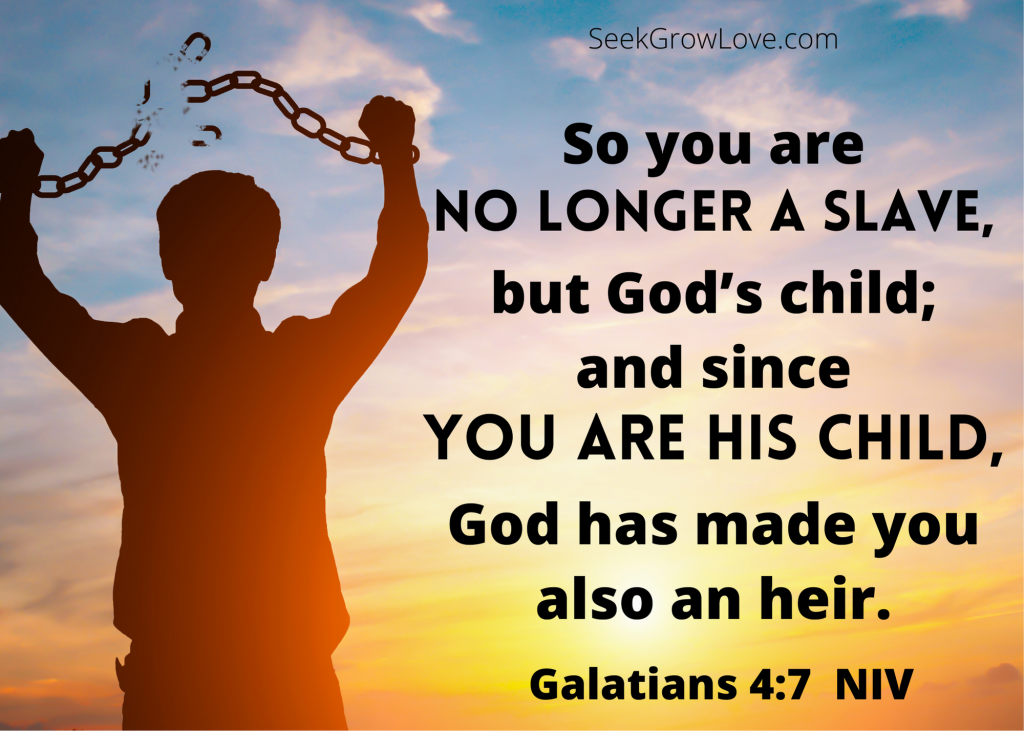
“But when the fullness of time had come, God sent his Son, born of a woman, born under the law, in order to redeem those who were under the law, so that we might receive adoption as children. And because you are children, God has sent the Spirit of his Son into our hearts, crying, ‘Abba! Father!’ So you are no longer a slave but a child, and if a child then also an heir, through God.” (Gal 4:4-7)
Paul is saying it is better to be a child and heir than to be a slave. Because of what Jesus has done, your status has changed from a slave under the law to a child of God and an heir of his promises. If you’re a child and heir, with rights and a large inheritance, you wouldn’t think of going back to having nothing.
You can imagine that trying to follow the letter of the law would feel burdensome, like it owned you. And the law has a way of making you hyper-aware of your sin. And sin is all tangled up with death. Thankfully we are filled with and are influenced by the spirit of God to help guide us. If we keep in step with the spirit and make ourselves vessels of God’s love, we don’t have to worry about breaking God’s laws. It is like they take care of themselves.
Starting in Galatians 4:21, Paul gives us an allegory of the slave woman and the free woman. He’s presenting us with a crossroads of sorts, but the choice should be easy. Of course if Jesus hands you a burger, you take it, and don’t bother with the salad. Why be a child of the flesh when you can be a child of the promise? Why be a slave when you can be free?
With all of this influence from Ecclesiastes lately, I can’t help but think Paul would say being slaves to the law is like chasing after the wind.
Reading for today: 2 Chronicles 35-36 & 1 Corinthians 1
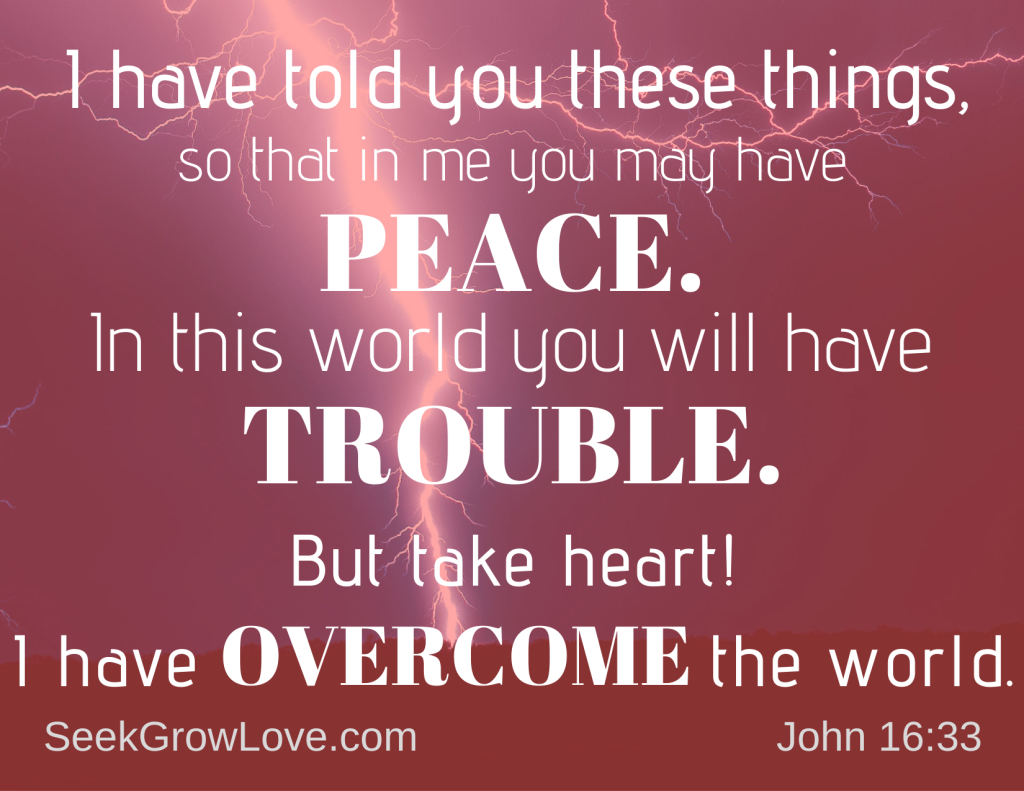
“I have told you these things, so that in me you may have peace. In this world you will have trouble. But take heart! I have overcome the world.” – John 16:33
You might wonder why our focus verse for today is from John when the daily readings are in Chronicles and Corinthians. This week is FUEL, a National Youth Camp in which young people from all over the country gather to learn and grow in their faith. And the theme for the camp this week is ‘hupernikao’ … a Greek word that means ‘overwhelmingly conquer’.
Every day this week, except for today, we will pull from the daily readings as well as the daily FUEL themes, to explore this theme of overcoming or conquering.
Today, I want to focus on the big picture a bit. Overcome what? How?
“I have told you these things, so that in me you may have peace. In this world you will have trouble. But take heart! I have overcome the world.” – John 16:33
This verse in John is rich in helping to answer those questions. We might think that Jesus, who is the speaker here, is being kind of a downer if we just look at part of the verse. In this world you will have trouble? Not much of a pep talk, Jesus.
But if you’re anything like me, this is exactly the kind of pep talk you need.
The truth.
A little aside: A pet peeve of mine is people who sell things who won’t admit that their products have flaws. Their company is the best thing ever, producing the best products ever, which will of course give me the best results ever…Every. Single. Time. Am I the only one who would always be more likely to believe someone who is honest about the limitations of their product line or who is able to admit that while there are great options, there are also some weaker products to avoid? Rant over.
Jesus is laying out the truth here. “You’re a human person living in this world? Yup, you’ll have trouble. Pain. Sorrow. Heartache. Difficulty. Expect that too.”
But he doesn’t leave us there. “Yes, life is hard. Really hard sometimes. … BUT … hold on! You can make it because I have overcome all of it!”
Do you know that in other places in Scripture we’re given specific assurances of overcoming the hard stuff Jesus warned us we would face? Here are a couple of examples:
1 Corinthians 10:13 tells us that God will provide us the means to overcome temptation:
No temptation has overtaken you except what is common to humanity. God is faithful, and He will not allow you to be tempted beyond what you are able, but with the temptation He will also provide a way of escape so that you are able to bear it.
And Romans 8:31-39 paints a beautiful and poetic word picture of overcoming a variety of troubles. Spend some time while you read this thinking about what you could use some overcoming in… Are you feeling separated from God’s love? Do you feel pain, even anguish that feels unbearable? Persecuted? Hungry for something but you don’t even know what so you keep going after the wrong thing? Are you in need, bare before Him? Or even feel in danger of slipping out of His grip?
Take heart.
What then are we to say about these things? If God is for us, who is against us? He did not even spare His own Son but offered Him up for us all; how will He not also with Him grant us everything? Who can bring an accusation against God’s elect? God is the One who justifies. Who is the one who condemns? Christ Jesus is the One who died, but even more, has been raised; He also is at the right hand of God and intercedes for us. Who can separate us from the love of Christ? Can affliction or anguish or persecution or famine or nakedness or danger or sword? As it is written: Because of You we are being put to death all day long; we are counted as sheep to be slaughtered. No, in all these things we are more than victorious through Him who loved us. For I am persuaded that not even death or life, angels or rulers, things present or things to come, hostile powers, height or depth, or any other created thing will have the power to separate us from the love of God that is in Christ Jesus our Lord!
Today’s reading is packed with so much good stuff, it’s hard to know what to write about.
I could comment about the overflowing generosity of King Hezekiah and the people when giving to the Lord, as found in 2 Chronicles 31. But I won’t.
I could stress how God blessed another faithful king, as found in 2 Chronicles 31:21, which says, “In everything that he undertook in the service of God’s temple and in obedience to the law and the commands, he sought his God and worked wholeheartedly. And so he prospered.” But I won’t.
I could comment extensively on how Hezekiah trusted God completely when attacked by the Assyrians, and then God sent the death angel, who killed 185,000 of the Assyrian army. But I won’t. (Besides, I prefer the accounts in 2 Kings 18-19 and Isaiah 36-37.)
I could talk about how Hezekiah cried out to God when he was about to die, and God added 15 years to his life, as recorded in 2 Chronicles 32. But I won’t. (Again I prefer the 2 Kings 21 and Isaiah 37-38 accounts.)
I could even expound on 2 Chronicles 32:31, “…God left him to test him and to know everything that was in his heart.” But I won’t.
Since I already commented yesterday about doing things to build up our neighbor, I won’t comment on that even though it is recorded again in the beginning of Romans 15.
Instead, I’d like to point out Paul’s faithfulness in evangelism. You may remember that Paul had a vision, where Jesus commanded him to spread the gospel to the Gentiles. In Romans 15:19-22, we read, “… So from Jerusalem all the way around to Illyricum, I have fully proclaimed the gospel of Christ. It has always been my ambition to preach the gospel where Christ was not known, so that I would not be building on someone else’s foundation. … This is why I have often been hindered from coming to you.”
It’s easy to pass over what Paul just said, so I’ll point out that according to The Wiersbe Bible Commentary, “from Jerusalem to Illyricum” covers about 14,000 miles (yes, fourteen thousand miles). When you consider Paul’s mode of travel, and the difficulties he endured (read 2 Corinthians 11:23-27), you can understand the immense achievement of Paul’s missionary work.
For your convenience, I’ll include 2 Corinthians 11:23-27 here:
… I have worked much harder, been in prison more frequently, been flogged more severely, and been exposed to death again and again. Five times I received from the Jews the forty lashes minus one. Three times I was beaten with rods, once I was pelted with stones, three times I was shipwrecked, I spent a night and a day in the open sea, I have been constantly on the move. I have been in danger from rivers, in danger from bandits, in danger from my fellow Jews, in danger from Gentiles; in danger in the city, in danger in the country, in danger at sea; and in danger from false believers. I have labored and toiled and have often gone without sleep; I have known hunger and thirst and have often gone without food; I have been cold and naked.
The real clincher comes in Romans 15:23, “But now that there is no more place for me to work in these regions…” Did you catch that? Paul has traveled 14,000 miles and told everyone he could about Jesus. Paul is basically saying, “But since there’s nobody else to tell (because they’ve all heard now); I’m done here; so I’ll finally come to visit you.”
What an astounding accomplishment. What an astounding example.
Jesus commanded His disciples to go into all the world and make disciples, baptizing them, and teaching them to obey all that Jesus commanded. And part of what was commanded includes making more disciples. So, through the Great Commission, Jesus commanded you and me to share the good news about Jesus with the whole world. Maybe we weren’t told as directly as Paul was, but we were told.
I don’t know about you, but I can’t say, “since I’ve told everybody I know about Jesus, I need to move on to find more people to tell.” I think all of us need a good reminder that God still expects us to make disciples today. –Steve Mattison
Today’s Bible reading passages can be read or listened to at BibleGateway here – 2 Chronicles 31-32 and Romans 15
Jehoshaphat was the fourth king of the Kingdom of Judah. We are told that he “sought the God of his father and followed his commands rather than the practices of Israel.” Jehoshaphat sent out leaders throughout Judah to teach the people from the Book of the Law of the LORD. He was a good king, but we are informed of a couple of mistakes he made in his life. In one instance, he allied himself with Ahab, the evil king of Israel. He even joined forces with Ahab to enter a war even though they were warned by God’s prophet that they would lose that battle. When he returns, he accepts the correction from Jehu the seer. We can learn so much from this.
When we find that we have sinned and realize that we have messed up in our spiritual lives, it is so important for us to repent and offer our situation up to God. He will forgive and restore us. Of course, no one wants to deal with the consequences of sin, but God will also give us the courage and strength to face the consequences as well. Paul assures us that nothing can separate us from the love of God that is in Christ Jesus our Lord. Let’s remember:
We are God’s children. (Romans 8:14-17)
God is for us. (Romans 8:31)
God gave up his own son for us so He will graciously give us all that we need. (Romans 8:32)
God has forgiven us. He justifies us, declares us righteous in Christ. Do not doubt, because no one condemns us. We are in Christ. (Romans 8:33)
Christ is interceding for us. (Romans 8:34)
Christ loves us and there is nothing that can separate us from His love. (Romans 8:35-39)
God and Christ will help you overcome. We are told that in all these things we are more than conquerors through him who loved us. What does it mean to you to be “more than a conqueror” through him who loves you? Trust Him to lead you to victory!
-Rebecca Dauksas
Today’s Bible reading passages can be read or listened to at BibleGateway here – 2 Chronicles 17-18 and Romans 8
I think everyone can empathize with Paul when he states, “I do not understand what I do. For what I want to do I do not do, but what I hate I do.” (Romans 7:15)
Even in every day routines there may be areas we want to improve or change. Just look at the huge amount of self-improvement and renewal books that are printed each year. Maybe we want to: lose weight, get fit, stop bad habits, eat healthier, get out of debt and save money, spend more time with family, be less stressed or read through the Bible. Ok, hopefully this one is happening.
So wanting to overcome sin and do good is a great goal, but maybe you feel as Paul did, “For I have the desire to do what is good, but I cannot carry it out.” On our own, we cannot overcome sin, but as Christians we are not on our own. Thank the LORD, He is with us and He has provided what we need to overcome sin. In verse 25 we see that Paul is relying on God’s provision in Christ. “Thanks be to God, who delivers me through Jesus Christ our Lord!”
We are no longer condemned because we are in Christ Jesus, but sin is condemned. Through Christ Jesus the law of the Spirit who gives life has set you free from the law of sin and death. We no longer live by our sinful nature, but according to the Spirit. And as we will discover in Romans chapter 8, we are more than conquerors through him who loved us and nothing in all creation, is able to separate us from the love of God that is in Christ Jesus our Lord. We truly need to realize the love that God has for us and rely on His Spirit working in us.
-Rebecca Dauksas
Today’s Bible reading passage can be read or listened to at BibleGateway here – 2 Chronicles 15-16 and Romans 7
Imagine the excitement as the very great caravan of the queen of Sheba arrived in Jerusalem. Envision the camels carrying spices, large quantities of gold and precious stones. The queen brought amazing treasures, but she was in search of a different kind of treasure from Solomon. She had questions and she wanted answers. Solomon was able to answer all her questions through the God-given wisdom he possessed. She experienced the blessings that God had given to this king and his people which made her feel overwhelmed. She offered praise to the LORD and understood that God loved Israel. She discovered that out of this love, God had provided the people with a king that could maintain justice and righteousness. Her encounter with Solomon, the people and her time of worship in the temple made a lasting change for this queen.
Even Jesus states that the queen will rise at the judgment with his generation and condemn it; for she came from the ends of the earth to listen to Solomon’s wisdom, and now something greater than Solomon was there. Of course, that something greater was our Lord Christ Jesus. It is great to imagine meeting and talking with this queen in the resurrection. It is incredible to think of the people that have the opportunity to experience this resurrection because of sharing our love and faith in our God. Just as the queen encountered the LORD through the Israelites, we have the opportunity to share how amazing God is with those in our world today. What a celebration that will be when all of us are together at the resurrection!
-Rebecca Dauksas
Today’s Bible reading passages can be read or listened to at BibleGateway here – 2 Chronicles 9-10 and Romans 4
My last devotional for this week comes out of Proverbs 19:18. It says, “Discipline your son while there is hope, and do not desire his death.” After doing this for a week now, the first portion of this passage made me immediately think about Amon. Remember him? He was that king of Judah that was murdered by his servants after reigning for only 2 years. He did evil in the sight of Yahweh. His father, Manasseh, also did evil in the sight of Yahweh but eventually repented and renewed his status with God. I had commented to myself on paper, thanking God for repentance – as there’s still time for it. What if you don’t have the time like Amon? What if you don’t even know that repentance is an option? This is why we are commissioned! Find those Josiahs and let them know the good news!
Discipline your son while there is hope, and do not desire his death… Why would any good parent desire their child’s death? My studies this week have also led me to some wisdom, I think, regarding the latter portion of this verse in Proverbs. I don’t think I would have understood the latter part if I hadn’t immersed myself in the word for a week. Words mean something. This is a wise, powerful statement that lets us know we DO desire our children’s death if we don’t take action to discipline them. We’ve got a great commission in our own homes if we are parents.
I have been wanting to do a study on child-rearing for a while now. Since I desire that my children live, I started by looking into discipline as it is demonstrated in the word. I found that my idea of discipline was nothing like what discipline actually meant in the bible.
Look at the Old Testament and how God, through Moses, disciplined the children of Israel in comparison to the New Testament and how God, through Jesus disciplined.
Deuteronomy 11:1-13 (NIV)
11 Love the Lord your God and keep his requirements, his decrees, his laws and his commands always. 2 Remember today that your children were not the ones who saw and experienced the discipline of the Lord your God: his majesty, his mighty hand, his outstretched arm; 3 the signs he performed and the things he did in the heart of Egypt, both to Pharaoh king of Egypt and to his whole country; 4 what he did to the Egyptian army, to its horses and chariots, how he overwhelmed them with the waters of the Red Sea[a] as they were pursuing you, and how the Lord brought lasting ruin on them. 5 It was not your children who saw what he did for you in the wilderness until you arrived at this place, 6 and what he did to Dathan and Abiram, sons of Eliab the Reubenite, when the earth opened its mouth right in the middle of all Israel and swallowed them up with their households, their tents and every living thing that belonged to them. 7 But it was your own eyes that saw all these great things the Lord has done.
8 Observe therefore all the commands I am giving you today, so that you may have the strength to go in and take over the land that you are crossing the Jordan to possess, 9 and so that you may live long in the land the Lord swore to your ancestors to give to them and their descendants, a land flowing with milk and honey. 10 The land you are entering to take over is not like the land of Egypt, from which you have come, where you planted your seed and irrigated it by foot as in a vegetable garden. 11 But the land you are crossing the Jordan to take possession of is a land of mountains and valleys that drinks rain from heaven. 12 It is a land the Lord your God cares for; the eyes of the Lord your God are continually on it from the beginning of the year to its end.
13 So if you faithfully obey the commands I am giving you today—to love the Lord your God and to serve him with all your heart and with all your soul—
Let’s go through this passage carefully. Through Moses, God disciplined the 12 tribes of Israel (the children of Israel). He disciplined them by first showing them his majesty, or who he was (Yahweh God!). Who he was could be recognized by the works he did (e.g., signs, miracles, plagues). He rescued them (from Egypt) and defeated their enemies (Egypt in the red sea). Along their journey to the promised land, he performed miracles to sustain them in the wilderness (e.g., manna, water from a rock). He got rid of the people among them who were insolent and tried to usurp Moses (i.e., Dathan and Abiram; Korah).
He then disciplines the children of Israel by telling them to obey the commandments they were given (i.e., obey the law of Moses) so that they would have strength to enter the promised land. He entices them to obey the law of Moses by describing how wonderful their hope is. In it, they will have long life and it will be well with them. In it, they will have good things (flowing with milk and honey). It is a land they won’t have to tend themselves (like they did in Egypt) to receive the good things in it. The good things will be sustained through heaven. To me, the last verse shows God’s heart. He cares so much about that land that he desires to give to his children.
Now let’s look at the New Testament and the discipline of God through Jesus. He pretty much does the same thing but gives greater honor and authority to Jesus since Jesus literally is the one who rescues the people.
In the New Testament, Jesus disciplined the 12 disciples by showing them who he was (is) (The Son of God! The Messiah – pretty much described throughout the whole book of John). Who he was (the Messiah) could be recognized by the works he did in their presence. There were some pretty distinctive works he did that pointed to himself as the Messiah (i.e., Isaiah 35:5-6a “Then the eyes of the blind will be opened and the ears of the deaf will be unstopped. 6 Then the lame will leap like a deer, and the tongue of the mute will shout for joy.).
It is Jesus himself who rescued them from their enemy (sin and death) by his death on the cross. Once seated at the right hand of God in heaven, it is Jesus who sustains them along their journey to the Kingdom of God (KOG). Post resurrection, it’s up to them (and us) to do these final things to enter into the KOG through Jesus. Jesus is the bread of life and he is the rock of our salvation who provides living water. He chastens us by pruning us along our journey (e.g., If your right hand offends you, cut it off – get rid of the people and things in your life that try to usurp Jesus as Lord of your life because they’ll prevent you from entering the KOG).
Jesus disciplines us by telling us to obey the Law of Christ (i.e., Love God and love people like Jesus loved). We need to obey these commandments so that we will have strength (through the receiving of the holy spirit) to enter the KOG.
The love of Christ compels us to obey by enticing us with the good things in the KOG, our hope. In the KOG, we will live forever with Jesus (and eventually with God himself). God will wipe away every tear from our eye; sin and death will be no more (the incorruptible crown; the crown of life). In it, we will be rewarded with good things, positional rewards based on how we built upon the foundation that was laid for us (built upon Jesus) (the crown of rejoicing; the crown of righteousness). If you’re an elder in your church, you’ll receive a crown of glory!
Once there, we won’t have to labor like we do now to enjoy the KOG. There will be a river of the water of life flowing from the throne of God and from the lamb. In it will be the tree of life on either side of the street with 12 kinds of fruit. The leaves of the tree will be for the healing of the nations. I realize that this may not all be literal. All I really know is that it will be unimaginably good and that God and my Lord Jesus will be there, so I’d like to be there too.
And then for my correlation of the last verse. I can only imagine the joy Jesus must have when he thinks about the coming KOG. It is his reward. He’ll be ruling the whole world from the new Jerusalem. I think this was God’s plan all along, with Jesus in mind as the king of his kingdom before the foundation of the world, to a people whose desire is for them whom they love.
Going back to the Old Testament passage, we see that not all of the children of Israel were witnesses to God through Moses. Therefore, he instructs them to discipline their children who were not witnesses. An example of discipling for the children of the children of Israel who were not direct witnesses was laid out for us in Deuteronomy 11.
Similarly, not many of us were direct witnesses to Jesus’ ministry on earth. Therefore, he instructs his disciples to discipline the rest of us who were not direct witnesses. I believe that through the power of the holy spirit however, we too can be called witnesses of Jesus, and are therefore also commissioned to discipline our children and others (the Josiahs). An example of discipling for us is laid out in the new testament, beginning with the gospels.
Can you say amen?
-Juliet Taylor
Today’s Bible reading passages can be read or listened to at BibleGateway here – 1 Chronicles 5-6 and Proverbs 19






 Seek Grow Love