It All Adds Up

2 Peter 1

Wednesday, October 12, 2022

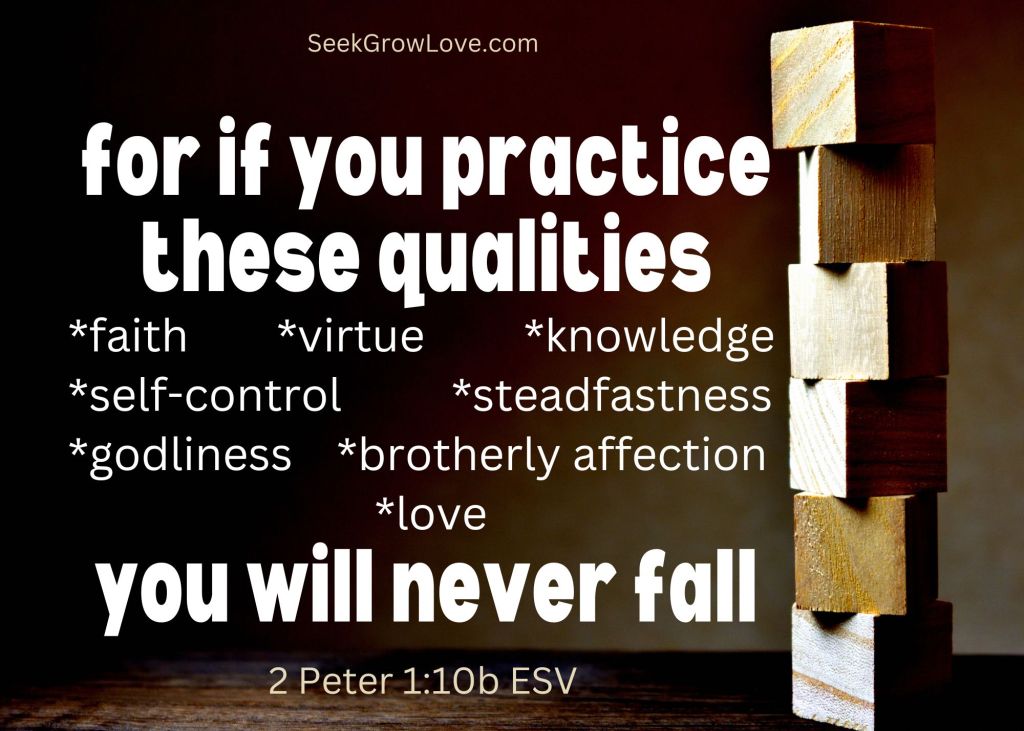
“His divine power has granted to us all things that pertain to life and godliness, through the knowledge of him who called us to his own glory and excellence, by which he has granted to us his precious and very great promises, so that through them you may become partakers of the divine nature, having escaped from the corruption that is in the world because of sinful desire. For this very reason, make every effort to supplement your faith with virtue, and virtue with knowledge, and knowledge with self-control, and self-control with steadfastness, and steadfastness with godliness, and godliness with brotherly affection, and brotherly affection with love. For if these qualities are yours and are increasing, they keep you from being ineffective or unfruitful in the knowledge of our Lord Jesus Christ. For whoever lacks these qualities is so nearsighted that he is blind, having forgotten that he was cleansed from his former sins. Therefore, brothers, be all the more diligent to confirm your calling and election, for if you practice these qualities, you will never fall. For in this way there will be richly provided for you an entrance into the eternal kingdom of our Lord and Savior Jesus Christ.” (2 Peter 1:3–11 ESV)

We have great and precious promises that have been made that will enable us to become partakers of the divine nature! As Jesus put on a new nature in his resurrection from the dead, so shall we when through faith, we endure through life’s many challenges and inherit the promise of the coming Kingdom of God.

Hebrews 11:1 says that “…faith is the assurance of things hoped for, the conviction of things not seen.” As we have faith that God will restore all things (Acts 3:21), upon our faith we must add virtue: meaning good quality of life or uprightness – not simply believing but living out our lives as something that reflects the nature of God’s goodness, justness, and righteousness. After believing and living a changed life, we are to add knowledge to that; we should always be striving to learn from God’s inspired word and learn from his spirit as it is active in us… And more than that, seek after his spirit that we might become more in line with his will and come to a greater understanding of its importance and how beneficial it is to us to walk in his ways.

Following the call to add knowledge, we encounter again the call to be self-controlled! It really does seem that much of what we read in scripture hinges on self-control and that circles back to our need to not stifle the spirit in our lives. If one of the elements that the fruit of the spirit brings forth in our lives is self-control, then we ought to do whatever it takes to drive away any behaviors that might cause God’s spirit to depart from us (Judges 16, 1 Samuel 16). Self-control allows us to endure – to stay on the course – as Paul might say, “to run the race”. We have to endure through all of the challenges and temptations that life throws at us, and we must allow the motivation of our hope, our uprightness, and the self-control that we are enabled to have through God’s spirit carry us through.

As we endure, we ought to have a reverential feeling or devotion to God, that’s what the Greek work translated godliness indicates. As we experience God’s goodness and see how His spirit works in us, we should feel more and more awe and reverence to our creator… After all, He put the plan into place that leads us into a life that transcends the brokenness that sin imparts on our lives – even though we sin and are affected by sin, God’s directives lead us onto a path that (through Jesus) casts that sin aside and draws us into community with him.

And as all these things are ingrained into our life, the part that affects others the most is the cherry on top… We are to have brotherly affection (love) as a defining characteristic in our lives! Love and care for one another as believers will lead us to speak into one another’s lives and help us when we hit rough patches. Even the most spiritually minded people hit dark periods in their lives (google the dark night of the soul). If we love our brothers and sisters in Christ, we will take the time to come alongside them, to care for them, to call them out, to admonish and encourage – brotherly affection means being intimately involved in the lives of our faith family – not being apathetic or half-hearted. We need to invest in each other as Christ has invested in us through his sacrifice (sometimes we must be self-sacrificial).

These qualities keep us from being ineffective witnesses and fruitless workers. We must be bearing the fruit of the word implanted in us (James 1) and strive to be effective ministers to the lives of those who are hurting and struggling. Peter says that whoever lacks these qualities is so nearsighted that he is blind! Yikes… lacking these qualities as I read this means that we cannot see beyond ourselves, and that it a tremendous problem when one of our chief goals is to preach the gospel to all creation.

If we take these qualities to head and practice them diligently it says we confirm our election (or being chosen out) into beneficiaries of the grace of God. Also, it says if we practice these things we will never fall. So, practice these things so that you may have entrance into the eternal kingdom of our Lord and Savior Jesus Christ (v11).

-J.J. Fletcher

Reflection:

1. Think about how Jesus exemplified all these characteristics listed in verses 5-7. If he had not exemplified all these things, would he have had the wherewithal to endure through his father’s plan of salvation through him? How can we expect to live exemplary lives if we do not take these characteristics to heart.

2. Think about the first 6 items listed (faith, virtue, knowledge, self-control, steadfastness, and godliness) and the final one: brotherly affection/love. What do the first 6 produce without the 7th? We’re designed (as individuals and as a church body) to be in community, how might we be rendered fruitless and ineffective if we excel at the 6, but lack the 7th?

Do Good

Hebrews 13

Saturday, October 1, 2022

I get to finish the book of Hebrews today with you, and wow have we covered a lot!  The last chapter is full of little gems like marriage, money, peace, faith, prayer… each are uniquely different, making it hard to write a quick devotional.  So, I’m going to cover the topic that spoke the most to me this week!  You may be drawn to a different aspect of the text, and I encourage you to listen to God’s voice and what He has to tell you versus my own thoughts and ideas.  Hopefully I’ll have something to add though!

I’m going to focus on the relational aspect of this chapter.  Verses 1 and 2 talks about loving others; specifically, strangers.  Now, it may be the “Minnesota-nice” in me, but I seriously love this reminder!  One of my biggest pet peeves is when people are rude to others they don’t even know.  Anytime I encounter someone new who is rude, or even just has a scowl on their face, it automatically turns me off from anything they have to say.

We are told to be examples of Christ, and as Christians, we absolutely are whether or not we think so!  If we are outspoken in our faith, if someone knows you go to church on Sundays, or whatever the situation might be, to anyone we interact with, we are examples of Christianity as a whole.  That is a big responsibility!  These verses are great reminders to love one another and to show hospitality to everyone we meet.  Who knows, maybe you’re loving on an angel!

Skipping ahead just a bit to verse 16, we have another reminder in how to act towards others.  We are told to do good and share with them.  Obviously, this is another way in which we can show the love of God and demonstrate Christianity to new believers.  But, I’ll be completely honest, I’m not always in the best mood to share or do good for other people.  And quite frankly, sometimes people don’t deserve it!  But this verse isn’t telling us to do these things for other people alone.  We are told to offer these things as sacrifices to please God.  Depending on the person, sacrifice might be a good word to describe it!  I think it makes it easier to do good and share if I think of doing it for God versus for man.

Looking at the word sacrifice in verse 16 and the verse directly before that, I am reminded at how the Hebrews originally viewed that word.  Remember, they are still learning that sacrifice no longer has to be the shedding of blood!  That must have been a little confusing to go from sacrifice being blood to being worship and sharing!  This is just another way that shows how drastically Jesus can change our lives.  He took the unclean, messy, death and changed it in to praising God and showing love to others!

We are so incredibly lucky to have a Savior that has changed our world for us.  As a show of gratitude, we can focus on loving one another and spreading the same grace we receive from him to others.  In times like this when our world is hurting from the loss of people to things such as mass shootings, plane crashes, abortions, wars, natural disasters, and so many other horrible things in this life, I encourage you, brothers and sisters, to show a little love.

Grace be with you all!

-Sarah Blanchard Johnson

(originally posted for SeekGrowLove on February 17, 2018)

Application Questions

  1. Reading through Hebrews 13 which of these final instructions is most powerful to you?
  2. How will you share and do good to others this week – remembering that this is your sacrifice which pleases God.

Frozen by Fear. Let Loose by Love.

2 Timothy 1

Sunday, September 11, 2022

The pale princess cowered in the corner of her frigid room. Though she had been living a solitary life for many years for fear of people discovering her secret, Elsa was now summoned from her self-imposed prison for her coronation. 

“Conceal; don’t feel. Put on a show. Make one wrong move and everyone will know…”

If you’ve seen the movie Frozen, you know that Elsa had some sort of mystical power that could create and manipulate snow and ice. She had hidden it for a long time, but a stressful situation at the coronation event caused her to lose self-control, divulging her secret to her entire kingdom and initiating an eternal winter in her kingdom. Afraid that people might turn on her, Elsa abdicated her right to the throne by escaping to the mountains to “let it go”, seemingly embracing newfound freedom resulting from the revelation of her secret. The story continues with ups and downs, laughter and sadness; however, at the end of the movie, Elsa discovers that the way to control her powers is not fear, but rather love! 

What does this have to do with 2 Timothy 1, you ask?  Well, in this letter (which is believed by many scholars to be the last correspondence that Paul penned before his death), Paul is reaching out to his young protege, Timothy. He wants to remind Timothy of the gift of his salvation, and give him some warning and encouragement for the trials that are yet to come as a follower of Jesus.  

Paul begins by reminding Timothy where his salvation journey began, being taught by his grandmother and mother. Paul then reminds Timothy to “fan into flame the gift of God” (verse 6). Elsa squelched her gift, but that is not the way God wants us to live in regards to our salvation. God gave Timothy, and us, a free gift of salvation, and He desires for us to fan it into flame! God longs for us to embrace His gift, to share it with others. What happens to a fire when you fan it, blow on it, nurture it? The fire grows! If you want to have a fire to keep you warm while you’re camping, you have to tend to the fire: replenishing wood as it burns down, blowing oxygen into it to get the fire rolling again, etc. Likewise, we need to actively be nurturing our gift of salvation, tending to our relationship with God each day, and sharing that gift with others, rather than hiding our gift like Elsa did. 

At the conclusion of the movie, Elsa is elated to learn that love, rather than fear, is the best way to manage her powers. Verse 7 continues, “For God gave us a spirit not of fear, but of power and love and self-control.” God’s design does not include us living in a constant state of fear. When we accept His gift, we receive the power of the Holy Spirit to work in and through us. In fact, we normally think of hate being the opposite of love (and sometimes it is), but scripture also indicates that fear and love are opposites (“There is no fear in love, but perfect love casts out fear.” I John 4:18). Paul wanted to remind Timothy to not focus on fear in the difficult times ahead, as God’s gift does not include fear; rather, focus on power (the Holy Spirit), love (God IS love – see I John 4:8), and self control (a fruit of the Spirit, along with love, that is produced in our lives when we are seeking Him).

In verse 8, Paul advises Timothy to not be ashamed to be a follower of Jesus, but to be ready to suffer for the gospel “by the power of God.” God’s power is promised to us even through the suffering, because we were saved and “called to a holy calling”. Just like Elsa’s powers had a purpose (which was further revealed in the sequel), God has a purpose for us, and He wants us to be strengthened and willing to partner with Him – through good times and bad – to fulfill our calling to His purpose. 

I’ll close with this 1883 hymn by Daniel Whittle that some of you might remember, which is based on verse 12: 

I know not why God’s wondrous grace
To me He hath made known,
Nor why, unworthy, Christ in love
Redeemed me for His own.


But “I know Whom I have believed,
And am persuaded that He is able
To keep that which I’ve committed
Unto Him against that day.”

I know not how this saving faith
To me He did impart,
Nor how believing in His Word
Wrought peace within my heart.

I know not how the Spirit moves,
Convincing men of sin,
Revealing Jesus through the Word,
Creating faith in Him.

I know not what of good or ill
May be reserved for me,
Of weary ways or golden days,
Before His face I see.

I know not when my Lord may come,

At night or noonday fair,

Nor if I walk the vale with Him,

Or meet Him in the air.

-Rachel Cain

Reflection questions: 

 – What are some practical steps you can take to “fan into flame the gift of God” in your life? 

– Reflect on some events in your life that led you to following Jesus. How can you use those experiences to encourage others to walk in faith and love instead of in fear? 

A Love Poem

Song of Solomon 2

Friday, July 22, 2022

Song of Solomon contains poetry written by Solomon.  Some people try to spiritualize it, suggesting it describes the relationship between God and a follower of God.  Those who think that have obviously not read it.  Song of Solomon describes the intimate relationship between a husband and a wife, sometimes a little graphically.  If you’ve never read the Bible before, the Song of Solomon just might pique your interest.  I’ll share a few verses from chapter 2.

SoS 2:2 says, “Like a lily among thorns is my darling among the maidens.”  Husbands and future husbands take note.  Highlight what you appreciate about your wife, and make sure she knows it well and often. But the praise must be sincere.  And if it’s appropriate and if she would appreciate it, make sure you extend this praise publicly.  But don’t just stop with praise.  Treat her like she is precious because she is.

SoS 2:4 contains part of the wife’s response, “His banner over me is love.”  All by itself, this sounds pretty weird.  I think this is saying that her husband is publicly proclaiming his love for her – sort of like writing it on a flag, and waving it around for everyone to see.  He is not ashamed to acknowledge her publicly.  Again, husbands take note.

In SoS 2:6, the wife goes on to say, “His left arm is under my head, and his right arm embraces me.”  I’ll leave it to your imagination to consider their position and presumed activity.  Husband’s again take note.  If you shower your wife with love.  If you make her a priority, and she knows it.  If she knows you’re never ashamed of having her at your side.  Things will go a lot better with your love life.

She goes on to say in SoS 2:7, “Do not arouse or awaken love until it so desires.”  I would say that differently.  I would say “save sex for marriage” – and then, it is a wonderful blessing from God for both husband and wife to enjoy to the fullest together.

In his reply, in SoS 2:15, the husband says, “Catch for us the foxes, the little foxes that ruin the vineyards, our vineyards that are in bloom”.  I think the idea here is that there are always little things that can attack the relationship, and these things need to be caught and stopped.  Some examples may include selfishness, pride, never admitting that you are wrong, finding fault, unforgiveness, mistrust, etc.  All of these have to be dealt with and removed in order for the love to blossom and flourish.

In SoS 2:16-17, the wife says, “My lover is mine and I am his; he browses among the lilies.  Until the day breaks and the shadows flee…”.  She is talking about how exclusive the marriage relationship must be.  (Unfortunately, Solomon didn’t do very well in this regard.  Maybe she should have said, “my lover is mine, and I am his and a thousand other women are his.”  Can you imagine how that would make your wife feel – if this wasn’t an exclusive relationship?  Husbands, again take note.

And you have to love that part in verse 17 where she says, “until the day breaks and the shadows flee…”.  It sounds like she is talking about being intimate all night long.  So, husbands, if you want verse 17, you have to have to practice verses 2 and 4 and 7 and 15.  In other words, if you want a great sex life in your marriage, adore your wife.  Let that show in everything you do and in every way you treat her, and you will see results.

Oh yeah, and do the same with your relationship with God, and you’ll see great results there too – both now and forever.

–Steve Mattison

Application Questions

  1. If you aren’t married yet – what is the greatest take-away you found in Song of Solomon 2?
  2. If you are married – what is the greatest take-away you found in Song of Solomon 2?
  3. Why do you think God included Song of Solomon in the Bible?

The Love Chapter

1 Corinthians 13

June 14

“Now these three remain: faith, hope and love.  But the greatest of these is love.”

“They” call 1 Corinthians 13 “the love chapter”.  It’s quoted from at most weddings.  So what is it talking about?  I don’t think it is a coincidence that Paul discusses love and speaking in tongues (a gift involving the ability to speak unique languages), in the same chapter.  Love is difficult to put into words.

In my work as a Funeral Director and Deputy Coroner, I am often at a loss for words.  I frequently have opportunity to speak with families when there is nothing to say.  Nothing that should be said, anyway.  That certainly doesn’t stop some people from trying.  I’ve heard people say all kinds of stuff to try to comfort the grieving.  Most of it, frankly, has no basis in scripture or reality.  Sometimes I wish I had a platitude and cliché bingo card I could pull out of my pocket and shout “BINGO!”.  About the only right thing to do in that situation is nothing at all. 

My father-in-law is a pastor and has served as Chaplain for a local fire department for a number of years and he recently commented during a sermon about how in most situations when the fire department is needed, if the crew showed up and just stood there people would say “Don’t just stand there, DO SOMETHING!” But when it comes to the work of a fire chaplain, the best approach is “Don’t do something, JUST STAND THERE!”  I liked that line.  I have stolen it and shared it with coworkers several times.  When a person has lost everything they don’t need a preacher, they need a presence.  To be able to just be present, is a gift.  (Do you see what I did there?).

As Christians, being confronted with a sudden and unexpected death is like being the pilot in charge of an airplane when the engines stall.  All that is really left at that point is faith, hope and love.  What words of comfort can you give when you know that a person did not have faith in Jesus Christ?  What chapter of systematic theology will you turn to for the family who has no hope in The coming Kingdom?

I said before, our dog is named Zippers due to her urge to chew on our coat zippers.  If we named our children using that method, one of my sons might have been named “Whacko”.  He has always liked to “whack” things with sticks.  When he was two years old we bought him a Sesame Street drum set for Christmas.

It was a pretty cool toy.  It came with a little stool to sit on.  It had a pedal for the bass drum.  It is hard to see in this picture, but there was even a tiny metal cymbal.  Man, did he love to whack that thing!

I honestly don’t know what ever happened to that drum set but I have a feeling it found its way to “a better place”.  The place where all the noisy toys end up.  You know the toys I’m talking about- the Jack in the boxes, the little microphones with the spring inside that toddlers yell…I mean sing into, the Fisher Price Pop “Corn Poppers” that aunts and uncles buy for their nephews as revenge for the year you wrapped up too many candy canes… We’ve all had noisy toys like that.             

Those noisy toys are exactly what I picture when I read 1 Corinthians Chapter 13.  To paraphrase, Paul says all of those gifts of the spirit we just talked about in the last chapter are great.  I’d really like for you to have ‘em, but in the end all that really matters is faith, hope and love.  Of those three qualities, if you only have room for one, choose love because when the rubber hits the road, what people need to know is that God loves them more than anyone has ever loved them.  All the rest is just noise.

-Brian Froehlich

Application questions:

  1. What is the noisiest toy you had as a child?
  2. What is the “noisiest” thing in your life right now?
  3. Have you ever had a friend who was just silently present with you when you needed them? 

Be A Good Neighbor

Romans 13

May 29

For most of my adult life I’ve lived in an apartment and one of the biggest realizations is this: it can be difficult to have neighbors that are so close to you. Rarely have I had quiet neighbors that have totally kept to themselves. I’ve heard the intricacies of arguments that I wish I could unhear. I’ve smelled cooking that was not appealing. I’ve been awakened in the middle of the night to a barking dog or to a loud crash of pots and pans falling out of a cabinet unexpectedly.


It isn’t always fun being a neighbor.


Sometimes it’s challenging to want to be a good neighbor to people because of the way they act. On the other hand, it’s not always as obvious to us that we might be the neighbor that needs some improvement. Being a good neighbor should not be something that we do because it is reciprocated by another person. Being neighborly to others is what God asks us to do despite the way they might treat or think of you.


The biblical concept of being a neighbor goes beyond those who are in our immediate vicinity. It is not just someone who lives in your apartment building or on your street. A neighbor is not limited to someone that looks like you, talks like you, or acts like you. A neighbor is not just someone who is a Christian. A neighbor is not just someone who shares citizenship in the same country as you. The Bible is clear that all fellow humans are our neighbors. This is a concept that Jesus really drove home in a conversation with a Pharisee.


The expert lawman approaches Jesus and asks “what must I do to inherit eternal life?” (Luke 10:25). Jesus then asks for the man’s opinion on what the law has to say about it. The man responds with “Love the Lord your God with all your heart and with all your soul and with all your strength and with all your mind and, ‘Love your neighbor as yourself’” (Luke 10:27). Jesus affirms the lawyer’s answer, but the lawyer had a follow up question: “Who is my neighbor?” (Luke 10:29). The question: “Who is my neighbor?” is not a
question of identifying who his neighbors are but rather who they aren’t. The question that the man is really asking is this: who am I allowed to not be loving towards and still get away with it? Jesus explains in the parable that follows this interaction that being a good neighbor means loving other people regardless of who they are.


Paul in Romans 13 really drives the point home on what it means to love our neighbors.

He says this:

“Let no debt remain outstanding, except the continuing debt to love one another, for whoever loves others has fulfilled the law. The commandments, “You shall not commit adultery,” “You shall not murder,” “You shall not steal,” “You shall not covet,” and whatever other command there may be, are summed up in this one command: “Love your neighbor as yourself.” Love does no harm to a neighbor. Therefore love is the fulfillment of the law” (Romans 13:8-10).

Paul begins his thought on neighborly love by speaking about debt. Paul wants to make it clear that the only thing we truly owe one another is to love one another continually. What a remarkable thought. That’s a type of debt that even Dave Ramsey can get behind!

Paul continues with a list of familiar commandments. The “shall not” list is a list of bare minimums of how we should treat one another. We shouldn’t be killing each other, or stealing from each other, or desiring one another’s possessions. But if we seek to love one another we are truly fulfilling what is required of us: not just scraping by on what’s minimally expected. That’s why Paul finishes up with this thought: “Love does no harm to a neighbor”. We should look to fulfill the highest good to those around us by never seeking to do harm in any capacity. Let us seek the good of those who might not seek our good in return. Let us not repay negatively for what negative things people might have done to us. Let’s take the higher path and accept the greater calling that God has called us to: to love others with no bounds.


Let’s strive to be good neighbors by seeking out the good to those around us. Let us be as loving as possible to others who are different from us. Let us fulfill what God has called us to: to love people no matter who they are or how different they might be. Let’s continually aim to fulfill the high calling of loving others as we love ourselves.


A lot has been said about loving others and seeking the good of those around us, but that is more of an ideal than something to do. Loving those around us in a neighborly way is extremely practical. It could be meeting the needs of someone in your community – whether physical, spiritual or emotional. It could be volunteering at your local food pantry to sacrifice some of your time to help the hungry. It could be spending time after school tutoring someone who is struggling in a subject. It could be performing a service for someone that isn’t physically capable of doing it. It could be spending time with a shut-in who is lonely. It could be discipling someone to follow Jesus. Loving people is an extremely practical act.


Being a good neighbor means meeting the needs of those around you regardless if they return the favor to you. Loving people is an endless job that will never have an end. The world needs strong examples of what it means to be a good neighbor, and it starts with us.

-Nathan Massie


Questions:

  1. What does it mean to be a good neighbor?
  2. Who are some neighbors in your community that need help, and how can you
    help them?
  3. How does being a loving neighbor positively impact your community?

Known by Your Love

John 13

April 10

Do the people you pass in your daily life know that you follow Jesus? Your coworker in the adjacent cubicle, the cashier at the grocery store, your neighbor down the street? How do they know? It’s probably not the length of your prayers, the Bible verses you have memorized, the fancy church jargon you use, or the gourmet casseroles you bring to your church potlucks. 

They will know you by your love. 

“A new command I give you: Love one another. As I have loved you, so you must love one another. By this everyone will know that you are my disciples, if you love one another” (John 13:34-35).

Following Jesus isn’t about knowing the most, but loving the most. 

Love is our faith in action. It might not always make sense to unbelievers, especially in the midst of our self-obsessed culture. 

Love your enemies and pray for those who persecute you (Matthew 5:44). 

Sell your possessions and give to the poor (Luke 12:33). 

Honor one another above yourselves (Romans 12:10).

Look after orphans and widows in their distress (James 1:27). 

Carry each other’s burdens (Galatians 6:2). 

We ought to lay down our lives for our brothers and sisters (1 John 3:16). 

When we love—even when it doesn’t make sense—we show our allegiance to Jesus. He is the perfect personification of love. This week, we celebrate the love he showed on the cross, where he bled and died to win your heart, where he was scoffed at by a world who couldn’t make sense of such great love. 

If we’re followers of Jesus, we’ll do as Jesus did. We’re called to pour even when our cup is empty, to give when it hurts, to expect nothing in return, and to lay down our lives for others. By this, the world will know you belong to Jesus. 

-Mackenzie McClain

Discussion & Reflection Questions: 

  1. Who will you show this nonsensical love to this week? How will you do it?
  2. Loving others cost Jesus his life. What might loving others cost you?
  3. By being known as a follower of Jesus, people will make assumptions about who Jesus is based upon how they see you act. What implications does this have for how you live your daily life? 

Boundaries

Deuteronomy 6

February 19

Love is one of the most powerful things in the world. You love your friends and your church, but most importantly you love your family. God is our father and he gives unconditional love to us. As we should give him this love he also shows us many times in the Bible, that love comes with boundaries and rules. The commands in Deuteronomy 6 show this. In any relationship there has to be boundaries and rules in order for it to be a healthy and loving relationship. These rules, like not putting your lord your God to the test, must be followed. Love comes with these boundaries and rules to have a steady balance. Look at the relationships you have. The love you have with certain people comes with certain boundaries and rules.

-Genesis Dylewski

Questions for Reflection and Discussion

  1. How do you show your love for God? With your heart? With your soul? With your strength? Are there any areas of your life where you feel you should love God more? How so?
  2. What was to be taught to the children? How? Why? How well are you passing along the knowledge of who God is, and how to love and obey Him to the younger generation? What can you do this week and throughout the year to increase your involvement and effectiveness with teaching and encouraging the children and youth in their Christian faith and upbringing? What will happen if we don’t?

Love and Truth

Matthew 15

January 15

We have used the word love to describe Jesus and his ministry many times in the last few days. And that is certainly true. But we would be creating a grievous error if we thought love was all that mattered to Jesus. Jesus’ ministry was about love and truth. Truth and love.

In Matthew 15 (and throughout the gospels) we don’t see a soft and cuddly pushover full of love and open arms. Indeed, Jesus is still love, but that includes love for the truth and love for those being led astray by deceit and human traditions. And sometimes love looks a little harsh when it is armed with truth.

The teachers of the law in Jerusalem were so curious about this Jesus. A delegation was sent to find him and question him. It would have been an 80-90 mile hike, or a 4-7 day journey from Jerusalem to the Gennesaret valley west of the Sea of Galilee. They were committed to this search for answers. How will they be received by Jesus?

There were a lot of Jewish laws and traditions about what to eat and not eat and what needed to be done surrounding the meal (like ceremonial washing of hands). The disciples and Pharisees were shocked to hear Jesus say that it wasn’t what goes into a mouth that makes you unclean, but what comes out of it. The disciples were also a bit surprised, I think, that Jesus answered the Pharisees the way he did, asking him, “Do you know that the Pharisees were offended when they heard this?” (Matthew 15:12). It is certainly NOT our purpose to try to be as offensive as possible when in religious discussion. And, it is wise to remember we don’t have all the wisdom of the Son of God. But, neither ought we be willing to keep the saving truth from those that might disagree with us, just because it would be more polite – or loving – to be silent.

How will you mix love and truth as Jesus did?

-Marcia Railton

Questions for Reflection and Discussion

  1. Jesus warned against following traditions of men that lead you to break the commands of God. What are some examples of how this could happen today? What are the benefits and drawbacks to following the traditions of men? What are the benefits and drawbacks to following the commands of God? Which would you rather follow? What will that look like this week?
  2. When is tradition a good thing? When is it a bad thing? Are there any traditions you are currently following that are not helpful in drawing you closer to what Jesus wants to see in your life?
  3. How can you bring truth and love into the lives of your family and those you are closest to? How can you bring truth and love into the lives of those who may not understand you or may outright oppose you?

The Heart of Christ

Matthew 9

January 9

I believe Matthew 9 gives us an excellent glimpse into the heart of Christ.  Let’s start at the end of the chapter.  Matthew 9:36 tells us, “When he [Jesus] saw the crowds, he had compassion on them because they were harassed and helpless, like sheep without a shepherd.”

Remember these crowds were filled with tax collectors and sinners – people rejected by polite society – people rejected by the religious leaders of the day.  And yet Jesus’ first instinct was that of compassion.  To understand the significance of this, let’s remember that Jesus was the only sinless person ever to walk the face of the earth.  One would naturally think that whatever sins cause us (sinful people) to cringe, would cause Jesus to be horrified.  And yet Jesus had compassion because the people coming to him were harassed and helpless.

If we now back up to Matthew 9:35, we see what he did because of his compassion, “Jesus went through all the towns and villages, teaching in their synagogues, preaching the good news of the kingdom and healing every disease and sickness.”  Jesus was interested in helping these people who were helpless in and of themselves.  He first met their most basic need – their spiritual need – the need to be reconciled with God – by preaching the good news of the kingdom of God.  If all Jesus cared about was people’s salvation, I suspect he would have stopped there.  But in addition to preaching and teaching, he healed every disease and sickness.  This again points out that Jesus was deeply concerned with the people themselves, and cared about what the people cared about – and solved the problems they faced.  The only explanation is that Jesus genuinely loved these “unlovable” people.

Let’s look at some of the other stories in this chapter.  The chapter begins with some men bringing a paralytic to Jesus.  Jesus was so eager to help the man, he didn’t wait for anyone else to even speak, and just jumped in with, “Take heart, son; your sins are forgiven.” – almost as if Jesus just couldn’t wait to help the man.  Jesus jumped right to the most important problem – reconciling this man to God.  Then, to prove he had authority to forgive sins, he demonstrated his power again by completely healing the man.  The crowds were in awe, and praised God.

The next section talks about Jesus’ calling Matthew, a tax collector, to follow him.  Jesus didn’t only tolerate those society rejected, he actively sought them out.  It was at Matthew’s house that Jesus’ enemies accused him of eating (coming in close fellowship with) tax collectors and sinners.  Jesus’ response, in Matthew 9:12-13 was, “It is not the healthy who need a doctor, but the sick.  But go and learn what this means: ‘I desire mercy, not sacrifice.’  For I have not come to call the righteous, but sinners.”  Mercy.  God desires mercy, and Jesus was demonstrating it.  And I would argue that one cannot really demonstrate mercy without first loving the target of that mercy.

The chapter goes on to detail other miracles, including raising a dead girl back to life, healing a woman who had been subject to bleeding for 12 years, and healing two blind men.  All in addition to the summary at the end, saying that he healed every disease and sickness throughout all their towns and villages.

For me, if I had to define Jesus with a single word, based on this chapter, that word would be Love.  Love we can’t even fully comprehend.  God-like love.  

1 John 4:16 says, “… God is love.  Whoever lives in love lives in God, and God in Him.”

John 5:19 tells us, “I tell you the truth, the Son can do nothing by himself; he can only do what he sees his father doing, because whatever the Father does the Son also does.”

-Steve Mattison

Questions for reflection & Discussion

  1. Does Jesus care about the things that concern you?  (Hint:  read Matthew 11:28-30)
  2. If Jesus loved the people of his day, how much must he love you?  
  3. How has he demonstrated his love to you?  
  4. What is your response?
  5. If Christians are supposed to “imitate Christ” what would that look like in your life? (Hint: read John 13:34, Philippians 2:3-8, 1 John 2:6)
  6. How are you measuring up?