An Offer of Life

Ezekiel 32-35

Devotion by Rebecca Dauksas (South Carolina)

The LORD explains so much of His perfect character in Ezekiel. He is merciful, loving, caring and He is just. We continue to see that each person is judged by their conduct and actions. The LORD declares that He takes no pleasure in the death of the wicked, but wants the wicked to turn from their evil ways and live. He warns to “turn back, turn from your evil ways!” The LORD offers life. The LORD sends the message that true repentance brings forgiveness. Ezekiel gives good news to the one that repents and lives for God. “None of his sins that he has committed will be remembered against him. He has practiced justice and righteousness; he shall surely live” (33:16).

Not only does the LORD offer life, but life with Him.  In chapter 34, He gives us this beautiful description of a caring shepherd. The LORD cares for and gathers His sheep. “I will feed them in a good pasture, and their grazing ground will be on the mountain heights of Israel. There they will lie down on good grazing ground and feed in rich pasture on the mountains of Israel. I will feed My flock and I will lead them to rest,” declares the Lord God. “I will seek the lost, bring back the scattered, bind up the broken and strengthen the sick” (verses 14-16a). What a wonderful description of our Good Shepherd.

So why didn’t the people listen to their watchman, Ezekiel? He was giving them the warning against their evil practices and the instructions to turn to the LORD for life. Instead of hearing God’s message, they acted as if Ezekiel were some kind of entertainer. They encouraged each other to come and hear what God’s message was, but just showing up was not enough. The people heard the words, but they did not put them into practice. We are told that they did the lustful desires expressed by their mouth, and their hearts went after their own gain. The LORD told Ezekiel, “Indeed, to them you are nothing more than one who sings love songs with a beautiful voice and plays an instrument well, for they hear your words, but do not put them into practice.” (33:32)

I hope that is never said of us. We want to take in the LORD’s message. We will heed the watchman’s warnings and receive the blessings that God offers. The greatest is to always be in His presence. In the presence of our Good Shepherd there will be showers of blessing. (34:26)

Reflection Questions

  1. How have you responded to the LORD’s offer of life? Are you hearing the words but not putting them into practice?
  2. What warnings do you think Ezekiel (or any modern messenger for the LORD) would have for you today? What role does repentance play?
  3. Is there a time/place God is asking you to be a watchman?
  4. Do you spend time in the presence of the Good Shepherd? How? How could you remain in His presence more? What are some of the blessings found there?

Clean the Pot

Ezekiel 24-27

Devotion by Rebecca Dauksas (South Carolina)

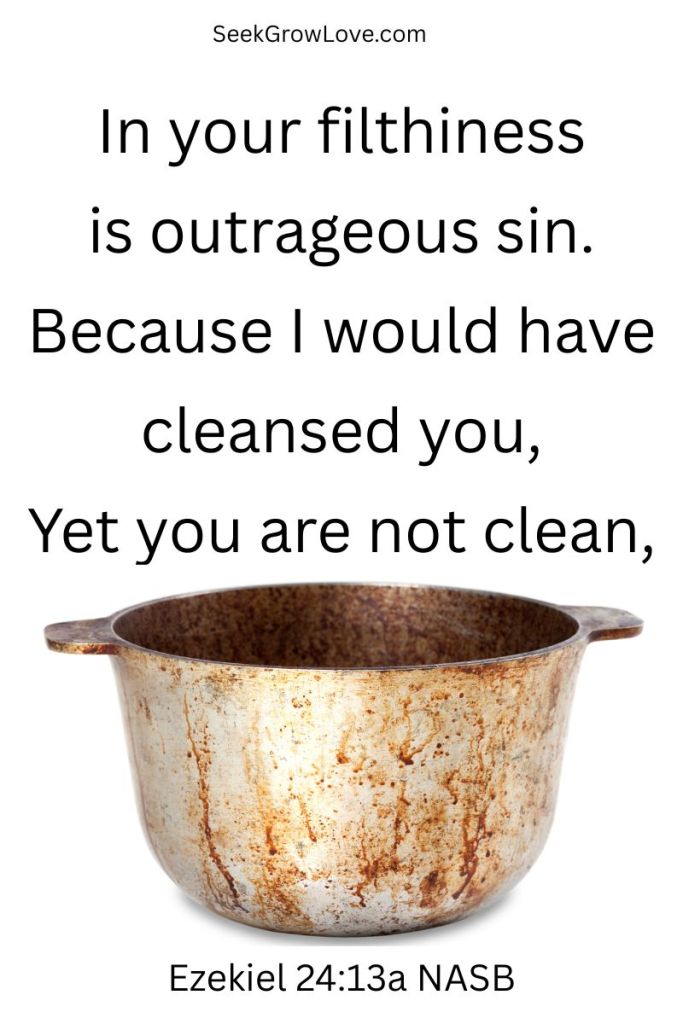
Today I scrubbed out our cast iron skillet. It would have been easier the night before, but I put this task off until today. It reminded me of our reading from Ezekiel 24. The parable for the Israelites contains a dirty, rusted boiling meat pot destined for cleansing by destruction. The pot was symbolic of Jerusalem. Ezekiel once again shares what the Sovereign LORD has said by telling his people this parable. The king of Babylon has laid siege to Jerusalem. The LORD shows the people what will happen if they continue in their evil practices. The LORD refers to Jerusalem as the city of bloodshed. When faced with a warning that severe negative consequences including death for many will follow their actions, we would think that they would stop sinning. We want the people to repent, to turn to God and accept His deliverance and His salvation. Unfortunately, they do not. 

That nasty stuff in the pot should have been removed long ago, but the people continued in their sins. We could compare the rust of the pot to the bloodshed that had taken place in Jerusalem. God had seen the killing and wounding of others in this city of blood. All the actions of the people were in full view for God. He also states that their impurity was lewdness. They did detestable acts and committed adultery. They chose indecent, obscene behaviors rather than allowing God to clean out all that crud.  They should have been filled with shame and repentance, but they openly committed their sins. The scripture tells us that the LORD tried to cleanse them, but they would not be cleansed. They were told, “You will be judged according to your conduct and your actions,” declares the LORD. 

The people of Jerusalem would not turn from their sin, but we can. We can recognize when we fall short and confess our sin. After all, He is faithful and just and will forgive us our sins and purify us from all unrighteousness. So God can make us a “vessel for honor, sanctified, useful to the Master, prepared for every good work.”

Reflection Questions

  1. What sins has Ezekiel mentioned in his book? What does God not like about them?
  2. Why do you think God is giving warnings before the punishment comes?
  3. What sins do you think God sees today – in you – that he would (or is) sending you a warning about? And what sins in the world around you?
  4. What would the cleansing process look like if we turn to God? What would the cleansing process look like if we don’t?

Who Will Stand in the Gap?

Ezekiel 21-23

Devotion by Pastor Jeff Fletcher – originally posted for SeekGrowLove on March 25, 2017, for Ezekiel 22-23.

Throughout Ezekiel there are certain themes that keep circling back around: God’s judgment against Jerusalem, Israel’s unfaithfulness to God.  In today’s reading we see another very graphic depiction of Israel’s immorality.  This time, it’s the northern kingdom of Samaria and the southern kingdom of Judah. They are likened to two sisters who prostitute themselves.  They again perform lewd acts shaming themselves before their neighbors.  It’s very sad, indeed.

God searches for someone to help:  “I looked for someone among them who would build up the wall and stand before me in the gap on behalf of the land so I would not have to destroy it, but I found no one.”  God could find no one righteous to fill the gap and act as the mediator between God and His people.

We know the Gospel, the good news of Jesus Christ and God’s Kingdom.  One day, Jesus would stand in the gap to keep God from destroying the earth.  Jesus on the cross fills the gap between a holy God and a sinful people.

I hope that these devotions from Ezekiel will help you to see some important truths with greater clarity.  God loves His people very much.  God wants His people to be faithful and obedient. Some are and some aren’t.  When His people are unfaithful, God brings calamity and judgment, in order to turn people’s hearts back to Him.  It’s not the judgment that ultimately turn hearts, but it’s the fact that despite all of our wicked acts that deserve punishment, God is faithful to His promises and His steadfast love remains.  Ultimately, it’s God’s mercy that leads us to repentance.  May you know His love and His mercy through Jesus Christ, the man who did stand in the Gap for us.

Reflection Questions

  1. What are the main themes of Ezekiel? How can we learn from them?
  2. How does Jesus, a mediator to fill the gap, change the relationship between God and His people? How has it impacted your relationship with God?

Consequences for Evil Overflow

Ezekiel 18-20

Devotion by Pastor Jeff Fletcher – originally posted for SeekGrowLove on March 24, 2017, for Ezekiel 20-21.

In Ezekiel 20 God reviews Israel’s history.  Over and over God provided for His people, over and over He warned them to get rid of their idols, keep His commands and observe His Sabbaths.  Over and over Israel failed to obey God and experienced the consequences.  Over and over God was compassionate and loving and forgave His people and restored them to blessings.

Israel has repeated this history again.  They failed to get rid of idols, they failed to keep his commands and observe his Sabbaths, and now they were about to experience the consequences of their sins.  God would once again treat them with mercy, not as their sins deserved and restore them to their land.

Ezekiel juxtaposes God’s promise to be merciful and restore His people with the threat that His judgment is coming and that both the evil and the good will be cut off from the land and the city and the temple.  Yes, everyone will suffer the consequences of the evil behavior of some.

There is tension throughout Ezekiel.  The wicked will suffer for their sins and the righteous will not suffer, except that at first they will suffer for the sins of others.  Sometimes when God brings his judgment designed to bring people to repentance there is collateral damage.  Good people suffer when bad people sin.  It’s how it was then, it’s still how it is today.  God’s salvation is coming, earth will one day be restored and made whole and good, but in the meantime, good people will suffer alongside the wicked.  Christians are martyred in places like Pakistan and Syria.  Christians sometimes suffer persecution in the United States.  Trials may come to God’s people during times of judgment, but those who trust God and repent of their sins will be saved.

Reflection Questions

  1. How often do we fall into the same cycle of disobedience that the Israelites followed for generations? What can be done to help break the cycle for you personally?
  2. How does God’s mercy and justice coexist throughout Ezekiel and today?
  3. What trials are you willing to persevere to avoid disobedience to God?

God of Mercy. God of Justice.

Ezekiel 16-17

Devotion by Pastor Jeff Fletcher – originally posted for SeekGrowLove on March 23, 2017, for Ezekiel 17-19.

God used the King of Babylon, Nebuchadnezzar to enact His judgment against Israel.  He carried off King Jehoiachin and 10,000 nobles to Babylon and installed Zedekiah to act as his vice regent or king in Jerusalem.  The prophet Jeremiah warned Israel that this was God’s judgment and that the exiles would not return from Babylon until the people repented.  But the people didn’t listen and false prophets gave Israel false hope that Babylon might soon fall.  So Zedekiah broke his treaty with Nebuchadnezzar and made an alliance with Egypt.   This led to a revolt against Babylon.  Nebuchadnezzar crushed the revolt.   Eventually, Jerusalem fell to Nebuchadnezzar and King Zedekiah and family were carried back to Babylon where they faced Nebuchadnezzar’s wrath.  Zedekiah had his eyes put out and his sons were executed.  Israel did not repent quickly nor easily, and because of her stubborn disobedience they continued to suffer.

In Ezekiel 17 God chose to use the allegory of an eagle plucking up the top of a cedar and then replanting it to depict His judgment against His people and to remind them of His power to build and His power to destroy.

In Ezekiel 18 God gives a very clear teaching to His people on the nature of sin, righteousness, judgement, repentance and forgiveness.  Each person is responsible for their own actions.  Parents are not held responsible by God for the sins of their children, and children are not held responsible by God for the sins of their parents.  Each person is responsible for their own behavior.  In the same way, you don’t get credit for your parents good behavior if you do bad.  Each person is responsible for their own sin and will be judged accordingly.

There is good news imbedded in Ezekiel 18.  God doesn’t take any pleasure in seeing wicked people die.  God wants to see people who do evil turn away from their evil.  God wants everyone to repent.  If an evil person repents, God will not punish them.  If a righteous person turns evil, they will be punished for their evil behavior.  God is a God of both mercy and justice.  He will punish unrepentant evildoers and he will forgive and restore those who repent of their evil.  This chapter is best summarized in the final three verses:  30 “Therefore, you Israelites, I will judge each of you according to your own ways, declares the Sovereign Lord. Repent! Turn away from all your offenses; then sin will not be your downfall. 31 Rid yourselves of all the offenses you have committed, and get a new heart and a new spirit. Why will you die, people of Israel? 32 For I take no pleasure in the death of anyone, declares the Sovereign Lord. Repent and live!

In Ezekiel 19, there is a lament for the end of the Messianic dynasty that came from David.  Since the time of David, his descendants, beginning with Solomon reigned as Kings over Israel.  But that has been brought to an end.  There were no more descendants of David serving as the Lord’s anointed over Israel.  Of course, we have the benefit of hindsight.  We live on this side of the New Testament.  After several hundred years of NOT having a descendent of David as King of Israel, one was finally born in Bethlehem and his name is Jesus.  One day, Jesus will sit upon the throne and rule over not only Israel, but all the earth.  In the meantime, we have a choice, we can turn away from our sins and turn to God, or we can face the judgment.  Jesus Christ is God’s provision for our salvation.  We go to him to get a new heart and a new spirit.

Reflection Questions

  1. Why did God provide an allegory for the people in Ezekiel 17?
  2. How often is suffering directly or indirectly an effect of disobedience to God or a lack of repentance?
  3. Is it easier or harder to read, study, believe, and live out the Old Testament teachings now or before the New Testament was written? What are the advantages to each side? How can that impact how we read the Bible today and how should we respond?

Idolatrous Attachments

Ezekiel 5-8

Devotion by Pastor Jeff Fletcher – originally posted for SeekGrowLove on March 20, 2017, for Ezekiel 5-9.

This portion of Ezekiel is, admittedly, difficult to read.  It’s a pretty graphic account of God impending judgment against the city of Jerusalem and his people, Israel.  God tells Ezekiel to shave his head and beard.  This would have been an act of mourning for most people, but it was double disturbing for Ezekiel, since he was a priest and normally forbidden from shaving his head or beard.  Ezekiel was told to burn, take a sword to, and scatter his cut hair.  This was to symbolize what was to happen to Israel.  A few hairs were kept back, symbolic of the remnant who would not be destroyed.

God accuses his people, Israel, the chosen nation, of being worse than the other nations.  They broke the law more than the nations that did not have the law.  God was bringing his judgment against His own people.  The description of the siege almost defies comprehension, including cannibalism of both parents and children.  This was to serve as a warning to the other nations: if this is how God treats his own people for their idolatry, beware of what he will do to you.

In Ezekiel six God makes it clear that their judgement is upon them because of their idolatry. However, there is a remnant that will be spared and live in captivity and will come to repentance.

In Ezekiel seven, a special emphasis is made regarding their idolatrous attachment to gold and silver.  This wealth that they turned to and fashioned into idols will be unable to save them from the coming judgment.  All the money in the world can’t save you from judgment.

In Chapter eight Ezekiel has a vision of the temple in Jerusalem.  This includes the “Idol of jealousy” which we discover is the pagan god Tammuz.  Tammuz was the Sumerian god of food and vegetation.  At the summer solstice there was a period of mourning as the people saw the shortening of days and the approaching drought.  Sacrifices were made to Tammuz at the door of the Jerusalem Temple.  This was an absolute abomination to Israel’s God, YHWH as He made it clear that He alone was to be worshipped as God (see Deuteronomy 6:4-5).

In Chapter Nine an angel is sent out to put a mark on all of the people of the city who did not commit idolatry and worship Tammuz.  They would be spared.  But then all those who did not receive a mark would be destroyed.  This is reminiscent of the story of Exodus, when the doorposts of the Israelites were to be marked with the blood of the sacrificial lamb, and those with the mark were spared their firstborn sons dying when the Angel of Death passed over their houses.  It also points to the future (See Revelation 13) when the beast will cause people to have a mark on their forehead or they would not be able to buy or sell.  This is contrasted with those in Revelation 14 who have the name of God and of the lamb on their foreheads.

God is a God of love and mercy.  God has provided a means for us to be rescued from the consequences of sin.  There is a way for each of us to be spared the final judgment of God that is coming.  Jesus Christ, the lamb of God is the only means by which we can escape judgment.  Along with God’s mercy is His holiness.  God will not allow sin and rebellion to continue on earth forever.  A day of judgment is coming for all the earth just as it did for the nation of Israel.  God tolerated their sin for only so long, and then came the time for judgment.  Mercifully, God spared those who repented by placing His mark upon them.  God has been tolerating sinful rebellion on earth, but a day is coming when He will destroy sin and sinners who have not repented and turned away from their sins and turned to him through Jesus Christ.  Ezekiel’s harsh imagery should remind us that we must not forget that God’s wrath is coming from which we all need to escape, and we need to warn others.  This won’t make us popular, but doing God’s will is seldom popular among the rebellious.

Reflection Questions

  1. What idols are present in the world today? And in your life?
  2. How does God’s love and mercy work with His justice?
  3. Has popularity ever been an idol for you over God’s will? When have you chosen popularity over God’s will? When have you chosen God’s will over popularity?

Pride Falls, But the Humble are Restored

Jeremiah 49-50

Devotion by Dustin Farr (South Carolina)

If you have been following along this week, today’s chapters may feel familiar. Once again, God speaks judgment over the nations. But this time there is a shift. In chapters 46–48, the focus was on nearby nations. In today’s reading, in chapter 50, the scope widens, and the spotlight turns to Babylon, the strongest empire of the day and the very nation God had used to discipline Judah.

Babylon’s fall was not just another victory in history. It was the fulfillment of what God had told Habakkuk earlier in our readings: the oppressor would not go unpunished. Their idols, walls, and armies would crumble, and their pride would be exposed. What made this moment unique was that the fall of Babylon also marked the beginning of Israel and Judah’s restoration. God promised they would return together, seeking Him with repentant hearts, and He would renew the covenant they had broken.

For us, the lesson is clear. Pride and worldly security can feel unshakable, but they cannot stand when God moves. True safety is found in humility before Him. As Jesus said, “For whoever exalts himself will be humbled, and whoever humbles himself will be exalted” (Matthew 23:12). The same God who brought down Babylon can rebuild what is broken in our lives if we turn to Him in humility and trust.

Reflection Questions:

  1. When God promised the fall of Babylon, it seemed impossible to those living under its power. How does this challenge your view of what is “too big” for God to change today?
  2. Israel and Judah’s restoration was tied to turning back to God with weeping and seeking. What would it look like for you to return to Him in a season where you feel far away?
  3. Babylon’s downfall shows that no one is beyond God’s reach. How can this truth shape the way you pray for people or situations that seem unchangeable?

A Time to Uproot – THEN – A Time to Plant

Jeremiah 32-34

In today’s reading in Jeremiah 32-34, God is furious with His people and promises to punish them. It won’t be pretty for a while, but eventually God’s love and mercy makes it back on the scene. We learned in yesterday’s reading how important God’s discipline is for shaping our character and turning us back to Him. I hope whoever is reading this realizes that you are never too far gone from God’s love and mercy. Yes, He might teach you a lesson to help you learn from it, but true repentance will lead to restoration. God will not stay mad at you if you choose to turn from your sinful ways. Maybe you’re holding back because you feel so embarrassed and humiliated at your poor choices and feel completely unworthy of God’s love. Maybe you feel like the prodigal son sheepishly returning home and expecting your father’s wrath, but you’re so desperate you will work as a servant in order to survive. Maybe you’re afraid you’ll receive a cold and resentful reception like the older brother gave the prodigal son. Don’t let fear of others’ judgment of you stand in the way of restoring your relationship with your Heavenly Father. His opinion of you is the only one that truly matters.

We can take comfort in God’s character revealed in 33:26 “…For I will restore their fortunes and have compassion on them.” God will meet your repentance with compassion and restoration, but you first have to face the reality of your sin and the damage it has done to your life and your relationship with God. 

-Kristy Cisneros

Reflection Questions

  1. What are some of the consequences of sin in your life? Have you experienced a time when your own personal true repentance has led to restoration? What might that look like – both today and in the future?
  2. How does God’s justice and mercy work together?
  3. Realizing there are still consequences for sin, how might God expect us to mirror His mercy to the repentant? How can your justice and mercy work together?

He Hears. He Disciplines. Because He Loves.

Jeremiah 30-31

I was especially struck by several verses in today’s reading. In chapter 31 verse 18 we read,

“I have surely heard Ephraim’s moaning:

    ‘You disciplined me like an unruly calf,

    and I have been disciplined.

Restore me, and I will return,

    because you are the Lord my God.

God heard their moaning. I find great comfort in that the creator of the universe cares enough about us to hear our moaning. He also cares enough about us to discipline us for our own good. Hebrews 12:7-11, 

7 It is for discipline that you have to endure. iGod is treating you as sons. For what son is there whom his father does not discipline? 8 If you are left without discipline, jin which all have participated, then you are illegitimate children and not sons. 9 Besides this, we have had earthly fathers who disciplined us and we respected them. Shall we not much more be subject to kthe Father of spirits land live? 10 For they disciplined us for a short time as it seemed best to them, but he disciplines us for our good, mthat we may share his holiness. 11 nFor the moment all discipline seems painful rather than pleasant, but later it yields othe peaceful fruit of righteousness to those who have been trained by it.

We all fall short of the glory of God and we will struggle many times to do what is right. When we recognize that we have strayed, we must repent and turn away from that sin. Jeremiah 31:19 gives a great example of what repentance looks like in action:

19 

After I strayed,

    I repented;

after I came to understand,

    I beat my breast.

I was ashamed and humiliated

    because I bore the disgrace of my youth.’

Verse 20 is perhaps the most poignant of all:

20 

Is not Ephraim my dear son,

    the child in whom I delight?

Though I often speak against him,

    I still remember him.

Therefore my heart yearns for him;

    I have great compassion for him,”

declares the Lord.

I don’t know about you, but my eyes fill with tears and I get goosebumps on my arms at the thought of God’s heart yearning for His people and Him having great compassion for us. Though he must discipline us at times, He does so out of His great love for us!

-Kristy Cisneros

Reflection Questions

  1. How do you view God’s discipline? Is there a time(s) you feel God disciplined you? Why do you think He disciplines – in that case, and in general? Or – asked a different way – Does a Good God discipline? Explain.
  2. What role does repentance play? What feelings come with repentance in Jeremiah 31:19?
  3. What do you love about God’s love? How would you try to explain it to somehow completely new to the concept of a loving God (who disciplines)?

Running with Their Message

Jeremiah 23-25

Jeremiah’s heart was broken over the ungodliness and wickedness he witnessed among God’s people. As noted in 23:11, the priests and prophets were particularly godless. Their wickedness was so immense that God compared them to Sodom and Gomorrah. The prophets were not speaking inspired words, but rather what came to their own minds. I can’t help but wonder if these prophets told the people simply what they wanted to hear. In other words, they were good old fashioned con artists. My mind immediately went to the concept of today’s prosperity gospel and how preachers like Joel Osteen tickle the ears of the people with assurances that God wants you to be wealthy. Or there are even pastors who justify, minimize or normalize sins that are clearly spoken against in God’s word. God issues a clear warning in Jeremiah 23:16-17 about not listening to those who are sharing their own ideas as opposed to God’s inspired word.

16 This is what the Lord Almighty says:

“Do not listen to what the prophets are prophesying to you;
    they fill you with false hopes.
They speak visions from their own minds,
    not from the mouth of the Lord.

Someone who is truly sharing the word of God will compel people to repent of their sins and turn toward God. Be wary of anyone who always tells you just what you want to hear.

22 

But if they had stood in my council,

    they would have proclaimed my words to my people

and would have turned them from their evil ways

    and from their evil deeds.

To whom are you listening? If those people are making you feel complacent with your sin, encouraging you to follow after ungodly things or not make the kingdom of God a priority, then you know that they are leading you astray and that will have dire consequences if continued. 

32 Indeed, I am against those who prophesy false dreams,” declares the Lord. 

“They tell them and lead my people astray with their reckless lies, yet I did not send or appoint them. They do not benefit these people in the least,” declares the Lord.

– Kristy Cisneros

Reflection Questions

  1. How do you discern what is a godly message and what did not come from Him?
  2. When have you seen people chasing after a message that did not come from God?
  3. To whom are you listening?
  4. How can your words better align with God’s message? What would God have you say, and to whom?