The Father’s Child

Old Testament: Hosea 10 & 11

Poetry: Psalm 125

New Testament: Matthew 11

I was touched by the beautiful imagery of the LORD calling to Israel as a child. Teaching him to walk and taking him into His arms. Here the LORD is also leading with kindness and bonded to His people in love. And I can just imagine a compassionate care taker releasing an animal from its burden-taking off the bridle and bit to allow the animal to freely eat and drink. The love and compassion of God are so evident in these passages. But Israel’s obstinance is also evident. These collections of poetry are calling out again to the people. Turn to God, do what is right and be saved. God desires for people to come to Him to be healed, forgiven and saved, but as we have seen over and over, the people continued to reject Him.

We are told what the result is, “Because there is no faithfulness or kindness or knowledge of God in the land. There is swearing, deception, murder, stealing and adultery. They employ violence, so that bloodshed follows bloodshed. Therefore, the land mourns, and everyone who lives in it languishes (4:1-3a)”. It is disturbing that this scripture could be describing parts of our own country today. But the poetic words of the prophet Hosea still speak through this book. Telling us about the LORD’S perfect character and His justice. We still hear a main theme of not rejecting, but accepting and remaining faithful to our God. How horrible to become stubborn and self-willed against the Only True Living God. That is a place that we never want to occupy. Unfortunately, I know that we could name some individuals who have turned away and have chosen lives that are in complete opposition to God. But we want to be those that faithfully hold to God. Hosea 14 describes it this way, “Whoever is wise, let him understand these things; Whoever is discerning, let him know them. For the ways of the Lord are right, and the righteous will walk in them, but transgressors will stumble in them (v.9)”. Hosea explains that someday the sons of Israel will return and seek the LORD their God; they will come trembling to the LORD and to His goodness. It is incredible that we can know, walk with, and most of all be in a loving relationship with Him right now.

-Rebecca Dauksas

(originally posted for SeekGrowLove on November 4, 2022)

REFLECTION QUESTIONS

  1. How is your nation like Israel? How are they different from Israel? How are you like Israel? How are you different from Israel?
  2. How would you describe God as a parent?
  3. How will you respond as His child? When have you been rebelled against Him? What is His desire for You?

The Implications of Living in God’s Love pt. 2 

Old Testament: Jeremiah 33 & 34

Poetry: Proverbs 20

New Testament: 1 John 3

“For this is the message that you have heard from the beginning, that we should love one another.” 1 John 3:11 

Implication #2: we must love one another 

Children of God 

There is an expression you may have heard that goes something like “the apple doesn’t fall far from the tree”, which is usually used to mean that a son is quite like their father in one or many ways. Sometimes it is used to praise someone who has shown virtue, other times it is used to lament how vices are handed down like heirlooms no one wants. John, similarly, calls those who have virtue from living in the love of God, children of God.  

As we can see from 1 John 3:1 and will see again tomorrow in 4:19, God’s love initiates our ability to be His children. God loves us, calls us to become a part of His family, and leaves it to us to respond positively to this call or to reject it. When we accept this call, we are not immediately transformed into a full-fledged twin of Jesus (the perfect son of God). As John points out in 3:2 what we will look like once God’s love has completed its work in us is not known. We have only seen God through mediators. One day that will change, and we will be like Him–which is an exciting and terrifying notion.  

In the meantime 

While we don’t know what we will be like in the future, John tells us what the love of God means for how we live now. We are to love one another. At the very least this means we must love those who are within the body of Christ. Some would like us to stop there. At times it seems an insurmountable challenge. However, an argument could be made and perhaps should be made that the child of God should love everyone. This is the view I hold. To paraphrase Jesus: “even the wicked take care of their own” (Matthew 5:47). The follower of Christ, however, is to love everyone. After all, God causes the sun to shine on the good and the bad (Matthew 5:45) and Christ died to save those who needed saving—that is to say, EVERYONE.  

The question of how to love 

Once one becomes a Christian and understands the need to love, the necessary question of how to love will follow. John anticipates this question and gives the answer: love how Jesus taught to love (3:23). When we love the way Jesus taught (and how he himself loved), it will show that we are the children of God and will keep us abiding in God.  

The question of how we can possibly love like Jesus 

Knowing that we should love like Jesus will not mean that we will love like Jesus. In fact, simply trying to do so will only lead to the frustrating realization that we can’t. That is to say, the apprentice will never be able to outdo the master so long as they remain an apprentice. Maybe thinking about it this way isn’t helpful since it seems hard to believe we will ever reach the same level of righteousness as Jesus–at least not while the world is still unredeemed. Maybe this is why John mentions the bit about not knowing what we will be. However, John does hint at how we can love in the way Jesus did: by the spirit of God within us. Only when we have the spirit of God working through us can we love as Jesus loved. This is the only way we can love our neighbors, love our enemies, and love our brothers and sisters in Christ.  

There’s one more implication of living in God’s love I want to mention, but it will have to wait until tomorrow.  

-Joel Fletcher

Names

Old Testament: 2 Kings 3 & 4

Poetry: Psalm 128

New Testament: Ephesians Intro – coming this afternoon because sometimes two posts are better than one

When we decided to name our children, I thought long and hard about the meaning behind each of their names. It was more than picking a cute name out of a book, or making sure they weren’t one of eight of the same-named kids in their class, or avoiding mispronunciations throughout the whole of their life.  My thoughts were more along the lines of a Bible name.  Well not directly from the Bible, like my names Aaron & Jonathan, but something with a deep, and sometimes, literal meaning.  For example: 

Adam – Son of the earth

Moses – Taken from the water 

Esau – Red & hairy

David – Beloved

Peter – Rock

Yeshua (Jesus) – Deliverer.  

What qualities would their name evoke or how might their name be prophetic?  We ended up landing on Oliver Ace – Peace & unity, Matilda Claire – Strength & clarity,  and Violet Lou – Wisdom & esteemed.  While each of their fulfillments is to be determined, I believe that God, indeed, has a plan for their name. 

Watching the actions of Elisha throughout the course of 2 Kings, we see time and time again the fulfillment of the name to which he was called, “God is Salvation.” In Chapter 4, as a vessel of God in faith, Elisha provides for a widow, saves prophets from being poisoned, feeds 100 with scraps, and brings a child back to life.  In each of these instances, God, through his agent Elisha, is salvation.  God will provide when you are in need.  God will save you from harm.  God will use your offering to multiply the blessing.  God will raise your very life from the grave.  Elisha is aptly named.

What is your name?  Yes, your name may have a rich meaning, or it could be you were named after your mom’s favorite band that had two hit songs and then was never heard from again.  It could be you were named Hannah, not because your parents wanted you to have favor or grace, but because your dad was obsessed with palindromes. It might be impossible to live out these names in such a way, and it could be that my own children’s names are simply names.  So instead, let us take time to focus on the names which God calls those who put their hope and trust in Jesus Christ:

A chosen generation & royal priesthood: “But you are a chosen generation, a royal priesthood, a holy nation, His own special people, that you may proclaim the praises of Him who called you out of darkness into His marvelous light.” – 1 Peter 2:9

Children of God: “See what great love the Father has lavished on us, that we should be called children of God! And that is what we are! The reason the world does not know us is that it did not know him.” – 1 John 3:1

Heirs: “If you belong to Christ, then you are Abraham’s seed, and heirs according to the promise”. – Galatians 3:29

His workmanship: “For we are His workmanship, created in Christ Jesus for good works, which God prepared beforehand that we should walk in them.” – Ephesians 2:10

Mine: “I have called you by your name. You are mine.” – Isaiah 43:1

These names, as well as many, many more (redeemed, blessed, chosen, victorious, etc.) become our prophecy, our inheritance, and our fulfillment. May God bless us all to fully live out the calling of our names, much like Elisha.

-Aaron Winner

Reflection Questions

  1. Does your name have a calling you are trying to live out? If you could choose any name for yourself – or your children – what would you choose and why?
  2. What do we learn from Elisha about himself and about his God? What do people learn about you and about your God from watching and knowing you?
  3. Which of the names God has chosen for those who chose Him and His Son mean the most to you? Why? What does it show you about God?

Even Your Enemies

Luke 6

Tuesday, December 13, 2022

Luke 6 is an instruction manual for Christ-followers; if you desire to live for him, these scriptures lay out how to do it. However, a lot of his words of guidance completely contradict what our instincts tell us, and what the world around us accepts as the norm.


We’ve all heard it many times before: love your enemies. Three words so commonly spoken within the church, but rarely fully absorbed. By habit, we show abounding love and affection towards the people in our lives who are close, and easy to love; to our family, our friends, the people we “click” with. But when it comes to the people we face who are difficult to even be around, how do you know how to begin showing them love in the same way we show love to those with whom it comes naturally? It often goes against every fiber of our being. But that’s the world in us, not God.


“Do not conform to the pattern of this world, but be transformed by the renewing of your mind. Then you will be able to test and approve what God’s will is—his good, pleasing and perfect will.”
Romans 12:2


As children of God, we live in this world, but we are not of it. To step out of the patterns of the world and into the lifestyle described in the Bible is to free yourself from the enslavement of sin. Because we are in such close proximity to ideas and actions that contradict God’s will for us, it’s so easy to fall into the trap that pulls us farther away from God. But we are not of the world, we
are of God, and our God is a God of love; He is the very definition of Love. To embody true, pure, godly love is to love all people, and to show it in your actions, in how you speak, and in everything you do. God’s love knows no bounds, it is limitless. It seeps into every space that allows room for it, and fights to get into every space that is full, flowing endlessly in every direction. It’s a love that isn’t “fair,” it isn’t earned. It isn’t exclusive, and it never runs out.


This is the love that we are to allow into our lives, the deepest form of love that cannot be found anywhere outside of God. And when we have that love in our lives, we are to show it to everyone around us, no matter who they are, whether friend or foe. It’s a light that doesn’t go out and never stops shining. By this love, Christ lives in us.

-Isabella Osborn

Reflection Questions

  1. What does Luke 6:35 mean to you? Does it fill you with hope and enthusiasm?
  2. How can you show God’s love to those you don’t normally feel obligated to show love to?
  3. What are some differences in how “even sinners” love (Luke 32-34), versus how we (as sinners, but also followers of Christ), are to love?

The Path to Life

Tuesday – May 25, 2021

1 Kings 1-2, Acts 22

1 Kings opens up with David’s final moments. His health begins to decline as turmoil grows in his kingdom. David’s sons had a history of defiance and wrongdoing, culminating in the story of Absalom’s revolt described in 2 Samuel 15. Absalom dies, and David mourns for him. In 1 Kings, we meet another of David’s sons, the next in line after Absalom – Adonijah. Adonijah is the heir apparent, the oldest surviving son. He begins to exalt himself in 1 Kings 1:5, saying “I will be king!” This Lion King-esque refrain has a darker tone to it. Adonijah was never truly promised the throne, and at the time he was saying this, his father was still alive. Instead of waiting for a peaceful transition of power, Adonijah seizes the moment of David’s weak health and begins amassing forces to take the kingdom by force. Adonijah’s greed for power leads to sin and death, as the revolt eventually spirals into his own demise. 

Adonijah walked down the path of foolishness. His rash actions were compounded by sinfulness and a total disregard for the law. He had to pay for all of his actions. But, in verse 6, there is an interesting statement: “But his father had never once reprimanded him by saying “Why do you act this way?” Adonijah did not commit these actions in a vacuum; he had a family, court, and religious leaders surrounding him. Who was speaking wisdom into Adonijah’s life? Encouraging him to make wise choices and reminding him of Absalom’s life – and what might happen if he doesn’t show patience in his potential ascension to the throne? David ‘never once reprimanded’ Adonijah, calling into question his wrong behavior. Instead, he allowed Adonijah to do what was right in his eyes. In doing so, Adonijah eventually walked towards his own death. David needed to provide guidance and discipline for Adonijah, and because of his refusal to do so, Adonijah caused turmoil and pain to himself and others. 

Discipline can seem like a scary thing. It’s definitely one of my least favorite parts of being a teacher. It’s complicated and sometimes painful to discipline others and be disciplined ourselves. But, discipline is a crucial part of being a disciple of Jesus. Hebrews 12:10-11 says, “10 [Our parents] disciplined us for a little while as they thought best; but God disciplines us for our good, in order that we may share in his holiness. 11 No discipline seems pleasant at the time, but painful. Later on, however, it produces a harvest of righteousness and peace for those who have been trained by it.” Discipline is such an important part of our sanctification. Essentially, discipline is the way that we call each other back to the way of righteousness and holiness. And, it’s the way that God calls us back to him. 

How have you experienced God’s discipline in your life – through his hand or those of your parents or church leaders? Remember, discipline can keep us from becoming an Adonijah, someone with no guardrails or guidelines for the right, wise way to live. Let’s pursue a righteous life together. 

~ Cayce Fletcher

Read or listen to today’s Bible reading at Biblegateway.com: Job 1-2 and 2 Corinthians 2 .

2 Fathers?

John 7-8

Okay, let me start by saying, it was SO hard deciding where to even start when I was writing today’s devotion. There is just so much meat in these two chapters, and I highly recommend that you set aside enough time today to really dig into these scriptures.

In today’s first chapter, John 7, we watch as Jesus instructs his disciples to go to the feast without him, because the Jews do not hate the disciples as they do Jesus. Eventually Jesus goes, but in secret. He went to the temple and began teaching, aware that if he were to make himself known to too many people, things wouldn’t end well. Which of course, in the long run, they didn’t – but let’s not get ahead of ourselves. As Jesus said, his time had not yet fully come. This is one of the reasons he was often so discreet. He couldn’t yet draw too much attention to himself, because he knew that would almost immediately lead to his death. This is important to note because he was not done with his time on earth; he knew there was more to accomplish before fulfilling the prophecy. And so he did, showing as much love and kindness as possible,
and bringing thousands and thousands of people into the light. (And in doing so, setting an example for us to do the same.)

We could, of course, continue to talk about this one chapter for days and days,
however, there’s also a ton of good stuff worth addressing from the next chapter, John 8. This one’s actually jam-packed with wise words and food for thought… so let’s dive in.


The first little section in John 8 is the story of the adulterous woman, which is
definitely a good one and can teach us a lot. However if you don’t know already, this story was not in early manuscripts of the book of John, and was likely not written by him. Regardless, the important take away of this story is that none of us have the right to judge another, for we all sin, and we all deserve forgiveness. What stood out to me most though, is that Jesus said “I do not condemn you, either. Go…” which of course is the point of the story, but then he said, “From now on sin no more.” We can’t forget this part in Jesus’ line of thinking. Yes, we can be forgiven, but that doesn’t mean just getting away with something and then going and doing it again. It’s also about repentance; turning yourself around and doing things different from there on out. That’s maybe the most important step: what you do after the fact.


In the next few sections of chapter 8, we’re walked through a series of conversations between Jesus and the Pharisees/Jews. Repeatedly, Jesus (humbly) says something authoritative, and repeatedly, the Pharisees have some illegitimate reason to disagree. Jesus describes himself in many ways over chapter 8: the Light, the Son, the Truth, etc. This is who he is, always, but it is in this chapter that these attributes resulted in so many people coming to believe in him, and so many people coming to hate him. What the Pharisees failed to understand was that Jesus truly did have authority over them. He is the Mediator between God and man. When he claims all these things about who
he is, it’s not to glorify himself, it’s simply the truth, God’s truth. As the Son of God he speaks God’s truth, not on his own initiative, but as the Father teaches him (John 8:28).


Jesus has to repeat himself many times in chapter 8, because his audience is really not getting it. At one point he even asks, “Why are you not understanding what I am saying?” which I always imagine was said in slight exasperation. From this point on, he really begins spelling it out for them, and for us. In verses 38-47 Jesus refers to two fathers, ours and his. At first the Jews think he means their descendant, Abraham. He proceeds to tell them that if they were truly children of Abraham, they would be acting like Abraham, but they’re not. Then they try to refute this by saying, oh well actually no, God is our one Father. Jesus then replies with, well if God was your Father, you would love me, because He’s the one who sent me. Then he reveals that the father he was really referring to as theirs was the devil, which had to have stung, but should
really make us think. Who are we allowing to lead our lives? As children of God, are we fully giving ourselves to Him- our Creator, our Potter, our Abba.

Lastly I want to quickly mention something about 8:58. Jesus says, “Truly, truly, I say to you, before Abraham was born, I am” (NASB). Many times trinitarians take this verse and try to claim that this means Jesus was around forever, making him one with God. However, it was really translated wrong, (as many verses are, due to the overwhelming amount of biased translators) and if translated correctly, would read something more like, “I am he,” or “I am the one,” which in this context, would just be referring to himself as the Messiah, existing not physically in Abraham’s time, or before, but in God’s plans for the world.

As you go through the rest of your week, pray that, being of God, you may hear the word of God, because followers of God WILL hear Him, and will know the truth (John 8:45-47), and the truth will set you free (John 8:32).

– Isabella Osborn

It’s a treat to hear from Isabella today. She is a wise and caring home-school student from South Carolina who loves loving God and others.

Today’s Bible passage can be read or listened to at BibleGateway here – John 7-8

Tomorrow we will read John 9:1-10:21 as we continue on our journey through God’s Word. Come follow along!

In the Flesh

2nd Epistle of John

2 John 7

The elect lady and her children, 2 John 1

This short epistle is written to “the elect lady and her children”. Most commentators believe “the elect lady” refers metaphorically to a congregation or church as whole, and “her children” are individual members within the church. Being a “child of God” was a consistent theme of 1 John (see 1 John). The children of God make up a family of those who believe the human Jesus is the Christ, and they are to love one another as brothers and sisters (1 John 5:1). In the last verse of 1 John 2 the author sends “the elect lady” greetings from “the children of your elect sister, i.e., from the believers of another congregation with children (see more comments about the “elect lady” in the REV Bible commentary).

The coming of Jesus Christ in the flesh, 2 John 7

The verse that particularly jumps out at us in this epistle is verse 7:

“For many deceivers have gone out into the world, men who will not acknowledge the coming of Jesus Christ in the flesh; such a one is the deceiver and the antichrist.”

We believe that “the coming of Jesus Christ in the flesh” means that the Messiah has come, and that he is the real human being, Jesus.

When John was writing there was already a teaching, today called Docetism, which claimed that Jesus wasn’t a real human being but only “seemed” or “appeared” to be a human. “Docetic” is from a Greek word meaning “an apparition, a phantom” and therefore Jesus only “seemed” to be human. According to this theory Jesus couldn’t be “flesh”, a real human, since the world and flesh are corrupt the “spiritual Christ” couldn’t be directly involved in it.

Traditional Christianity is not entirely docetic but tends toward Docetism since it claims that Jesus only “took on flesh”. If Jesus only “took on flesh” then he is not a real human being, not a real human person. Unfortunately, traditional Christian belief by definition denies that Jesus the Messiah is a real human person. Because, if Jesus is an eternally pre-existent God-person, he can’t be a real human-person, because then he would be two persons (a god-person and a human-person). So traditional Christianity beginning in the centuries after Jesus was on earth began to say that Jesus was a god-person who only “took on flesh”. But a pre-existent god-person who only “took on flesh” is not really a human person. He only “seemed” to be a human person.

John tells us differently. He emphasizes that Jesus is a real human person.

“Jesus” is the name of the child born in Bethlehem, not the name of a pre-existent deity. This Jesus is the Messiah (Christ) who has “come in the flesh”. “Christ, Messiah” is never a title for God himself in the Scriptures. It is a title for the “Anointed” one chosen by God.

Jesus didn’t just seem to have flesh (Docetism), and didn’t just seem to be a human person (Traditional Christianity).

Jesus the Messiah has real human flesh (now raised from the dead, glorified, immortal).

Jesus the Messiah is a real human person, not a god-person just dressed up in human flesh.

See our comments on 1 John 2:22 and 1 John 4:2 earlier this week for more description of what John did NOT say when he said that “Jesus Christ has come in the flesh.”

“Don’t receive him into the house”, 2 John 10

2 John 10 is a verse that can easily be taken out of context and abused. “If any one comes to you and does not bring this doctrine, do not receive him into the house or give him any greeting.” A person can make up any false doctrine, and then say if someone doesn’t agree with it, “don’t receive him into the house”.  This is what Traditional Christianity has done. Traditional Christianity, denying that Jesus is a real human person, made up a false doctrine in the centuries after Jesus, claiming: “Jesus is pre-existent eternal God who took on flesh”. Then once that false doctrine was established, Traditional Christianity said: “Don’t let anyone who doesn’t agree with this doctrine into the house”. See our comments to 1 John 2:19 (this past Sunday) about many anti-christs who have come into the world.

God, and God’s Son, 2 John 3

The beautiful greeting that the author sends God’s children is also a fitting departure blessing.

“Grace, mercy, and peace will be with us, from God the Father and from Jesus Christ the Father’s Son, in truth and love.”  There is only One God, the Father. Jesus the Messiah (Christ) is God’s Son, and we as God’s children are Jesus’ brothers and sisters.


Bill & Stephanie Schlegel

His Commandment

1 John 3

IMG_0009

The World’s Relation to God’s Children

This chapter mentions two ways in which the non-believing world reacts to the children of God:
1. The world does not know us (that we are God’s children) just as it did not know Jesus, that Jesus is God’s Son (3:1).
2. The world hates us (3:13). The world is like Cain, who hated and even murdered his brother.
Especially in 3:11-18, the author instructs us not to be like the world and hate our brothers, our fellow believers in Messiah Jesus.
Knowing what Love is, I John 3:16, the parallel to John 3:16

“By this we know love, because he laid down his life for us. And we also ought to lay down our lives for the brethren.”
This verse encouraged me (Stephanie), so much during the hardest time of my life, which was just after my husband came to the understanding of the one true God and His Messiah Jesus – and the mistreatment that followed in result of his faith. The verse really helped me to focus on what real love is – to think how Jesus humbled himself to death on a cross. He was mistreated and ill spoken of; they even took his clothes away from him. That is how I know what love is, and I could take courage because of what Jesus went through and lay down my life for the brethren, disregarding the shame.

Jesus didn’t come to give a license to sin, but to remove sin, 2:4-10
At first glance the author may seem to contradict himself. In 1:8-9 he says we sin, but in 3:6 he says “no one who abides in him (Jesus) sins”. I think what the author is saying is that believing in Jesus does not give people a license to sin. Believers may sin (and there is a way to forgiveness, 1:8-9) but a life characterized by continual sin is not one in step with abiding in Jesus. Jesus didn’t come to give a license to sin. On the contrary, the writer gives two reasons why Jesus “appeared”:
1. To take away sin.
2. To destroy the works of the devil
Jesus and a believers life in Jesus does not give license to sin, but rather removes and destroys sin.
Theme Verse
1 John 3:23 could perhaps be considered a good theme for the entire epistle:
“And this is his commandment, that we should believe in the name of his Son Jesus Christ and love one another, just as he has commanded us.”

Bill and Stephanie Schlegel

Some observations from 1 John, chapter 2

1 John 2 1

“From the beginning…”


The phrase “from the beginning” which was used in the first verse of the book (1 John 1:1), is used 5 more times in chapter 2. In John 1:1 “that which was from the beginning” was that which they had heard, seen and touched, “the word of life”. This “beginning” refers to Jesus the Messiah and his ministry on earth communicating God’s word, not to the beginning at creation. The occurrences of “from the beginning” in chapter 2 are verses 7, 13, 14, and 24 (two times). It is important to keep in mind that “from/in the beginning” in the Scriptures does not always refer to the Genesis creation.


Context must help determine which “beginning” is meant. For instance, in the Gospel of John, the phrase “from the beginning” does not usually refer to the creation, but to Jesus ministry on earth. Note these references:

  • “For Jesus knew from the beginning who those were who did not believe, and who it was who would betray him” (John 6:65)
  • “So they said to him, ‘Who are you?’ Jesus said to them, ‘Just what I have been telling you from the beginning’” (John 8:25).
  • “I did not say these things to you from the beginning, because I was with you” (John 16:24).
  • “And you also will bear witness, because you have been with me from the beginning” (15:27).

In each case mentioned above, from the beginning means the beginning of Jesus’ ministry.

With only two exceptions (John 8:44 and 1 John 3:8 which refer to the devil) “from the beginning” in the Gospel of John and in the Epistles of John (1 John 1:1; 2:7, 13, 14, 24; 3:11 and 2 John 1:5-6) refers to the beginning of Jesus’s ministry. This may help us understand “In the beginning…” of John 1:1. Some One God believers see John 1:1 as a reference to the beginning of Jesus’ ministry. Similarly, Luke mentioned “those who from the beginning were eyewitnesses and ministers of the word” (Luke 1:2). Mark 1:1 mentions “the beginning of the Gospel of Jesus the Messiah.”


“My little children”


Several times the writer refers to those whom he writes as “my little children” or “children” (2:1, 12, 18, 28). This should not be understood as if the writer is derogatorily chastising his listeners for being immature. Rather, these references should be understood as a terms of endearment and care, just as when he calls his listeners “beloved” (1 John 2:7, 3:2, 21, 4:1, 7, 11). As children of God (3:1-2), those that believe that Jesus is the Christ are a family, brothers and sisters, who must love one another (5:1).


An Advocate with the Father


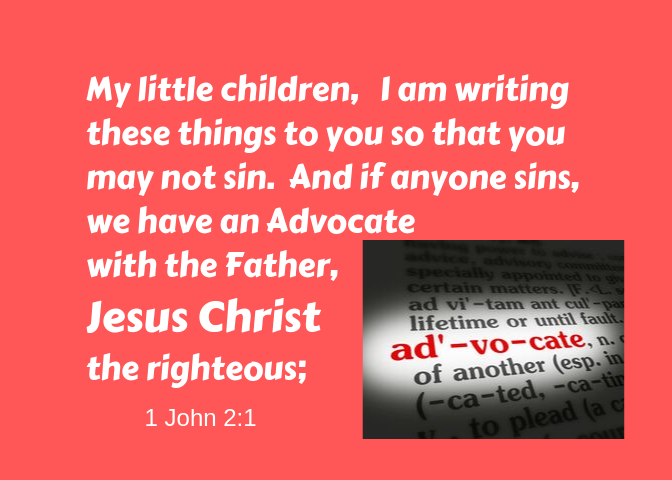
The writer explains that we do sin, but there is a path to forgiveness (1 John 1:8-10). He writes to us “so that we may not sin, but if anyone does sin, we have an advocate with the Father, Jesus Christ the righteous.” Jesus is our advocate, like a lawyer on our side. This should give us great encouragement. Jesus is the honest, righteous lawyer on our side. He is for us. As an expert lawyer, Jesus knows the rules. He knows how to take our case before the Father. He has access to the Father and successfully intercedes for us (cf. 1 Tim. 2:5 and Hebrews 8:1).


We lived in Israel and all our children were born there. Most countries do not grant citizenship to foreign children by virtue of being born in the country. Two of our young adult children applied to become citizens in Israel. They were denied several times over three years. However, not long ago a lawyer, an advocate, took up their case and presto, my children received their citizenship. The lawyer knew the rules, had the connections, authority and knowledge on how to present my children’s case, and succeeded. Jesus is our expert, righteous, successful advocate before the Father.


“Do not love the world…”


The author’s admonition to “not love the world or things of the world” are perhaps the best known verses of chapter 2 (vs. 15-17). He defines what “loving the world” is: the lust of the flesh, the lust of the eyes, the pride of life. It is a love of the way of the world, or of this world’s system. This doesn’t mean that we shouldn’t have an appreciation for the beauty and grandeur of God’s creation, the work of God’s hands, which is “very good” (Gen. 1:31). After all we wait for the regeneration of this world, and indeed the regeneration of this world’s system (Matt. 19:28, Heb. 2:5).


“The last hour”  and “anti-christs”

The author says it is the last hour. What a long hour it has been! He knows that it is the last hour since many anti-christs had already come. Specifically, here he says that the anti-Christ (anti-Messiah) is anyone who denies that Jesus is the Christ (the Messiah). The text does not say, as many traditional trinitarian Christians say, that the anti-Messiah is anyone who denies that God is the Messiah, or that the Messiah pre-existed as God. Rather, the text says that the anti-Messiah is anyone who denies that Jesus, the man Jesus, is the Messiah. “Christ” (Messiah) is never a title for God himself.


Of these anti-christs, the author says: “They went out from us, but they were not of us; for if they had been of us, they would have continued with us…” (1 John 2:19). It is easy to see how a text like this could be mis-interpreted and mis-applied. Especially as centuries passed, anyone could use the text to condemn any kind of a reformer. For instance, Catholics could apply it against Protestants.  Today it is leveled against anyone who denies that Jesus is God. But in its original context it was directed against anyone who denied that the man Jesus is the Christ (Messiah).


The promise of God – eternal life

1 John 2:25 says that God has promised us eternal life (immortal life in the age to come). We can take comfort and joy that God is pretty good at keeping His promises.


Having confidence, and not shrinking back in shame


1 John 2:28 says that if we abide in Jesus, that is, live according to knowledge of who he is, we can have confidence so that when he appears, at his coming, we won’t shrink back in shame. Since we know who Jesus is — the Messiah of God the Father, risen from the dead, exalted to God’s right hand, appointed to rule the world, we can look forward to his return. There is a similar admonition in Hebrews 10:39: “But we are not of those who shrink back and are destroyed, but of those who have faith and keep their souls.”

-Bill Schlegel

Through Faith

Galatians 3

Galatians 3 26

Paul has been summarizing different points of his life in his letter to the Galatians.  But it is not without a point.  He brings it back to them at the start of this chapter.  They have fallen into the same pattern that Peter and some other Jews had of believing that they were saved by works of the law, so Paul is needing to correct them to right thinking.  Like his reminder to Peter, he reminds them of that faith or belief.

6 So also Abraham “believed God, and it was credited to him as righteousness.” 7 Understand, then, that those who have faith are children of Abraham.8 Scripture foresaw that God would justify the Gentiles by faith, and announced the gospel in advance to Abraham: “All nations will be blessed through you.” 9 So those who rely on faith are blessed along with Abraham, the man of faith.

This is us!  We call ourselves of the Faith of Abraham or of the Abrahamic Faith.    God promises Abraham in Genesis 22 that through his offspring, all nations on earth will be blessed because of his obedience.  In God’s earlier promises to Abraham, He promises that his descendants will be blessed, but this takes it a step further and gives hope to those who did not come from a Jewish background.  It was through Christ’s sacrifice that we are able to be a part of the blessing given to Abraham by faith.

Paul tries to explain that we are saved by faith in another way:

16 The promises were spoken to Abraham and to his seed. Scripture does not say “and to seeds,” meaning many people, but “and to your seed,”[i] meaning one person, who is Christ. 17 What I mean is this: The law, introduced 430 years later, does not set aside the covenant previously established by God and thus do away with the promise. 18 For if the inheritance depends on the law, then it no longer depends on the promise; but God in his grace gave it to Abraham through a promise.

Usually when I think of the Old Testament times, I think of the law.  But Paul reminds me here that the promise given to Abraham was before the law and the law does not replace God’s covenant with Abraham.  Abraham, who we look to as an example, was before the law and God’s blessings were given to him.

Paul then summarizes with this encouraging message:

26 So in Christ Jesus you are all children of God through faith, 27 for all of you who were baptized into Christ have clothed yourselves with Christ.28 There is neither Jew nor Gentile, neither slave nor free, nor is there male and female, for you are all one in Christ Jesus. 29 If you belong to Christ, then you are Abraham’s seed, and heirs according to the promise.

Our backgrounds don’t matter.  Our identity is in Christ, and he is our hope to be heirs to the Kingdom of God.  That is something to be thankful for!


~Stephanie Fletcher