Don’t Tell

Mark 9

Sunday, July 31, 2022

Have you ever felt like you’ve been burdened with a task that doesn’t make any sense at all, and yet you have to do it anyway? A completely unreasonable duty that requires you lend trust that you may not be ready to give? I know I sure have, in fact just about every day. Through life, there are so many times that we’re required to give our trust over to God and have faith that He will take control. This can be really difficult to do, and Mark, chapter 9 can help give some insight into why we need to be prepared to do so.

It’s not every chapter that we’re blessed with multiple examples of both proverbial teachings and unfathomable biblical spectacles. In Mark 9, however, we see exactly that—there’s the transfiguration of Christ, holy expulsion of a demonic spirit, and, of course, wise parables from Jesus. It can be difficult to lump so many fantastical and seemingly unrelated events into one central theme, but as is always the case, there’s a lesson to be learned through all of it. Let’s travel through this chapter through the eyes of the disciples.

The disciples, although justifiably righteous, are still humans and still feel the same emotions that we feel—both good and bad. It can be difficult to relate to some of the things that happen in the Bible, especially when they come from the mind or mouth of a literally perfect person (Christ), so trying to see the events of the Bible as the disciples would have seen it can provide a unique lens of interpretation.

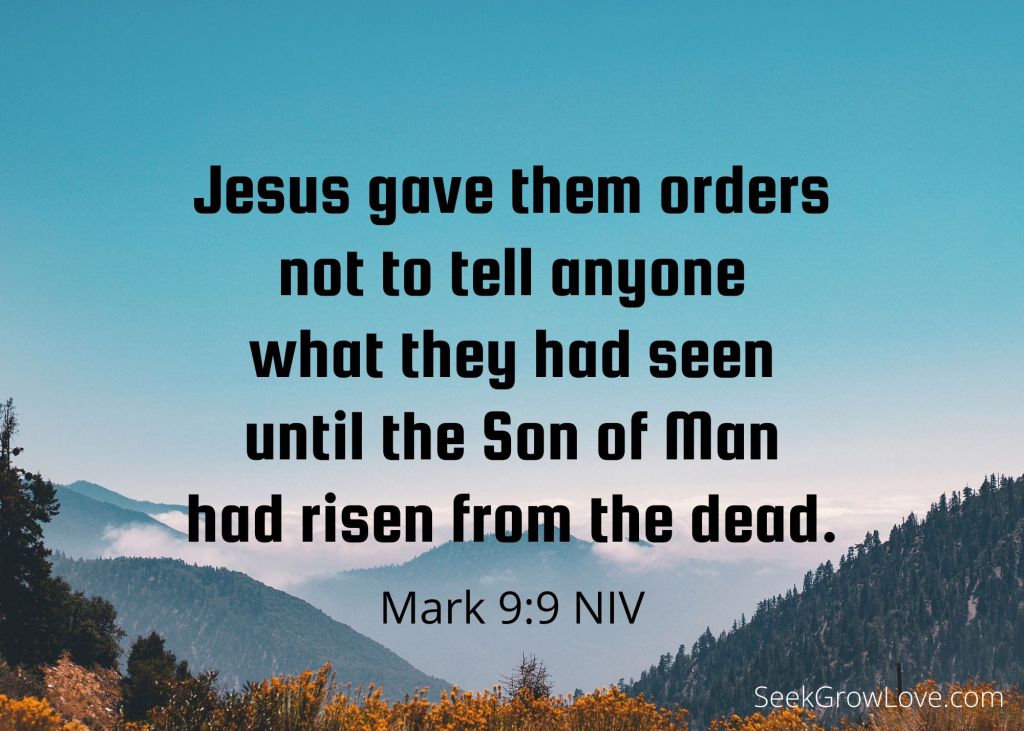
The chapter begins with the transfiguration of Christ, where he takes Peter, James, and John on top of a mountain. There, he is mystically clothed in the brightest white on earth, and his face becomes like the sun. He’s accompanied by Moses and Elijah, before the voice of God comes from a cloud proclaiming “This is my Son, whom I love. Listen to Him!” – Mark 9:7. The disciples are of course terrified by this experience, because that’s a pretty terrifying thing to experience! But as they’re coming down the mountain, Jesus gives them the super cryptic message “not to tell anyone what they had seen until the Son of Man had risen from the dead. “– Mark 9:9.

Firstly, that’s a very difficult thing to ask of anyone; not to speak of literally hearing the voice of God and visions of prophets. Secondly, that’s a very ominous thing to say to people whom you love. It not only means they’d have to wait to share what they’d seen until Jesus dies, but also until He comes back to life. Would you be able to heed the requests of Jesus when they, at the moment, seem so unreasonable?

After this, in verses 14-27, Jesus expels a demonic spirit from a boy who had been plagued by this spirit from birth. He then takes the disciples away and tells them that “The Son of Man is going to be betrayed into the hands of men. They will kill Him, and after three days He will rise.”—Mark 9:31. Again, we get a cryptic message prophesying the death and resurrection of Christ. Imagine what the disciples must have been thinking when they heard this, knowing that even they were afraid to ask Him about it (Mark 9:32).

Ultimately, the disciples were too afraid, and denied Christ, thus not putting their trust in Him. They were not able to abandon their understanding of what they thought would or should happen—opting instead to their own paths away from Jesus. It is up to us, as believers, to learn from their humanly mistakes and recognize that what we want, or what we think should happen, is not always what’s best for us, or simply may not be in the plans God has for you, and that we need to put our whole faith and trust in the only constant in life—God. 

-Mason Kiel

Application Questions

  1. If you had been one of the 3 disciples who witnessed the Transfiguration, and then were told not to tell what they had seen until Jesus rose from the dead do you think you would be trustworthy to follow Jesus’ instructions?
  2. What instructions of Jesus do you have a hard time following? Why?
  3. When have your plans not matched God’s? What did you learn?
  4. Reading through Mark 9 what do we learn about Jesus’ view of children?

The Problem with Traditions

Mark 7

Friday, July 29, 2022

How easily can we judge others for not upholding our standards which don’t even derive from the word of God? In Mark Chapter 7, the religious leaders gathered around Jesus and began to ridicule him and his disciples for not upholding their traditions. They didn’t even pretend that this was the command of the Lord, they said to Jesus, “Why do your disciples not walk according to the tradition of the elders, but eat their bread with impure hands?” The sad thing is that they wanted to enforce their traditions on others. Jesus quickly rebukes them with the words of the prophet Isaiah, “These people honor me with their lips, But their heart is far away from me…”. It is a matter of the inner man (the heart), these people acted for an outward display of “their righteousness”. “For they loved the approval of man rather than the approval of God”(John 12:43). Jesus goes on to say “You are experts at setting aside the commandment of God in order to keep your tradition”.

It’s so easy to look at the Scribes and Pharisees and ridicule them for being so unbelieving. However, if we’re being honest, the modern day church is a lot like them and maybe it’s become worse. Let us ask ourselves, have we become experts in setting aside the word of God to hold to our traditions? Have we skillfully misinterpreted texts and passages to alter the identity of Jesus Christ? Have we become experts at downplaying scripture which glorifies the all powerful saving grace of God? Maybe the church relates to the Scribes and Pharisees a lot more than we think, “That which has been is that which will be, and that which has been done is that which will be done, so there is nothing new under the sun”(Ecclesiastes 1:9). “Let us examine ourselves” but let us also be merciful because, “this man was handed over to you by God’s deliberate plan and foreknowledge; and you, with the help of wicked men, put him to death by nailing him to the cross”(Acts 2:23). Could it have been any other way? There had to be the unbelieving ones who would hand him over. The Scribes and Pharisees were clay in the hands of the potter. They were doing only what God’s plan intended. Did Jesus not have to die for the sins of the world? Would we have forgiveness of sins if he hadn’t? 

Later on in the chapter, Jesus declares that it’s the things that flow from the heart that defiles a person, and not that which enters, “(Thus he declared all food clean)”. Jesus is speaking of the works of the flesh and sinful nature we have inherited. Romans 11:32 says “For God has shut up all in disobedience so that he may show mercy to all”. And again, “the body that is sown is perishable, it is raised imperishable”(1 Corinthians 15:42). For a temporary purpose God has given us corruptible, sinful, and perishable bodies. However, “Just as we have borne the image of the earthly, we will also bear the image of the heavenly.”(1 Corinthians 15:49). Out of the heart (inner man) flows these sinful actions and thoughts. But thanks be to God who gives us his spirit to purify the inward man to be renewed day after day. Romans 8:29 says “For those he foreknew, He also predestined to be conformed to the image of his son…”. It is an ongoing process that we are being made into the image of God, we are being conformed, even as I type this and even as you read this. “For God is at work in you both to will and to do of his good pleasure”(Phil. 2:13). 

Later on in Mark 7, Jesus performs a miracle and heals a deaf and dumb man. Jesus says “Be opened!”, “And his ears were opened, and the impediment of his tongue was removed, and began speaking plainly”. The people spoke “He has done all things well; He makes even the deaf to hear and the mute to speak”. Before I give the spiritual revelation on what Jesus is doing, these things can still happen today. God can still do miracles because “For I, the Lord, do not change”(Malachi 3:6) God is still just as powerful today as he was back then. Okay moving on, what is happening? “However, the spiritual is not first, but the natural; then the spiritual.”(1 Corinthians 15:46). Jesus is doing something first that we can see and experience with our eyes, then he will later perform the spiritual. There was evidence naturally that the man could now hear and speak. “Yet to this day the LORD has not given you a heart to know, nor eyes to see, nor ears to hear”(Deuteronomy 29:4). God has to open our eyes and ears and hearts spiritually for us to understand and perceive the things of the spirit. Jesus opened the man’s ears to hear naturally, but Jesus opens ears now to hear and perceive spiritual truths. “But the person without the spirit of God does not accept the things that come from the spirit of God but considers them foolishness, and cannot understand them because they are discerned only through the spirit.” (1 Corinthians 2:14). And again “The mind governed by the flesh is hostile to God; it does not submit to God’s law, nor can it do so”. (Romans 8:7). The person without the spirit of God cannot understand. The person who Jesus doesn’t say “Be opened!” to, cannot yet perceive. This however, is only a temporary purpose, “for the earth will be filled with the knowledge of the glory of the LORD, as the waters cover the sea”(Habakkuk 2:14).  Jesus opens our hearts, minds, and ears by giving us the spirit of God so that we can hear and speak the truths of God. Otherwise, we cannot hear. It’s a miracle from God for us to understand spiritual truths. “To you it has been granted to know the mysteries of the kingdom of heaven, but to them it has not been granted”(Matthew 13:11). 

-Ryan Prott (recently earned his Associates degree from Atlanta Bible College and currently serving in Arkansas)

Application Questions

  1. Truthfully consider, what human traditions do you hold tighter to than to the commands/word of God? Why is this a problem? What changes need to be made?
  2. Pray, asking God to open your eyes, ears, and hearts to spiritual truths. Who else will you pray this prayer for?

How can we feed 5 thousand with so little?

Mark 6

Thursday, July 28, 2022

Everyone knows the story of Jesus feeding the five thousand. It is one of the classic stories that we first learn in bible school! While it is a very simple story, there is hidden meaning in the words. Yes, it is a story of how incredible Jesus was, and it showed how faithful people were to him, but what else does it mean?

Mark 6:34, is where Jesus first notices the people gathered on the shore. He says they were like, “Sheep without a shepherd”, and he has compassion for them. He sees people who are lost and makes sure to go and guide them towards life and hope.

But the thing I want to focus on is when he talks with the disciples and feeds the people.

Mark 6:35-44.

Once it was late, the disciples went to Jesus and told him that he should send the people away so they could eat. Jesus responded and told the disciples to feed the crowd of people. I can only imagine the looks on their faces! They responded, asking Jesus if they should go buy 200 denarii worth of bread. Finally, Jesus tells them to go and see how many loaves of bread are in the crowd – five loaves and two fish.

            Now imagine being a disciple at this point. They have seen Jesus do miracles, but this must seem nuts! They have nothing close to being enough to feed these people, but they knew he would somehow do it. This is what God wants us to be like with our faith. We may feel like we are standing in front of a mountain, but God wants us to trust him and know that with his strength, we can do anything. Whether that’s feeding five thousand or climbing a mountain.

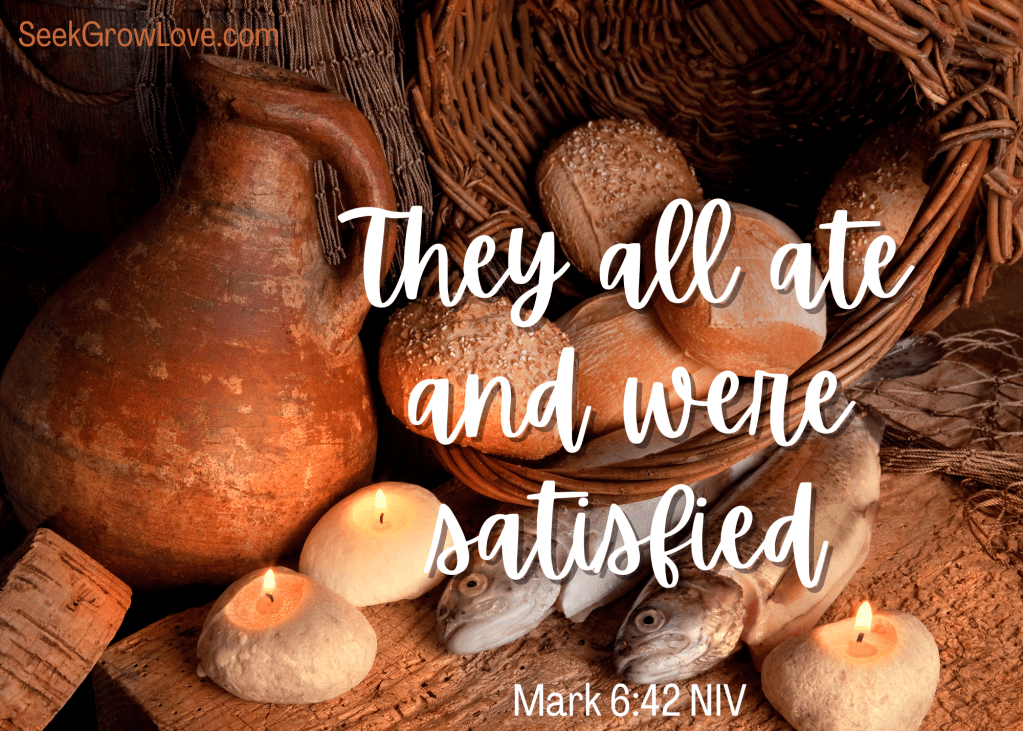
Jesus then looks to the heavens while breaking the loaves and dividing the fish, and there was enough to feed and satisfy everyone, and there was extra.

This story touches my heart because it describes how we can do so much with only a little. We do not start with everything we think we need, but God provides abundantly more than we could ever imagine as we work to reach his people. No matter what our purpose is, God provides everything we need, we just must have faith and be patient, knowing that whatever we are called to, God will provide.

-Hannah Eldred

Application Questions

  1. When have you felt there was no way you would have enough (resources, finances, companionship, wisdom, or faith)? How did it work out for you? In what ways do lean times help grow your faith?
  2. In what ways has God shown Himself to be faithful in your own life, in His word, and in the lives of others?

Your Faith Has Healed You

Mark 5

Wednesday, July 27, 2022

Mark chapter 5 has a lot of good stories but I want to focus on verses 25-34 where Jesus heals a woman who has had a sort of bleeding for twelve years.  Now at first glance this could seem inconsequential, as Jesus healed many people.  What stood out to me is the fact that she had it for twelve years!  That’s over four thousand days and over three hundred million seconds.  It’s a hard amount of time to imagine. I’m sure that it was a fact of life for her, like living in the same place for a long time. 

The chapter also says, “She had suffered a great deal under the care of many doctors and had spent all she had, yet instead of getting better she grew worse” Mark 5:26.  So, over the course of twelve years she tried everything, but it only got worse.  I don’t know about anyone else but at this point I would have lost hope in finding a remedy of some kind.  But she didn’t.  In fact, she had so much faith, that when she touched his cloak, she was healed.  That to me is amazing! 

It really isn’t inconsequential as she lived this way for over a decade.  You see a lot of people being healed by Jesus but not as many who were healed by their own faith.  

I feel oftentimes this little story is overshadowed by his raising of a young girl from the dead a few verses later, and his casting out of the demons into pigs, but there is so much you can take away from these few short verses.  She endured twelve years and still had so much faith that deserves to not be forgotten.

-Philip Kirkpatrick

Application Questions

  1. Would your faith have been enough to be healed after twelve years?
  2. What do you believe Jesus can do for you? How will you show him that you really believe?
  3. Are there small stories that you skip to get to the big ones?

Sowing the Seed

Mark 4

Tuesday, July 26, 2022

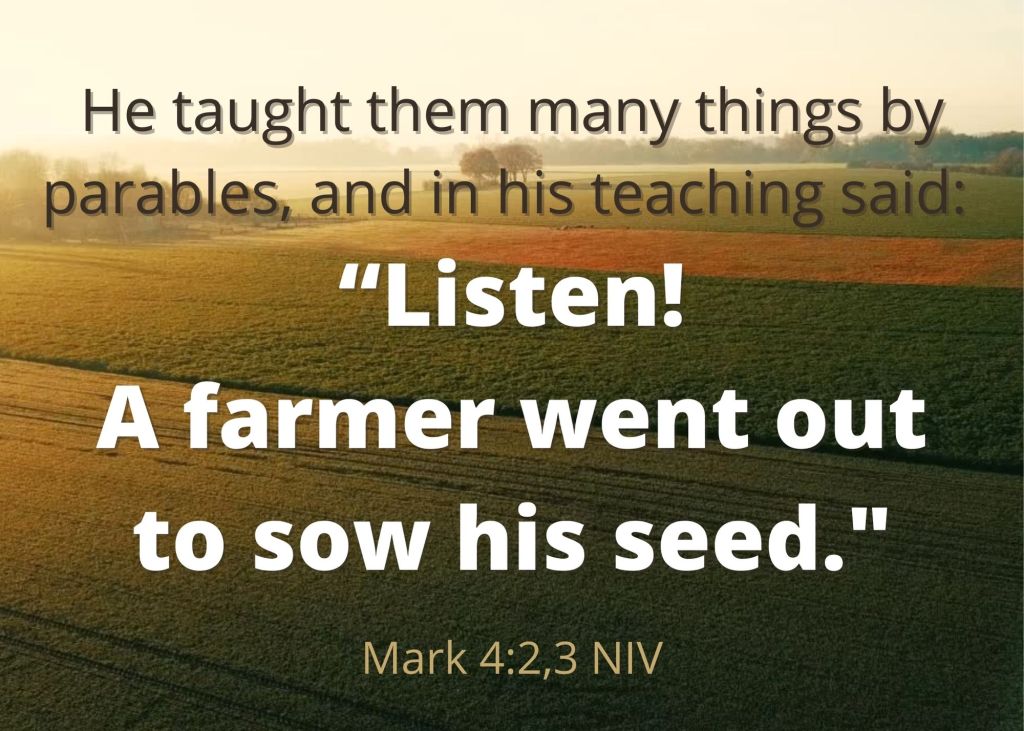
Mark 4 starts out with some parables that most of us have heard many, many times. The parable of the sower, the parable of the growing seed, and the parable of the mustard seed. 

Now I think that these were all meant to be taught together. So today, we are going to look at these 3 parables and how they relate to each other.

Starting with the first one, Jesus explains the parable of the sower to us in this chapter, and it is clear that we are supposed to be the seed in the good soil. And if we are that seed we are called to “bear fruit thirtyfold and sixtyfold and a hundredfold.”​​ But what does it mean to bear fruit? 

I think Jesus answers this for us in his next parable. The parable of the growing seed. The man goes out and spreads seed. And little by little the seed starts to grow, until it is ready to be harvested. 

This begs the question: what is the seed that we scatter? Now I think this seed can be a few different things. I think it could be the good news of Jesus and the Kingdom, and/or the love of Jesus shown to people through us. Personally, I think it’s the “and.” I think it is both of those things. Now in conversations I’ve had with some people, they say that their coming to Jesus was not overnight, it was years and years of people pouring into them with love and the Word until they eventually came to the full truth and understanding of Christ, and calling Him their Lord and Savior. This is what Jesus is getting at. That slowly the seed we plant grows until it’s ready to be “harvested” or until they are ready to accept Jesus, repent, be baptized and live for him until his return.

This brings me to the last parable Jesus shares in this chapter – the parable of the mustard seed. Our small seed grew and grew until it could be harvested, now they will plant their seed and it will grow, and so on. So our small “mustard seed” action can grow into that large plant in the garden. Our small impact that we can have in the lives of others can drastically increase the Kingdom and multiply to the “thirtyfold and sixtyfold and a hundredfold.”

-Camden Bormes

(Editor’s Note – Today and the rest of this week we get to hear from some youth and young adults who spent last week at FUEL Youth Camp. Camden is a recent graduate. He spoke at his school’s Baccalaureate on the good news of the Coming Kingdom. Keep sowing seeds, Camden, and challenging us to as well!)

Application Questions

  1. Who helped sow the seed in your life? How did they do so?
  2. How are you continuing to grow? Are you multiplying? What is needed for a healthy “Christian” plant to thrive and reproduce?
  3. How are you – or can you – plant the seed? When have you seen the seed fall on the path, on rocky places and among the thorns? Pray for your planting, that the seed may fall on good soil and produce reproducing Christians seeking His Kingdom.

Knowing Jesus

Mark 3

Monday, July 24, 2022

How well do you know Jesus? I mean, really know him?

The Pharisees (the religious leaders who prided themselves on supposedly having mastered the Old Testament law) knew Jesus – and were plotting with the government leaders to find a way to kill this rebel.

The sick and the maimed and the hurting knew Jesus – and were flocking to his side in droves, anxious for their turn to be touched, recognized and healed by this miracle worker.

The evil, impure spirits knew Jesus – they knew they were powerless before the one they rightly recognized as the Son of God.

The 12 disciples knew Jesus – and they dropped what they were doing to follow him, sit at his feet, learn from him, and do the work this teacher sent them out to do.

His mother and brother knew him – or they thought they did. They thought he was out of his mind. They were so familiar with him, they missed who he really was and couldn’t comprehend his true mission from God.

The teachers of the law knew Jesus – and they were so upset and thrown off by him they accused him of being possessed by Beelzebub the prince of demons. It is easiest to accuse what we don’t understand or what we feel threatened by.

So, I ask again, how well do you know Jesus? I mean, really know him.

Thousands of years later and there are still many different ways people think they know Jesus and respond to him. Some are still so familiar with Jesus (they’ve grown up with Jesus all their lives) they have actually missed who he really is. Others see him as a threat to their way of life or popularity and have made him out to be the enemy, attacking him with vicious lies and accusations at every chance. Others, are sincerely working at being his disciples, spending time with him and doing the work he sends them out to do. Some still recognize Jesus as the healer, the one who can ease their pain and put the brokenness back together again. And, the evil spirits still know they are no match for the power of the Son of God. They may win a battle here and there, but the ultimate victory will go to Jesus Christ.

Do you know who Jesus is?

Does he know who you are? Will he tell his Father in heaven that you are his brother, sister or mother, because you are doing God’s will?

-Marcia Railton

Application Questions

  1. How well do you know Jesus? How would you describe Jesus to someone who has never heard of him before?
  2. If you have grown up with Jesus, how can you be sure you aren’t so familiar with Jesus that you are missing who he really is? Where do you get your information about Jesus? What did Jesus say about himself? (Did he ever say he was God the Son?)
  3. Today, who is attacking Jesus and how? How will you make sure you are on Jesus’s side now and at the time of the last battle between good and evil?
  4. What does Jesus know about you?

Which is Easier?

Mark 2

Sunday, July 24, 2022

Go ahead and read the full chapter, but here’s the first 12 verses we will be discussing today.

A few days later, when Jesus again entered Capernaum, the people heard that he had come home. They gathered in such large numbers that there was no room left, not even outside the door, and he preached the word to them. Some men came, bringing to him a paralyzed man, carried by four of them. Since they could not get him to Jesus because of the crowd, they made an opening in the roof above Jesus by digging through it and then lowered the mat the man was lying on. When Jesus saw their faith, he said to the paralyzed man, “Son, your sins are forgiven.”

Now some teachers of the law were sitting there, thinking to themselves, “Why does this fellow talk like that? He’s blaspheming! Who can forgive sins but God alone?”

Immediately Jesus knew in his spirit that this was what they were thinking in their hearts, and he said to them, “Why are you thinking these things? Which is easier: to say to this paralyzed man, ‘Your sins are forgiven,’ or to say, ‘Get up, take your mat and walk’? But I want you to know that the Son of Man has authority on earth to forgive sins.” So he said to the man, “I tell you, get up, take your mat and go home.” He got up, took his mat and walked out in full view of them all. This amazed everyone and they praised God, saying, “We have never seen anything like this!” (Mark 2:1-12)

”Which is easier: to say to this paralyzed man, ‘Your sins are forgiven,’ or to say, ‘Get up, take your mat and walk’?” (Mark 2:9)

That question has always kind of thrown me for a loop because, if I’m being totally honest, my answer would be different from the one Jesus seems to be implying is correct.

Forgiveness is invisible. Anyone could say ‘Your sins are forgiven’ and we’d never know for sure. But healing someone, telling a paralytic to ‘Get up, take your mat and walk’… well, we would see pretty quickly if that took or not.

I once read that “forgiveness becomes real to you as you believe it, not as you see it.” I think what that means in this context is that the lame man couldn’t see Jesus’ forgiveness. He had to choose whether to believe it was true or not, whether Jesus was trustworthy or not. That’s very different from believing that Jesus had healed him…after he was up walking around.

And now I can see why the former would be so much more difficult. It’s harder to trust what we can’t yet see.

Kind of reminds me of the ‘we walk by faith not by sight’ (2 Cor. 5:7) and faith is confidence in what we hope for and assurance about what we do not see’ (Heb. 11:1) verses. God does not provide us with ‘grace-received’ certificates to prove our forgiveness, our salvation. We either believe it or we don’t. We either experience the joy, peace and burden-lifting that grace brings… or we don’t.

Jesus, help us to trust today that you know what’s best for us even when we can’t see it. We want to experience the lifting of burdens in our lives, and to feel the peace and joy that eludes us when we believe what we see instead of what you tell us is true. We want to drop the things that paralyze us and have the faith to get up and walk.

-Susan Landry

Application Questions

  1. Have you accepted Jesus’ forgiveness? How forgiven do you feel? Jesus has already done the hard part. What can you do to accept it, believe it and feel it more and more?
  2. What things, thoughts, attitudes paralyze your faith. Will you drop them? How? What will that look like? What will it look like to get up and walk in faith? Where might your faith lead you?
  3. From verses 13-17, are you more often like Levi or the teachers? What do you admire about Levi? What can you do this week that would be Levi-like?

You Don’t Have to Pretend with God

Psalm 77

Monday, July 11, 2022

            I remember as a kid we had about a 30 minute drive to Church every Sunday.  Now, you put 2 adults and 3 kids in a car for a half hour and there’s bound to be some excitement, maybe even some conflict.  Somebody is going to say or do something to annoy someone else and that kind of stuff is contagious so that by the time we get to Church everyone’s cross with each other and in a bad mood.  But it always amazed me that when we got out of the car and walked into church people smile and we smiled back, how are you?  I’m fine, how are you.  It was like someone flipped a switch and we instantly turned off all of the bad feelings.  Was it really that easy?  Of course not.  We just stuffed the bad feelings back inside and pretended it was okay. 

            Human beings learn to do that a lot.  We hide our pain and gloss it over with fake smiles and civility.  Now, there’s a certain amount of this that is necessary.  If you work at Chick Fil A and you had a fight with your boyfriend before your shift started, the Jones family doesn’t want to buy your drama along with their chicken sandwich so you learn to tough it out, smile and at the end of the order respond, “My pleasure.”  But you can’t hide those bad feelings forever.  Everyone needs someone that they can go to and share their hurt and sadness and tears.  Ideally, church should be a place where we can do that, where we can find grace even on our worst days.  I realize that not all churches feel like safe spaces to share our painful emotions so some keep on pretending.

            The Bible reminds us over and over again that we don’t have to pretend with God.  The Psalms are an example of how open God is to receiving all of our feelings.  There are Psalms of joy and thanksgiving, “Let everything that has breath praise the Lord”!  There are also songs of complaint, “My God, My God, Why have you forsaken me?”  The Bible says that we should rejoice with those who rejoice and weep with those who weep.  God wouldn’t ask us to do something that He is not willing to do.  God is willing to share both our joyful moments and painful experiences.  God wants us to feel freedom to bring everything to him.  When you pray God wants you to bring your whole self to him, the parts that love and celebrate, and the parts that hurt and complain.  In fact, there is one type of prayer that is specifically about bringing our pain to God.  It’s called a prayer or a psalm of lament.

            Psalm 77 is a psalm of lament.  Take a minute to read Psalm 77 if you haven’t already.  There’s no warm up here- there’s no “Dear Lord, you are holy, great and glorious.  Dear Lord, on this day we thank thee for all they bountiful gifts and we ask thee to bless us…. Etc…”   Instead he jumps right in with essentially “God my life sucks right now and I keep telling you about it and I’m not getting anywhere.  Have you forgotten me God?”  That’s a prayer of lament.  There’s no pretense here.  God, things are terrible, I feel awful and it doesn’t feel like you even care.” 

            As you read Psalm 77 you might notice that the whole first half of the Psalm is just full of complaining.  It’s like the prayer brings all of these painful feels to God and gives a big emotion dump.  And then between vs. 9 and 10 I feel there’s kind of a pause… we got all of the pain and anger out on the table.

            Just as an aside, did you know that the practice of writing down a painful or traumatic memory can aid in the process of healing that trauma?  Something about the practice of writing actually moves the trauma from a part of your brain that has trouble letting go, to another part that is more able to deal with it.  Could it be that the very process of writing down his prayer of lament to God helped his brain begin the process of healing?

            In the second half of the Psalm he is able to think and remember differently.  He is able to recall all of the ways in the past that God has done miracles and healing and turned sadness into joy and darkness into light and death into life.  It’s a totally different feeling from the first half of the prayer.  The complaints have given way to praises.  The despair  has given way to hope.  The painful and traumatic memories have fallen away and revealed a powerful and compassionate God who can and will make all things right if we continue to trust and pour out our hearts to him.

            So next time you’re carrying a lot of pain and hurt, you might have to suck it up and sell someone their chicken sandwich and smile about it, but then when you have the space and the time, bring that pain to God in prayer and allow him to heal and transform your heart.

-Jeff Fletcher

Reflection Questions:

  1.  When you are hurting and need to tell someone how you are really feeling, who is your go-to person?
  2. When  was the last time you brought a painful feeling to God in a prayer of lament? 
  3. If you’ve never felt safe or comfortable bringing pain or complaint to God, bring that fear to God and ask God to help you explore what might be keeping you from feeling free to be open and honest with all of your feelings.

The 23rd Psalm

Psalm 23

Saturday, July 9, 2022

What comes to your mind when I say “The 23rd Psalm?”  Perhaps you know that it is the most famous of all the Psalms, or even the most well-known chapter of the Bible.  You might think, “Ahhh, the Shepherd Psalm.”  Maybe you remember its author, David, and that he was a shepherd boy.  Or, perhaps you know that Psalm 23 is identified as a Messianic Psalm, picturing Jesus as the Good Shepherd.  These thoughts are all reasonable when considering Psalm 23.  But here are my thoughts when the words “The 23rd Psalm” are said to me. 

I remember a little 4-year-old girl attending the Church of God Illinois State Conference Bible School in Oregon, Illinois in the summer of 1956.  During our lessons that week, the children in attendance were challenged to memorize Psalm 23.  The little girl thought she could memorize it just as well as her older brother, and she was determined to do so.  At the end of the week, each child was asked if he/she wanted to go in front of the gathered students, and recite this beautiful Psalm.  The little girl was shy, but went up in front, by her teacher, and proudly recited the Psalm.  There were a few missed words, but she finished well, and was applauded for her efforts.  She was so proud to receive a ribbon with a “Shepherd and sheep” seal upon it, as an acknowledgement of her accomplishment.  She kept that ribbon for years!

As I (the little girl, as you probably guessed) grew older, I would occasionally recite the psalm to myself.  Years later as an adult, I realized I couldn’t recite it anymore.  I was disappointed in myself.  I made an effort to re-memorize the Psalm, and now it is a part of me.

If you are sad, recite the 23rd Psalm.  Are you stressed, weary, needing direction?  Quote Psalm 23.  Is everything swirling about you, are the burdens weighing too heavily on your shoulders, is hope fast disappearing before you?  Say the 23rd Psalm to yourself.  It offers comfort, strength, and encouragement every time. 

As you say the words, picture yourself as a sheep, lovingly cared for by Jesus, our Good Shepherd.  He leads you to green pastures for grazing, quiet waters for a refreshing drink, and guides you THROUGH dangerous territory, “the valley of the shadow of death.”  He draws you close with his staff, and he rubs oil in any wounds you might have.  What reassurance and love the Shepherd gives his sheep.

As Jesus states in John 10:27, “My sheep hear my voice, and I know them, and they follow me.”

The 23rd Psalm’s words are a treasure to all who read or recite them, providing immeasurable solace in the midst of life’s challenges and troubles. 

The opening sentence actually sums it up.  “The Lord is my shepherd; I shall not want.”

-Paula Kirkpatrick

Questions for Reflection

  1.  When you hear the words, “The 23rd Psalm”, what comes to your mind?
  2. What scriptures provide comfort and peace to you?

A Close Examination

2 Corinthians 13

Thursday, June 30, 2022

Have you ever heard of the Viceroy butterfly? These winged insects look almost exactly like the beautiful Monarch butterfly. To the untrained eye it would be very difficult to tell the two apart. To tell the two specimens apart, one would have to examine them closely.

In this section of Paul’s letter to the Corinthians, he urges them to examine themselves. He wants them to consider where they are placing their faith and if they are truly living for Christ.

The monarch is poisonous to some predators. By masquerading as the Monarch, the Viceroy can allude and fool its predators. However, underneath the façade, it is not a true Monarch. In fact, it is not potent at all. Within its heart, the Viceroy is nothing like the Monarch

If we listened to Paul and took a step back to examine ourselves, what would we find? Are we masquerading as a follower of Christ or are we the real deal? Are we the Viceroy butterfly or are we the Monarch?

As we examine ourselves and aim for a life where our actions and our heart profess our faith, remember the words in verse 4. “For indeed he was crucified because of his weakness, yet he lives because the power of God. For we also are weak in him, yet we will live with him because of the power of God directed toward you.”

-Hannah Deane

Application Questions

  1. How can you tell if one’s faith is real or phony? What characteristics does real faith have? What characteristics does phony faith have?
  2. What do you see when you examine yourself?
  3. Are there areas where you want your faith to grow deeper and more genuine? What steps will help you grow in that direction? Are you willing to do them?

(Tomorrow we will begin a 3 week look at some of the highlights of the Old Testament books of Poetry: Job, Psalms, Proverbs, Ecclesiastes and Song of Solomon. After that, mid-July to August, we will read Mark, one chapter a day, and then return to Paul’s letters. Lots of good stuff ahead! Keep Seeking God and His Will in His Word! SeekGrowLove)