The book of Romans has been called the Magna Carta of the Word by many writers when they describe the freedoms that God shows us in its pages. Romans 8 is the start of a transition from the doctrine of salvation that is presented in Chapters 1-7. Chapter 8 is about walking in the spirit and what true fellowship with God is based on. Chapter 9 moves to a section that is concerned with Israel and their relationship to the church and salvation in Christ.
Chapter 7 ends with these verses where Paul tells us of his frustration with his walk of believing Romans 7:21-25. I have discovered this principle of life—that when I want to do what is right, I inevitably do what is wrong. 22 I love God’s law with all my heart. 23 But there is another power within me that is at war with my mind. This power makes me a slave to the sin that is still within me. 24 Oh, what a miserable person I am! Who will free me from this life that is dominated by sin and death? 25 Thank God! The answer is in Jesus Christ our Lord. So, you see how it is: In my mind I really want to obey God’s law, but because of my sinful nature I am a slave to sin.
Paul has trouble with his Christian Walk???
But then Romans 8 begins with this contrast of truth about who we really are in Christ:
Romans 8:1-4(NLT) So now there is no condemnation for those who belong to Christ Jesus. 2 And because you belong to him, the power of the life-giving Spirit has freed you from the power of sin that leads to death. 3 The law of Moses was unable to save us because of the weakness of our sinful nature. So God did what the law could not do. He sent his own Son in a body like the bodies we sinners have. And in that body God declared an end to sin’s control over us by giving his Son as a sacrifice for our sins. 4 He did this so that the just requirement of the law would be fully satisfied for us, who no longer follow our sinful nature but instead follow the Spirit.
The transition that we are being taught by Paul is that when we walk in fellowship with God, then we are able to overcome our sin nature. We will be without condemnation when we are guided by the spirit of God that He has given us. Our spiritual nature of Christ in us gives us the power and ability to do the will of God and do good in this world.
We have Christ in us when we are born again by God’s spirit but our daily walk with God is one of obedience to fellowship with Him, or disobedience to living without God’s fellowship. Christ walked in perfect fellowship with God and because he always did the Father’s will, he was not condemned by the law.
What are the ways we can grow in our ability to be in fellowship with God and His Son?
Romans 8:5-6(NLT) Those who are dominated by the sinful nature think about sinful things, but those who are controlled by the Holy Spirit think about things that please the Spirit. 6 So letting your sinful nature control your mind leads to death. But letting the Spirit control your mind leads to life and peace.
The Old Testament law really is a law of life, but the Pharisees and scribes had turned it into a law to control people politically and physically. Look sometime at the undoable complexity of the rulemaking in the Talmud and Mishnah. Those regulations are only to control people from a human standpoint. Jesus Christ does all of God’s intentions for the true interpretation of the law of Moses. He is judged righteous by God because of his obedience. God gives to us the righteousness of Christ when we confess him as lord and savior.
Romans 10:9-13(NLT) If you openly declare that Jesus is Lord and believe in your heart that God raised him from the dead, you will be saved. 10 For it is by believing in your heart that you are made right with God, and it is by openly declaring your faith that you are saved. 11 As the Scriptures tell us, “Anyone who trusts in him will never be disgraced.” 12 Jew and Gentile are the same in this respect. They have the same Lord, who gives generously to all who call on him. 13 For “Everyone who calls on the name of the LORD will be saved.”
Our salvation is received by grace from God and is not dependent on our works or actions before that point. We cannot earn our salvation, but we receive it by trust that Christ is what we need in our lives. To confess him as lord is to say fully in our hearts that we cannot do this ourselves but will follow and obey him. Many denominations have reduced this as a simple confession of “Jesus is Lord”, but to truly say this declaration it means that I understand the complete futility and incompetence of my own efforts. I need the righteousness that comes only from God in Christ to overcome the sinful person who is me.
What righteous thing have you done that will impress God with your goodness?
Before or after the point of your salvation?
Grace from God is the only way to fellowship with Him. We can approach the throne of grace because the righteous son of God is there to advocate for us. God sees us with the righteousness of the Christ in us and then we are able to have fellowship with a righteous God. By our own efforts we fall completely short of this. That is why we are able to walk with no condemnation from the law of Moses or the law of slavery to sin that we are delivered from.
Why do we need Christ’s intercession with God on our behalf?
Have a victorious day today walking in fellowship with God with Christ beside you.
Romans 8:38-39(NLT) And I am convinced that nothing can ever separate us from God’s love. Neither death nor life, neither angels nor demons, neither our fears for today nor our worries about tomorrow—not even the powers of hell can separate us from God’s love. 39 No power in the sky above or in the earth below—indeed, nothing in all creation will ever be able to separate us from the love of God that is revealed in Christ Jesus our Lord.
Only God’s love can change us and this fallen world. Thanks be to our God that He truly loves us so much to save us and take care of us each and every day.
Prior to the New Covenant, the Jews were like slaves to the law, in the sense that children are slaves to their parents’ rules until the time has come to set them free to do what they’ve learned is right without their parents’ involvement. This is what Paul is trying to reiterate regarding the Law of Moses and the Law of Christ/law of liberty to the Galatians.
When Jesus ratified a new covenant with them (and us), the Jews were set free from the Law of Moses in the same manner that a child is set free from her parents’ rules/laws once she becomes an adult. Because Jesus came, the Jews are now free to walk by faith like Abraham did, without a law to teach him what to do, but with God’s wisdom about what to do, having already learned what is good from their “childhood.”
To make this point clearer, think of the things you still do as an adult because your parents taught you well when you were a child, like holding the door for the person behind you, or waiting patiently for your turn while in line, etc. They’re not things that you’re doing because you’re still under your parents’ rules and will receive consequences from them if you don’t (or do). They’re things you’re doing because they’re ingrained in you to do from their discipline of you, and because you’ve learned that they are good practices to help you live well (to keep yourself and others from harm and to do good to others).
If you engage in the good things your parents taught you once a “free to do as you please” adult, you will probably do well in life. If not, you will understand that you’re not really free, you’re just not under your parents’ authority anymore. They’re not going to be the ones providing you with consequences for your actions because you’re not under their yoke. You’re under a free society’s yoke – one that obviously still expects you to do what’s right so that you won’t harm yourself or others.
And there will be some behaviors that you’re no longer expected to engage in in your free society, such as not talking to strangers. Though your parents may have taught you to heed this rule when you were under their yoke to keep you from harm, it no longer applies in your free society. The opposite is actually expected for love and respect’s sake.
If they (and we) now identify in Christ, they are free from the Laws of Moses (free from their “parent” Moses’s rules), its consequences, and its authority. They are adults, free to serve God without specific laws about how they must live, beyond what their new authority Jesus says to do, which is to love as Jesus loved, giving the world the royal treatment (love your neighbor as yourself).
What’s ingrained in a Christ follower is the Holy Spirit, not the laws from the Law of Moses. It is the Spirit that writes the law (of Christ) on our heart, urging us to do what pleases God. If we (both Jew and Gentile) listen to the urging of the Spirit, we are walking by the Spirit and pleasing God. If not, we’re walking by the flesh and pleasing ourselves (sinning/choosing our own will).
We will reap what our behavior sows in the end, either to the flesh, which leads to death, or to the Spirit, which leads to life. Jesus, our authority under the New Covenant, will be our judge.
So, how have you been doing in loving God and loving people?
If you don’t know how to love like Jesus, ask God for his wisdom about how to love your neighbor (and God), or what actions you should take to love them. His desire is to give you his wisdom about what to do when you ask.
First Corinthians 1:30 says that Jesus has become wisdom for us, so look to him for wisdom; look at his words to help you to know what God’s will is. Look at the people that Jesus entrusted God’s word with, like Paul. At the end of almost all of his letters, he gives those he’s writing to some practical application in how to love like Jesus. James gave us a lot too!
The more we follow the urging of the spirit to do God’s will, the more we become like Christ and will do God’s will. Becoming this type of person takes time, molding, and shaping. There will be times when we miss the mark and wander off the path. Isn’t it a blessing though to be under the law of liberty, free to make mistakes without the consequences from the Law of Moses when we do? What a burden that would be! Thank God that we won’t receive the consequences from the Law of Moses when we miss the mark on our race.
Under the New Covenant, God urges us to restore one who’s wandered off, gently, as consequence. We must help each other stay on the path of righteousness and bear each other’s burdens, like Paul is with the Galatians in his letter. This is how you fulfill the law of Christ/the law of liberty.
So, should we follow the Law of Moses to be sure we are living well? No. We should read and understand all scripture, as it is all God breathed, “profitable for teaching, reproof, correction, and training in righteousness; so that the man of God may be adequate” (2 Tim. 3:16-17), but we should apply what we read and do in light of the New Covenant we are under with our new high priest and mediator Jesus. It is a better way to live, with a lighter yoke. Jesus teaches us how to do this (seek God’s wisdom through him).
For example, before Jesus was crucified, he shared in the Passover meal with his disciples. The Passover was a meal shared to remember what Yahweh God had done for the Jews, leading them out of slavery from the Egyptians, to serving him. But at the last supper Jesus has with them, he tells them to remember something new when they have Passover. He says to remember him, remembering what he did for them in shedding his blood and breaking his body.
Gentiles don’t celebrate Passover, because it doesn’t apply to them. But many Christians do share a meal together once a year that they call communion, remembering Jesus’s shed blood and his broken body for us. God didn’t give Gentiles a law telling them they must celebrate Communion under the New Covenant, but his son told his disciples to remember him. We must remember what Christ did for us too.
Communion is a good practice to help us remember, but it is not a law we must abide by to be in Christ (identified as a Christ follower). What we must abide by is what Jesus said, which is to remember what he did for us.
It is easy to forget what Jesus did for us when we don’t engage in practices that help us remember. However, if a Gentile chooses not to remember Jesus’s blood and body every year, he is not condemned to not enter the kingdom of God. But each year he forgets about Jesus’s sacrifice, the more off track he may get, which can put him in jeopardy of not entering the kingdom of God at the end of his race.
And Jewish Christians no longer need to celebrate Passover/Seder. But it is okay if they do, so long as they’re not doing it to separate themselves from Gentiles as righteous. But when they do, it would be good practice to primarily remember what Jesus did for them, which is much better than what Moses did for them. If they don’t, they are not condemned to not enter the kingdom of God in the end, but the more they forget about Jesus’s sacrifice for them, the more off track they may get, which can put them in jeopardy of not entering the kingdom at the end of their race.
The Galatians (and we) should understand that teaching anyone, even a Jew, to follow the Law of Moses for the purpose of being identified as righteous, is wrong. It is a false gospel. Doing what Christ says to do is the true gospel, and it identifies you as a child of God in Christ. Faith in Jesus, with the faith of Abraham/of Jesus, identifies you as a true child of God.
Paul emphasizes his point with an analogy of two women from the Old Testament. Hagar was a slave, Sarah was free. The enslaved woman will have no part of the inheritance of the free woman, so the Galatians need to get this right. Lives are at stake.
When Paul first preached the Gospel to the Galatians, they were fulfilling the Law of Christ because of their great love for Paul, not only listening to him and receiving his teachings, but also taking great care of him while he was sick. They treated him like he was a messenger from God, like Jesus himself. Paul said if it were possible, they would have torn out their eyes to give them to Paul if he needed them. That is loving like Jesus. It’s sacrificial love. It is giving their neighbor Paul the royal treatment.
There is no law about what exactly we must do to love like Jesus the way the Galatians did at first. But we know that to love like Jesus when we see a brother sick and in need means doing something to help that brother. Think on the wisdom we received from James to understand (James 2:15-17). Your faith is worthless if you don’t give a brother what he needs, and it makes you a sinner.
Again, 1 John 3:16 tells us what loving like Jesus is, and that we should follow suit. This is how we know what love is, Jesus the Christ laid down his life for us, and we ought to lay our lives down for our brothers and sisters. What this verse is saying is that love is sacrifice. We are to sacrifice our lives to love someone else, in all of our doings under our new authority.
For Jesus, it looked like living a sinless life and dying on the cross to save us. For the Galatians when they first met Paul, it was to take care of him in his ill state. Paul is now loving them by urging them to remember their first love (acts of love towards him when he had a need) in the rest of their doings.
There are many things that we can do to love like Jesus. We are going to need to seek God’s wisdom to know the specifics and be led by the spirit in our various circumstances, but we can all heed this bit of wisdom at the end of Paul’s letter to the Galatians to remain on the path of righteousness under the New Covenant through Christ:
Instead of allowing someone to enslave you with their false teaching, a good practice is to serve one another through love, like the Galatians did at Paul’s first preaching. This is the freedom they have in Christ, to do good until Paul without a law that tells them so.
We are called to freedom, but we should not turn our freedom into an opportunity to sin just because there’s no law under the New Covenant. Remember, there’s wisdom! The whole Law (of Moses) is fulfilled in one word, the statement, “You shall love your neighbor as yourself.” Under the new Covenant, this is also wisdom from God. But if you bite and devour one another, you may just be consumed by one another. You won’t be entering the kingdom of God if you’re doing this because you’re not loving your brother like Jesus taught. Instead, walk by the Spirit so that you won’t carry out the desires of the flesh.
The desires of the flesh (not God’s will) are whatever is opposed to the desires of the Spirit of God (God’s will). The spirit he put inside you urges you to do his will, while the flesh urges you to do your own will, or what you think is good for you to do.
If you want to know if you’re walking by the spirit or walking by the flesh, Galatians 5:19-21 gives you a pretty clear list of things that people do when they’re walking by the flesh. These are things that are going to harm yourself or others and if practiced (meaning ongoing without repentance), they’re going to make you forfeit your entrance into the kingdom of God.
Instead, walk by the Spirit’s urging about what you should do, and the fruit of the Spirit will follow. They are things that are produced by people who love like Jesus. If you want to know if you’re a disciple of Jesus, they’re great identifiers: love, joy, peace, patience, kindness, goodness, faithfulness, gentleness, and self-control (Gal. 5:22-23). If these characteristics are yours, you’re not under a law (you can call it the law of liberty if you really want to be under a law). You’re in Jesus’s free society (free to love like Jesus based on the needs of those you’re serving, based on God’s wisdom about it, not by a law outlining specifics you must do to be righteous).
If you are a Christian, you crucified the flesh with its passions and desires when you entered the New Covenant. I think this means that since becoming a Christian, you have decided to live by the urging of the Spirit inside you, as opposed to your former ways following the desires of your flesh, just like Paul proclaimed of himself. But if one of you practices one of those things from the flesh list, then your brother who is spiritual should restore you gently. Be sure the restorer is spiritual though, being sure the one restoring the brother sinning doesn’t have a log in his own eye to clean out first, lest he also be tempted. And bear one another’s burdens. I love how Paul basically reiterated how to fulfill the law of Christ in this situation using the same wisdom that Jesus used when teaching his disciples how to live from the from the Sermon on the Mount (Matthew 5-7).
Some more wisdom to stay on track to the Kingdom of God include sharing good things with the one who teaches you the word. If the one teaching you God’s word took time away from doing other things to support their family, then in return you should support your teacher.
Remember, God is not mocked. Whatever a person sows, he will also reap, whether to the flesh (ongoing sin/your own will) which leads to destruction or to the Spirit (God’s will), which leads to eternal life. The one preaching the false gospel will reap what he sows.
Don’t grow weary in doing good. This can be a hard one with all of life’s ups and downs. I remember when I knew I was growing weary, so I cried out to God to help me keep going. He simply reiterated it back to me through the prophetic word of a dear sister in Christ, and then told me what to prioritize.
In due time, if we don’t become weary, we will reap good things. While we have opportunity, let’s do good to all people, especially those who are of the household of the faith. Amen!
I find it hilarious that Paul says, “See what large letters I have written to you with my own hand!” It sounds like he’s saying that he’s using Caps Lock to shout out to the Galatians this point: All who want to make a good showing in the flesh try to compel you to be circumcised, so that they will not be persecuted for the cross of Christ. In other words, they’re not trying to teach you their false gospel to help you, they’re teaching it to try to help themselves.
Wouldn’t we all like to be able to say this after trying to reprove a fellow Christian, “I boast in the cross of our Lord Jesus Christ, through which the world has been crucified to me and I to the world. Circumcision and uncircumcision is nothing. What’s something is a new creation in Christ.” If you think and behave in a way knowing this, then peace and mercy to you who are now the Israel of God.
Reflection Questions
1. Have you witnessed the cry, “Abba! Father!” since receiving the Spirit of God’s son into your heart?
2. How did the son who was born according to the flesh persecute the one who was born according to the Spirit (Gal. 5 29)?
3. Gal. 5:1 says, “It was for freedom that Christ set us free; therefore keep standing firm and do not be subject again to a yoke of slavery. What do you think “freedom” means in this verse? Freedom from what and to what? (I think it means a little more to a Jew than to a Gentile).
When I began reading Paul’s letter to the Galatians, I noticed that this bold man had doubts and fear that he wasn’t preaching correctly at times after his initial conversion. It took him 14 years (after an initial 3 + years to talk to Peter for 15 days) to talk to those of repute about the Gospel. I can relate.
We are called to preach the Gospel, but we don’t want to teach something that’s inaccurate if it leads others down the wrong path because lives are at stake. But that’s exactly what was happening with the Galatians.
The once fearful Paul boldly asks the Galatians who bewitched them, attempting to enslave them to a different gospel, which was a distorted gospel of Christ. The distortion was in teaching others to follow certain laws from the Law of Moses (commandments they must follow to be identified as righteous), instead of having the freedom in Christ to follow Jesus through the urging of the Holy Spirit to do God’s will. Paul goes so far as to say that the ones doing this should be accursed!
*Note, I believe the issue is not about salvation. You were saved (rescued) from sin and death and placed on the path of righteousness for the purpose of serving God through Jesus when you first believed. And you can’t “lose” your salvation. Said another way, no one can stop what was already done for you when Jesus rescued you (when you believed). But you can decide if you’ll remain on that path of righteousness (doing what Jesus says is right to do under the New Covenant terms) or not before you reach the Kingdom of God, when you’ll be saved from this present evil age.
Someone(s) was trying to lead the Galatians to look back to what was already fulfilled in Christ by teaching the Galatians to follow the Law of Moses, particularly to follow the law to be circumcised for the purpose of being made righteous, or as a member of the Jewish community. Though some may have been teaching this practice to save the Gentiles from Roman persecution that Jews were exempt from, Paul teaches them that it’s better to be persecuted for the sake of Christ than to be enslaved to the Law of Moses or to look back at our former life before Christ. We should all do well to remember Lot’s wife.
Aside from the issue dealing with circumcision, Paul recounts a similar issue when Peter was hypocritical, separating himself from eating with Gentile Christians in the presence of other prominent Jews (called “from the circumcision”). I believe this all happened after the record we read in Acts when Peter boldly recounted his experience with Cornelius, proclaiming that he was not to call any person unholy or unclean, and that God is not one to show partiality (Acts 10). This was really bad, as the rest of the Jews joined him in his hypocrisy, which led others astray.
Paul goes on to help clarify why the distorted version of the gospel was so devastating to the true gospel.
Jews by birth who now identify in Christ understand that they are not justified by the works of the law, but by faith (trusting) in Jesus the Christ (i.e., they do things that Christ says to do because they put their trust in him to tell them how to do what is good, not in Moses/the Law of Moses). But if the Jews sin under Christ, they are just as guilty as the “sinning Gentiles,” as such they defined them when under the Law of Moses (this statement makes me think that the main motive for teaching the Gentiles to become like Jews was pride).
When you entered the New Covenant with God through Jesus, you died to your old man/old ways of living (sinning). If you rebuild what you destroyed (the sinning person), you are quite the wrongdoer indeed! For Jews wanting to rebuild who they identify in via following laws from the Law of Moses, they’re sinning! They’re nullifying the work of Jesus, and even worse, teaching new Gentile Christians to do the same.
Through the Law of Moses, Paul died to the Law, so that he could live by letting Christ lead him via the Holy Spirit instead of the old man he was, who followed Moses.
The Law of Moses was beautiful, just read about what David says about it. But it should not be forced on anyone as necessary to be righteous or a child of God. If you are a Jewish Christian or a Gentile Christian who would like to engage in behaviors commanded from the Law of Moses (those that weren’t meant to separate Jew from Gentile regarding your identity in Christ) because you think if applied, they can help you live well in this age, you can, because they will, if you apply them as you would under the law of liberty/the New Covenant, like Jesus taught. But part of how to do that would be to first ask God for wisdom about them so that you’ll be led by the Spirit, and not your own will in doing them (especially so that in so doing, you won’t lead others astray with your behavior).
For example, under the New Covenant, Jesus applies a new way of thinking to many of the laws from the Law of Moses using the new commandment of love (as he loved) as motivation for all that a Christ follower should do. So, instead of abiding by a law that says don’t murder from the Old Covenant, Jesus teaches his followers not to have contempt in their hearts for their brother in the first place. If they can do that, they won’t even come close to murdering their brother.
But how does one really do that? Did Jesus just make a new law for us to follow that’s even harder to do than refraining from murder? No, he gave us wisdom about how not to murder, and that’s by not allowing contempt to be in your heart in the first place. You read about how to keep contempt out from the word, such as by acts of love towards your brother before contempt can grow, by prayer, by turning the other cheek, by gently correcting your brother, etc. Seek wisdom from God about how to keep contempt out by reading the Bible and asking him. Then don’t be surprised when you get an urging from the Holy Spirit to do what God wants you to do to keep contempt out. He is a good and faithful God who will give you the wisdom you desire when you ask.
Through Jesus, God always gets at the heart of the issues that led to the Law of Moses, to shape people into those who do good because of love for God and others. But doing good for love’s sake even under the New Covenant doesn’t save you. Christ’s works saved you. Doing good once saved keeps you on the path of righteousness.
So, we must be careful not to enslave someone with our preaching of a law from the Law of Moses that we must keep to be identified as righteous since we are under the New Covenant. We are righteous when we do what is right. What is right is what Jesus says is right to do (1 John 3:7), as opposed to what Moses said is right to do for his time, or what the other gods who the Gentiles formally served said was right to do, or what our own will desires for us to do. If you want to know what Jesus wants you to do, read his words and ask via the Holy Spirit.
A good question to ask someone who tries to enslave others to keep the Law of Moses for the purpose of identification as righteous is to ask them what Paul asks the Galatians, “Did you receive the Spirit by works of the Law, or by hearing with faith?” If the answer is the latter, don’t force a yoke on someone that Jesus carried for us.
Or ask them this, “Does he who provides you with the Spirit and works miracles among you do it by works of the Law or by hearing with faith?” The latter of course is the answer. The righteous one will live by faith, like Abraham did. Abraham did what God told him to do without a law to tell him.
The point of this letter is to overemphasize to the Galatians that identification as righteous comes by way of faith (trust) in Jesus, not by faith in Moses (via works from the Law of Moses).
*Note, under the Law of Moses, before Jesus came and inaugurated the New Covenant, the Law of Moses did keep an Israelite on the path of righteousness, because that was God’s will at the time. But it could never save. Belief in Jesus’s work on the cross saves.
We mustn’t confuse faith in Jesus with hearing only either. We know what Abraham did to receive his title as faithful, with promises to his faithful seed. He did all that God commanded him (Genesis 26:5). Jesus is that promised seed, who did all that God commanded him. God made him both Lord and Christ. If we identify as “in Christ,” because of the works he did, it follows that we who have made Jesus our Lord by definition, will do what he says. Those are the terms we entered into under the New Covenant.
Why the Law of Moses then if what God promised to Abraham was what would last forever, as opposed to what God gave to Moses? The Law of Moses was added on account of the violations of God’s commands by the Israelites, until the seed would come to whom the promise was made.
I take this to mean that the Israelites weren’t living by faith (i.e., they didn’t trust God to be faithful to them, so they weren’t faithful to do what he said). They were sinning. They needed help to get on the path of righteousness. They needed something to guide them so that they’d live in such a way that it would be well with them and they’d stop sinning. They needed God’s wisdom about how to represent him well as his children, as lights to the world, rather than allowing them to continue to rely on their own wisdom about how to live (which never ended well). Even so, they still failed to be who God wanted them to be by doing their own will, and the Law of Moses came with a heavy yoke.
But since the promised seed has come, they are no longer in need of a guide (or a guardian to keep them on track) that separates them from the rest of the world who have decided to do God’s will. Instead, both Jew and Gentile under the New Covenant receive a guide inside them, guided by Jesus via the Holy Spirit. And it’s a much easier yoke to bear.
We have something in us that urges us to do the will of God. It urges us to do God’s will when we seek wisdom about it. We seek God’s wisdom about what to do because we’ve read his book and witnessed that what God says is good for us is good. We’ve witnessed that when people chose to follow the urging of their flesh to do their own will, their fall was great.
We’ve witnessed that God’s wisdom is found in the man Jesus, not Moses, because Jesus always did our father’s will, because of his great love for everyone (even his enemies). We’ve learned that everyone who desires to be like Jesus, a person who desires God to be judge over our lives so that no harm will come to anyone, will be saved. We’ve learned that God made that man Jesus our Lord who will do the judging in the end. We learned that no one can enter who desires to do their own will because it will affect us all. See this current age as example.
We don’t want to preach something that’s inaccurate, and we don’t want to fear preaching because we may lead others astray. Let’s start by asking God for his wisdom about what we should do, look at Jesus’s words, and do the things that the word says to do to be filled with the spirit so that we can walk by it/let it lead us, just like our Lord Jesus, because we desire life for all. But don’t enslave someone with laws they must do to be righteous. Show them how to love through your good works. To do that, seek God’s wisdom (it’s found in Jesus) and follow the urging of the Holy Spirit to do his will.
Reflection Questions
1. Do you think those preaching a distorted gospel should be accursed?
2. What is right is what Jesus says is right. What is wrong?
3. How did Abraham know what was right to do without a law to tell him?
Acts chapter 14 ended with teaching us that God had opened a door of faith to the Gentiles. In chapter 15, the disciples are met with a conundrum because some men from Judea were teaching that, “Unless you are circumcised according to the custom of Moses, you cannot be saved.”
I think it is good to remember that post Jesus’s accomplishments on the cross, most of the Jewish Christians were still behaving like Jews – they were still going to synagogues on the Sabbath, they were still preaching from the Old Testament (because that’s the scripture they had), and were still engaging in many of the activities that they learned from their culture that were good.
I don’t think that the Jewish Christians were ever told to stop “being Jewish.” But they were told to follow Christ, not Moses, when it came to doing God’s will. In the book of James, we read that they were instructed to follow the law of liberty, which I believe is in applying (doing) the New Covenant commandment to ‘love as Jesus loved’ to all aspects of our lives. He taught us how using several Old Covenant commandments in light of the New Covenant command of love. He learned how to do this from Jesus. Jesus taught in this way in his Sermon on the Mount (e.g., instead of murdering your brother, don’t even get angry with him).
I don’t think this means that we are to keep the Old Covenant commandments, nor even to do the things Jesus said to do (hear me out), AS LAW, that we must keep in order to enter the Kingdom of God. Rather, we are to seek God’s wisdom about a matter (such as with being angry with a brother), with the motivation that Jesus had to love the brother, in order to do what God wants us to do in the situation (God’s will) to save him.
Jesus’s words are wisdom for us, not law.
For example, there will be times when we are angry with our brother, and it will be righteous anger. We need to seek God’s wisdom to know when that is the case and what to do about it to save the brother (or the enemy). There’s much wisdom throughout the Bible on this topic. But there’s no specific law outlined for us to do under the New Covenant. We have the freedom/liberty to seek God’s wisdom in the matter to know what to do to help, and then are commanded to do it. For the most part, it will be what Jesus said to do.
Jesus says that, “if you love me, you will keep my commandments” (John 14:15) – but we must understand what they mean and how they will apply to the situations we get in in order to do them according to God’s will. We do this by reading scripture (OT) and the word (the gospel; NT) for God’s wisdom, and then by doing what he says by way of the urging of the Holy Spirit. You’ll see this in action throughout the book of Acts.
Read the rest of John 14 and remember from John 6 that the Spirit gives life. “If anyone loves me (Jesus), he will keep my word; and my father will love him, and we will come to him and make our abode with him” (John 14:23). “But the helper, the Holy Spirit, whom the father will send in my name, he will teach you all things, and bring to your remembrance all that I said to you.” (John 14:26).
There’s no law in the New Covenant about what commandments we must keep from the Old Covenant, as we’re not under it, but there is much wisdom we can learn about why God wants us to obey many of them (look at Jesus’s words to understand what he wants us to know and do). They (the commandments God wants us to know and do) are the things we should know about Yahweh God, his son Jesus, and how to love like Jesus in order to compel others to want what we want – God’s will to be done for our own good, because it will save us. It’s the Gospel.
The new knowledge the early Jewish Christians were learning (that they were no longer to separate themselves from Gentiles) was unfolding in many of the books of the New Testament for us to gain wisdom about. We get to see how they worked out this new revelation. We also get to refer to scripture from the Old Testament that prophesied about this.
*The wisdom of God will be found in the Bible, but the understanding of it, wisdom, we must seek by asking, by way of the Holy Spirit, so that we can do God’s will and not our own, for the good of all to save them.
Paul and Barnabas had a heated argument and debate with the teachers of the “circumcision to be saved” message (meaning it is okay, and good for us to debate to get to the truth). It was determined that they should go to Jerusalem to consult with the apostles and elders concerning this issue. On their way, they witnessed Gentile Christians who were doing well and bringing great joy to all of the brethren.
However, when they arrived in Jerusalem, some of the apostles and elders who were Pharisees but believed in Jesus, also said that the new Gentile converts must follow the Law of Moses and be circumcised to be saved. All the apostles and elders then came together to discuss the matter. After much debate, Peter gave a speech that I think reiterates what is needed to be a Christ follower. He said that God wanted the Gentiles to hear the word of the gospel and believe.
Whoever does God’s will according to the gospel will get a heart cleanse and receive the Holy Spirit (a connection with God through Christ, urging us to do God’s will (life) instead of following the urges of our flesh’s desire to do our own will (sin)). The receiving of the Holy Spirit was a great witness to the Jewish Christians of the truth in this matter.
Peter told those who would teach the Gentiles that salvation came by way of the Law of Moses that they were testing God. Don’t do this! We saw how it ended in Massah and Meribah when they tested God. Teaching the Gentiles to follow Moses via the Law of Moses was placing a yoke on the neck of the disciples that neither their fathers, nor they were able to bear. Instead, believe that we are saved through the grace of the Lord Jesus – all of us who enter the New Covenant through him.
Everyone listened silently as Barnabas and Paul relayed all the signs and wonders that God had done through them among the Gentiles.
James, the brother of Jesus, and now head of the council in Jerusalem, confirmed what Peter said, drawing on Peter’s revelation from what God had foretold his people in scripture long ago (Acts 15:16-18; Amos 9:11-12). Therefore, it is his judgement that they should not trouble the Gentiles to keep the Law of Moses, but to abstain from things contaminated by idols, from acts of sexual immorality, from what has been strangled, and from blood. For Moses has been preached since ancient times in every city every Sabbath.
What does that mean? I think it means that James’s judgement is not to force the Gentile converts to keep the Law of Moses. But they should give the Gentiles some ordinances to help them live well among their new Jewish brethren in peace and in love.
These seemingly strange to us ordinances he gave were about the Gentile eating habits that could cause tension with Jews who would find it hard to eat with someone who ate meat they historically thought dishonored God. Gentiles were in the habit of eating meat sacrificed to idols, in horrific ways (involving sexual immorality and inhumane animal killing). Jews who heard the Law of Moses prohibiting such practices preached every Sabbath would find it hard to accept eating with a person engaging in that eating habit, though they are no longer yoked to separating themselves from Gentiles.
The church council is not creating laws that the Gentiles must follow in order to be saved. They are creating guidelines for them to follow to love their Jewish brethren, who may find it hard to stop segregating because of the Gentile eating habits.
After becoming of one mind on the matter, Paul and Barnabus were sent to the Antioch church with a letter to tell them about their judgement, along with select men who had risked their lives for the name of the Lord to reiterate these things by word of mouth. They were taking great care to help the new converts and Jewish brethren to understand why they came up with this judgement, which is also said to have come about by way of the Holy Spirit’s urging (Acts 15:28). It’s about loving God and loving people, helping them to live well with this change of lifestyle to stop segregation between Jew and Gentile under the New Covenant. The people in Antioch rejoiced because of the letter’s encouragement.
Chapter 16
In chapter 16, we find Paul’s missionary journey continuing. He and his companions were letting their journey to spread the gospel be led by the Holy Spirit. He did something seemingly contradictory to Timothy, but I think it was done with the same intention that the council had when providing Gentiles with ordinances to keep the peace in love at mealtime without segregation.
Paul circumcised Timothy so that the Jews would initially accept him as the word of the Lord was preached, particularly the part of the good news that the council came up with to be sure the Jews wouldn’t put a heavy yoke on the Gentiles, while also helping the Gentiles to be loving with their eating practices to help the Jews stop segregation. It was likely a wise, loving thing to do to aid in the spreading of the gospel, urged by the spirit. As they did this, the churches were being strengthened in the faith and were growing daily.
They continued to let the Holy Spirit lead them on their journey. It prohibited them from speaking the word in Asia and a few other places. It led them through a night vision to Macedonia. As a result of doing this, they met a worshipper of God who opened her heart to respond to the things taught. Her response was to pay for their journey to continue spreading the gospel.
They ran into some hiccups along the way, like being beaten and thrown into prison in chains, but this unjust trial was a blessing in disguise. While in prison, they prayed and sang hymns of praise to God while all of the other prisoners listened. An earthquake threatened the life of a jailer, as it unchained all of the prisoners. He was about to commit suicide, assuming he had failed his job by allowing prisoners to escape, but none tried (likely urged to stay put by way of the Holy Spirit). Instead of committing suicide, he asked them how to be saved (I’m sure all of the other prisoners were saved that day too!).
This is what our lives should be about; Saving lives, no matter our circumstance, by following the urging of the Holy Spirit to do God’s will instead of our own, because we desire for them to enter the Kingdom of God.
Paul told the jailer that to be saved, he must believe in the Lord Jesus. He spoke the word of God to him and all who were in his house, and they were baptized. The jailer’s response was to take care of his new Christian brethren, inviting them into his home, washing their wounds, giving them food, and rejoicing because he and his whole household were now believers in God by way of Jesus. What a response!
When day came, the chief magistrates sent their officers to release Paul and his companions secretly. But Paul told them no because they were unlawfully beaten in public without due process, and they were Roman citizens, which frightened the magistrates (because they would have consequences for doing that to Roman citizens). They agreed to being led out of jail and followed their urging to leave the city. They went to Lydia’s home, where they were encouraged (likely with money for their journey), and then went on their way. I think all of this was orchestrated by the leading of the Holy Spirit to do God’s will. What do you think?
REFLECTION QUESTIONS
1. Are Jesus’s words wisdom or law? What are Jesus’s commandments that we must keep?
2. When the church was planted in Antioch, the disciples went to great lengths to help them succeed. How can we be as proactive with the churches we plant?
3. How do you think the Holy Spirit led Paul and his companions? We know it was through a night vision to find Lydia. How else do you think the Holy Spirit led them?
Life is difficult. Even if we believe we have a good life, there is still difficulty. We face temptation, and we sometimes lose our way. We face pressure, and we lose our cool. We have high expectations for ourselves or others, and they are not met. While we may not feel persecution quite like the early church did, we are still likely to face discouragement as we try to live out our faith.
Think about the disciples after Jesus was arrested and executed. They were huddled up and discouraged. The shock and pain of the moment resonated, unlike some words that Jesus had shared with them not too long before then.
Jesus speaks about a helper in John 14 and 15. Let not your heart be troubled. Easier said than done. We all face things at some point that are troubling, but when we have help, it takes the burden off. Certainly, we can be sad and upset when certain events happen, but there is a difference between sadness and despair. Despair is when you are overcome by fear or grief and lose hope.
What is this helper that Jesus speaks of? The best kind, one that is a direct line from God. Jesus also calls this the Spirit of Truth. When I think about the spirit in the context that Jesus is speaking of, I think of revelation. Through this spirit, God’s people will receive instruction. We see inspiration to write the gospel accounts like the one we’re gleaning from today, and we’ll see letters from Paul and others that instruct and give order to the church.
I believe the spirit of God will also reveal things to us about ourselves. As Paul instructs us to pray in the Spirit, I believe that this is one way that we get direction from God. As we earnestly seek his will or desire for our lives (beyond the general instruction of scripture), I believe he will reveal it through his Spirit, the helper.
When we face difficulty, we should also be praying in the spirit. This is what we see Jesus modeling in the days leading up to his death. He is earnestly praying for an out but also relying on his father to give him resolve through the Spirit. When Jesus says, “let not your hearts be troubled”, it’s not a matter of resolve; rather, it is a matter of surrender. Allow the Helper, the Spirit of Truth, to guide you through the trouble.
Reflection Questions:
1. Jesus speaks of the Holy Spirit as The Helper; what are some other ways that you think about the Spirit?
2. How have you felt the presence of God’s spirit in your life? How can you test the spirits of influence to make sure they are from God?
3. Think of some of the ways that Jesus was helped by the Spirit through his ministry. What are some ways that the Helper can impact our ministries in the local church? Do we look for that help?
Throughout history God has lead his people many ways. To a few he spoke audibly, others in dreams but he used the tabernacle to lead the Israelites. They set up the tabernacle to the very detail as God requested. After it was complete, 40:34 says
Then the cloud covered the tent of meeting, and the glory of the Lord filled the tabernacle.
God made his presence known and clearly began to lead the people on their travels. Whenever the cloud left the people knew it was time to get up and go. Whenever the cloud would stop the people would also stop.
Sometimes I wish that God led us today in such an obvious manner. I need fool proof directions just to get across town let alone the race we are called to run as followers of Christ.
Although it is not as obvious, God still leads his people. He still tells us when and where to go and also when and where to stay.
The tabernacle was a dedicated place for God in the lives of the Israelites. They gave of their time, energy and resources to have a spot for God in their lives. Many often claim that they want direction from God but have not made space for his leading in their lives. They have not made time or space for God.
After the ascension of Christ, the believers were blessed with God’s presence in an even better way than the tabernacle. God’s power, his presence, his spirit can dwell in YOU!
Will you make time and space in your life – for the glory of God to lead you where he would have you go? And further, are you willing to follow that lead?
John Wincapaw
(originally posted for SeekGrowLove on February 12, 2020)
Reflection Questions
Can you give some examples of God’s leading in your life – in big or small ways?
What types of preparation and space making would God like to see you involved in before He reveals where He wants you to go next? Unlike Moses, are there any directions you haven’t completed yet that might be a helpful pre-cursor to the big journey God wants to lead you on next?
“Will you make time and space in your life – for the glory of God to lead you where he would have you go? And further, are you willing to follow that lead?” What does it look like to make time and space for God?
To human beings who rely on our five senses to understand the world around us, it can be hard to make sense of this invisible power mysteriously referred to as the Helper. Jesus is vague in his description of the Helper—so vague that the disciples may have been picturing a cape-wearing, hammer-throwing, bad-guy-slaying superhero.
Throughout the New Testament, in Jesus’ teachings and the following epistles, we get a clearer picture of what the Helper is. We most commonly refer to the Helper as the Holy Spirit. It is the power and presence of God active in the lives of believers.
Using scripture as our reference, let’s demystify what the Holy Spirit is doing in your life. (If you’ve committed to following Christ, this power is already inside you! If you haven’t yet, this power is available to you!)
The Holy Spirit, through Jesus, dwells in us to be our helper.
Through Jesus’ sacrifice, which made you a vessel fitting of the Holy Spirit, God’s power lives in you. Whether you’ve realized this before or not, you wield a supernatural force—your very own super power, your helper.
Have you ever gotten your fingers pinched, or crushed in a door? Ouch. That stings. Have you ever watched as someone walked (or ran) right into a closed door, falling backwards? I watch a lot of preschoolers – it’s a regular thing. Some handle it well, and dust themselves off as they go on, sometimes even laughing. Others need to take some time on the floor (and sometimes in my arms) to get over the shock and pain.
Have you ever been excitedly making plans of how your day, your trip or your life would go – only to find closed or closing doors. Maybe your fingers gets pinched in the process, or maybe your whole body and spirit are totally knocked out from a closing opportunity you were planning on and excitedly anticipating?
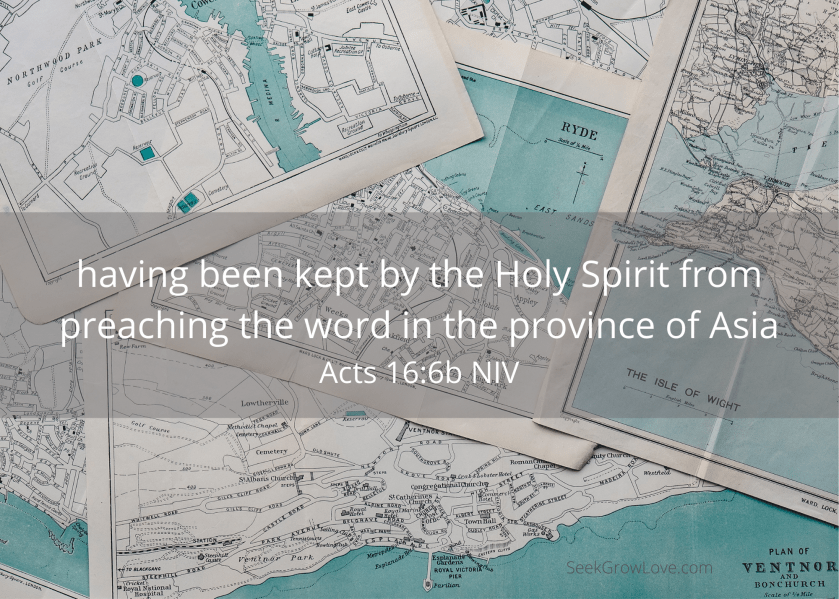
There are a lot of closed and closing doors in Acts 16. Paul and his companions (including Silas and Timothy at this point) were at the beginning of Paul’s second missionary journey. It is helpful to look at a map as you read Acts 16:6-10 to see what is really going on with Paul’s travel plans. (I also found William Schlegel’s Satellite Bible Atlas handy). Verse 6 says the Holy Spirit kept them from preaching the word in the province (not continent) of Asia. This indicates that they had wanted to, were planning on, and would have taken the gospel message to the province of Asia. That sounds like a very good thing! But, Asia became a closed door – because of the Holy Spirit. The map shows that the province of Asia would have been to their west as they were traveling. The very next verse says that at the border of Mysia (indicating that they did indeed continue traveling after their first way was blocked), “they tried to enter Bithynia, but the Spirit of Jesus would not allow them to” (Acts 16:7 NIV). Bithynia would be to their east. Closed door, again! Can’t go west, then, further down the road they can’t go east.
It would be interesting to know what these closed doors looked like. Maybe government red tape and passport issues that prevented travel to certain areas. Maybe a prophecy or just plain “bad feeling” about proceeding in the intended direction. Maybe advice from others regarding weather or disasters or unrest ahead. Maybe we will know one day what their closed doors were. Probably you can see what your closed doors are. What has kept you from the day, the trip or the life you envisioned? Maybe you have become discouraged because of all the things you were planning on doing, that aren’t working out right now as you had planned. If so, keep reading Acts.
It’s easy to ask, “What’s up, God? Don’t you want these on-fire evangelists to carry your word to the world?” How many closed doors are we supposed to come across and still keep going? It is so easy to let road blocks and closed doors defeat us, but Paul kept traveling, wherever he could. Can’t go to Asia, can’t go to Bithynia, let’s try heading to Troas. He was rewarded with a vision of a man from Macedonia calling out for help. The Bible tells us, when Paul received the vision, “We got ready at once to leave for Macedonia, concluding that God had called us to preach the gospel to them.”
So off to Macedonia they went. And what adventures – and lots of open doors – awaited them in Macedonia! There were new churches and hearts God was preparing in Philippi and Thessalonica and Berea (all cities of Macedonia). But God had planned that they would hear the message from Paul and his companions. He just needed to get Paul to them. If God had allowed Paul to enter Asia or Bithynia when they had wanted to, Lydia and the Philippian jailer and so many others would have been left waiting.
God’s plans were better than Paul’s . God’s plans are better than ours. His open doors are the best. His closed doors are closed for a reason – and that is okay – even good – even when it pinches a bit or throws us to the ground for a spell. Get up and try another door. Keep traveling and testing doors. The one He wants you to go through will indeed open. And behind THAT door are adventures and blessings that He has prepared for you – and people that He has prepared for you to carry the good news to. Don’t miss out on finding the open doors because you are sulking at the closed ones.
(Note on Holy Spirit and the Spirit of Jesus: both of these spirits were blocking Paul’s way at different times. I think it is not saying these are the same – but they did have the same purpose which was to get Paul to where God wanted him by keeping Paul from going other places, at least for now (later he would travel to Asia and work with the people who God had prepared at that time). Just as God and His Son are two side by side in heaven right now, they are active in the same spiritual battle for saving lives by sending their spirits to guide, empower, and close and open doors. It’s kind of like getting two superheroes on your side instead of just one.)
-Marcia Railton
Reflection Questions:
Do you sometimes tell yourself that your plans are better than God’s? How can you trust Him more?
What doors have been closed that you were anticipating traveling through? How did you handle it?
What doors have been opened that you hadn’t been anticipating or planning? What blessings would you have missed out on if you had taken the closed door route instead?
The story of Philip and the Ethiopian eunuch provides us with an example of how to witness and share our faith with others. Let’s start from the beginning of Phillip’s journey in Acts 8:26.
Philip is told by God to travel in a certain direction. Next he is told to walk next to a certain carriage. His directions are coming step by step. Philip trusts God. He doesn’t demand to know the game plan, but allows the Holy Spirit to guide his way bit by bit. Sometimes, that is how God delivers his instructions to us.
Next, we see Philip addressing the Ethiopian man with a question. Philip sees the man is reading scripture and instead of butting in with his own agenda, Philip asks the man if he understands what he is reading. Starting with a question is a great way to initiate a conversation about faith. This allows the other person to set the tone of the conversation with how he or she chooses to answer. In this instance, I love the man’s response, “‘How can I, unless someone instructs me?’” (Acts 8:31 NLT) He is straight up honest, aware of his own limitations, and you’ve got to admire that!
Philip joins the man in his carriage and instead of launching into his own explanation, he waits for the eunuch to ask his own followup question. Again, Philip is allowing the man to take control of the conversation. Philip is not following his own evangelical agenda, but meeting the man where he’s at with what he wants to know. Therefore, even though the eunuch is admitting to not having knowledge on the subject, Philip is giving him dignity by letting the man determine the direction of their discussion.
I love what Philip does next. Acts 8:35 says “Beginning with the same scripture, Philip told him the Good News about Jesus.” Beginning with the same scripture. That phrase is key. Philip didn’t ignore the eunuch’s questions and launch into his own prepared testimonial speech. He didn’t pull out the Roman Road, or a pamphlet in his back pocket on how to talk to people about Jesus. He related what the man was already reading to the Gospel.
This is not to say anything negative about evangelical tools. In fact, I led a Bible study in college using the Roman Road method, and I think it’s great. There is nothing inherently wrong with these tools, but that’s just what they are, tools. Tools to use with human judgment. Not every faith related conversation calls for your life story on how God changed you. Not to say we shouldn’t tell our stories, but we should find an appropriate way to fit it into the conversation while witnessing. We should never ignore someone asking direct questions about our faith.
One year in my high school art class I sat next to a girl who was openly a non-believer. Art class is one of those few classes in school where you can actually get away with talking as long as you are still focused on your work. When she learned I was a Christian she would come into class with prepared questions for me. I don’t know if she was actually genuinely interested, or if she was just trying to find a way to trip me up. It seemed more like the latter. She asked the hard big questions, like why does evil exist, why did God give us freewill. I never pressed her too much, but I answered her questions. If I didn’t know the answer, I would ask the adults in my life or look it up on my own then come back with an answer later. This went on for several weeks. I didn’t preach at her, but I answered her questions honestly and in doing so, shared the Gospel with her. I prayed for her in my own quiet time with God and asked for his direction during our conversations. I never had a come to Jesus moment with her, but I don’t think I was ever meant to, either. I kept hearing a voice in my head urging me to plant the seed. I don’t think she was ready to receive the Gospel at that point in her life. I believe I was meant to plant a seed that would be given the chance to grow years later. I did all this by meeting her where she was at, with her questions, instead of my own agenda.
Philip quite literally and figuratively meets the eunuch where he is at. Eventually, the eunuch becomes so moved by what he has heard from Philip he decides to be baptized. Church history relates this encounter to how the Gospel came to Africa. After the eunuch was baptized and Philip left him, the man brought his new found faith to his people. This all comes from Philip being willing to follow God and being open to the promptings of the Holy Spirit. Next time you find yourself in a position to share the Gospel, remember Phillip. Remember how Phillip treated the eunuch tactfully with dignity, meeting him right where he was at, just as Jesus does with us.
-Emilee Ross
Reflection Questions
How well do you follow promptings from the Holy Spirit, especially as it applies to sharing your faith? Have you ever felt like you missed a God-given opportunity? How can remembering Philip help you?
What questions do you think are common among the world regarding faith in God?
Pray for guidance and wisdom in knowing how God wants to see you sharing your faith.
In yesterday’s reading of Exodus 35 God filled the tabernacle craftsmen (Bezalel, Oholiab and others) with his Spirit providing them with the skill, ability and knowledge to do the work the Lord desired them to do for Him. In today’s reading of Acts 2 God pours out His Holy Spirit on Jesus’ followers and they, too, are enabled to do the work the Lord desired them to do for Him. This time the Spirit was not delivering the ability to create beautiful gold cherubim and lampstands or embroidered curtains. God had a different job in mind for these workers.
In the Old Testament we see the Spirit given, or described as “in” various leaders so they are able to carry out the work that God wants them to do. Joshua is chosen to succeed Moses due to “the spirit” in him (Numbers 27:18). Gideon receives the Spirit of the Lord, and he blows a trumpet to assemble an army to go up against the Midianites (Judges 6:34). Ezekiel records that the Spirit came into him as he heard God call him to be a prophet to carry God’s words to the rebellious and obstinate nation of Israel (Ezekiel 2:1-4). And there are other instances found in the Old Testament. Sometimes the spirit was given to provide gifts of leadership and skills (including but definitely not limited to craftsmanship). Sometimes the spirit was given to embolden and provide power and strength to overcome the enemy. Sometimes the spirit was given to the one chosen to carry God’s precious words and warnings of His judgment to God’s people, whether they listen or not. The Spirit was a special gift to those leaders willing to do what He says and do His work.
Fast forward to the beginning of Acts and we find Jesus’ followers who had witnessed Jesus’ death and the empty tomb now get the privilege of 40 days with the risen Christ as he tells them all about the kingdom of God. He also tells them his Father has a gift for them – but they can’t have it quite yet – they have to wait for it in Jerusalem (Acts 1:4). Can you imagine their excitement! They are ready to see this kingdom start. They are ready for their gift. They might even be thinking the hard part was now behind them. They had followed Jesus for 3 years. They had watched him die. But now Jesus is alive and by their side and the kingdom is around the corner. Little kink in their plan, Jesus tells them only the Father knows when it will begin; but he encourages them with these words: “You will receive power when the Holy Spirit comes on you; and you will be my witnesses…” (Acts 1:8). THEN, Jesus leaves, again! He isn’t dead, he is very much alive this time, raised in the clouds to heaven and the men in white assure them that this same Jesus will return the same way. What should the disciples do next? Probably obey. Go to Jerusalem and wait for that gift Jesus mentioned.
They do what Jesus told them to do and in Acts 2 they are waiting in Jerusalem. Perhaps receiving the gift requires obedience first. Approximately ten days later, on the Day of Pentecost, the gift was delivered – and what a delivery it was. Much more dramatic than a singing telegram or balloon delivery, the gift was accompanied with the sound of a violent blowing wind. I have never heard a tornado myself, but it is often described as the sound of a freight train getting closer and coming at you. Imagine hearing these violent winds coming into the room you are in. And what you hear is only surpassed by what you see: a ball of fire suspended in the air which then separates as a tongue of fire comes to rest on each one of you! God was definitely getting their attention with this gift delivery! I think He wanted them to always remember this moment and never doubt that He had indeed delivered what Jesus had promised his Father would deliver.
In fact, Jesus was not the first one to promise the delivery of this gift. Many years earlier the prophet Joel had foretold of a time when God would, “Pour out my Spirit on all people. Your sons and daughters will prophesy…even on my servants, both men and women, I will pour out my Spirit in those days and they will prophesy.” (Joel 2:28-32 and Acts 2:17-21). This was now a pouring out of God’s Spirit! It was not just for a few select leaders who had a job to do. Now everyone seems to have a job to do! The sons and daughters, young and old, even on my servants, both men and women, Joel says God says. So pour that Spirit on – they are going to need it! They are going to prophesy and speak for God. Prophecy is sometimes thought of as just foretelling the future but it actually includes hearing and speaking for God whatever message He sends.
And this time He sent His message in many foreign languages, all at once, to the disciples who had previously not known or understood or spoke these foreign languages, but now their words were heard and understood by the Jews gathered from many foreign lands and tongues. “All of them (the Jesus followers gathered in Jerusalem who had just heard the wind and saw the tongues of fire land on each of them) were filled with the Holy Spirit and began to speak in other tongues as the Spirit enabled them” (Acts 2:4). Turns out God not only wanted to get the disciples’ attention – but also the attention of all the Jews from many foreign lands and tongues who were in Jerusalem for the Day of Pentecost celebration. The people each hear their own language from these Galileans and they are amazed and perplexed – and listening!
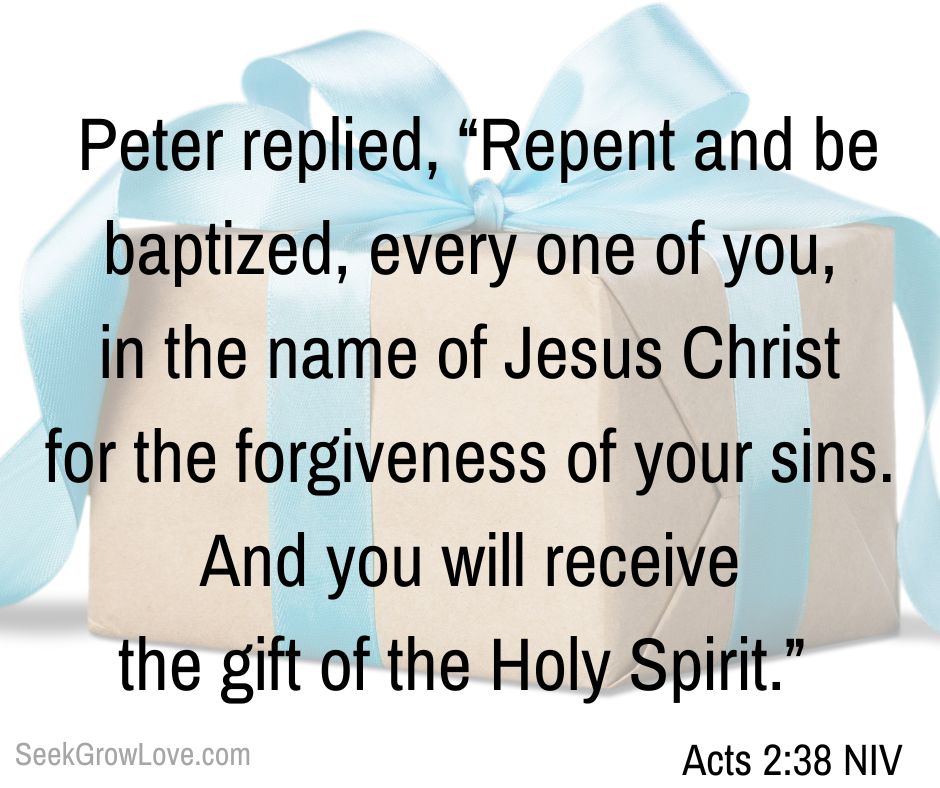
So Peter stands up and speaks for God – with an amazing sermon in Acts 2 you don’t want to miss! This is the same Peter who approximately 53 days earlier denied Jesus three times. He wouldn’t even admit to the servant girl that he had been with Jesus. This is the same Peter who wept at his weakness. Now he is preaching to the multitude to tell the Jews of every nation about Jesus whom God has made both Lord and Christ. The Spirit makes a difference -a big difference. Peter explains from Joel, to the man Jesus. He explains to the Jews how they put Jesus to death and God raised him to life, freeing him from death. He explains how David is in the grave, but Jesus is not. When the people hear, understand and are convicted they ask what they must do. Peter replies, “Repent and be baptized, every one of you, in the name of Jesus Christ for the forgiveness of your sins. And you will receive the gift of the Holy Spirit” (Acts 2:38). Obey these steps – and the gift is ready for you.
God’s gift of His Spirit is no longer just for the Bezalels, Joshuas, Gideons, and Peters. It is no longer just for the disciples who physically walked with Jesus. Now, if you repent and are baptized, this gift is for you! Are your ready to obey and do the work God has for you? You, too, can receive the gift of God’s Holy Spirit to do the work that God has for you to do. The gift is not always delivered with the sound of violent winds and tongues of fire. What the gift enables you to do still depends on what job the Lord has for you to do. Without it, you are weak. With it, comes power, words, skills, and energy you are not capable of on your own. Are you ready to receive God’s gift?
-Marcia Railton
Reflection Questions
What are your thoughts on God’s Spirit? What does Scripture teach about God’s Spirit?
What work do you think God has for you to do? Are you already using His Spirit to do this work?
What does one have to do to receive God’s gift of His Spirit?






 Seek Grow Love