Throughout history God has lead his people many ways. To a few he spoke audibly, others in dreams but he used the tabernacle to lead the Israelites. They set up the tabernacle to the very detail as God requested. After it was complete, 40:34 says
Then the cloud covered the tent of meeting, and the glory of the Lord filled the tabernacle.
God made his presence known and clearly began to lead the people on their travels. Whenever the cloud left the people knew it was time to get up and go. Whenever the cloud would stop the people would also stop.
Sometimes I wish that God led us today in such an obvious manner. I need fool proof directions just to get across town let alone the race we are called to run as followers of Christ.
Although it is not as obvious, God still leads his people. He still tells us when and where to go and also when and where to stay.
The tabernacle was a dedicated place for God in the lives of the Israelites. They gave of their time, energy and resources to have a spot for God in their lives. Many often claim that they want direction from God but have not made space for his leading in their lives. They have not made time or space for God.
After the ascension of Christ, the believers were blessed with God’s presence in an even better way than the tabernacle. God’s power, his presence, his spirit can dwell in YOU!
Will you make time and space in your life – for the glory of God to lead you where he would have you go? And further, are you willing to follow that lead?
John Wincapaw
(originally posted for SeekGrowLove on February 12, 2020)
Reflection Questions
Can you give some examples of God’s leading in your life – in big or small ways?
What types of preparation and space making would God like to see you involved in before He reveals where He wants you to go next? Unlike Moses, are there any directions you haven’t completed yet that might be a helpful pre-cursor to the big journey God wants to lead you on next?
“Will you make time and space in your life – for the glory of God to lead you where he would have you go? And further, are you willing to follow that lead?” What does it look like to make time and space for God?
To human beings who rely on our five senses to understand the world around us, it can be hard to make sense of this invisible power mysteriously referred to as the Helper. Jesus is vague in his description of the Helper—so vague that the disciples may have been picturing a cape-wearing, hammer-throwing, bad-guy-slaying superhero.
Throughout the New Testament, in Jesus’ teachings and the following epistles, we get a clearer picture of what the Helper is. We most commonly refer to the Helper as the Holy Spirit. It is the power and presence of God active in the lives of believers.
Using scripture as our reference, let’s demystify what the Holy Spirit is doing in your life. (If you’ve committed to following Christ, this power is already inside you! If you haven’t yet, this power is available to you!)
The Holy Spirit, through Jesus, dwells in us to be our helper.
Through Jesus’ sacrifice, which made you a vessel fitting of the Holy Spirit, God’s power lives in you. Whether you’ve realized this before or not, you wield a supernatural force—your very own super power, your helper.
Have you ever gotten your fingers pinched, or crushed in a door? Ouch. That stings. Have you ever watched as someone walked (or ran) right into a closed door, falling backwards? I watch a lot of preschoolers – it’s a regular thing. Some handle it well, and dust themselves off as they go on, sometimes even laughing. Others need to take some time on the floor (and sometimes in my arms) to get over the shock and pain.
Have you ever been excitedly making plans of how your day, your trip or your life would go – only to find closed or closing doors. Maybe your fingers gets pinched in the process, or maybe your whole body and spirit are totally knocked out from a closing opportunity you were planning on and excitedly anticipating?
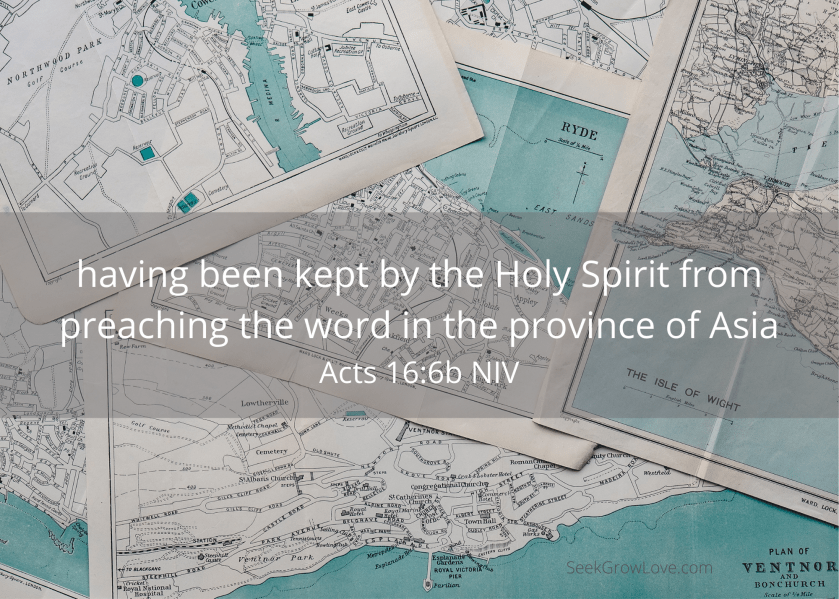
There are a lot of closed and closing doors in Acts 16. Paul and his companions (including Silas and Timothy at this point) were at the beginning of Paul’s second missionary journey. It is helpful to look at a map as you read Acts 16:6-10 to see what is really going on with Paul’s travel plans. (I also found William Schlegel’s Satellite Bible Atlas handy). Verse 6 says the Holy Spirit kept them from preaching the word in the province (not continent) of Asia. This indicates that they had wanted to, were planning on, and would have taken the gospel message to the province of Asia. That sounds like a very good thing! But, Asia became a closed door – because of the Holy Spirit. The map shows that the province of Asia would have been to their west as they were traveling. The very next verse says that at the border of Mysia (indicating that they did indeed continue traveling after their first way was blocked), “they tried to enter Bithynia, but the Spirit of Jesus would not allow them to” (Acts 16:7 NIV). Bithynia would be to their east. Closed door, again! Can’t go west, then, further down the road they can’t go east.
It would be interesting to know what these closed doors looked like. Maybe government red tape and passport issues that prevented travel to certain areas. Maybe a prophecy or just plain “bad feeling” about proceeding in the intended direction. Maybe advice from others regarding weather or disasters or unrest ahead. Maybe we will know one day what their closed doors were. Probably you can see what your closed doors are. What has kept you from the day, the trip or the life you envisioned? Maybe you have become discouraged because of all the things you were planning on doing, that aren’t working out right now as you had planned. If so, keep reading Acts.
It’s easy to ask, “What’s up, God? Don’t you want these on-fire evangelists to carry your word to the world?” How many closed doors are we supposed to come across and still keep going? It is so easy to let road blocks and closed doors defeat us, but Paul kept traveling, wherever he could. Can’t go to Asia, can’t go to Bithynia, let’s try heading to Troas. He was rewarded with a vision of a man from Macedonia calling out for help. The Bible tells us, when Paul received the vision, “We got ready at once to leave for Macedonia, concluding that God had called us to preach the gospel to them.”
So off to Macedonia they went. And what adventures – and lots of open doors – awaited them in Macedonia! There were new churches and hearts God was preparing in Philippi and Thessalonica and Berea (all cities of Macedonia). But God had planned that they would hear the message from Paul and his companions. He just needed to get Paul to them. If God had allowed Paul to enter Asia or Bithynia when they had wanted to, Lydia and the Philippian jailer and so many others would have been left waiting.
God’s plans were better than Paul’s . God’s plans are better than ours. His open doors are the best. His closed doors are closed for a reason – and that is okay – even good – even when it pinches a bit or throws us to the ground for a spell. Get up and try another door. Keep traveling and testing doors. The one He wants you to go through will indeed open. And behind THAT door are adventures and blessings that He has prepared for you – and people that He has prepared for you to carry the good news to. Don’t miss out on finding the open doors because you are sulking at the closed ones.
(Note on Holy Spirit and the Spirit of Jesus: both of these spirits were blocking Paul’s way at different times. I think it is not saying these are the same – but they did have the same purpose which was to get Paul to where God wanted him by keeping Paul from going other places, at least for now (later he would travel to Asia and work with the people who God had prepared at that time). Just as God and His Son are two side by side in heaven right now, they are active in the same spiritual battle for saving lives by sending their spirits to guide, empower, and close and open doors. It’s kind of like getting two superheroes on your side instead of just one.)
-Marcia Railton
Reflection Questions:
Do you sometimes tell yourself that your plans are better than God’s? How can you trust Him more?
What doors have been closed that you were anticipating traveling through? How did you handle it?
What doors have been opened that you hadn’t been anticipating or planning? What blessings would you have missed out on if you had taken the closed door route instead?
The story of Philip and the Ethiopian eunuch provides us with an example of how to witness and share our faith with others. Let’s start from the beginning of Phillip’s journey in Acts 8:26.
Philip is told by God to travel in a certain direction. Next he is told to walk next to a certain carriage. His directions are coming step by step. Philip trusts God. He doesn’t demand to know the game plan, but allows the Holy Spirit to guide his way bit by bit. Sometimes, that is how God delivers his instructions to us.
Next, we see Philip addressing the Ethiopian man with a question. Philip sees the man is reading scripture and instead of butting in with his own agenda, Philip asks the man if he understands what he is reading. Starting with a question is a great way to initiate a conversation about faith. This allows the other person to set the tone of the conversation with how he or she chooses to answer. In this instance, I love the man’s response, “‘How can I, unless someone instructs me?’” (Acts 8:31 NLT) He is straight up honest, aware of his own limitations, and you’ve got to admire that!
Philip joins the man in his carriage and instead of launching into his own explanation, he waits for the eunuch to ask his own followup question. Again, Philip is allowing the man to take control of the conversation. Philip is not following his own evangelical agenda, but meeting the man where he’s at with what he wants to know. Therefore, even though the eunuch is admitting to not having knowledge on the subject, Philip is giving him dignity by letting the man determine the direction of their discussion.
I love what Philip does next. Acts 8:35 says “Beginning with the same scripture, Philip told him the Good News about Jesus.” Beginning with the same scripture. That phrase is key. Philip didn’t ignore the eunuch’s questions and launch into his own prepared testimonial speech. He didn’t pull out the Roman Road, or a pamphlet in his back pocket on how to talk to people about Jesus. He related what the man was already reading to the Gospel.
This is not to say anything negative about evangelical tools. In fact, I led a Bible study in college using the Roman Road method, and I think it’s great. There is nothing inherently wrong with these tools, but that’s just what they are, tools. Tools to use with human judgment. Not every faith related conversation calls for your life story on how God changed you. Not to say we shouldn’t tell our stories, but we should find an appropriate way to fit it into the conversation while witnessing. We should never ignore someone asking direct questions about our faith.
One year in my high school art class I sat next to a girl who was openly a non-believer. Art class is one of those few classes in school where you can actually get away with talking as long as you are still focused on your work. When she learned I was a Christian she would come into class with prepared questions for me. I don’t know if she was actually genuinely interested, or if she was just trying to find a way to trip me up. It seemed more like the latter. She asked the hard big questions, like why does evil exist, why did God give us freewill. I never pressed her too much, but I answered her questions. If I didn’t know the answer, I would ask the adults in my life or look it up on my own then come back with an answer later. This went on for several weeks. I didn’t preach at her, but I answered her questions honestly and in doing so, shared the Gospel with her. I prayed for her in my own quiet time with God and asked for his direction during our conversations. I never had a come to Jesus moment with her, but I don’t think I was ever meant to, either. I kept hearing a voice in my head urging me to plant the seed. I don’t think she was ready to receive the Gospel at that point in her life. I believe I was meant to plant a seed that would be given the chance to grow years later. I did all this by meeting her where she was at, with her questions, instead of my own agenda.
Philip quite literally and figuratively meets the eunuch where he is at. Eventually, the eunuch becomes so moved by what he has heard from Philip he decides to be baptized. Church history relates this encounter to how the Gospel came to Africa. After the eunuch was baptized and Philip left him, the man brought his new found faith to his people. This all comes from Philip being willing to follow God and being open to the promptings of the Holy Spirit. Next time you find yourself in a position to share the Gospel, remember Phillip. Remember how Phillip treated the eunuch tactfully with dignity, meeting him right where he was at, just as Jesus does with us.
-Emilee Ross
Reflection Questions
How well do you follow promptings from the Holy Spirit, especially as it applies to sharing your faith? Have you ever felt like you missed a God-given opportunity? How can remembering Philip help you?
What questions do you think are common among the world regarding faith in God?
Pray for guidance and wisdom in knowing how God wants to see you sharing your faith.
In yesterday’s reading of Exodus 35 God filled the tabernacle craftsmen (Bezalel, Oholiab and others) with his Spirit providing them with the skill, ability and knowledge to do the work the Lord desired them to do for Him. In today’s reading of Acts 2 God pours out His Holy Spirit on Jesus’ followers and they, too, are enabled to do the work the Lord desired them to do for Him. This time the Spirit was not delivering the ability to create beautiful gold cherubim and lampstands or embroidered curtains. God had a different job in mind for these workers.
In the Old Testament we see the Spirit given, or described as “in” various leaders so they are able to carry out the work that God wants them to do. Joshua is chosen to succeed Moses due to “the spirit” in him (Numbers 27:18). Gideon receives the Spirit of the Lord, and he blows a trumpet to assemble an army to go up against the Midianites (Judges 6:34). Ezekiel records that the Spirit came into him as he heard God call him to be a prophet to carry God’s words to the rebellious and obstinate nation of Israel (Ezekiel 2:1-4). And there are other instances found in the Old Testament. Sometimes the spirit was given to provide gifts of leadership and skills (including but definitely not limited to craftsmanship). Sometimes the spirit was given to embolden and provide power and strength to overcome the enemy. Sometimes the spirit was given to the one chosen to carry God’s precious words and warnings of His judgment to God’s people, whether they listen or not. The Spirit was a special gift to those leaders willing to do what He says and do His work.
Fast forward to the beginning of Acts and we find Jesus’ followers who had witnessed Jesus’ death and the empty tomb now get the privilege of 40 days with the risen Christ as he tells them all about the kingdom of God. He also tells them his Father has a gift for them – but they can’t have it quite yet – they have to wait for it in Jerusalem (Acts 1:4). Can you imagine their excitement! They are ready to see this kingdom start. They are ready for their gift. They might even be thinking the hard part was now behind them. They had followed Jesus for 3 years. They had watched him die. But now Jesus is alive and by their side and the kingdom is around the corner. Little kink in their plan, Jesus tells them only the Father knows when it will begin; but he encourages them with these words: “You will receive power when the Holy Spirit comes on you; and you will be my witnesses…” (Acts 1:8). THEN, Jesus leaves, again! He isn’t dead, he is very much alive this time, raised in the clouds to heaven and the men in white assure them that this same Jesus will return the same way. What should the disciples do next? Probably obey. Go to Jerusalem and wait for that gift Jesus mentioned.
They do what Jesus told them to do and in Acts 2 they are waiting in Jerusalem. Perhaps receiving the gift requires obedience first. Approximately ten days later, on the Day of Pentecost, the gift was delivered – and what a delivery it was. Much more dramatic than a singing telegram or balloon delivery, the gift was accompanied with the sound of a violent blowing wind. I have never heard a tornado myself, but it is often described as the sound of a freight train getting closer and coming at you. Imagine hearing these violent winds coming into the room you are in. And what you hear is only surpassed by what you see: a ball of fire suspended in the air which then separates as a tongue of fire comes to rest on each one of you! God was definitely getting their attention with this gift delivery! I think He wanted them to always remember this moment and never doubt that He had indeed delivered what Jesus had promised his Father would deliver.
In fact, Jesus was not the first one to promise the delivery of this gift. Many years earlier the prophet Joel had foretold of a time when God would, “Pour out my Spirit on all people. Your sons and daughters will prophesy…even on my servants, both men and women, I will pour out my Spirit in those days and they will prophesy.” (Joel 2:28-32 and Acts 2:17-21). This was now a pouring out of God’s Spirit! It was not just for a few select leaders who had a job to do. Now everyone seems to have a job to do! The sons and daughters, young and old, even on my servants, both men and women, Joel says God says. So pour that Spirit on – they are going to need it! They are going to prophesy and speak for God. Prophecy is sometimes thought of as just foretelling the future but it actually includes hearing and speaking for God whatever message He sends.
And this time He sent His message in many foreign languages, all at once, to the disciples who had previously not known or understood or spoke these foreign languages, but now their words were heard and understood by the Jews gathered from many foreign lands and tongues. “All of them (the Jesus followers gathered in Jerusalem who had just heard the wind and saw the tongues of fire land on each of them) were filled with the Holy Spirit and began to speak in other tongues as the Spirit enabled them” (Acts 2:4). Turns out God not only wanted to get the disciples’ attention – but also the attention of all the Jews from many foreign lands and tongues who were in Jerusalem for the Day of Pentecost celebration. The people each hear their own language from these Galileans and they are amazed and perplexed – and listening!
So Peter stands up and speaks for God – with an amazing sermon in Acts 2 you don’t want to miss! This is the same Peter who approximately 53 days earlier denied Jesus three times. He wouldn’t even admit to the servant girl that he had been with Jesus. This is the same Peter who wept at his weakness. Now he is preaching to the multitude to tell the Jews of every nation about Jesus whom God has made both Lord and Christ. The Spirit makes a difference -a big difference. Peter explains from Joel, to the man Jesus. He explains to the Jews how they put Jesus to death and God raised him to life, freeing him from death. He explains how David is in the grave, but Jesus is not. When the people hear, understand and are convicted they ask what they must do. Peter replies, “Repent and be baptized, every one of you, in the name of Jesus Christ for the forgiveness of your sins. And you will receive the gift of the Holy Spirit” (Acts 2:38). Obey these steps – and the gift is ready for you.
God’s gift of His Spirit is no longer just for the Bezalels, Joshuas, Gideons, and Peters. It is no longer just for the disciples who physically walked with Jesus. Now, if you repent and are baptized, this gift is for you! Are your ready to obey and do the work God has for you? You, too, can receive the gift of God’s Holy Spirit to do the work that God has for you to do. The gift is not always delivered with the sound of violent winds and tongues of fire. What the gift enables you to do still depends on what job the Lord has for you to do. Without it, you are weak. With it, comes power, words, skills, and energy you are not capable of on your own. Are you ready to receive God’s gift?
-Marcia Railton
Reflection Questions
What are your thoughts on God’s Spirit? What does Scripture teach about God’s Spirit?
What work do you think God has for you to do? Are you already using His Spirit to do this work?
What does one have to do to receive God’s gift of His Spirit?
There is so much to digest in the Sermon on the Mount. Jesus sets the standard of living in all aspects of life and slowly combats the legalistic Jewish culture of his time. Our Messiah makes us aware that His Father can see through our actions, straight to the root, or better yet, the heart of our motivation; this is truly convicting. What may look like altruism or mercy from the outside may, in fact, be manipulation and control in the mind. Out of all the qualities in the Beatitudes, it may be most rare to find someone who is pure of heart.
In Genesis 5, the great-great-great-great-grandson of Adam, Enoch, is given more than the standard father/age line. It states that Enoch walked faithfully with God and then God took him away. Many times the discussion around Enoch prioritizes “Where did he go?” The more important discussion is “How was he so faithful in his walk with God?” I don’t really have an answer to either question, but I will make an inference about the latter based upon the promise within the Beatitudes. Enoch faithfully walked with God because he was pure of heart and he has seen or will see God (Hebrews 11:5-6,39-40).
“Create in me a pure heart, O God, and renew a steadfast spirit within me. Do not cast me from your presence or take your Holy Spirit from me. Restore to me the joy of your salvation and grant me a willing spirit, to sustain me.” – Psalm 51:10-12
To gain further insight into what exactly is a pure heart, we can ironically turn to David at the moment he felt the most disconnected from the Almighty. David had accomplished so much in the name of the God of Israel. Fighting a giant in faith, leading Israel into battle, giving mercy to God’s anointed, becoming king of the chosen people, and writing a myriad of worship songs in honor of the Lord, yet, in his most impure moments, he had committed adultery, was responsible for a cold-blooded death of a man, and was delivered a bleak message by God through His prophet, Nathan. In reflection, David indirectly states that a pure heart is steadfast, focused on the joy that comes from God, and is in tune with the Holy Spirit. Ultimately, David is restored through repentance and the mercies of God and is still considered a man after God’s own heart, the purest of them all.
So what exactly does it take for each one of us to be pure of heart? First, we must be motivated by and steadfast in the love of God. If we are motivated for the glory it will bring to ourselves or in the indulgences of our flesh, we will never be satisfied. There are not enough likes or followers to replace the unconditional attention of your Heavenly Father. Next, we must be joyful in all seasons. When we become motivated by God, we are no longer victims of circumstance but part of God’s salvation plan. Our pressings and persecutions become opportunities to share our promise. Finally, purity is finding and following God’s will through receiving and responding to His Holy Spirit. Let His power lead your feet and the Gospel message . By remaining pure of heart, walking with God, we will see God move and experience the fullness of Him and live with the hope that our faith will be made sight, seeing Him face to face.
-Aaron Winner
Reflection Questions
What grade would you give your heart’s purity (or lack thereof)? For you personally, what motivations, behaviors, attitudes get in the way of having a pure heart? In what ways can you work towards a more pure heart?
How would you describe each of the other Beatitudes in Matthew 5:1-12 – and the reward for each?
Why do you think Jesus started his sermon this way?
There are some four-thousand years between the first and second Adam, both the bookends of the fall of man. Through the first Adam, sin found a foothold in the world. Through the second Adam, Jesus Christ, the sting of eternal destruction in the second death (Rev. 21:6, Rom 6:23) is broken and restoration that comes from God is complete. Being familiar with scripture and his role as Savior, Jesus knew he was the precious Lamb of God, who upon him was transferred the weight and debt of all our sins. Jesus would go on to fulfill this role as our purification offering, fulfilling the law and the words of prophets.
In a similar manner, Jesus redefines and completes baptism in Matthew 3. Although not defined by religious laws in the Old Testament, baptism had become a common practice for sects of Judaism from the time of Malachi to the beginning of the Common Era. It was performed as a ritual cleansing, done in preparation to ready oneself to make a sacrifice at the temple. This could be done time and time again because of the literal and spiritual uncleanliness that would appear between trips to the Temple. John’s baptism took on this role, specifically for the forgiveness of sins. So why would a sinless Savior need to engage in such a symbol?
“Then Jesus came from Galilee to the Jordan to be baptized by John. But John tried to deter him, saying, ‘I need to be baptized by you, and do you come to me?’ Jesus replied, ‘Let it be so now; it is proper for us to do this to fulfill all righteousness.’ Then John consented. As soon as Jesus was baptized, he went up out of the water. At that moment heaven was opened, and he saw the Spirit of God descending like a dove and alighting on him. And a voice from heaven said, ‘This is my Son, whom I love; with him I am well pleased.’ – Matthew 3:13-17
The first reason Jesus is baptized is as simple as he stated, “to fulfill all righteousness.” Baptism is not merely for the forgiveness of sins. It is first and foremost the public dedication of your life to love God, accept Jesus as Lord and Savior, and live for his Kingdom. To us this means that looking for a pass on sin without submission is not living-saving nor does it accept the grace of God. Specifically, those who participated in the baptism of John for the forgiveness of sin were told to be rebaptized when they knew this Good News.
The second basis for baptism is the fulfillment of the gracious cleansing we receive by the sacrifice of Jesus. Just like the payment of Christ, baptism is once and for all. By being fully immersed in water, we demonstrate not only His death, but our own. Likewise, in rising out of the water, we illustrate the cornerstone of our hope, that Jesus has risen from the dead. Furthermore this illustrates by dying to Him, we are raised to life, asking the raised Christ to live in us as Lord of our life today and being assured of the hope of our own resurrection if we remain faithful.
Arguably the third purpose for baptism is the invitation of the Holy Spirit in our lives. Jesus is shown this power of God at His baptism, and the Holy Spirit descending onto ministry of miracles. Baptism, in fullness, is an invitation for the Spirit of God to direct your path (Rom 8:14), bear fruit because of its presence (Gal 5:22-23), and to even comfort in times of hardship or grief. (John 14:26) It is the same power that raised Jesus from the grave that can now live in us. (Rom 8:11)
If you haven’t considered baptism up to this point, what is stopping you from such a confession of faith? Baptism is not the culmination, but the entry point of faith. You do not have to understand the nuances of scripture, only that our Heavenly Father sent His Son into the world to die for your sin, and they are coming back to Earth with eternal life in hand.
If you have already dedicated your life through this public confession, hold close to your heart the promise that is in the symbol. Time and time again, we trip, stumble, and fall flat on our faces, but with each fall, we are lifted out of the waters of baptism and covered in the grace of God through Jesus Christ. Thank God we do not have to be reimmersed. Many of us would spend the vast majority of life underwater. We can confess to Heavenly Father with a repentant heart and the power of baptism in Jesus Christ not only banishes the wages of sin, but gives us the present presence of God for now and for eternity.
-Aaron Winner
Reflection Questions
If you haven’t considered baptism up to this point, what is stopping you from such a confession of faith?
Yesterday, we read about the resurrection of Lazarus. John actually structures the first part of his book (chapters 1-12) around seven signs that Jesus is the Messiah, with the power of raising Lazarus as the seventh. Peter points out that Jesus was attested to the people of Israel by God through those mighty works and wonders and signs. (Acts 2:22) However, while most commentaries talk about the seven signs, I would contend that the resurrection of Jesus himself is the eighth sign of his Messiahship. Acts 2:24 “God raised [Jesus] up, loosing the pangs of death, because it was not possible for him to be held by it.”
What an amazing verse! Not that Christ could struggle against and eventually overcome death, but that it was not possible for death to hold him.
What an amazing savior! Christ had every right as the Son of God to rule as king and call upon legions of angels to defend him, but instead he chose to willingly submit himself to the plan of God.
What an amazing God! God gave us a salvation through the death of Christ that we could never earn, and gave us a hope through the resurrection of Christ that is greater than any we could ever imagine!
Luke wrote Acts based on the eyewitness testimony of those who not only followed Jesus when he was alive, but saw him when he had been raised. God raised up Christ, and all these fishermen and tax collectors and sinners in Acts 2 experience in and participate in the miracle of new life through the Holy Spirit now. Because Christ has been raised to life and is at the right hand of God, we are able to praise him with the Holy Spirit speaking through us, extolling the greatness of our God and his Christ.
If you want this new life that begins now to continue forever, you need to follow the commands of Peter in Acts 2:38 : “Repent and be baptized every one of you in the name of Jesus Christ for the forgiveness of your sins, and you will receive the gift of the Holy Spirit.” “The Spirit marks us as God’s own. We can now be sure that someday we will receive all that God has promised. That will happen after God sets all his people completely free. All these things will bring praise to his glory.” (Ephesians 1:14, NIrV)
What an amazing gift! The Spirit given to us through baptism is the teacher, guide, helper, and empower-er of the people of God so that we can do God’s will in the world.
What an amazing promise! The Spirit guarantees that we will one day be raised from the dead, like Christ!
What an amazing Spirit, the power of God!
What an amazing Savior, Jesus Christ our Lord!
What an amazing God, The Father of Jesus, YHWH alone!
Amen!
-Jake Ballard
Reflection Questions
Do we too often forget how amazing God’s plan and his words are? What do you find amazing in Acts 2?
What does it mean to you that Jesus is the Messiah? What does it mean to you that death could not hold him?
Paul spent over a year and a half in Corinth, probably the fifth largest city in the Roman empire at the time, and in Acts 19 we read about the over two years he spent in Ephesus, which was in fourth place (v. 10; for those who are interested, Antioch was in third). I have seen estimates for Ephesus having as many as a quarter million people when Paul was there. You may not often visualize what it was like in cities of the Roman empire, particularly not in the largest ones, without mass transit or mass communication. Demetrius the silversmith managed to stir up a crowd, which created a mob, that stormed into the theater to complain about Paul. At that time the theater was probably still under construction, its initial seating ended up somewhere in the 17,000 to 22,000 range (the theater was expanded later). When the mass of angry people eventually left most of them were still unclear why they had come. In a mob setting a person could die without ever getting a hearing. You can see why Paul’s friends did not want him to try and defend himself. But perhaps in the days that followed the details filtered out, and God let the aftermath of the controversy give more awareness to the presence of Christianity in Ephesus.
When I read about handkerchiefs and aprons touched by Paul being carried to the sick and the possessed to give them relief (v. 11-12), I wonder about the practical reasons that may have been involved. He was “reasoning” in the school of Tyrannus every day (v. 9). I have to imagine that Paul would have found it difficult to also travel to all of the people in need of his help in that city. So, this solution developed. Maybe someone suggested the idea to him, or maybe he raised the possibility. The description brings several scriptures to mind. But first we need to recognize that this situation is about faith, not magic. There was not some kind of power being imbued into the cloth, and that matters. Taking the cloth from Paul to the person in need was intended as a symbol of trusting that Paul’s concern for the person mattered for them, which really related to the Holy Spirit power Paul wanted to be exerted on behalf of that person in the name of Jesus.
For relevant Bible examples one that is close at hand is Peter in Acts 5:15, when people put the sick on cots and pallets near his path so that “perhaps” his shadow would fall on them. It doesn’t suggest Peter was involved in organizing these efforts. Also verse 16 says that healing was occurring, but it is ambiguous whether this is about people Peter’s shadow fell on.
In Luke 8:43-48 Jesus encountered a woman who had hemorrhaged blood for twelve years and then tried to touch Jesus’ clothes to be healed. She succeeded, and Jesus knew power went out from him but not who received it. That text is well worth a discussion on its own, in part involving the feelings of unworthiness she felt and her not speaking up to Jesus at first, and her great faith that allowed her to seek healing. But she was able to get power by faith without Jesus knowing the details at first – God knew the details and took care of the problem while using Jesus as the path through which God’s power flowed. And in effect it all happened through contact with a piece of cloth.
In 2 Kings 4 Elisha sent his servant Gehazi with his staff to put it on a dead child to restore the child to life (v. 29-31). The attempt was not successful. We may be tempted to link that to Gehazi’s negative issues (see 5:20, 25-27 with Naaman), but Elisha was already following Gehazi and then became involved more personally to help, so while the desire for this to work was there on Elisha’s part maybe he wasn’t certain about the idea.
With 2 Kings 13:21 we have a particularly odd variation on a miracle taking place through an “object,” which doesn’t really fit the theme we are discussing. A dead body was put in the grave of Elisha and came back to life when it touched Elisha’s dead body. I think it likely that we are just not getting much of the story here, and that God raised this person for reasons specific to the situation. Perhaps God used the contact with Elisha’s body to make it clear that this was a miracle related to the God of Elisha, and nothing else.
Unfortunately, examples like these can get taken up in an unhelpful way and be used to support the tradition of “relics.” To briefly explain that idea, sometime after Christians began to be killed as martyrs others began to save remains from their deaths. These remains might be just ashes after they were burned at the stake. The extent of what people tried to save expanded over time, and along the way what people thought about what had been saved also changed. There developed the idea that access to these remains involved the potential for special power, because martyrs were “special” and went straight to heaven when they died – and that being in heaven and with God they were now prepared to give special attention to those who had access to their bones, or hair, or teeth, or clothing, or etc. And the relic system expanded beyond what the martyr had when they died – every one of those handkerchiefs and aprons Paul touched would still matter. The idea also developed that if the relics changed hands the special attention of the martyr would change focus to wherever the relics went. It is striking how aspects of this tradition came to be formalized.
The Council of Carthage in A.D. 401 determined that no shrines to martyrs were valid unless they contained relics of the martyr or were at sites known to be “hallowed” by the saint’s life or death, so all old shrines were to be destroyed unless those rules applied. In 787 the Second Council of Nicea said that every altar, in a church, a monastery, anywhere, needed to be consecrated by a relic. But by then it had been decided that a relic cut into small pieces still counted like the original whole. As far back as A.D. 430 Theodoret of Cyrhus expressed his support for cutting up the bodies of martyrs to provide relics. He described martyrs as the “ambassadors to the universal Lord” and said that the people of many cities gain benefits through them and “when a body has been divided, its grace remains entire, so that a small part has the same potency as the whole body” (quoted in The Oxford History of Byzantium, edited by Cyril Mango, p. 108). On the other hand the idea of moving martyr’s bodies around had not been accepted widely for quite a while, but it seems to have been fine as of 787. The fondness for relics peaked in the 9th to the 11th centuries when there were over one hundred recorded thefts of relics, taking them from one area to another in an effort to shift spiritual attention.
As I wrote earlier, the power that was working in Ephesus was never in the cloth, the power was from God’s Holy Spirit. And there are not thousands of ambassadors of the Lord from whom people can seek to receive assistance, there is one mediator between God and mankind, the man Christ Jesus (1 Timothy 2:5). Nor, as the seven sons of Sceva learned, is there power in the name of Jesus if you have no understanding of him or faith in him. His name is not a magic charm. We are to have an actual relationship with an actual person. When we read our Bibles, or even our devotions, it may sometimes feel like we are involving ourselves with a story. But as marvelous and powerful as the actions of Jesus are, and as generous and loving as his actions are, he is not invented, he lives, he is real. He wants to be engaged with my life and your life. Allow him to be.
Dear Lord, thank you again for allowing me to serve you through your son. I look forward to being with you in your kingdom and understanding so many things that I do not understand now. For the moment, please allow me to be patient, to continue to grow, and to be of use where I can. Please help me to be bolder, and kinder. Thank you. In Jesus’ name, Amen
-Daniel Smead
Questions
Some of the people Paul knew may have spent their entire ministries in just one city. How do you think things worked differently for Paul because he moved around so much?
How do you think that Luke’s description of the disciples of John the Baptist in Ephesus compares with his description of Apollos? Does it seem like they believed basically the same things?
If new converts brought out useless and somehow corrupt things valued at 50,000 days’ wages (v. 19) to be burned as a sign of now serving Christ, what sort of impact do you think that would have on your congregation? On your city?
Right after the events of this chapter Paul left Ephesus. How do you think the Ephesian believers felt about Paul leaving the city?
In Revelation 2:4-5 Jesus told the Ephesian church that they had left their first love and they needed to repent and do the deeds they did at first. From what you see in the chapter, what would you guess Jesus might be referring to?
Did you know that cities of refuge were first established by God? Did you know that everything good and just has its origins from our God? Our God performs righteous deeds and judgments for all who are oppressed. Our God establishes mercy and justice, and desires that from those who fear him. But often we do not. Instead, we pervert his ways. We do what Romans chapter one says and distort his good gifts and his good intentions for us.
We don’t get what we deserve. We deserve death, or at the very least, a reprimand, like the one God gave through his prophet John the Baptist to the crowds coming to him to be baptized.
Luke 3:7-8 (NASB) 7…“You brood of vipers, who warned you to flee from the wrath to come? 8 Therefore bear fruits in keeping with repentance.”
Psalm 103 tells us that our God 10 “has not dealt with us according to our sins, nor rewarded us according to our iniquities” (Psalm 103:10). If he did, none of us would be here.
Instead, 12 “as far as the east is from the west, so far has he removed our transgressions from us.” (Psalm 103:12). We must remember that. He pardons, he heals, he redeems. He’s compassionate and gracious, slow to anger and abounding in lovingkindness. In our New Covenant, he does this through his son Jesus. That is the God we serve. But we must also remember that he will not strive with us forever.
Can you imagine the impact our modern Sanctuary Cities would have if they functioned with God’s definition of mercy and justice at the helm? One day they will, assuming we still need them, when our righteous ruler, King Jesus returns. In the meantime, we can be Jesus’s hands and feet to the oppressed by asking our Lord Jesus what we can do.
Before the people asked Jesus what they should do, they asked the one who prepared the way before him, John the Baptist, knowing that a man from God had the authority to teach them and tell them what to do. He responds with justice because he knew what to say through the holy spirit.
His responses sound very familiar, like the responses Jesus gives during his ministry. I believe this is because it is the same spirit that is within John the Baptist that is then placed fully upon Jesus at his baptism, but to an even greater measure than it was placed on the highly respected John the Baptist. It reminds me of Elijah, being full of the holy spirit, who went before Elisha, who received an even greater measure of spirit from his God. In fact, the word tells us that John the Baptist came in the spirit of Elijah. Jesus goes so far as to tell us that John the Baptist “is” Elijah who is to come. Of course, not literally; all in spirit.
The people were amazed by John. They, 15 “were in a state of expectation and all were wondering in their hearts about John, as to whether he was the Christ.” (Luke 3:15). Of course, he was not, and made sure the people knew that the one they were looking for would not baptize them with water, but with the holy spirit.
It is Jesus whom we should look to with our questions. In Jesus we find all the fullness of the spirit of God, without measure, because God gave all power and authority to his son, with whom he is well pleased, until all enemies are made his footstools for him in the end. It is Jesus who is our salvation, a man who is mightier than John the Baptist; A man who eventually gave us the holy spirit, the power and presence of God, so that we could “be Jesus” to those who are oppressed in our day.
Unfortunately, as we look to the perverted justice system in our society, we see that there is much work to be done before our life race ends. It will never be fully just until Jesus returns and makes all wrongs right, but if we have the power now, in an even greater capacity than even Jesus was given, because now the holy spirit is given through Jesus post his death on the cross, we can keep doing the work he left for us to do.
God told us what he desires from us throughout scripture. Everything he wants for us he wants because it is good for us, and it culminates in Jesus. If we are going to stop perverting God’s words and his will, we must repent and ask God through his son what we must do! He has made known his ways through Jesus in the New Covenant. Remember his precepts through Jesus Messiah and do them. Remember what he did through Jesus and remember what Jesus chose to do for you and I often. Jesus’s yoke is easy. Serve him by doing his will, which is God’s will. And bless the Lord oh my soul for his everlasting lovingkindness!
-Juliet Taylor
Questions
What does it mean to bear fruits in keeping with repentance?
Why do you think God chooses to work through his son? In turn, why do you think Jesus chooses to work through us?
What work do you think Jesus wants you to want to do for him in your life race?