1 Corinthians 15 is a chapter all about resurrection. In 1 Corinthians 15 there were people within the church who don’t believe in the resurrection and feel like it’s not an important belief of being a Christian.
Unfortunately, this is still a belief held by some people today. There are people in the world that teach that the death and resurrection of Christ never really happened, instead it’s just a made up story. Some people even try to water down the gospel and come up with scenarios that are more “plausible” than Jesus dying and being resurrected. This is an incredibly dangerous thought process as the validity of the resurrection gives us purpose as Christians.
In 1 Corinthians 15:3-8, Paul reminds those that don’t believe in the resurrection that there is evidence it happened. There were hundreds of eyewitnesses that saw Jesus alive after being publicly executed by the Romans. Paul then goes on to explain that without the resurrection we are all lost. In 1 Corinthians 15:17-18 Paul says
“And if Christ has not been raised, your faith is futile; you are still in your sins.Then those also who have fallen asleep in Christ are lost.”
Paul is essentially saying that without the resurrection our faith is pointless. We are unable to be saved and our loved ones are unable to be raised from the dead. Paul then goes on to remind us that the resurrection is real! The resurrection of Jesus reminds us of what’s really important in our lives, to glorify God during our lives on Earth.
-Brooke Cisneros
Reflection Questions
Why does it matter if you believe in the resurrection of Jesus Christ or not?
Do you believe in the resurrection of Jesus Christ?
How can you put into action verses 57 & 58, Paul’s concluding words on the resurrection and the difference it should make in our lives?
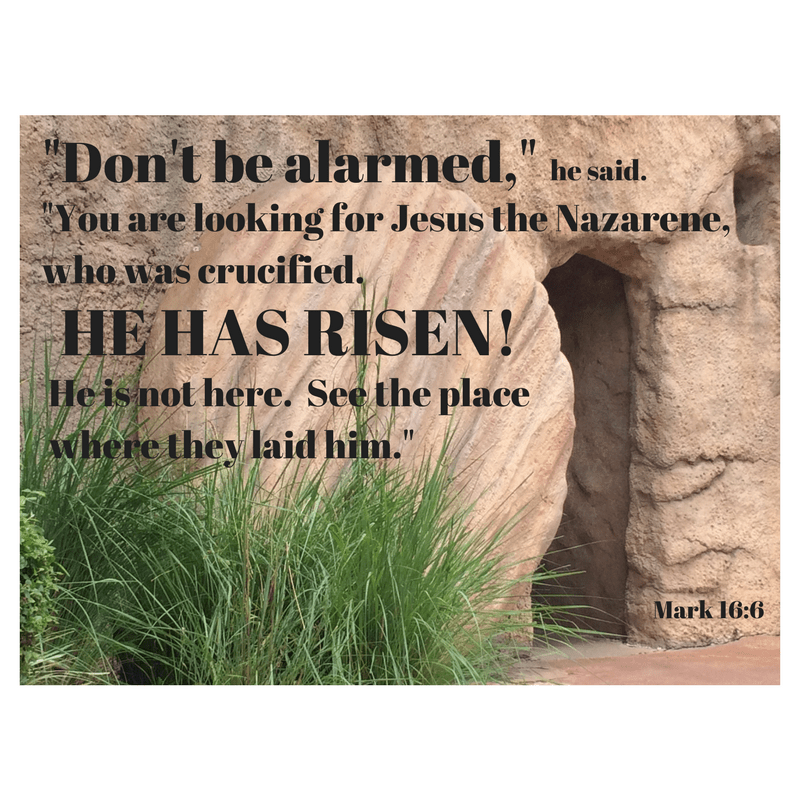
Looking at Mark 15 allowed us to consider what Jesus suffered, and why. But the dawn has come, and now we can eagerly seek the news that our savior is raised to life. That transition from death to life is as simple for us as turning a page in our Bibles. Most Christians cannot approach Mark 16 without being aware of what should come next, which may always have been the case. Mark may not have written his Gospel primarily to tell people about Jesus, but to remind and encourage believers in their faith. We might imagine the text being read aloud in a group setting.
We can envision the early listeners to this passage trying to put themselves in the places of Mary Magdalene, James’ mother Mary, and Salome. Certainly they understood what brought those women to the tomb: love, and mourning, and the wish to offer Jesus what support was possible by caring for his body. But from hindsight it was also clear that the tomb would be found open and empty – what a wonderful surprise for the mourners!
And so as the account was read the listeners waited to hear of the women’s overcoming joy at learning about Jesus’ new life. It was not to be. Rather the three were left trembling, astonished, and afraid. And upon exiting the tomb they say nothing. (We know that ultimately more happened – particularly in the case of Mary Magdalene – but that is where the text stops.)
Your Bible version, whatever version you are reading, probably does not cut off after verse 8. Perhaps it offers a footnote discussing what scholars think about the verses that follow (they doubt that the verses are legitimate). In fact different manuscripts contain four endings for the Gospel of Mark – aside from the version that simply cuts off after verse 8. That variety of endings not only shows us that some people were disappointed with the ending they had received, and tried to “fix” the issue, but it also demonstrates that the version which cuts off at verse 8 is from a pretty early date (so if there is a “real” ending of Mark lost due to damage that happened a long time ago).
The way Mark 16 ends at verse 8 has been compared to how the book of Jonah ends. After God reprimands Jonah we never learn Jonah’s response. In Mark there may be a similar tone of leaving issues hanging at 6:52.
So, let’s consider the possibilities. Mark may have intended to have a somewhat jarring ending to spur his audience to think about their own situations – each of them had the knowledge of Jesus’ resurrection (and had received sufficient time to get over the shock about it), so would they be silent, or would they proclaim it? Perhaps the closing line of Mark’s book was intended to open a discussion, an interactive lesson plan which is so old we have lost the details for it.
Or it may be that Mark was unconcerned about how the ending of his book came across, because the middle of his book already set up all the promises that were needed regarding Jesus’ new life, they just need to be believed. Having arrived at the end of Mark’s gospel, we certainly have not arrived at the end of Jesus’ story. To quote from Donald H. Juel, who discussed this idea,
There is every reason to believe that the rest of his promises will be fulfilled: James and John will drink from the cup; the disciples will give testimony; the gospel will be preached to all the Gentiles. Jesus will be enthroned at God’s right hand and will one day come with the clouds of heaven so that ‘all will see’ and will send his angels to gather the elect from the four winds.
(Mark, in the Augsburg Commentary on the New Testament series.) The trust that these promises will be fulfilled is not based on human effort, and neither is the end of the story. “The story is not over and will not be until Jesus returns.” (Juel).
Knowing if one of these possibilities about Mark is correct is not the most important thing. We know that Jesus is alive. Both of these ways of viewing Mark’s book can be useful ways for us to think about our relationship with our living savior, and to better prepare ourselves to continue serving him. We sometimes approach Resurrection Sunday as a time to think about our own future lives, but there is much to be done in the meantime to be prepared, and to invite others.
Dear God, on this Resurrection Sunday help me recommit my heart to you and to your son Jesus, the Christ, my savior. Allow me to examine myself through the guidance of your Spirit and to determine both what I need to set aside and what I need to take up for the improvement of my service. You offered me a new life, a resurrection into immortality. Please help me be more responsible in how I live this life, so I can relay your wisdom to those around me. Make me a witness of your grace and mercy and love. In the blessed name of your son Jesus I pray these things, Amen.
-Daniel Smead
Reflection Questions
Do you find it strange for a Gospel not to include an appearance of the resurrected Jesus?
Might Mark have stopped where he did because he saw the alternative as a much longer book (perhaps with part of what we know as Acts)?
Over 500 believers saw Jesus alive in his resurrected state (1 Corinthians 15:6), but most have needed to wait to see Jesus, and are blessed for having believed without seeing (John 20:29). What affect do you think it would have had on the church if Jesus had been taken up to heaven without appearing to anyone?
It feels funny to be talking about Jesus’ death and resurrection during Christmas week. Sunday we were expecting a baby to be born, Monday the angels were singing to the shepherds announcing his birth. Here it is Friday and he has already been crucified and his cold, dead body lies in a tomb. It is kind of jarring to go from celebrating a baby born to be king to suddenly mourning his death.
Life is often experienced as a kind of emotional roller coaster. Something great happens, and you are laughing and joyful. Then, suddenly you are hit with bad news and the laughter turns to tears. The events we have been reading about took place over 30+ years from the time Gabriel first appeared to Mary with the announcement that she had been chosen by God to bear his son, the Messiah until she stood at the foot of his cross and watched him die. As you may recall, there was death surrounding Jesus right from the beginning, as King Herod was trying to kill him when he was a baby, when the little innocent baby boys of Bethlehem were slaughtered. Jesus warned in John 10:10 that “the thief comes to kill, steal and destroy”. Right from the beginning evil was out to destroy Jesus. It took 30 years, but finally Jesus was dead. The rejoicing has turned to weeping.
The good news of the Gospels is that death doesn’t have the final word. Evil doesn’t win. God wins! At the Last Supper just before Jesus was arrested he laid out for his disciples what was about to happen:
16 Jesus went on to say, “In a little while you will see me no more, and then after a little while you will see me.”
At this, some of his disciples said to one another, “What does he mean by saying, ‘In a little while you will see me no more, and then after a little while you will see me,’ and ‘Because I am going to the Father’?” They kept asking, “What does he mean by ‘a little while’? We don’t understand what he is saying.”
Jesus saw that they wanted to ask him about this, so he said to them, “Are you asking one another what I meant when I said, ‘In a little while you will see me no more, and then after a little while you will see me’? Very truly I tell you, you will weep and mourn while the world rejoices. You will grieve, but your grief will turn to joy. A woman giving birth to a child has pain because her time has come; but when her baby is born she forgets the anguish because of her joy that a child is born into the world. 22 So with you: Now is your time of grief, but I will see you again and you will rejoice, and no one will take away your joy. (John 16:16-20).
This brings us to today’s reading in John 20. As we saw yesterday, Jesus was unjustly killed for political reasons. The principalities and powers tried to buttress their own power and control and they saw Jesus as a threat, so they had him unjustly killed. However, it takes more than the death of his son to thwart God’s plan. As it turned out, the powers who orchestrated Jesus’ death played right into God’s plan that goes back to the very beginning. That’s right, since the time of Adam and Eve and the Fall, God’s plan to defeat evil included the sacrificial death of the one who would be the son of God and Messianic King. Revelation 13:8 speaks of the “lamb that was slain from the foundation of the world.” Before Jesus ruled as King, he first had to die as sacrifice, as savior, as redeemer. He died to bear our sins as Isaiah 53 prophesied would one day happen.
God raised Jesus from the dead. Death did not have the final word, God has the final word and it is life. Along with life, Jesus offers the gift of forgiveness. When you believe that Jesus died and was raised to life and give your loyalty to him as your king, you will share in that blessing Jesus promised. Your sins will be forgiven and you will have your fellowship with God restored. The result of this restored fellowship is peace, the peace that only Jesus can give.
Jesus points out to the disciples that they came to believe in him by seeing him in person after the resurrection. Thomas even had the benefit of physically touching Jesus’ scars to help him accept the truth of the resurrection. Jesus points to those who will believe in him without the benefit of having seen him after his resurrection. Those who have faith in the message of the gospel passed down for 2000 years in the Bible from the first eyewitnesses to the risen Jesus. The good news is, that is you, if you believe that God raised Jesus from death to life, you receive the blessing Jesus promised. I hope you believe, I know I do.
-Jeff Fletcher
Reflection Questions
What do you love about God and His plan as revealed in John 20? What questions do you have about God and His plan and Jesus’ part in that plan?
What has Jesus offered to you? Have you accepted these gifts? Why or why not?
What is the next step in God’s plan and what is your role in it?
Revelation 20 involves God’s judgment, and it may make sense to put 19:20-21 in your mental image of the passage so the beast, the false prophet and their armies are in there. Verse ten reiterates the judgment of the beast and the false prophet, pairing them with the devil they had served. I see the passage with alternating sections of negative and positive references to judgment (19:20–20:3, 7-10, 15) and (20:4-6; 11-14). Grouped this way the text has every use of “lake of fire” (a different phrase appears in 21:8).
After 19:20-21 establishes the punishment of those who served the dragon, chapter 20 opens with very satisfying language about the serpent not being able to deceive the nations. He is chained and sealed away for a thousand years.
The description of the saints’ resurrection which follows in verses four to six may seem notably out of sequence. The first resurrection takes place at the last trumpet, in the twinkling of an eye (meaning in the time it takes to blink; 1 Corinthians 15:52). At Christ’s return the dead in Christ rise first, at the sound of the trumpet, and his servants who remain alive rise to meet him just afterward (1 Thessalonians 4:14‑17). That happens before Jesus fights the armies of the antichrist. It seems that the first resurrection was skipped over in Revelation 19. It also seems questionable for there to be an evaluation of the martyrs like is described in the vision. God knows all about them – they are raised because of who they are. It seems that the evaluation was described just for the sake of the vision, and what this passage presents as “judgment” clearly would need to be a fully positive judgment.
Recognizing all of that, I think God wanted this text here, after a description of what happened to the devil. It contrasts what happened with those who accepted the mark of the beast (dead) and the leaders of the conspiracy (burning) and the one who inspired that conspiracy (imprisoned for a thousand years) to those who stood firm against it (they come to life and reign with Christ for a thousand years). Considering what these martyrs suffered, God wants to emphasize their acceptance and glorification, although that called for it being addressed out of sequence.
In verses seven to nine Satan is again free, for a short time. Perhaps this represents a winnowing of the nations before God makes the next big change in the status of earth. Satan again deceives the nations who are willing to be deceived and assembles them for judgment (even if he doesn’t understand that is what he is doing). And this time judgment comes on him as well. God is closing out the books, after this there won’t be anyone else around able to be tempted. God could have left this entire story unmentioned, but He wanted us to know this part of the future, to be aware that our enemy will be permanently dealt with. (Not that Genesis 3:15 didn’t already indicate it.)
I like the imagery in verse 11, as though perhaps God’s majesty surges up, and all that is nearby is not holy enough to remain. “Earth and heaven fled away, and no place was found for them” (v. 11). We continue to be reminded that this is a vision, as the lake of fire is still present for the later part of the vision and did not flee away. Maybe this is looking toward the next part of the story, that God is in the process of replacing heaven and earth (2 Peter 3:12). The description of death and Hades being thrown into the lake of fire is very positive (v. 14), but also serves as another reminder that we are reading about a vision (as it is hard to figure how John knew this happened except by being made aware of it).
Elements of both the positive judgment scenes (v. 4-6, 11-14) can be found in Daniel 7:9ff, with the thrones, the books, and the fire, but they are mixed. It is a common statement that prophets of the Old Testament saw future events like we might see a distant mountain range, unable to tell very well how large a valley was between the peaks. Events from Christ’s first coming and second coming could be discussed right next to each other in a passage. With Daniel 7, making distinctions relevant to the existence of multiple resurrections wasn’t purposeful. And with Revelation John could not see and appreciate all the things happening in fully accurate order.
I questioned whether to think of the judgment in Revelation 20:11-15 as neutral, or to break it between a positive first four verses and a ‘negative’ verse 15, because it raises the idea of someone’s name not being found in the book of life. It is interesting to think that verse 15 involves a resurrection too late in history to be relevant for the reader and so may not be intended as a warning for us. But I suppose it will be a warning to people during the millennium.
Lord, your judgments are true. Thank you for offering your mercy. Please open my heart to accept your gracious offer, for myself, and for others. Don’t allow me to remain burdened with the past. Don’t let me be held back by refusing to forgive. Lord, let me listen so well to you now that I will not be deceived by the evil one or accept any of his lies. Let me seek your truth, and love it. In the name of your beloved son, Amen.
-Daniel Smead
Reflection Questions
What do you think it will be like for people in the millennium to read the Bible?
How does it make you feel to think that God is eager to praise those who have faithfully served Christ?
The text refers to “priests of God and of Christ” who will “reign with Him for a thousand years” (v. 6) – have you given much thought to what that might involve?
What makes a firefighter run into a burning building to save a human life? What makes a police officer run towards gunfire rather than away from it? What makes a nurse care for a patient with a contagious virus? What makes a soldier live in constant danger in a far away land? What makes a father or mother risk their own life in order to save their child? These are common examples of bravery. We often take these sorts of things for granted. We often just assume that someone will be there to save us when we are in trouble. However, these acts of bravery and self-sacrifice are counter intuitive. Why would someone risk their own life to save another person, even a stranger? Why would you run into a burning building or knowingly expose yourself to a deadly disease? Why would you count your own life as nothing for the sake of another? We have here a special kind of love and a special kind of courage. Normal human beings can do incredible things.
Hebrews chapter 5 teaches that Jesus is our High Priest by virtue of His sacrificial death upon the cross. Hebrews portrays Jesus in a very human way. Jesus was well acquainted with the human experience. In fact, the experiences of Jesus made Him worthy to be our high priest. Hebrews 4:15 reads of Jesus, “For we do not have a high priest who cannot sympathize with our weaknesses, but One who has been tempted in all things as we are, yet without sin.” He was tempted just like we are. Hebrews 5:2 writes of the high priest, “…he can deal with the ignorant and misguided, since he himself is beset with weakness…” For this reason, according to Hebrews 4:16, “Therefore let us draw near with confidence to the throne of grace, so that we may receive mercy and find grace in the time of need.” For Jesus knows the human experience. He knows that it is not easy to choose right over wrong. He knows that the right choice is not always the easy choice.
Hebrews 5:7 reads, “In the days of His flesh, He offered up both prayers and supplications with loud crying and tears to the One able to save Him from death, and He was heard because of His piety.” This verse relives that most dramatic moment in Jesus’ life as He prayed in the garden of Gethsemane. After observing the Passover with His disciples in the upper room, Jesus and company retired in the darkness to a garden located on the Mount of Olives. Jesus knew what was about to happen. He was about to be betrayed. He was about to be judged by corrupt men. He was about to be humiliated. He was about to be nailed to the cross and killed. Even knowing what was going to happen didn’t make it any easier for Jesus. There Jesus prayed to His God, “Father, if You are willing, remove this cup from Me, yet not My will, but Yours be done.”(Luke 22:42) As He labored in prayer and poured His heart out to His Father, great drops of sweat dropped from His brow like blood. An angel strengthened Him as He prayed. For the Father had asked Him to willingly give His life for the sake of the whole human race. Jesus, we know made the choice to obey God when it would have been easier not to obey God. God was asking Jesus to give everything, all that He had. Was it courage? Was it bravery? Was it faith in His Father?
Notice the content of Jesus’ fervent prayer in Hebrews 5:7: “He offered up….prayers….to the One able to save Him from death, and He was heard because of His piety…” That verse might make us pause for a moment. For, Jesus in one sense was not saved from death. He was crucified. He died and was placed in a tomb. However, “being saved from death” is a reference to the resurrection of Jesus. His Father saved Him from being dead. Jesus gave up everything and God restored it all…..and even more. This act of obedience even in the face of death was a remarkable moment in human history. It was not just facing death. It was facing death with the expectation that life would be restored by God Himself. Jesus trusted God, His Father, with His life. Hebrews 5:9 says of Jesus, “Having been made perfect, He became to all those who obey Him the source of eternal salvation.” Jesus is the model and example of what God created all human beings to be. Namely, Jesus trusted God with His life. He obeyed God even when it was dangerous. He obeyed God even when it was easier not to obey. God wants you to trust Him with your life. God wants you to believe His promise of resurrection. God wants you to put your life in His hands. God is calling us normal human beings to do incredible things.
-Scott Deane
Reflection Questions
How would you describe the relationship between God and Jesus described in Hebrews 5?
What does eternal salvation mean to you? What does it mean to you that Jesus died for you to receive it?
How did Jesus show us how to trust God? How did Jesus show us how to obey God? How are you doing following Jesus’ example?
“There Ain’t no grave, gonna hold my body down. There ain’t no grave, gonna hold my body down. When I hear that trumpet sound, gonna rise right outta the ground. There Ain’t no grave gonna hold my body down.” I love hearing Johnny Cash sing that song with his old, gravelly voice. He recorded it not long before he died. I imagine he was thinking a lot about death at that point in his life. Most old people do think about death. And most young people I know don’t think much about death. We all know vaguely that we are mortal and that one day, somewhere far down the road we will have to face our own death, but we usually try to distract ourselves from the reality of death by thinking about other things. In his Pulitzer Prize-winning book The Denial of Death, Ernest Becker wrote: “Modern man is drinking and drugging himself out of awareness…”. I think that’s pretty accurate.
Personally, I never thought much about my own death until I was diagnosed with cancer 7 years ago (I’m still here). Cancer doesn’t automatically mean you are going to die, in fact, the majority of people with cancer do not die from cancer, at least not right away. There are many treatments to delay or send many cancers into remission. But I can tell you from experience when you hear the word cancer it does make you at least think about death, not just as a remote possibility but as something that you will actually have to experience someday. I imagine an accident or other near-death experience will do the same thing. PTSD (Post-Traumatic Stress Disorder) can be caused by exposure to death or fear of dying.
People deal with the fear of death in a variety of ways. One approach goes back to the time of Epicurus 300 BC who taught that there was no judgment or afterlife. When you die you simply cease to exist. There is no future reward beyond this life, and there is no fear of future punishment. Modern day atheism has embraced this approach to death. Another common approach to dealing with death is the denial of death by believing in the natural immortality of the soul. We are all immortal by nature. Our bodies die but our souls are immortal and when our bodies die our souls live on in another place like heaven or hell or come back in another form, reincarnation.
The Apostle Paul offers a third, biblically consistent, and hope-filled understanding of death. We are mortal by nature, not immortal. Death is a reality, but it does not have to be the final reality. In Christ there is the hope of the resurrection from the dead. Just as Christ died and went to the grave and on the third day was raised from the dead (in the same way that Jesus had previously raised Lazarus from the dead) Paul hoped that in Christ he too might attain the “resurrection from the dead.” (Philippians 3:11 NRSV).
Paul’s hope was that his savior, the Lord Jesus Christ who is currently in heaven will come and transform “the body of our humiliation” (Phil 3:21) into a glorious body like Jesus is today. Paul’s term “the body of our humiliation” can also be translated as “of low estate” or even “vile”. In my work at a hospital chaplain, I am daily acquainted with how our bodies suffer decay and corruption. When people are sick the fragility of their bodies is exposed. The fragility of Jesus’ body was also exposed in his crucifixion. Ultimately, our fragile bodies will suffer disease, injury, and slow decay and we will die. But our hope in Jesus Christ is that he will come again and raise our bodies up in glory, in bodies that are no longer corrupt and subject to death. This is our blessed hope.
For Paul there was a daily awareness that he had not yet arrived at the fullness of the resurrected body, that will only happen when Christ comes at the end of this age. So for now Paul’s focus was to “press on” (Philippians 3:12) or “strain forward” (3:13). It gives us the image of a runner keeping his eye on the finish line. Paul is saying “keep your eye on the prize”.
Paul contrasts this way of being with those whom he says live as though they were “the enemies of Christ”. Their gods are earthly things (their belly or human appetites- 3:19). Paul makes their end clear – destruction (3:19). For Paul, humans are mortal, death is a reality that we will all face one day. For those who make themselves an enemy of Christ by rejecting him and making their own appetites their gods, the end is final destruction. But for those who put their hope in Jesus Christ, whom God raised from the dead, their hope is to be raised up from among the dead to be transformed into a glorious body like Jesus has been transformed into at his resurrection. A body that is not corruptible and cannot die. They will be clothed in immortality by Jesus upon his return from heaven.
I hope that you, like Paul and like me and countless other believers, trust in Jesus Christ and keep pressing on to follow him. Keep your eye on the prize.
“There Ain’t no grave, gonna hold my body down. There ain’t no grave, gonna hold my body down. When I hear that trumpet sound, gonna rise right outta the ground. There Ain’t no grave gonna hold my body down.”
-Jeff Fletcher
Reflection Questions:
What value can you see in understanding the reality of death and the hope of bodily resurrection at the return of Christ as opposed to the no hope of life after death or the natural immortality of the soul?
Paul named those who were doomed for destruction as those whose gods were their belly/appetites. What might you name as other appetites/gods of people today? In what ways do pursuing those gods lead to destruction?
What does the promise of resurrection from the dead reveal to us about God’s character and plan for the world? What difference does that make in your life?
1 Thessalonians 5 carries on Paul’s discussion from the end of chapter 4 about death and resurrection (13-18). Paul had just said what it meant for a person to be dead (asleep, as a metaphor), awaiting resurrection. He said this instruction was intended to avoid the Thessalonians being “uninformed” and allow them to “comfort” each other (4:13, 18). But it is hard to imagine that Paul had not already told them about these things. We aren’t told that the people received conflicting teachings from another source. Perhaps after members of the congregation died confusion developed about how events were meant to work out. It may be that they asked, through Timothy, for more instruction on the topic of death, resurrection, and the future.
In 5:1 the discussion shifts to when these things could be expected. Paul wrote “you have no need of anything to be written to you” on the subject of “the times and epochs” – a phrase used by Jesus in Acts 1:7 apparently to describe the basic idea of events for the future including his return. When Paul wrote “you have no need” it doesn’t seem like Paul meant that the believers in Thessalonica had a clear understanding of everything related to the future, but rather that they have heard about these things before and should not need to ask for more information on the topic. The essence of the situation, as Paul lays it out, is that believers know about what is coming and non-believers don’t – in the sense of being forewarned. It is not just this awareness that affects their conduct, of course, but they will behave quite differently. One group is in preparation for that time and the other is not (Luke 21:34-36). But the future issue of knowing when that time will come is beyond both groups. Jesus had earlier declared it was even unknown to himself and to the angels in heaven (Matthew 24:36, 43). It is for God to set the schedule, and to declare it.
The events of “the times and epochs” relate to judgment, rewards, resurrection, death, joy, sorrow, renewal, and discovery. There is more tied up in that than I would try to express in one devotional, and I don’t understand it all anyway. But even with the Thessalonians clearly not having understood all that was involved in that, Paul felt that he could write: “Therefore encourage one another and build up one another, just as you also are doing.” (5:11). He felt good about them, and what they were getting done, although they didn’t have their eschatology (ideas about the future) all straightened out. That is comforting. Still, Paul figured they were about to have it cleared up, since he had written his letter. I’m not saying none of this mattered to him (he didn’t want to leave them uninformed and figured it would have made them uncomfortable). But it is nice to think there is some room for uncertainty, while we seek to build each other up.
Lord, thank you for those who have built me up and encouraged me. Help me to accept the strengthening they have offered me, and to not allow myself to be torn back down by the world. Let me use that strength for useful purposes. Help me to encourage and build up others. Please let me take that goal seriously and give me opportunities to do so. Let your Spirit work in your people to draw us closer together and show your love more clearly. Thank you, Amen.
-Daniel Smead
Reflection Questions
We hear a lot about the day of Christ’s return being “like a thief” meaning it will catch people unawares – but it seems like that is meant to emphasize the effect on unbelievers. Do you think the real effect of the metaphor might have been to make us concerned about other people not being ready for that day?
We don’t know what confusion the believers in Thessalonica had about death, we could imagine all kinds of things. Maybe they just assumed that believers weren’t supposed to die before Jesus returned, having heard of believers who were returned to life. What difficulties do you think there were for Christians as they moved into a second generation of believers?
How might things have been changed if God simply told the first generation of disciples exactly when Jesus was going to return? Do you think they might have left that information out of the Bible if they had received it? What if Jesus promised to give the believers a 30-year warning alert of when he would return? Is it better to be left with each generation not aware if it is the generation that will be alive when the trumpet sounds?
Last year, the young adults at my church went through an in-depth study of the gospel. We discussed what the gospel is and why it is so important to be able to “give an answer for the hope that you have” (1 Peter 3:15). What is your understanding of the gospel? Go ahead a pause for a minute and try to sum up what you think the gospel is in a few sentences.
It’s important to be able to quickly and succinctly sum up what the gospel is. Yes, we can go deeper in our theology. Some things about our Christian walk take a whole life time of wisdom to be able to truly understand. However, when it comes to the basic building blocks of our faith, we need to have an answer for it. We need to understand what we believe. This is the first step towards spiritual maturity.
In today’s reading, Paul begins his letter to the Colossian church. He give thanks to God for the people in the church and then describes to them why Christ should be so highly esteemed. This passage is a good go-to passage for understanding what the gospel is. Paul begins in Colossians 1:18-20, “And [Jesus] is the head of the body, the church. He is the beginning, the firstborn from the dead, that in everything he might be preeminent. For in him all the fullness of God was please to dwell, and through him to reconcile to himself all things, whether on earth or in heaven, making peace by the blood of his cross.” The gospel, or good news, is the reconciling of us to God through the blood of Jesus. Jesus’ sacrifice made peace between God and man. Not only that, the gospel also points to our hope. Jesus was the firstborn from the dead. His resurrection is proof and assurance of our future resurrection.
Paul goes on to describe how the gospel changes us in verses 21-22. He says, “And you, who once were alienated and hostile in mind, doing evil deeds, he has now reconciled in his body of flesh by his death, in order to present you holy and blameless and above reproach before him.” When we were not reconciled, we lived doing evil deeds. We were in darkness. Because we have been justified before God, we also can be sanctified. This is the process of being made holy, blameless, and above reproach before God. We are learning how to be made righteous, be made perfect. This is a process that takes a lifetime. The gospel changes everything about us, maybe not right away – but instead through consistently trying to live for God in the best way we can.
This is why it is so important to understand the gospel and be committed to living for God throughout our life. We will be sanctified “if indeed [we] continue in the fath, stable and steadfast, not shifting from the hope of the gospel that [we] heard” (v. 23). Hold fast to the one who saves!
Mema Ballard owned a set of Encyclopedia Britannicas … or is it Encyclopedias Britannica? That is exactly the kind of question one my be tempted to look up in an encyclopedia. Technically, it’s the latter, but she only owned one Encyclopedia, with multiple volumes. It felt like no matter what question we wanted answered, all we had to do was look in the Encyclopedia and boom! Question answered. Crisis of unknowing averted. “All’s right in the world.”
When I entered college, I thought of the Bible much the same way. One library of books, containing multiple works, and if I came with a question, I would have it answered as soon as I learned to know where to look.
It sure would be nice if the editors of the Bible just put it all into easy-to-read statements of fact and doctrine. Why use all this narrative, all these stories, all these symbols? Poetry; why, couldn’t that lead to interpretation, discussion, and, horror of horrors, more questions?
Obviously, it does.
And yet God did not inspire an encyclopedia. He inspired a library of books that pokes and prods and needles as much as, or much more than, it answers and comforts and assuages.
If we are asking, “what can we know about death and the Kingdom at the end of the age”, and we turn to Revelation 20 (conveniently at the end), suddenly a lot of questions crop up.
Which angel comes down and binds Satan?(20:1) Why does Satan need to be released? (20:3) Why is this the only chapter where the dead in Christ are raised in a resurrection apart from the rest of the dead (20:5), and why is this the only chapter where the 1000 year reign of Christ is spelled out in clear detail (20:4, 6)? How could people who saw immortals ruling over them, as is implied, think that they stood a chance, and join forces as “Gog and Magog,” against the “camp of the saints and the beloved city”? (20:8-9)
I think these questions do have answers; for some, they are complicated, and for others, I don’t know them.
Should I say that again?
I don’t know everything.
Questions unanswered, hurtling directly into the unknown, and I feel the anxiety all around.
Do you sometimes feel the same way? That you don’t know everything and the things you do know you aren’t sure about?
You don’t have to know everything, because we can’t.
But we can know one thing with absolute certainty,
We know the ONE who does know everything.
Which angel? An angel sent by the God who controls all things and cannot lose to Satan. Satan is ALREADY defeated, one day he will be bound.
Satan’s release and turning away of the nations? God gives everyone a choice to believe, and people can make the choice to not believe.
The 1000 year reign and two resurrections?
I don’t know everything, but I know that if we place our hope in Jesus, we receive eternal life. (John 17:3) We can and should argue, teach, and debate theological and doctrinal points, because they are important.
But those are secondary to trusting in the Messiah for salvation, and living the way Jesus showed us to live. Because those who do not give in to the sins of this world, and live for the will of God (20:4), they will be blessed. And they are blessed in this way : “Blessed and holy is the one who shares in the first resurrection! Over such the second death has no power, but they will be priests of God and of Christ, and they will reign with him for a thousand years.” (Rev. 20:6)
Do you believe? Because if you do believe, there is just one more thing I know.
Revelation 21:3-4 “Behold, the tabernacle of God is among men, and He will dwell among them, and they shall be His people, and God Himself will be among them, and He will wipe away every tear from their eyes; and there will no longer be any death; there will no longer be any mourning, or crying, or pain; the first things have passed away.”
I know I want that experience.
No death.
No grief or crying.
No pain.
Every tear of sorrow wiped away.
God with us.
I know I want that for you.
And, even with all your questions, you know you want that too.
Because that is good news.
That’s gospel message.
That’ll preach.
Amen.
-Jake Ballard
Reflection Questions
Describe the ONE that you know with absolute certainty. What do you learn about Him in His words? What do you still want to learn about Him?
Why do you think God inspired the Bible as it is, rather than to be like an encyclopedia?
How often do you think about what happens at/after death or what will happen at the end of this age? What is the benefit of studying what the Bible says about these topics?
Jake Ballard is pastor at Timberland Bible Church. If you’d like to hear more from him, you can find Timberland on Facebook (https://www.facebook.com/TimberlandBibleChurch/ ) and on Instagram (https://instagram.com/timberlandbiblechurch?igshid=t52xoq9esc7e). The church streams the Worship Gathering every Sunday at 10:30. Besides studying and teaching God’s word, he is raising three beautiful children with the love of his life, is a big nerd who likes fantasy (right now, Harry Potter), sci-fi (Star Trek), and board games (FrostHaven). If you’d like to reach out to talk Bible, talk faith, or talk about your favorite nerdy things, look Jacob Ballard up on Facebook (https://www.facebook.com/jacob.ballard.336 ) or email him at jakea.ballard@yahoo.com. God bless you all!
Bible Trivia : The Apocalypse is an apocalypse; the genre of Revelation is not “prophecy” in the strictest sense, but a genre called “apocalypse”.
There is a LOT of prophecy in Revelation. I think Revelation shows us a picture of the future of the cosmos and the end of this age. However, “apocalyptic literature” is a genre that details events, both of the current day and in the future, with a ton of metaphor and allegory. Apocalypse uses symbolism to teach people that God is acting in history. The authors of this genre also usually view this world pessimistically and declare that a new world is coming quickly.
In fact, along with Revelation (which we will talk about tomorrow), the book of Daniel is also considered “Apocalyptic”, especially the visions, chapter 7 forward. At the very end of this book, we see a glimpse into the end. I won’t try and explain in a daily devotional the significance of the archangel Michael, the two men speaking at the River, or the specific length of days at the end. (And to be clear, if I had a large book to write to explain it, there is a lot of disagreement and debate about the full meaning of some parts of this book; all my thoughts are just another disciple adding their musing to what the church has said for centuries.)
But there are a few things I would like to point out about chapter 12 that I can say with much more confidence.
First, in verse 2, the author uses a common expression, “many”, to mean “everyone.” In the end, all will be raised. This one resurrection pictured is to be raised to life and raised to judgement. Everyone’s life will be opened up on display before the Messiah. In Hebrews 9:27-28, we read “And just as it is appointed for man to die once, and after that comes judgment, so Christ, having been offered once to bear the sins of many, will appear a second time, not to deal with sin but to save those who are eagerly waiting for him.” After death comes judgment for all, but those who eagerly wait for Christ will be saved. Some will come up to life, those who have done good will come out to the resurrection of life. (John 5:29) Some will come out to everlasting shame and contempt, those who have done evil to the resurrection of judgment. (John 5:29, again) Those who do not receive life, who do not do the work of God by believing in the name of Jesus (John 6:29), will receive the opposite of life. Those of whom the Messiah is ashamed, whom God contempts, they will not receive the life of the Messiah, or be in the presence of the God who is the source of life.
Second, those whose name are written in the book will be delivered. (12:1) To experience this, you must be numbered among the wise. After the coming of the Messiah, it is not being wise on our own, and certainly not being wise in our own eyes, but being wise by trusting in Him who is the wisdom of God. (1 Corinthians 1:24) Not only should we trust in the Jesus the Messiah, but we should “turn many to righteousness”. (Daniel 12:3) We turn many to righteousness when we preach the message of the Kingdom, when we “make disciples by going into the world, baptizing them, and teaching them all Jesus has commanded.” (Compare Matthew 28:19-20, Mark 16:15-16, Acts 1:8)
Third, and finally, you can be like Daniel. Daniel was told point blank by the angel “you will rest” (die) “and then at the end of the days you will rise to receive your allotted inheritance.” (Daniel 12:13) My friend, if you place your trust in Jesus, if you believe that he died to bring you into relationship with God, that he reigns from heaven at the right hand of God over the church, and that he is coming to reward those who follow his will by the power of the spirit he gives, the words spoken to Daniel, “you will rise to receive your allotted inheritance”, are spoken to you. You WILL have eternal life, the promise of God, given by Christ (Romans 6:23), and confirmed by the Spirit. (Ephesians 1:14)
And that is anything but trivial.
-Jake Ballard
Reflection Questions
Does the order of events matter – in a story, criminal trial, math problem or God’s plan of salvation?
Is the information given to Daniel (including the order of events) widely accepted and believed today? Why or why not? What is different from many ideas held today? What is not mentioned in Daniel 12? Why do you think it is not mentioned?
Are you prepared for the return of Jesus the Messiah? Why or why not? Is there anything God wants you to do before you rest, rise and receive? If so what? And when, where, how will you do it?