Take Care

Old Testament: Isaiah 5 & 6

Poetry: Psalm 61

New Testament: Hebrews 6

Is it possible to lose your salvation?  The author of Hebrews thinks that this is a real possibility.  It can happen.  In Hebrews 3:12, he wrote, “Take care, brethren, that there not be in any one of you an evil, unbelieving heart that falls away from the living God.”  In Hebrews 6:5, he writes about those who “…. have fallen away, it is impossible to renew them again to repentance…”  Truly, these are very troubling words to read and to contemplate.  We might wonder to ourselves, “I have gone too far?  Have I sinned too much?  Have I ruined my chances with God?”  For each one of us are sinners.  We are imperfect.  We are prone to sin.  We get distracted.  We get discouraged.  We get apathetic.  Each of us can think of people who, at one time, sincerely followed Christ.  They attended church.  They lived good lives.  Their faith seemed genuine.  However, now things are different.  They live as though they had never known the Lord.  In some cases, they have openly embraced evil.  The way of Christ has been rejected by them.  Has their salvation been lost?

      What is it to be saved?  It may be helpful to think of salvation in terms of past, present and future.  In the past tense, you have been saved.  Christ died on the cross for your sins some 2000 years ago.  The work is done.  His blood covers all who come to Him in faith.  Each one of you fondly remembers the day when you came to Christ.  On that day, whether decades ago or only days ago, you were justified before God by the blood of Christ.  So, you have been saved.  In the future tense, you will be saved.  Salvation, life eternal, is not yet in your possession.  You are saved now only in hope and in promise.  The resurrection at the return of Jesus Christ is when salvation will become yours.  You will be saved.  That is the past and future of salvation.  What about the present?  You are now being saved.  You have been saved in the past.  You are being saved in the present. You will be saved in the future.  So, you are being saved.  The present work of salvation in us has been called “sanctification.”  It is a process.  It is to grow into the image of Christ.  God, by His Spirit, is working in you to change you and transform you.  However, the Apostle Paul recognized that there is an ongoing struggle within each Christian.  While we hope in the age to come, we still live in this present evil age.  Paul in Romans 12:2 urged Christians “…do not be conformed to this world, but be transformed by the renewing of your mind…”  Another common theme in the writings of Paul is the encouragement to live by the “Spirit” and not by the “flesh.”  It is no wonder that Paul looked at the Christian life as a contest that must be won, a race that must be completed, a journey that must be finished, and a battle that must be waged.  To be a Christian is to be actively engaged against sin and evil in your life. The book of Hebrews draws from the rich history of Israel to make the point.  The people of Israel were saved from slavery in Egypt by God’s mighty works.  The people of Israel left Egypt with the goal of entering the Promised Land.  However, between the past and the future, between Egypt and the Promised Land was the wilderness.  The wilderness wanderings are what tested the people of Israel for 40 years.  The wilderness tried their faith and challenged their hope.  Then, the people of Israel lived in the shadow of God’s presence.  They had seen the mighty works of God.  God fed them daily with the manna.  He gave them water out of the rock to drink.  However, as incredible as it may seem, many of them remained disobedient.  They grumbled and complained.  They wanted to go back to Egypt!  Hebrews 4:1,2 comments, “Therefore, let us fear if, while a promise remains of entering His rest, any one of you may have come short of it. For indeed we have had the good news preached to us, just as they also; but the word they heard did not profit them, because it was not united by faith in those who heard.”  In the same way, we Christians find ourselves in a “wilderness” of sorts.  Behind us lay our sins and our old way of life.  Before us lay the Promised Land, the kingdom of God, eternal life.  However, you are now walking through the wilderness of this present evil age.  The wilderness is what can make you or break you.  The wilderness experience will reveal who and what you really are.  You have to keep your eyes upon the distant Promised Land.

     Hebrews 6:4,5 observes, “For in the case of those who have once been enlightened and have tasted the heavenly gift and have been made partakers of the Holy Spirit, and have tasted the good word of God and the powers of the age to come and then have fallen away, it is impossible to renew them to repentance, since they again crucify the Son of God and put Him to open shame.”  This verse is not declaring a penalty against those who have fallen away.  Rather, it is simply describing the reality of the human heart.  Some of the Israelites of old were apparently untouched by the wonders that they had seen.  They had short memories.  They were easily discouraged by obstacles.  They didn’t trust the God who had saved them.  They returned to their old ways.  In the same way, some Christians after tasting “the good word of God and the powers of the age to come” have fallen away.  They were unimpressed by what God had done in them.  They were no longer moved by the sacrifice that Jesus made on the cross.  After God had revealed His glory to them, what further could God do to convince them now?  If you have seen miracles and all you can do is yawn, what more can God do with you?  I believe God, in His grace, would allow repentance in these cases.  However, can such a hardened heart be able to repent?  If you have already proven yourself resistant to the Holy Spirit, you have rendered yourself blind and deaf to the saving gospel message.  It is a though God has cooked you a wonderful gourmet meal with the best ingredients.  However, you have no taste for what God is serving.  So, you won’t be back because you have no appetite for what God is serving.  Hebrews reads, “…it is impossible to renew them to repentance….”  You have headed back to Egypt and have forsaken the Promised Land.  What could convince you change your course now?  God had given you his best and you didn’t want it.

      However, it is not the intent of Hebrews to discourage, but to encourage.  Hebrews 6:9 reads, “But, beloved, we are convinced of better things concerning you….”  Hebrews 6:11 adds, “And we desire that each one of you show the same diligence so as to realize the full assurance of hope until the end…”  The book of Hebrews, taken as a whole, is a word of encouragement.  Don’t give up.  Don’t quit.  Don’t be discouraged.  Don’t be overcome by sin.  Have hope.  Have faith in the promise of God.  For God is faithful.  For you will find troubles and challenges in the wilderness.  So, brothers and sisters, if you are reading these words, you have not yet given up. You are not lost.  You are still seeking the Promised Land.  Hebrews 10:35,36,39 sums up this message: “Therefore don’t throw away your confidence which has great reward.  For you have need of endurance, so that when you have done the will of God, you may receive what was promised….but we are not those who shrink back to destruction, but of those who have faith to the preserving of the soul.”  So, the wilderness road may have beaten up a bit.  You may have wandered in the wrong direction at times.  Perhaps you had temporarily lost your way.  You might have encountered obstacles.  However, you are still on the road with your eyes focused on the Promised Land.  Keep going and don’t give up.

-Scott Deane

Reflection Questions

  1. Why is it important to know what you believe about salvation?
  2. Have you accepted Jesus and been baptized? Are you assured of your salvation?
  3. What are some reminders you can put into your everyday routine to point you to living a gospel-centered life so that you don’t forget your primary calling?

Our Hope in the Face of our Enemies

Old Testament: 1 Chron 1-3

Poetry: Ps. 140

New Testament: Colossians Introduction See Below

I love a good adventure story. One of my favorites is The Lord of the Rings (the original series of course). The movies came out when I was young, and I loved the epic battle between good and evil that they portrayed. One of my favorite parts is in the second movie during the Battle of Helm’s Deep. For those of you who aren’t familiar with this scene, let me paint the picture for you. The people were terrified as they were locked away in a fortress that was described as impenetrable. However, the defenses were failing as a massive army of mindless monsters had lined up before the fortress with the sole purpose of annihilating everyone within them. The people inside felt hopeless. They had sent the women and children to hide in caves. The men were putting on armor, knowing that the outcome of the war was a seemingly hopeless situation, that the fight they were putting up was futile, symbolic. They would not back down. 

I imagine that the people in Helm’s deep would empathize with the Psalm we read today. David, who was also on the run from his enemies, faced imminent danger. Because of Saul’s jealousy, he was out to kill David. In Saul’s mind, David was a threat to his throne, and that threat must be taken care of even though David had been nothing but respectful of Saul’s authority throughout his life. David knew what it was like to be in a seemingly hopeless situation. He explains in Psalm 140:1-3, “Deliver me, O LORD, from evil men; preserve me from violent men, who plan evil things in their heart and stir up wars continually. They make their tongue sharp as a serpent’s, and under their lips is the venom of asps.” David was pursued by evil men and felt like he was almost in their clutches. Without God, his situation would have been hopeless. 

In the battle of Helm’s Deep, the people were saved after the third day when Gandalf returned with another army that was able to defeat the army of the enemies. This is an obvious allusion to our ultimate hope that J.R.R. Tolkien, a Christian, included in his book. David also points to this hope in Psalm 140 when he says in verse 12-13, “I know the LORD will maintain the cause of the afflicted and will execute justice for the needy. Surely the righteous shall give thanks to your name; the upright shall dwell in your presence.” Though David’s situation was difficult and dangerous, he knew that there was hope in his situation that seemed hopeless. His hope was God, and he knew that God would come to his aid. 

God has also come to our aid through his son. Jesus is the light at the third day coming to defeat the forces of darkness in the world. The genealogies of 1 Chronicles point to this perfect salvation, the son of David. He is “the true light, which gives light to everyone” (John 1:9). This “light shines in the darkness, and the darkness has not overcome it” (John 1:5). 

When we face down our enemies, when we feel like we are in a seemingly hopeless situation, we can remember of the light, the hope, that we have in Jesus. He has already saved us. 

~ Cayce Fletcher

Reflection Questions: 

  1. Are there areas of your life that feel hopeless? How does this Psalm give encouragement to you?   
  2. Now that we are not fighting physical battles as frequently as in David’s time, some of the Psalms can seem a little archaic. Who are our enemies now? How do we fight against them?  
  3. Why do you think that 1 Chronicles begins with a focus on genealogies? How does knowing your history help you live well today? 

Colossians Introduction

Paul, possibly with the help of Timothy, wrote the book of Colossians to the church at Colossi while in prison in Rome.  He had never been to Colossi when he wrote the letter to them.  

Paul wrote this letter warning the Colossians about doctrinal errors in 2:8, “See to it that no one takes you captive through hollow and deceptive philosophy, which depends on human tradition and the basic principles of this world rather than on Christ.”  This sounds like particularly good advice to us today.

Paul highlighted the importance of living a holy life.  3:1-6 is just a sampling, “Since, then, you have been raised with Christ, set your hearts on things above, where Christ is, seated at the right hand of God.  Set your minds on things above, not on earthly things.  For you died, and your life is now hidden with Christ in God. When Christ, who is your life, appears, then you also will appear with him in glory.  Put to death, therefore, whatever belongs to your earthly nature: sexual immorality, impurity, lust, evil desires and greed, which is idolatry. Because of these, the wrath of God is coming.”

I’ll close with Paul’s advice as recorded in 3:23-25, “Whatever you do, work at it with all your heart, as working for the Lord, not for human masters, since you know that you will receive an inheritance from the Lord as a reward. It is the Lord Christ you are serving.  Anyone who does wrong will be repaid for their wrongs, and there is no favoritism.”

–Steve

sgl23bibleplanDOWNLOAD

Good News and Bad News

I’ve got some good news and some bad news.  Which would you like first?  If you’re like me, you’d prefer to rip the band-aid off and get the bad news over with and finish with the good news.  So let’s get to it.

The bad news.  Humans have made a pretty big mess out of this world.  Yes, we’ve done some amazingly good things too, but we’ve made an awful mess of the world.  One of my ministry settings is as a hospital chaplain.  When I visit with patients, a lot of them are there because either they, or someone else, has made a huge mess of their lives.  Sometimes it’s from drug or alcohol abuse, sometimes they are victim of crime, often they have not taken very good care of their bodies.  Sometimes they’ve been in such despair that they attempted to end their life by suicide.  I’m not going to spend a lot of time listing the ways human beings have made a mess out of the world, if you need proof, just turn on the news for an hour or two.

Here’s the thing about messes, you can ignore them, and they will simply get worse, or you can clean them up.  Usually when you clean up a mess you preserve somethings and you discard others.  You try to salvage what is worth saving and discard what isn’t.  That requires some decision making.  What to keep and what to discard.  If you want clean dishes, you have to discard the dirty stuff that’s on the dishes.  If you want a clean house, you have to purge the junk.  If you don’t ever throw anything out then you become a hoarder and that’s an awful mess and no way to live a flourishing and happy life.

In today’s first reading in Isaiah, Israel had made quite a mess.  They failed to be faithful to YHWH, the God who created them and called them to be His.  Despite warnings and pleadings, Israel worshipped other gods.  They failed to give YHWH their exclusive love and devotion.  After numerous attempts to get them to stop, God finally allowed them to face the consequences of their unfaithfulness.  God allowed their enemies to conquer them, destroy their beloved temple and city, Jerusalem, and they went into captivity for 70 years.  That was the bad news.

Now for the good news.  God was going to rescue them, restore them and return them to their beloved Jerusalem.  

Isaiah 61

“The Spirit of the Sovereign Lord is on me because the Lord has anointed me to proclaim good news to the poor. He has sent me to bind up the brokenhearted, to proclaim freedom for the captives and release from darkness for the prisoners,[a] to proclaim the year of the Lord’s favor and the day of vengeance of our God, to comfort all who mourn, and provide for those who grieve in Zion— to bestow on them a crown of beauty instead of ashes, the oil of joy instead of mourning, and a garment of praise instead of a spirit of despair. They will be called oaks of righteousness, a planting of the Lord for the display of his splendor. They will rebuild the ancient ruins and restore the places long devastated; they will renew the ruined cities that have been devastated for generations.”

Isaiah goes on to describe how much better things will be for God’s people.  He uses the image of a bride being rejoiced over by her groom.  God’s love for his people is great.

Toward the end of the section is the promise: ” ‘See, your Savior comes! See, his reward is with him”

Notice God’s rescue of his people is good news for some, and bad news for others.  It’s both the year of the Lord’s favor and the day of vengeance.  

Think about WWII for a minute.  When the Allied Forces defeated Hitler and his armies and came to the internment camps like Auschwitz, it was good news for the prisoners, but bad news for the German army.  Hitler chose suicide over the swift justice that was sure to come.  For the men and woman who were set free it was good news but for the perpetrators of injustice it was a day of vengeance.

Jesus is coming again.  In Titus 2 we are told:

“1For the grace of God has appeared that offers salvation to all people. 12 It teaches us to say “No” to ungodliness and worldly passions, and to live self-controlled, upright and godly lives in this present age, 13 while we wait for the blessed hope—the appearing of the glory of our great God and our Savior, Jesus Christ, 14 who gave himself for us to redeem us from all wickedness and to purify for himself a people that are his very own, eager to do what is good.”

God’s purpose in allowing His people Israel to face judgement was his way of cleaning up the mess that they had made and giving them a chance to start fresh, free from the worship of idols.

God’s purpose in sending Jesus was to extend the opportunity of salvation to all people, again, to clean up the mess and rescue those who are willing to receive the grace of God.  While we are waiting for Jesus to come and all the mess to be finally cleaned up, God invites us in the name of Jesus to follow him and live Godly lives, rejecting the mess of the world.

The world is a mess and God is fully and finally going to clean it up through the coming of Jesus Christ.  For those who reject God’s grace and mercy it will be a day of vengeance.   While we wait, God is working in our lives to clean up our messes and put us to work doing good, helping point others to God.  Are you willing to say “no” to ungodliness and worldly passions?  Are you willing to be different (FUEL 2019).  Are you eager to do what is good?  God wants to purify you and put you to work.  Are you willing?

-Jeff Fletcher

Today’s Bible reading plan passages can be read or listened to at Biblegateway.com here. Isaiah 61-62 and Titus 2.

Belonging to the Lord

Numbers 3-4 and Psalm 35-36

            Today, we get to talk about the Levites.  We should already basically be pros on the Levites, as we just finished the book of Leviticus.  Just a refresher though, the Levites descended from Levi, the son of Jacob.  If we remember from Exodus, God saved the Israelites and spared their firstborn sons through the Passover.  Therefore, rather than God taking the oldest son of each family, the descendants of Levi would be dedicated to God.  We can read about that in Numbers 3:11-13, as God says, “They shall be mine: I am the LORD.”  Moses and Aaron were both Levites as well who belonged to the LORD.

            The Levites had a number of jobs, but they are mostly known for being priests.  Aaron himself was one of the Levite priests, and his descendants followed in his footsteps.  No matter what job a Levite had, they were to be used for God’s glory and sake.

One of the main responsibilities of the Levites were to care and provide for the Tabernacle.  I like to refer to the Tabernacle as a “portable temple”.  The Israelites were constantly moving around in the wilderness.  Therefore, they had to build the Tabernacle out of curtains so that they could move it around easily. 

            Chapter four talks about the Kohathites, and they are a clan within the Levites.  Their jobs specifically revolved around the Tabernacle.  The Kohathites were in charge of setting it up and breaking it down each time.  It reminds me a lot of the last day at a church camp, and we all have to pitch in to put away all the equipment.  It’s a tough job that we sometimes forget about.

All in all, the Levites were a very important group of people in the Old Testament, as they ultimately belonged to God.

A note from Psalms:

“Then my soul will rejoice in the LORD, exulting in his salvation.” Psalm 35:9

Let this serve as a joyful reminder that we should constantly be rejoicing in the LORD.  We serve a good, good God who provides each of us the opportunity to partake in his salvation!  Hallelujah!  Praise God!  Amen!

-Kyle McClain

Links to today’s Bible reading – Numbers 3-4 and Psalm 35-36

Test Yourself!

Matthew 25

Today as we look at Matthew 25 we should take notice that though we are starting a new chapter the context surrounding this chapter is the same as that of chapter 24. Matthew 24 and 25 are a single unit of thought. This can be seen in verse 1 with the word “then” (the NIV says “at that time”) indicating what Jesus was speaking about in chapter 24 is continuing into chapter 25. The focus of the chapter is about the end of this age when Jesus returns and the judgement that he will enact. 

There are three pictures of judgement in chapter 25. The first two are parables (the parable of the ten virgins and the parable of the talents) and the last one is a description of the judgement scene. 

In the first parable there are ten virgins who wait for the bridegroom. The bridegroom delays in appearing and all fall asleep but suddenly the bridegroom appears but only five are ready for the bridegroom while the other five are not ready and they are denied entrance into the wedding feast. The virgins denied entrance are then told by the bridegroom he never knew them. 

The second parable is about a master and his slaves. The master gives each slave a talent (an amount of money) and went on a journey. When the master returns only two of the three slaves honored the master with what they were given. The third slave squandered his talent and is rebuked by the master and the slave is thrown out into the outer darkness.

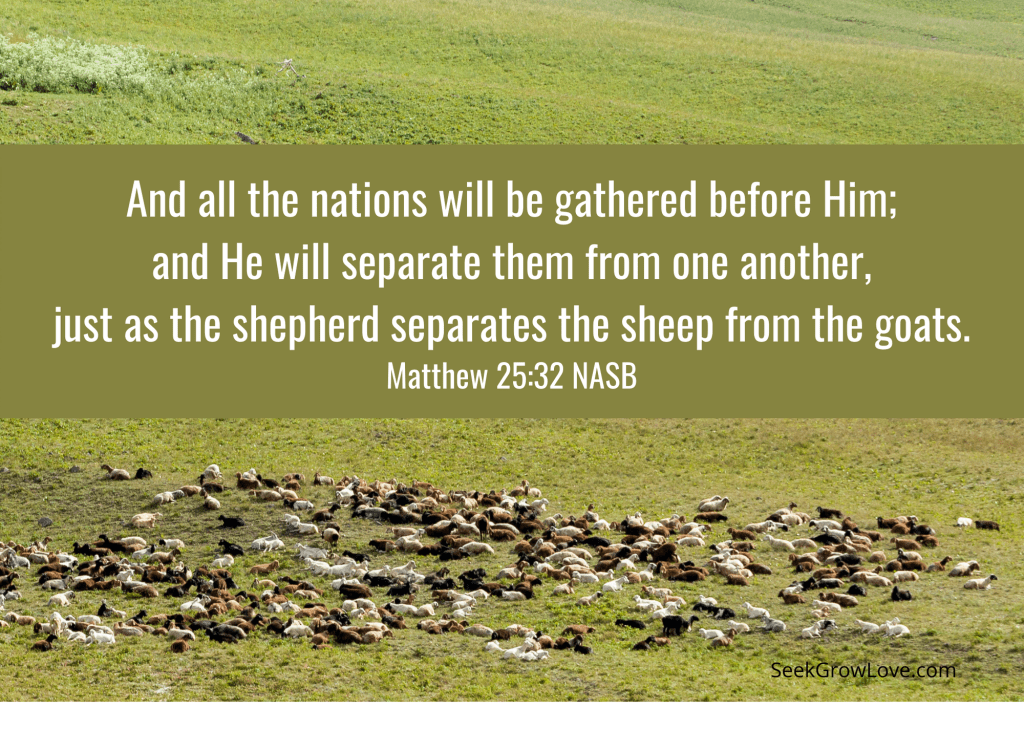
The third picture of judgement involves Jesus separating goats from sheep among the nations. The sheep and goats represent those who belong to Jesus and those who do not. The sheep (believers) are rewarded with the kingdom and the goats (non-believers) are cast into hell with satan and his demons. 

What are we to make of this chapter? What does Jesus want us to learn from these three pictures of judgement? I believe it is this.

There is a judgement coming and not everyone who calls themself a Christian will enter into life. The reality is, not everyone who calls themself a Christian is a true believer. In all three teachings there is one group of people who are then divided into those who are accepted and those who are rejected. Many people comprise the Church but not everyone who attends church is a true believer. The judgement of Christ sorts out the self-deceived from the real believers. Jesus himself teaches this earlier in Matthew 13.24-30, 36-43 in the parable of the tares. And he also teaches this in Matthew 7.21-22. 

Who are you? Are you deceived or a true believer in Christ? The five virgins were accepted into the feast because they were ready and prepared. The 2 slaves were honored by the master because they were faithful with what the master had given them. And the sheep entered the kingdom because they loved and served other Christians in need. 

A true believer will have evidence of salvation in their life. A true believer bears the fruit of the spirit, they grow in holiness, they grow in their disdain for sin, they hunger for the scriptures, they serve other Christians and people. A real believer matures and grows in Christ.

Paul tells the Corinthians in II Cor. 13.5 to test themselves against the scriptures to see if they are in the faith. Compare yourself to scripture and to the words of Jesus. Have you really received salvation from God? In addition to this, talk with mature believers closest to you about this serious matter if you question your salvation.

-Jacob Rohrer

Today’s Bible passage can be read or listened to at BibleGateway here – Matthew 25

Tomorrow we will read Matthew 26 and Mark 14.

In Need of a Shepherd

John 9:1 – 10:21

Imagery of sheep and shepherd are found all throughout the Bible, in both the old and the new testaments. Because of this, I think we sometimes forget some of the metaphorical imagery that comes with the sheep and shepherd dynamic. Sheep are not an intelligent animal in any sense of the word. They often wander off and get themselves in trouble. When threatened by predators, sheep will often clump themselves together in such a tight pack, that sheep in the center will often suffocate. All in all, sheep are fully reliant on their shepherd for protection, food water, and for their own survival.

Here in John 10, when Jesus is speaking about sheep, and he being the good shepherd, the people probably would have seen it as insulting when he compared them to sheep. But the point that Jesus is trying to make, is that like sheep we could not depend on ourselves for salvation from the consequences of our bad choices. God had to send us a shepherd who would “lay down his life for his sheep”. So he sent us His son Jesus. And as Jesus said, no one took his life from him, but he laid it down of his own accord. I don’t think we could have asked God to send us a better shepherd than who He sent us, His one and only son, Jesus. In just over a week, the Thanksgiving season will begin, and I think that this year we need to spend time thanking God, for the gift of the Good Shepherd, who laid down his life willingly, for us his sheep.

Jonny Smith

Today’s Bible passage can be read or listened to at BibleGateway here – John 9:1 – 10:21

Tomorrow’s passages will be the rest of John 10 and Luke 10.

Be a tree!

Matthew 13 & Luke 8

There is something so beautiful about watching a plant grow from a little seed to a strong healthy plant. Christians are compared to plants in this way. A spiritually mature Christian should still continue to grow in their walk with God. 

Jesus often taught the crowds and his disciples using parables, which can be found all throughout the Synoptic Gospels. With seven parables in Matthew chapter 13, the parable of the sower is the only parable in this chapter that doesn’t start with “The Kingdom of heaven is like” because this parable is how the Kingdom of God is going to begin. In fact, it is already happening right now. 

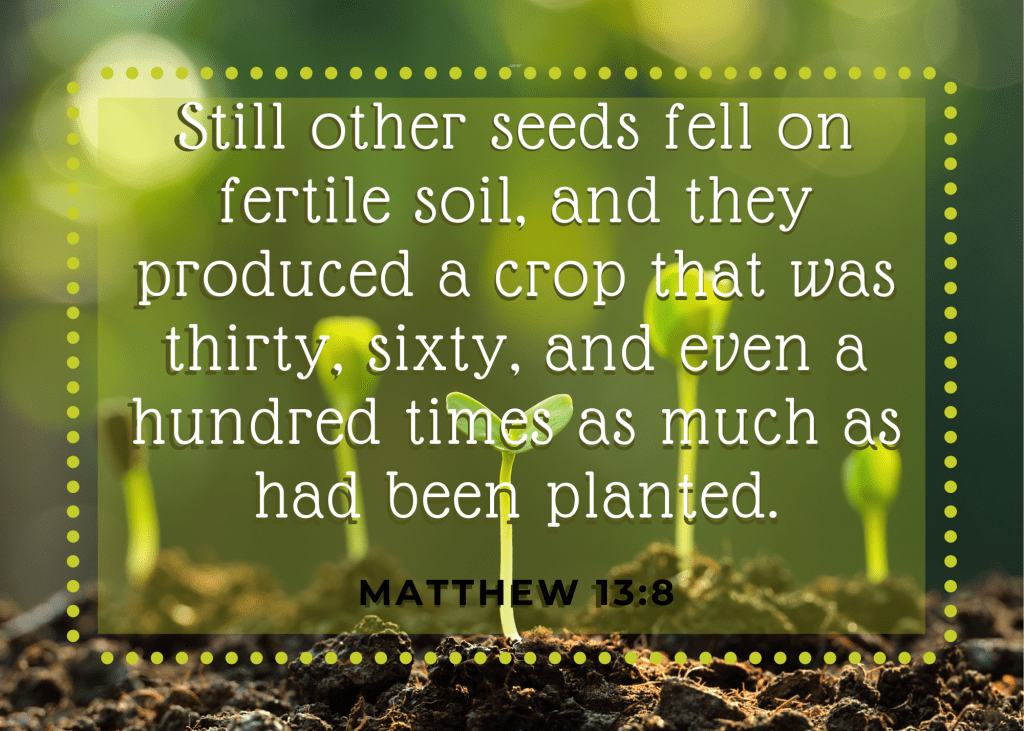
There are four different scenarios of what becomes of the seeds that are sown that Jesus depicts here, being eaten by birds, scorched by the sun, choked by thorns, or producing a crop. Which respectively relate to being taken by the evil one, trouble and persecution, worries of life and the deceitfulness of wealth, or yielding a hundred, sixty, or thirty times what was sown. Out of four scenarios there is only one that has roots, which leads to salvation. By having the deep roots, a foundation on God and his word, you will bear fruit. Fruit that can show God’s love and share the hope that we have with others and by doing so yield sixty or a hundred times what was sown. 

To go along with the analogy, John 15:1-8 adds on to it and explains the dire need of having deep roots in God and Jesus. 

John 15:5 says, “Yes, I am the vine; you are the branches. Those who remain in me, and I in them, will produce much fruit. For apart from me you can do nothing.” 

So how are you going to strengthen your foundation and bear fruits? Be a tree! Three out of the four groups are between a rock and a hard place. So defy the statistics. Commit your life as a living sacrifice for God bearing cherries, apples, bananas, and pears. Put in the effort to focus on your foundation. Make it a priority to spend quality time with God. Paul tells us that fruit will come as a result of our faith, so when they do, nurture them, prune, water, weed, do whatever it takes to help them grow. The parable of the sower shows the importance of how we are living our lives right now. So go, be a tree, rooted in God and overflowing with fruit!

-Makayla Railton

Today’s Bible passage can be read or listened to at BibleGateway – Matthew 13 & Luke 8

Tomorrow we will read Matthew 8:14-34 and Mark 4-5.

Jesus Talks with a Samaritan Woman

John 2-4

You may be familiar with the story of the “Good Samaritan”.  But do you know the story of the “Bad Samaritan”?  You might know this better as the story of the woman at the well.

In Jesus’ day, Jews thought very little of Samaritans.  It may not be an overstatement to say the Jews hated the Samaritans.  The origin of this animosity dated back to the Assyrian invasion of Israel around 721 BC.  The Samaritans were of mixed race, partially Jewish, and partially who-knows-what.  They weren’t welcome in the Temple in Jerusalem, so they worshiped in their own temple in Samaria.  And, as Jesus pointed out, they worshiped what they didn’t even understand.

In John 4, we find Jesus arriving at a well near Sychar around noon.  Jesus waited at the well, while his disciples went into town to buy some food.  As Jesus waited, a woman came up to draw water.  I’ve heard this would have been a very unusual time to draw water – and she probably came then to avoid having to interact with others – because even the people in town would have looked down on her.

Anyway, Jesus started up a conversation with the woman, asking her for water.  In doing this, Jesus cut across all the social norms of his day.  First, Jesus was a Jew, and the woman was an “inferior” Samaritan.  Second, as I understand it, men of the day felt superior to women, and again, wouldn’t typically strike up a conversation.  Finally, Jesus was holy and the Samaritan woman wasn’t.  And religious leaders of his day felt superior to common sinners, and wouldn’t associate with them.  Jesus cut through all of those norms to interact with this woman.  The obvious reason given was because Jesus was thirsty, and the woman could draw water from the well.  I believe the ulterior motive was to share salvation with this woman and ultimately with the whole city.

Right from the beginning of the conversation, the woman was surprised that Jesus would even talk with her, since he was a Jew.  Jesus pointed out that if she understood who it was she was talking with, He could offer her something amazing – water welling up to eternal life.  Jesus told her to get her husband, to which she replied, “I don’t have a husband.”  When Jesus told her that she had had 5 husbands and that she wasn’t married to the man she was living with then – she recognized Jesus was a prophet. She said, “I know that Messiah is coming.  When he comes, he will explain everything to us.”  Jesus told her directly, “I who speak to you am he.”  The woman left her water jug and immediately went into town to tell everyone that she had found the Messiah.  The whole town came out and ultimately believed – first, because of the testimony of the woman, then eventually because of their experience with Jesus.

Often, when we read a story like this, we associate with Jesus.  We may think, “I should follow Jesus’ example, break social norms, and associate with those who are “inferior” to me.”  

While this may be true, I’d like to focus on the woman, and see what we can learn from her.  Although presumably “unworthy”, and probably a social outcast, Jesus revealed Himself to her – little by little.  She first recognized he was a Jew, then a prophet, and finally the messiah.  Once she recognized that Jesus was the messiah, the savior, she immediately dropped what she was doing to go tell everyone about her experience with Jesus. Then she literally led the people of the town to meet Jesus.  Think of how little theology she knew – how few spiritual truths.  But she had found the Lord, and she wanted to tell everyone. Her enthusiasm and eagerness to tell others of her experience with the Lord puts us to shame. 

When you were introduced to Jesus, what was your reaction?  Did you tell everyone you knew about Jesus, and what he had done for you?  Did you do everything you could to bring as many people as possible to encounter Jesus?

Jesus pointed out to his disciples, “Open your eyes and look at the fields!  They are ripe for harvest.”  He wasn’t talking about agriculture, he was talking about a crop for eternal life – people needing to come into a saving relationship with the Lord.

I challenge you to first, truly develop a relationship with Jesus.  And once you do, tell everyone you know about the good news, so they can be saved too.  The consequences are literally life and death – for eternity.  What are you waiting for?

–Steve Mattison

Today’s Bible passage can be read or listened to at BibleGateway here – John 2-4

Tomorrow we will read Mark 2 as we continue Seeking God, Growing our Faith, and Increasing our Love on our 2020 Bible reading plan.

Isaiah 13-17

A person may think their own ways are right, but the Lord weighs the heart.

Isaiah revealed a prophecy against the nations in our reading today.  In some cases those that received these warnings had years before the prophecies would occur. There was time to listen, repent, turn their lives around, prepare and be ready. What holds us back from surrendering everything to God and getting ourselves “right with Him”?

Sometimes it is pride. In Isaiah 13:11 we read “I will put an end to the arrogance of the haughty and will humble the pride of the ruthless.” When we become prideful, we exalt ourselves as our own god. We put our desires and wants as our top priority. We justify and reason that our actions are acceptable because those actions are “right” in our own eyes (Proverbs 21:2). As I grew up, I had friends that rejected following God because “they wanted to do, what they wanted to do”.  They viewed God’s commands as restricting them instead of seeing Him as a loving Father providing the best way for His children to live life. Pride tells us that we know what is best for ourselves. We think that God does not understand who and what we are. C.S. Lewis stated that “Pride leads to every other vice: it is the complete anti-God state of mind.”

In Isaiah 14 we see so clearly that the leaders in the world appear to have power, but they cannot defeat death. Those leaders claimed that “I will make myself like the Most High” (v.14), but only God has power over death. In the following chapters we see that the great cities and wealth of nations will not last. The armies of vengeance and wrath destroyed the cities and carried the wealth away. Punishment was administered to nations. In fact we explore that God is the only One who controls nature, which provides our food source. Though they planted the finest plants and imported vines, yet they did not have a harvest. These illustrations should show us that God is ultimately in control. We need to be humble before Him. Isaiah 17:7 contains the answer. “In that day people will look to their Maker and turn their eyes to the Holy One of Israel.”

That is the answer for us today. We need to come to God humbly, honoring Him as the absolute authority. God is sovereign. He is the supreme authority and all things are under His control.

We need to turn our attention away from the raging nations of the world, and turn to Our God who gives love, wisdom and salvation.

~ Rebecca Dauksas


Today’s Bible passage can be read or listened to on Bible Gateway.

Tomorrow, we continue reading the history of Israel in Isaiah 18-22 – as we continue the 2020 Chronological Bible Reading Plan

2 Chronicles 27 & Isaiah 9-12

Surely God is my salvation; I will trust and not be afraid. The Lord, the Lord himself, is my strength and my defense[j]; he has become my salvation.”

I am not where I planned to be today. You see for many years this weekend is when I have helped load vans, buses, SUVs and even a Volkswagen bug with a lively group of cheerful travelers as we start making our way to Northern Indiana. Our group is always made up of students and youth workers heading to a youth camp named FUEL. Weeks spent at camp are so incredible because we intentionally set aside time to focus on God. We worship, we learn, we laugh, we encourage, we grow, we pray, . . . This camp offers us the chance to spend some intentional focused time with God. We remember our ultimate life goals of loving God with all that we are and loving others as ourselves. We align our lives with these main goals. We determine our next steps and develop practical actions that show that we have a close, loving relationship with God through Christ and that we truly love others.

Unfortunately, we will not gather physically for FUEL this year, but that shouldn’t stop us from taking time to connect with God. Yes, He is in northern Indiana, but He is where you are right now (He is not far from any one of us Acts 17:27). God loves us so much that He wants to connect with us and He is always there to direct us as well. We just need to focus on Him.

Today we read about a King who did exactly that. He was Jotham. Jotham was the eleventh king of Judah. It was stated that he did what was right in the eyes of the LORD.  What a great way to be remembered. We are also told that He grew powerful because he walked steadfastly before the Lord his God. Steadfastly-that could describe the way we order the habits of our lives! Walking resolutely, firm and unwavering because we are living our lives connected to God.

Jotham benefited from seeing what a king should and should not do from his father. He also benefited from being a contemporary with the prophets IsaiahHoseaAmos, and Micah. Praise God we have their writings available to us today! Just like the faithful kings we can read the message from God sent through these prophets. Isaiah (9-12) presents the coming of the Messiah, just judgment, the future rally of nations to Christ, the Lord’s glorious holy mountain, and the earth being filled with the knowledge of the LORD as waters cover the sea. What an amazing experience it will be to meet with those prophets and those kings that “did what was right in the eyes of the LORD” in the Kingdom of God!

So even though we may have to be socially distant right now, we look forward to that perfect time. Isaiah (12) describes the people rejoicing on that day because the Holy One of Israel is among them. Today we can rejoice because the Holy One of Israel can also be with us!

~ Rebecca Dauksas


Read or listen to today’s bible passage on Bible Gateway: 2 Chronicles 27 & Isaiah 9-12.

Tomorrow, we read more of God’s prophecies to Israel and Judah in Micah 1-7 – as we continue the 2020 Chronological Bible Reading Plan