Flesh & Blood

Luke 22 & John 13

Devotion by JJ Fletcher (Minnesota)

Throughout Jesus’ ministry, we see him bring a new level of focus and understanding to different laws or topics. When the Pharisees question Jesus about why his disciples are doing something on the Sabbath, Jesus says that the Sabbath was made for man, not man for the Sabbath. It was a day to honor and remember God, but it was also a day of rest.

In the lead-up to Jesus’ arrest and trial, we see the hustle and bustle of everyone getting ready for the Passover. Passover was the remembrance and celebration of the Israelites’ deliverance from Egypt and takes its moniker from their firstborn being spared during God’s final plague that killed the firstborn of Egypt.

This was already a day of remembrance and of sharing a meal, but Jesus is giving it a new context as the birth of his church grows near. This will be a time to reflect on the New Covenant. Jesus’ physical blood marks the sealing of the New Covenant, so this cup of wine will be a reminder of his blood that would be poured out just a few days after the meal they were sharing. The bread is a reminder of Jesus’ body, which would be beaten and abused. Breaking the bread is a reminder of how his body would essentially be broken through the abuse and execution that were upcoming.

Today, we get to celebrate the Lord’s Supper under much different circumstances. We have the context that the disciples didn’t. A resurrected Jesus and the testimony of his disciples. We can also celebrate this as often as we’d like, but typically it is monthly (at least in my church). We perhaps do the remembrance part right, but later, Paul talks about the need to examine oneself. We should be examining how we’re doing. Are we doing an okay job living our lives for Jesus, or do we need to refocus? I would add that there is also an element of fellowship here. Typically, we observe the Lord’s Supper during a service, but it would perhaps be a good thing to observe it during a meal. Engaging in meaningful interactions with brothers and sisters during celebration.

One other thing to take away from Jesus’ last supper, he’s doing all this with Judas at the table. He knows what’s about to happen, but he doesn’t let that derail this important gathering. When we are having interpersonal issues in the church, we should be striving to repair what is wrong. We should, however, also be able to set aside our differences as we observe the remembrance of Jesus by fellowshipping and breaking bread together. If Jesus can face Judas, you can face someone who has done far less by comparison.

Reflection Questions:

1.        Is it easy to let communion become a rote practice and not a real time of reflection? How can that be changed?

2.        Have you participated in different ways of observing the Lord’s Supper? Were some practices more impactful than others? Why or why not?

3.        A monthly observance was mentioned earlier. Is there a benefit to observing communion more or less frequently? Why do you think this? If you don’t have an opinion, why do you think someone else might have strong opinions on the frequency of observation?

Unity

Through Tradition, Modesty and Respect for One Another.

1 Corinthians 11

June 12

I graduated from Atlanta Bible College in 2003.  I worked with a couple small churches after that, but found my “calling” in helping people through grief.  Next month, my wife, Hannah, and I will celebrate our 18th wedding anniversary.  Our marriage is almost old enough to vote.  We have four children ranging in age from 12 to 3.  In November 2021, we bought a purebred english mastiff puppy.  We call her “Zippers” for her propensity to chew on jacket closures.   This is the lens through which I see things, my source for some great sermon illustrations and the perspective from which I write today.

I am my parent’s oldest child.  I was the first grandchild on both sides of the family.  I had three whole years of life experience before my sister was born.  I felt like I was practically an adult at age 13 when my youngest brother was born.  When I went through grade school in DeKalb, Illinois, each student attended kindergarten through 4th grade at the elementary school closest to his or her home.  Then “the whole city” converged on Clinton Rosette Middle School for 5th and 6th grade. Then, everyone transferred to Huntley Middle School for 7th and 8th grade. Finally, everyone went on to the last building of the journey, DeKalb High School.  That means when I was a big 7th grader, my 4th grade little sister was still “two whole buildings behind me” in “baby school”, at Carl Littlejohn Elementary.  I didn’t let her forget it.  I mean it had “Little”, right there in the name.  My sister and I would fight like cats and dogs growing up but if anyone else tried to mess with her, they’d better look out.  Being “the big brother” or “the oldest” was a big part of my identity growing up.  As adults, the three year chasm between my sister and I, does not seem so important.  She’s about to finish her master’s degree and will probably make more money than me.  My brother can definitely grow better facial hair than me. When we are together people have mistakenly thought he was my older brother.  I’ll admit I don’t love having my sense of identity challenged.  I think some of the early Christians in Corinth might have felt the same.

In 1998, I “officially” started dating the preacher’s kid, a “PK”, as they say.  I quickly learned that people (including myself) make certain assumptions about how a pastor’s family members ought to behave.  Sometimes there are unrealistic expectations.  When you date a preacher’s daughter, people have some expectations for you too.   Some are unspoken.  Most of them should be.  A lot of them aren’t.  Churches are funny that way.  People feel safe saying things they shouldn’t, or wouldn’t say elsewhere.   If someone perceives you as too perfect, or not perfect enough, they might feel the need to take you down a notch, or give themselves a little ego boost by comparison.  It’s kind of like social media.  

Sometimes the point of what people are trying to say is correct, but it is lost because of the way they say it.  If we aren’t careful, even discussing certain topics can ignite a public opinion forest fire. Polarizing material is pumped into our televisions and handheld devices every day.  Maybe that’s why they call them devices; because they are so divisive.   Lifelong friendships have been destroyed over which “side of the aisle” a person stands on certain topics.  Gender equality is one of these “hot button topics”.  At first glance it might look like 1 Corinthians 11 is “too hot for TV”.  I suggest that it is not, but reader discretion is advised.

What is Paul talking about with all this head covering business in the first part of this chapter?  Is he suggesting that women are somehow less important than men?  Not at all. 

As I understand it, the tradition of the time was for women to cover her head (and in some cases, her face too) while in public as a symbol of faithfulness to her husband.  She was saving her beauty “for his eyes only”.  An online Bible commentary on the subject explained that it was not completely unlike the message that would be conveyed by a woman wearing a big diamond engagement ring in today’s American culture.  It said she is taken.  It said, don’t event try to flirt with her.  Prostitutes on the other hand, would not have covered their head in public.  They wanted to draw attention to themselves.  To do that in church, when the focus was supposed to be on worship, would have been quite provocative.  Can you imagine if a woman came into church wearing “barely there beach attire” nowadays?  It would be distracting for both men and women alike as was the case in the time Paul wrote this letter to the church in Corinth.

In case there was any question as to where Paul stood in regards to the value of women.  He clears it up in 1 Corinthians 11:12 when he says:  “For as woman came from man, so also man is born of woman. But everything comes from God.” So in the first part of 1 Corinthians chapter 11 Paul tries to build unity in the church by asking people to be modest.

The second half of 1 Corinthians chapter 11 is less controversial.  Paul admonishes the Corinthians for abusing the opportunity for unity through communion.  People in that time were eating without waiting for each other and totally missing the point of the exercise. It reminds me of obedient mastiffs and “Boy’s night waffles”. 

My wife, Hannah, is a nurse.   When my oldest son, Carter was little, Hannah would usually work the evening shift at the hospital.  So when she worked, Carter and I had “‘Boy’s night!”  Sometimes, I would make waffles and sausage for supper and we would load them all up with all the toppings we both liked: Chocolate chips, blueberries, strawberries, whipped cream, etc.  Hannah would never buy all that stuff.  So we called them “Boy’s Night Waffles”.  As we had more kids, Carter still wanted  Boy’s Night Waffles.  But it became increasingly difficult with four children.  It was like conducting an uncooperative orchestra to have all the waffles warm and the toppings cold and help the kids cut their food into reasonable bites so we could all eat at the same time. Now on the rare occasion that we have Boy’s Night Waffles, I just have the kids start eating as their food is handed to them.  We don’t even try to eat at the same time on waffle night.

English mastiffs like our dog, are sometimes called gentle giants.  They are known for their size.  They are one of the largest breeds there is.  A female, like ours, can easily be around 150 pounds.  They can be intimidating looking, but they are generally very calm and don’t need a ton of vigorous exercise.  These qualities match our family pretty well.  I hope to use our dog Zippers as a therapy dog, so I have been going to obedience classes with her one or two times per week ever since she was small.  A large part of what we do in class is walk in circles reminding her to watch me and not  ahead of me or behind me.  When we get to a doorway we practice having her wait and not allowing her to just run right in or out.  When we put food in front of her she has to leave it until we say a release word.  Zippers is pretty good at the waiting part.  She’s not so good at the release word part.  We have tried “OK” and “Free” and “Eat”.  A lot of times she will not start eating unless one of us sits beside her.  Paul would probably like this dog.

As I see it, 1 Corinthians Chapter 11 is meant to remind the reader, (originally, Christians at the church of Corinth in about 55 AD), about the importance of unity.  Paul says he is glad that the Corinthians are following his teaching and traditions but, he wants to remind them that it is more important to follow Christ than following himself.  He encourages the church to be modest and build unity over division.

-Brian Froehlich

Application Questions:

  1. What traditions in your church have become a part of its identity?
  2. What are some behavioral differences you notice when you visit another congregation?
  3. What are two or three attitude adjustments your church should consider for the sake of unity?
  4. How does the Corinthian Communion service compare to those you have participated in?

The Saving Blood of the Lamb

Exodus 12

February 11

It’s a beautiful thing to read of the Israelites’ obedience regarding the Passover meal and God’s subsequent command to continue observing it through the generations and to teach their children about the significance of it.

24 “Obey these instructions as a lasting ordinance for you and your descendants. 25 When you enter the land that the Lord will give you as he promised, observe this ceremony. 26 And when your children ask you, ‘What does this ceremony mean to you?’ 27 then tell them, ‘It is the Passover sacrifice to the Lord, who passed over the houses of the Israelites in Egypt and spared our homes when he struck down the Egyptians.’” 

It is a powerful story of salvation and it is worth telling and celebrating. I love that we as Christians can mirror this celebration of God’s beautiful provision of salvation through the observance of Communion. The salvation at the original Passover was temporary and specific and only pertained to being shielded from that particular plague of death at that specific point in time. Thanks be to God that the salvation offered through the Passover Lamb Jesus Christ is not limited to a specific group of people in a specific time in history. It is a free gift with an eternal reward that is open to all of mankind who choose it. 

While God’s provision for salvation is so beautiful and worthy of celebration, we would be remiss if we did not recognize those who fall in the shadows outside of God’s protection of salvation. I can’t help but imagine what a terrifying time it was for the Egyptians as the angel of death struck the households that were not protected by the blood of the Passover lamb. Verses 29-30 give us a glimpse of the sounds of that night,

29 At midnight the Lord struck down all the firstborn in Egypt, from the firstborn of Pharaoh, who sat on the throne, to the firstborn of the prisoner, who was in the dungeon, and the firstborn of all the livestock as well. 30 Pharaoh and all his officials and all the Egyptians got up during the night, and there was loud wailing in Egypt, for there was not a house without someone dead.

As I read that passage and experienced compassion for those not covered by the blood, I couldn’t help but be reminded of the pressing urgency there is to reach out to those today who are not covered by the blood of the ultimate Passover Lamb Jesus Christ. As the Israelites were instructed about how to avert sorrow and disaster being brought upon their household by covering their doorposts with blood, we need to help others find the way to salvation by being covered with the blood of Jesus. 

May we be challenged to revisit the story of the Passover with a new set of eyes and a heart full of compassion for those who need to hear the greatest story ever told.

-Kristy Cisneros

Questions for Reflection and Discussion

  1. Do you feel a sense of urgency for the lost? If so, pray to God to instruct you on how to increase your effectiveness in reaching others. If not, pray to God that He will change your heart in this regard and give you a newfound sense of urgency and compassion for the lost.
  2. The Israelites were saved from what by the blood of the Passover lamb? Describe as fully as you can. Christians are saved from what by the blood of Jesus? Describe as fully as you can.
  3. How can we make sure we are covered by the blood of the Lamb? How will we make sure we – and our children – do not forget? Who do we know who is not covered by the blood of Jesus?

Tomorrow – Exodus 14

Memes and Remembrances 

Matthew 26

January 26

At this point in our reading, things start to get serious, so before we get into that I’d like to give you this meme for your sharing pleasure. I hope that you can enjoy the humor, because the stories and questions today should give us time to pause and think, to pray, and to trust in the grace of God. 

We start with this meme because of the story in verses 6-13. While there are multiple proposed solutions to how many times Jesus was anointed (see note), at this point I lean to the idea that Jesus was anointed with oil in two different scenarios, the one recorded in Luke, and the one recorded in Matthew, Mark, and John. In Matthew a woman pours very costly perfume on Jesus, and the disciples were livid. “HOW MUCH GOOD COULD WE HAVE DONE WITH THAT MONEY?!” They all berate the woman. But Jesus recognizes the act of utter worship and adoration that this woman desired to give him.

When Jesus said “you always have the poor with you” was he saying that we shouldn’t give to the poor? After all, if we give to the poor person in front of us, won’t there be another the next day, right? For the latter question, yes there will always be another poor person. But for the first question, Jesus was referencing Deuteronomy 15:10-11 “Give generously to him, and do not let your heart be grieved when you do so. And because of this the LORD your God will bless you in all your work and in everything to which you put your hand. For there will never cease to be poor in the land; that is why I am commanding you to open wide your hand to your brother and to the poor and needy in your land.” Jesus wasn’t saying “don’t give” but instead “if you are so concerned about the poor, you will be able to give to them with OTHER gifts.” In fact, Judas was berating the woman because he would have had access to the funds for himself, as he stole money from the group. Maybe other disciples were upset that this woman was showing greater devotion for Jesus than they were willing to show. Jesus is, in effect, calling their bluff : “If you truly want to serve the poor, you’ll be able to do so the rest of your life. She is choosing to serve me now!”

The rest of the chapter is full of familiar stories that we remember during the Season of Lent, Passover and Easter/Resurrection Sunday every year. 

Jesus at this time institutes the act of communion, a time to remember what Christ has done for us. To be fair, Jesus does not begin something new, but changes the focus of something ancient. Passover is a holy Jewish meal that signified God’s redemption of Israel from Egypt. Jesus says it’s no longer just about that. Now, this bread that was about fleeing slavery is about the body broken for us to free us from sin. The wine is now about the blood of Jesus spilt for the forgiveness of our sins. 

Judas decided to betray Jesus and feigns offense when Jesus accuses the disciples there is a betrayer in their midst. Jesus knows what he has decided and is not fooled by his act. But we shouldn’t miss that Peter ALSO betrays Jesus. Judas desired money. Some postulate that Judas was trying to force Jesus and God to bring the Kingdom now. But whatever his motives, the betrayal was still evil and unjustified. But the betrayal of Peter was just as significant and just as thorough. Peter’s betrayal was fueled by self-preservation and fear. Both denied their Lord, their Savior… their friend. 

Jesus is broken hearted by what is happening to him. He knows that the woman who anointed his feet just days before was preparing him for burial, but still he did not want to die. He asks God if he can be spared, not only from the pain of death, but the rejection he is about to receive from God on behalf of all people. Jesus is about to have all sin heaped on him. God is about to cut all ties from his Son, and their connection will be severed so sin can be destroyed. Jesus, in his love for all of us, decided to follow the plan of God. He decides that he will drink the cup of the wrath of God, so that those who trust in Christ will not have to drink that cup themselves. 

While we began with a meme, we need to take time for serious remembrance of what Christ decided to do for us. 

Let us remember the anointing and worship of the woman. 

Let us remember the poor that Jesus calls us to serve. 

Let us remember Jesus by taking communion as we are able. 

Let us remember Peter and Judas so that we may not betray Jesus like they did. 

Let us remember a savior who was willing to die for us, who was willing to take the cup of wrath, and was willing to do the will of God so that we may have grace and peace and life. 

-Jake Ballard

Questions for Reflection and Discussion

  1. Are we willing to anoint the feet of Jesus with everything we have? Are you willing to give extravagant worship to Christ that others call outrageous, because you know how you have been forgiven? How deep does your love and worship go?
  2. Go back to yesterday’s question 3 (are you taking care of the least of these?) Ask yourself those questions again. Are you serving the poor, giving to them no matter how many there will be in the land? Or is your heart hardened by the reality of this world? Will you ask God to change your heart and make you love the poor?
  3. Have you participated in the grace of communion recently? The next time you do, take a moment to reflect on the thousands of years that the faithful people of God have celebrated this meal and emblem, first as freedom from slavery in Egypt, and now, through Christ as freedom for slavery from sin. How does it make you feel that you participate in thousands of years of history along with all of God’s people?
  4. In our sin, do we betray the savior who loves us? In what ways can we overcome the sin we have so we do not betray and deny our savior and lord?

Note: For an explanation of multiple ways of interpreting the passages see: https://answersingenesis.org/contradictions-in-the-bible/how-many-times-was-jesus-anointed/ AIG believes there were THREE events, but I think that even that would be a bit of a stretch. 

The Not Last Supper

Luke 22:1-38

God is an epic story-teller. One trick up every story-teller’s sleeve is repetition, only each new repetition brings a new twist. The story in today’s chapter is titled, The Last Supper, implying that other suppers preceded it. 

The first meal of this kind is found in Exodus; the Israelites were captive to Pharaoh in Egypt, who worked them ruthlessly.  God sent a series of plagues to convince Pharaoh to let His people go, which would culminate in the death of all firstborn sons—people and livestock alike. To save the Israelites from this horrific plague, God gave specific instructions to Moses and Aaron:

“On that same night I will pass through Egypt and strike down every firstborn of both people and animals, and I will bring judgment on all the gods of Egypt. I am the LORD. The blood will be a sign for you on the houses where you are, and when I see the blood, I will pass over you. No destructive plague will touch you when I strike Egypt.” (Exodus 12:12-13)

The Israelites with the blood of the lamb slathered on their door frames were safe, as the angel of death passed over their houses. God ordered the Israelites to commemorate the day God saved Israel, and they did so every year. 

Over one thousand years later, in the week leading up to Jesus’ death, Jesus celebrated Passover with his disciples in Jerusalem. This time, there was a new twist. Jesus gives new meaning to the emblems eaten that meal: 

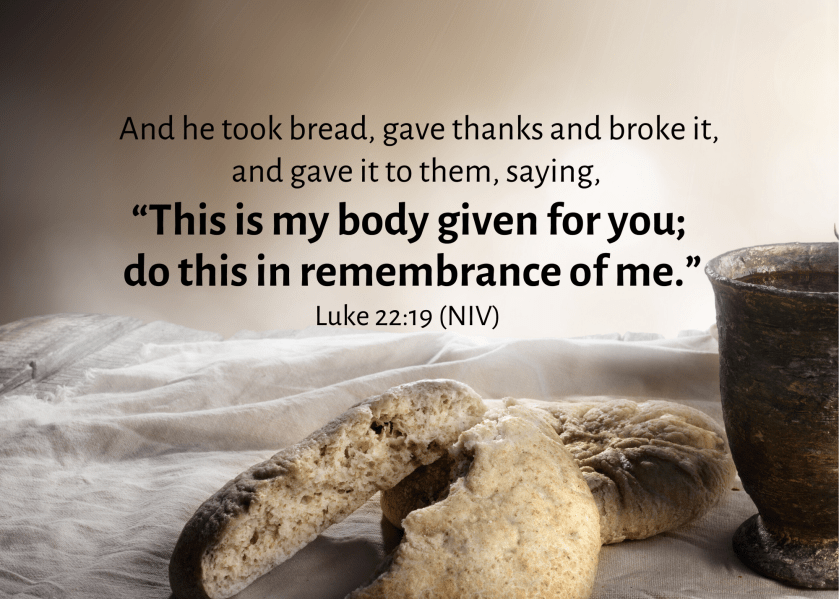
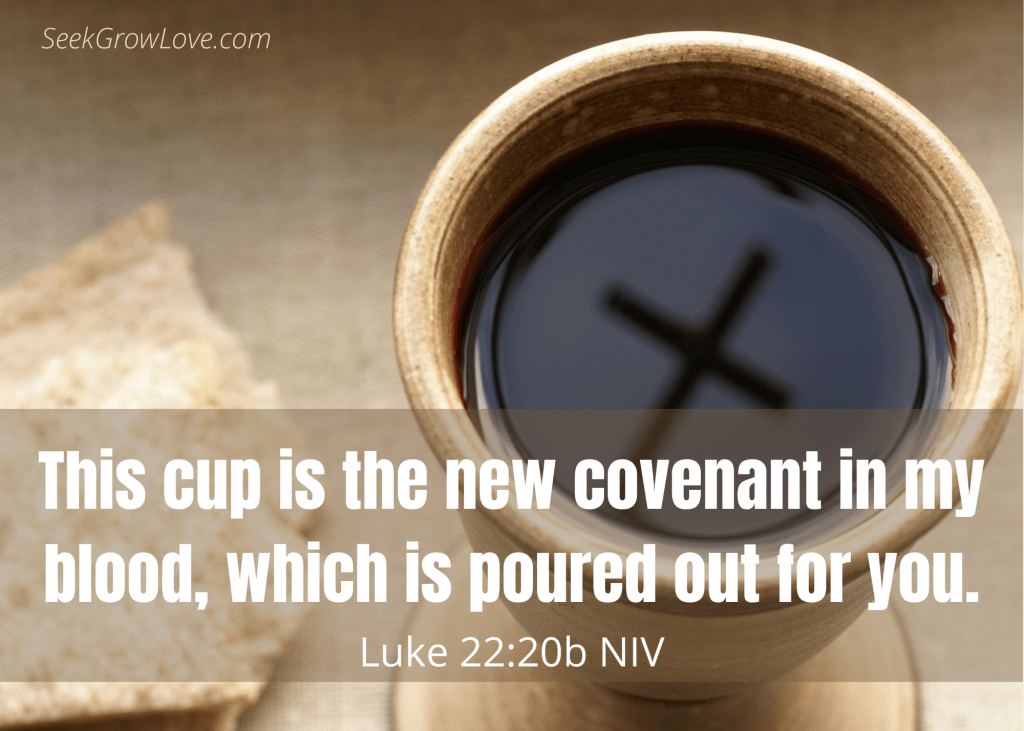
And he (Jesus) took bread, gave thanks and broke it, and gave it to them, saying, “This is my body given for you; do this in remembrance of me.” In the same way, after the supper he took the cup, saying, “This cup is the new covenant in my blood, which is poured out for you.” (Luke 22:19-20).

Jesus’s body was given for you, his blood poured out for you. His sacrifice marks a new covenant in which Jesus’ death atones for the sin of the world: 

Behold the Lamb of God who takes away the sin of the world. (John 1:29)

Have you ever read a story in the Bible with a hint of jealousy, wishing you, too, could have witnessed that moment? I know I have. I had a seat at that table with Jesus, eating and drinking, hearing his wisdom, and honoring his upcoming sacrifice. The good news for us is that “The Last Supper” isn’t really Jesus’s last supper: 

And he (Jesus) said to them (the disciples), “I have eagerly desired to eat this Passover with you before I suffer. For I tell you, I will not eat it again until it finds fulfillment in the kingdom of God.” (Luke 22:15-16)

It’s another feast with another twist. This time we’ll be eating and drinking in physical communion with Jesus, but in the Kingdom of God. I am excitedly awaiting that day, but in the meantime we have the honor of commemorating Jesus’ sacrifice regularly through Communion. The next time you take Communion, do it in remembrance—and in sweet anticipation—of all Jesus has done and is yet to do. 

-Mackenzie McClain

Today’s Bible reading passages can be read or listened to at BibleGateway here – Deuteronomy 27-28 and Luke 22:1-38

Remember Jesus

Luke 22

Luke 22 19 NIV
If you’re Facebook friends with my dad, Joe Myers, the chances are very high that you will see a post on Christmas morning about our family’s traditional Christmas brunch – steak and eggs, cheesy hash brown casserole, English muffins, and homemade Orange Julius. It’s a meal that my parents started enjoying the first Christmas that they were married, waaaaaay back in 1972. And almost every December 25th since, it’s what we have on our plates. There was one year that our family drove from Georgia up to North Carolina on Christmas morning to visit my uncle and cousins and so we ended up eating at Waffle House and it just wasn’t the same…

In Luke 22 we read about another meal that holds significance for all of us. The Passover meal was prepared every year as a way to remember the Great Egyptian Escape. In Exodus 12, God had very specific instructions for the food that the Israelites were to eat and how it was to be prepared and served. And it is this meal that Jesus and his disciples are eating in Luke 22.
Only now, Jesus is adding the New Testament significance to this meal. Jesus calls himself the Bread of Life (John 6:35). Accepting this bread means we will never go spiritually hungry. And the wine for this meal represents the blood of Jesus poured out on the cross for the atonement of our sins. Accepting this drink means that we can have a right relationship with God because our sins have been paid for in full.
Jesus instructs his followers to prepare this meal regularly in order to remember the sacrifice that Jesus made on our behalf. And so that is what we do. We remember Jesus’ life. We remember Jesus’ death and resurrection. And we remember the promise that was made – that one day, we’ll sit at a table with Jesus and eat a meal. What a wonderful thing to look forward to.
Bethany Ligon

Peculiar

Phil 2 15.png
If someone were to describe your behavior as “peculiar”, you would most likely not take it as a compliment.  Peculiar’s origin as a word stems from particular, singling out an item or idea from the rest, but over time the definition, and more importantly, the connotation has shifted.  To be peculiar is not simply to be different, but to be strange, funny, odd, specifically to a way we act or think seemingly with rational or reasonable explanation behind the behavior.  Peculiar could be someone who wears different styles, colors, and heights of socks simultaneously (me), or someone who doesn’t like the food on their plate to touch (my wife), or someone who would turn down all the wealth of this world to serve the will of God (Jesus, Matt 4).

There is truly something odd about the Christian life.  We are constantly denying our instinct in order to fulfill our call.  Many times Jesus uses radical, hyperbolic language to teach the most important disciplines of the strange Christian life.  These words are meant to shock, encourage whispers, and dramatically shift the way we act and think.  Those who want complacent faith? To have miracles without the mindset? To have salvation without giving up their reputation or station?  They walked and will continue to walk away.  They don’t want to be perceived as peculiar, and more accurately, don’t want to be forever changed – a holy-first mindset.

In keeping with today’s theme, here is a shortlist of six of the most odd and convicting teachings of Jesus.  If you’re not different or weird because you do these things, then you are doing them wrong.  As you devote time to reading this list, use this as an opportunity for a gut check – are you only a listless spectator watching and critiquing without any action or any sacrifice or are you actively working on becoming a sold-out slave to the Savior’s summoning?

1. You must be baptized for forgiveness and to receive the Spirit – Jesus answered him, “Truly, truly, I say to you, unless one is born again he cannot see the kingdom of God.” – John 3:3 – Jesus has an eye-opening conversation with Nicodemus about the way God uses this symbolic gesture that had become a part of Jewish religious culture.  John the Baptist, like others before him, uses immersion in water as a means of symbolically cleansing us from our sins, but Jesus sets the example (Matt 3) that this also symbolizes a changing of our mindset.  The death and burial of our old self, and the rebirth of someone who is ready to receive the Spirit, the dwelling of God’s power in us.  There are theological nuances that we will leave to the scholars to debate, but this symbolic act is clearly exampled and talked about by Jesus, and practiced and talked about some more by his disciples.  This is the beginning.  If you haven’t been baptized, but you see the compelling case for Christ in your life, now is the time.  This symbol marks the launching point, not the precipice to our walk in Him.

2. You must be willing to live and die for Christ – “If anyone would come after me, let him deny himself and take up his cross and follow me. For whoever would save his life will lose it, but whoever loses his life for my sake will find it.”  Matt 16:24,25 – Obviously the apostles saw something happen that dramatically shifted the trajectory of their lives forever.  After the resurrection of Jesus, they were accused of moving His body to perpetuate the story that He had risen.  But would every single one of these men be ready and willing to travel so far and literally give up their lives for Christ? While a single man might die to protect a lie, I find it very hard to believe a whole group of men would do so. All of them, save John who was exiled, were put to death, each one receiving their punishment, not simply for their beliefs, but for their pursuit of evangelism and sharing the good news.  They each daily sacrificed their life, and even used their death, as testimony of the life-altering Gospel message.

3. You must live out communion  – “For My flesh is real food, and My blood is real drink. Whoever eats My flesh and drinks My blood remains in Me, and I in him. Just as the living Father sent Me and I live because of the Father, so also the one who feeds on Me will live because of me“ – John 6:56 – Here we have another physical gesture that is symbolic of Christian life.  While it is not too difficult to eat a piece of bread or crackers, or knock back a cup of wine or grape juice, the conviction of these symbols is terrifying – we must always remember that we are striving to be one with Christ.  Anything we put in our body, use our body for (i.e. sex, 1 Cor 6:18), or anything that happens between our two ears, has to be reconciled by or repented to Christ for Him to remain in us.  This means the act of communion, whether done formally or figurative as a daily discipline, should be convicting and purging us from the things that tear us away from Christ.

4. You must find joy in persecution and dejection – “Blessed are you when people insult you, persecute you and falsely say all kinds of evil against you because of me.” Matthew 5:11 – Our natural instinct when we are attacked is to strike back.  If you hit me, I will return the blow.  If you hurl insults at me, I will use my wit and tongue to put you in your place.  Even when we gratify ourselves with revenge, there is no joy in it.  In Acts 5, Peter and the apostles receive a verbal and physical lashings.  What is their response?  Jubilation.  They found great joy in suffering for Christ because it meant they were becoming more like Him, and they were living out the Great Commission.  We should be ready and willing to be challenged, made fun of, and even receive physical abuse because we have taken a stand for Christ.  When we take a stand and our joy grows, but so does our testimony and resolve (James 1:2,3), compelling others to seek out the reason for our peculiar perseverance.

5. You must be willing to count anything as loss – “If your hand or your foot causes you to stumble, cut it off and throw it away. It is better for you to enter life maimed or crippled than to have two hands or two feet and be thrown into eternal fire.” – Matthew 18:8 – The example Jesus uses is a challenge to control our carnal nature using figurative language. If someone had the resolve to literally cut off the hand or foot, they definitely have a resolve to control other behaviors in the life.  But are we willing to literally cut out other things?  Are you willing to give up comfort? Opportunities? Sports? Friends? Family members?  Would you be willing to be thought of as dumb, ignorant, a fool, and even pitied?  Would you be willing to part with all of your money, all of your possessions, and all of your time?  It is better to lose your identity in this world or  to have no home, than to be thrown alongside your pride and identity in the fire.  It is better to throw away a coveted scholarship than for you to be thrown alongside your degree to be thrown in the fire. It is better to find new friends and family, or even have no friends and family, than to be thrown alongside them in the fire.  Now each of these things are placed in the proper perspective; pride, a degree, friends, family can all be great God-filled things, just like hands and feet, but if they are moving you away from Christ, they are not beneficial.  We have to remove them.

6. You can’t stop loving others. Ever. – “Love your neighbor as yourself.” – Matthew 22:39 – It would be so much easier if Jesus never said this.  The most radical, the most challenging, the hardest-lived statement is in these five words.  Loving God is truly easy – He deserves honor and praise, He loved us first, and He has established things in past, present, and future for us that are greater than we can ever imagine.  I would even dare say I am loving God more than myself on my greatest days of faith (which is not nearly enough).  But loving my neighbor. C’mon.  What have they done to deserve my love?  My neighbor could bash my faith on social media.  My neighbor could be making such poor choices with their money.  My neighbor could be abusing their family.  My neighbor could be lying to me, stealing from me, and badmouthing me all over town. My neighbor could physically spit in my face, beat me to the point of death, and hang me on a cross.  And that’s when we realize, we are Christ’s neighbor.  He have power to change our lives forever by living out the love of God.  He was so purposeful in His love in God that He saved us all from eternal separation.  By doing this, He has given us the power to peculiarly love people we don’t know, but even more so, people we know well.  We have the same opportunity as Christ.  We can do everything possible to love our neighbor into conviction and submission that comes from seeing, hearing, and feeling the Gospel message coming from God through us.  Yes, this is the most peculiar of all, but as strange, odd and weird as it is, it’s the most beautiful, the most attractive, and the most fulfilling thing we could ever do on behalf of our Father in heaven who so much loves His peculiar people.

-Aaron Winner

Baby Spit-Up – Really?

1 Corinthians 11

1 Corinthians 11 26

Transubstantiation.  It’s a big word that means the belief that when communion bread and wine are taken, they literally become the body and blood of Christ.  The Catholic church holds this view.

A friend of mine was sharing a story recently of a visit to a Catholic church in which he discussed this with the priest.  The priest explained how it was because of this belief that the Catholic church began the tradition of priests placing the communion wafers directly into the mouths of parishioners.

You see, if the bread literally is the body of Christ, how awful if it were to fall and break on the floor.  The lay people of the church did not want to bear this responsibility.  They felt more secure in only having priests handle such a precious treasure.  And thus began this now common tradition.

My friend went on to share how he had asked the priest how this played out when they administer the tiny morsel of communion bread to babies upon baptism.  What if the baby spits the bread up?

The priest has to eat it.

Yup.  Let’s just leave that there and read a couple of verses from our chapter in Corinthians.

1 Corinthians 11: 27-28

Therefore, whoever eats the bread or drinks the cup of the Lord in an unworthy manner will be guilty of sinning against the body and blood of the Lord.  A man ought to examine himself before he eats of the bread and drinks of the cup.

Have you ever felt that taking communion can become rote?  Something you do without really thinking?

Clearly God cares that we take this exercise seriously.  But can we agree that we should find a happy medium between mindlessly consuming the bread and the cup and having to eat baby spit-up?

What this passage encourages me to do, and I encourage you to do, is to be mindful during the communion service.  How?

  • Always always always take a moment to pray and examine your heart before the Great God of the universe.
  • Humble yourself.
  • Be quiet.
  • Look around your church and ask God how you can build unity among the body (this instruction from Paul comes, after all, in a section of his letter instructing the Corinthian church on getting along at church).
  • Think about the fact that the last time Jesus participated in this it was the night before he died for you. Maybe thank him for that.
  • Realize that the next time Jesus participates in this he will have come again. Wow!  Maybe ask him how you can get ready for that.


-Susan Landry

Who is the Son of God?


Luke 22

luke 22_46

Yesterday, in Luke 21 Jesus was warning the disciples (and those who would follow) of persecution while encouraging them to stand up under it.  And today, in Luke 22 Jesus himself is cast into a fierce storm of persecution.  He will now be showing – not just telling – the disciples, his contemporaries, and all those who would come after him how to stand up under persecution.

But first, a private dinner with his closest disciples to commemorate the Passover – when God saved his people from slavery by the blood of the lamb.  And very soon a new lamb would be sacrificed to save God’s people from slavery to sin.  Jesus tells his disciples that he will not eat the Passover meal, or drink of the cup again, until the Kingdom of God comes.  Communion services are a great reminder of this promise.  At the dinner, he uses the opportunity to remind them once again the secret to great leadership – be a servant.  Stop fighting over who is best…just serve.

I love how even though Jesus knew ahead of time that Peter would fail him, he had still prayed that Peter’s faith would not fail.  And even though Satan would have the opportunity to “sift all of you as wheat,”  Jesus saw a future for Peter in which Peter would be using those painful experiences to help strengthen his brothers.
And then, in the garden while Jesus is pouring his heart out in prayer – his disciples are sleeping.  I wonder how many times he would prod me and say, “Get up and pray so that you will not fall into temptation.”  How much better would Peter – or I – stand Satan’s arrows if he – or I – were fully filled up with prayer rather than whatever feels good or most urgent at the moment?

Enter, Judas – and the chief priests and the guards and the great betrayal!  And even in the midst of the hurt and personal persecution – Jesus gives healing as he restores the servant’s ear.

Early the next morning, Jesus is brought before the chief priests and elders and is questioned about who he is. Is he the Messiah?

Jesus answered, “If I tell you, you will not believe me, 68 and if I asked you, you would not answer. 69 But from now on, the Son of Man will be seated at the right hand of the mighty God.”

70 They all asked, “Are you then the Son of God?”

He replied, “You say that I am.”

They didn’t expect the Son of God to have appeared as a baby in a manger.  They didn’t expect the Son of God to have a rag-tag group of followers in the countryside.  They didn’t expect the Son of God to be persecuted at their own hands.  Beware of what you expect from the Son of God.  Keep reading the gospels – and all of God’s Word to see who God really is, and who the Son of God is!

-Marcia Railton