Paul’s God

Old Testament: 2 Samuel 7 & 8

Poetry: Proverbs 20

New Testament: Acts 14

As we look at chapter 14 of Acts, we are going to go back to the idea that one way we can learn is by studying what isn’t said. This chapter becomes even more unique and interesting when you look at it from this perspective. In context with the surrounding chapters, Paul and Barnabas are traveling to Jewish synagogues in order to convince the Jews that Jesus is the Messiah. This chapter is no different; the Jews are still stubborn and are stirring up the crowd and even trying to kill them. But when Paul saw a lame man who had the faith to be healed, he immediately healed him through the power of God. Their message is interrupted by the people claiming that Paul and Barnabas are gods who have come down to earth. This was common Greek mythology of the time.  At the sound of this accusation, Paul and Barnabas immediately reject its legitimacy and instead give the one true living God the glory.

Paul describes the power of God and all the things that He has done for His creation. Paul takes a little intermission from the message of Jesus in order to stand up for the name of Yahweh. From a Trinitarian perspective, Paul’s approach should raise some red flags because he failed to mention how God “came to earth”. If Paul held trinitarian beliefs, then he would have used this as a preaching opportunity to connect the name of Jesus to the pagan beliefs of gods visiting earth. If I were Paul, and for the sake of the argument, I was theoretically a Trinitarian, then I would have told the crowd, “Hey, I’m only a human but the real God did come down to Earth, but you rejected him!” This would have been a Trinitarians’ dream opportunity to take the crowds’ presuppositions about gods coming to earth and use it to present Jesus as God in human form. Logically, this would allow Paul to connect with their understanding of gods and use it to preach the true God. Instead, he didn’t mention a human form of God, neither does he even mention Jesus at all. But instead, the issue at hand in the mind of Paul is solely on rejecting the crowds claims and giving all the glory to God. Jesus did not even cross his mind, instead he was focused on defending the authority and power of God. But it is not as if Paul said the wrong thing or missed an incredible opportunity to share the gospel. In fact, Paul even urges the crowd to turn from “these worthless things to the living God”. The only possible ‘worthless things’ that the crowd was discussing in this chapter was that the “gods have come down to us in human form”. Therefore, it seems that Paul is urging the crowd to disregard their pagan and Greek mythological beliefs about God and believe in the God who created the heavens and earth. 

And when you combine this argument with the argument that Paul did not correct the Jews on their understanding of the Messiah, along with the fact that Paul never explains the Trinity, then I would consider it to be enough evidence to suggest that Paul did not hold Trinitarian beliefs. If we believe that the Bible is God’s inspired word to reveal himself to His creation, then it seems like we should be able to see God being accurately revealed.

Acts is the perfect book to study how Paul and the other apostles preach and reveal God and the Messiah to the crowds. We can learn so much from the theological lessons found in the book of Acts, hopefully you can keep an eye out for more theological truths as you continue through the book. 

-Makayla Railton

Reflection Questions

  1. In Acts 14 Paul is stoned and left for dead – and then continues on with his missionary journey – sharing the good news. What is so important about the message he is preaching? Is it that important to you?
  2. What can you learn about Paul’s God from his preaching (and what he didn’t preach) and from his life? Do you worship the same God?

How to Fall Less Often

Old Testament: 1 Samuel 19 & 20

* Poetry: Proverbs 11

New Testament: Acts 5

From the assortment of proverbs that we find in chapter 11, I want to select one proverb for us to deliberate on in more detail. Let’s consider Proverbs 11:14, “Without wise guidance, people will fall, but with a multitude of advisors, there is deliverance.” Part of the context that must be inferred is who is the one needing “wise guidance” or else they will fall? Presumably this would be a king or governmental official of a city or nation who is in need of counsel in order to make good choices.


The metaphor “fall” can refer to any number of detrimental circumstances such as the decline in the local economy, the failure to enforcement of civil policies, or worse, being conquered and destroyed by an invading enemy army. Most likely the last circumstance probably forms the best background with which to interpret the proverb since the terminology of “deliverance” often refers to being saved from the threat of defeat in battle.


The parallelism structure of the proverb is antithetic where the two lines express opposing ideas. The first line says that if you don’t listen to “wise guidance” then you will experience a “fall,” but if you listen to a “multitude of advisors,” then you will have “deliverance.” The first line offers a negative outcome, while the second a positive one. These outcomes are intended to motivate the reader to understand that in order to not “fall” and in order to
have “deliverance” one must listen to counsel and instruction from trusted individuals. To ignore “wise guidance” will result in failure (i.e., defeat), but with the wisdom that comes from many advisors, there will be victory/safety. Thus, the proverb is exhorting the reader to listen to and learn to follow sound advice in order to make better decisions.


We may not be fighting battles where the quality of our military strategies can result in either being conquered or successfully defending a territory, but we are faced with difficult decisions every day about situations that can result in potentially negative outcomes. Think about a time when you made a decision, only to find out later that it wasn’t a very good decision because you realized something that you didn’t know beforehand, and then you thought to yourself, “If I only knew this at that time, I would have decided to….”

We probably have all had that thought—and perhaps some of us (like myself) have it quite often. If we ask for advice from others, oftentimes they can see things in a situation that we are blind to, or their experience from a similar situation can help steer you away from making a foolish decision. Whatever the case may be, we are better suited to make a smart choice if we gather “wise guidance” from others. Remember, “None of us is as smart as all of us!” So, don’t resist listening to the counsel of others, because to think that we know better is to prepare ourselves for a “fall.” And believe me, falling hurts!

-Jerry Wierwille

Reflection Questions

  1. When was a time that you “fell” because you tried to figure it out without hearing the wisdom of others?
  2. Who is currently in your list of people you turn to when you need advice? Do they provide wisdom and guidance?

Good News Today

Old Testament: Judges 3 & 4

Poetry: Psalm 108

New Testament: Luke 8

I was having a phone conversation with someone who had been serving in their local church. The topic of the Kingdom of God came up and she asked me what is the Kingdom of God?  She said she really didn’t know about that.

I was thrilled to answer her question with scriptures about the Kingdom and I sent her lessons and lists of verses. Of course, I had to be selective because there is so much about the Kingdom in the scriptures.

In Luke 8, we discover that Jesus is traveling from “one town and village to another, proclaiming the good news of the Kingdom of God”. It was good news in the time of Jesus and it is good news today. The Kingdom message offers hope and eternal perspective.  Jesus and his followers lived in the real world, too. They faced difficulties as we can see from this brief description of the women who followed him and also financially supported Jesus’ ministry. The women “had been cured of evil spirits and diseases”. They had experienced first-hand the blessings of being spiritually and physically healed by Jesus. Now they could also support the Lord Jesus as he shared the good news of the Kingdom of God with others.

Jesus used multiple parables or short stories to illustrate the importance and astounding value of the Kingdom (see Matthew 13 for more).  The parable of the Sower is presented to show that a person should receive the word of God and produce good fruit. We are so blessed that Jesus also shares the explanation of the parable in the following verses. As Jesus told his disciples the knowledge of the secrets of the kingdom of God have been given to you.  We see that the word of God is offered freely, but some allow it to be snatched away and others fall away when the going gets tough. Some let life’s worries, riches and pleasures take over and there is simply no room for it in their lives. Now of course our hope is to be those with noble and good hearts, that hear the word, retain it, and by persevering produce a crop. From season to season, I have been amazed by some plants that produce like crazy. When you have a harvest of “get me another basket”, the garden work is worth it.  So keep planting and watering and sowing those good news seeds so God can produce His kingdom fruit through you.

-Rebecca Dauksas

Reflection Questions

  1. What do you know about the Kingdom of God? What does Jesus want people (then and now) to know about God’s Kingdom? Why do you think it was what he spoke about? Is it what your church talks about?
  2. Look again at Luke 8 at the types of soil the seed – word of God – landed on. Can you think of an example of each – what causes the seed/plant to NOT grow healthily? What is needed for it to be healthy and growing/producing? How healthy is the word of God in your life? What is interfering with its health?

Preparing Your Conscience: Seeking Forgiveness

*Theme Week – Jesus: Matthew 27

Old Testament: Joshua 3 & 4

Psalms Reading: Psalm 96

Let’s face it. We’ve all done things we have felt guilt over. Accepting responsibility for our actions is one of the most difficult lessons to learn. 

We see in this account of Jesus’ arrest and subsequent torture and death a few different takes on acknowledging wrong done and accepting, or denying, blame. 

Judas’ guilt is overwhelming. So much so, that he no longer knows how he can go on living. We don’t know what Judas said to God in his final moments or whether he sought forgiveness. But rather than trying to find repentance in living a Godly life, he decides to take his own. 

The Jewish leaders who paid Judas to betray his rabbi and Christ acknowledged that the money Judas returned to them was blood money. If that isn’t a confession of some form of guilt, I’m not sure what is. And yet they, too, choose not to repent. Instead they continue on with their mission. 

Pilate, warned by his wife, knows that the man before him is not guilty of any crime worthy of death. He gives the people several outs, including offering over a known, terrible criminal. But rather than stand up to the crowd, he proclaims himself guiltless and allows them to take away to torture and kill a man he knows is innocent. 

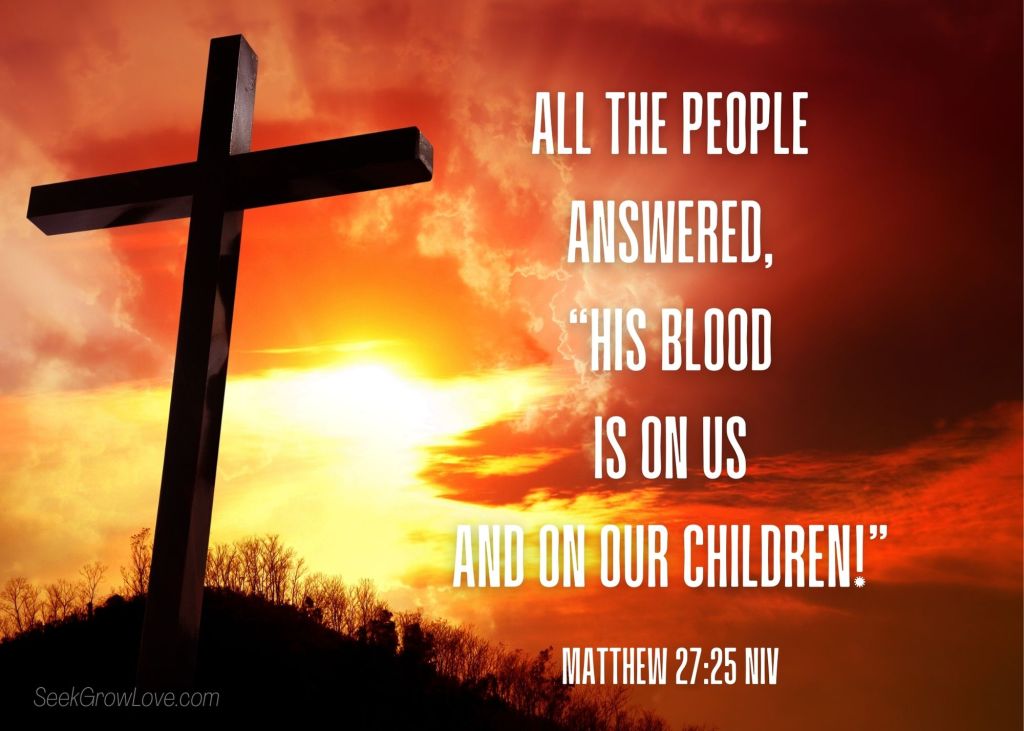
And the Jewish crowd. This one hurts me most of all, because in true mob mentality, they flippantly ignore their consciences, ignore God’s presence, and accept all guilt of Jesus’ death. And they do it without second thought, it seems. They accept the blame not only on themselves, but on their children as well! 

Our savior stood before all these people, blameless and betrayed, and said not a word of condemnation or defense. How many sins have we committed that have been laid upon his shoulders? 

Isaiah 53:6-8 says: 

We all, like sheep, have gone astray,
    each of us has turned to our own way;
and the Lord has laid on him
    the iniquity of us all.

He was oppressed and afflicted,
    yet he did not open his mouth;
he was led like a lamb to the slaughter,
    and as a sheep before its shearers is silent,
    so he did not open his mouth.

By oppression and judgment he was taken away.
    Yet who of his generation protested?
For he was cut off from the land of the living;
    for the transgression of my people he was punished.

For our transgressions, to take care of our guilt, he was punished and died. 

Today is Good Friday, the day we remember Christ’s sacrifice. Take some time with me today to prepare yourself by seeking forgiveness. Ask yourself:

What sins have I committed that I have laid on my Messiah’s shoulders? There are so many, but which have I not sought forgiveness for? 

Are there sins that I’m not sure how to handle, and that seem hopeless, like Judas’? How can I turn them over?

Are there sins that I’m choosing to ignore, like the Jewish leaders? How can I repent and turn the other way?

Are there sins that I could avoid or turn a blind eye to like Pilate? How can I call them out for what they are and act against them?

Are there sins that I’m willingly accepting blame for but I’m determining them inconsequential so I can continue doing them like the angry mob? How can I fully realize and accept how they are affecting my life in a negative way?

I pray that today as you meditate with me and observe Jesus’ sacrifice for all our sins, we are able to call out our sins for what they are and spend time with God seeking forgiveness and redemption. His son suffered and died for us, to cleanse us of those sins. Today is a day for reflection and repentance, so please take the opportunity for it. 

We mourn the suffering of our savior today and the fact that we, and our sins, are the cause of it. But because our God is good, we know that our sin and that cross are not the end of the story. 

Jenn Haynes

Do you Know the Son of the Vineyard Owner?

Theme Week: 1 God, 1 Messiah – Mark 12

Old Testament Reading: Deuteronomy 5 & 6

Psalms Reading: Psalm 79

In Mark 12 Jesus hinted at his identity as God’s son, starting in the parable of the tenants. For a listener to have recognized Jesus in the parable may have depended on recognizing the tenants as his opponents, the current leaders of the nation – but they recognized themselves in the parable. The parable is quite different from how Nehemiah 9 presented the history of the nation. The whole of the land is pictured as a vineyard, carefully prepared by God. The emphasis is on the great lengths God went to in His mercy despite the repeated failings of the tenants. Jesus’ parable focuses on the last stage of the story, the current leadership which betrayed the trust they had been given. No parable conveys the real life situation exactly, and the image in the parable of the tenants seeking to take the inheritance for themselves by killing the heir cannot be precise – the leaders were not going to acknowledge Jesus’ identity. But they did arrange his death out of a mix of reasons that included avoiding having their positions disrupted.

     Jesus hinted at his identity again when he discussed Psalm 110:1, the Old Testament verse most often quoted in the New Testament. In the Hebrew the phrase “the Lord said to my Lord” uses God’s name (as revealed to Moses) and sets up a conversation between God and someone David (the psalmist) calls “my Lord”. Jesus asks the reasonable question why, since it was understood that the “Lord” in this text was David’s own descendant, that David would write of his descendant as his own “Lord”. The crowd may only have seen this as an interesting puzzle, but we can recognize he was showing that one of the sons of David was going to be something more significant than that one role could involve.

     In various ways Jesus came “at the right time”, fulfilling prophecies and meeting needs, including by arriving when he would be rejected. If he was not rejected, the plan could not go forward as God intended. Yet Jesus was recognizable, in a number of ways. Even in this chapter he showed his insight more than once. He showed it when he declared that holding to the one God above all, and loving your neighbor, are the height of wisdom. Anyone who set out to follow those commands would see in Jesus a fellow servant of God. But those who valued something else were still able to turn against him.

     The fact that idolatry was no longer accepted in Jewish society did not make the nation righteous, and it did not mean that the people all gained a clear grasp of God. “Idolater” may once have seemed like a good shorthand for describing a sinful character. Why, after all, would someone who did not wish to serve God choose to worship at His altar, when there were so many options to choose from? But with idolatry uncommon the “sinners” mingled with the “purer” of the flock. And sinners wished to masquerade as righteous. Some perhaps even tried to fool themselves. As Jeremiah once said, “the heart is more deceitful than all else” (17:9, NASB); God can understand all human hearts, but we can have difficulty understanding even our own. The sort of person who in the past might have knelt at a family idol of silver, while mocking his neighbor’s wooden idol, could easily fit in with some niches of Israel’s new religious elite. The scene described at the end of the chapter, with the wealthy dropping off tiny portions of their riches to great acclaim while a poor widow gave all she had, screams that the system needed reform. Yes, the donations might achieve some purpose in terms of charity or service work. But it seems like a system with fewer risks for the givers could be developed.

Lord, thank you for giving your son for me. Allow me to grow in love for you each day, and to grow in my understanding of love so that I can share it with others as well. You are a great God, and greatly to be praised. Your son, who allowed himself to die for me, is a remarkably trusting and loving man and I want to grow in my ability to be like him. Thank you, Lord. In Jesus’ name, amen.

-Daniel Smead

Reflection Questions:

  1. What do you think are some things that God wants people to understand about Him?
  2. Having created your list from the first question, based on whatever standards, now try to think about what practical benefits might exist for people to know those things. There may be cases where you trust God wants a thing known, because of scripture for example, but you aren’t actually sure why.
  3. What are characteristics you think are true of both God and His son, and what are some characteristics that are different between them? How about characteristics that are specific to only Jesus, and no one else?

The LORD Reveals Himself

* Old Testament Reading: Exodus 33 & 34
Psalms Reading: Psalm 43
New Testament Reading? Romans 13

Those silly Israelites. Even when God demonstrates His power in huge and miraculous ways like splitting the sea in half so they could walk across, they STILL forget and worship other gods. I would never be like that if I were an Israelite! … or would I? Sometimes, I forget God’s faithfulness and love too, and am tempted to wander from Him. I’m betting you have been like me and the Israelites at different seasons of life as well. 

Yesterday, in Genesis 32, we read about Moses bringing the Ten Commandments down from the mountain, only to find his people worshiping a golden calf they had made, claiming it was a god who had delivered them from Egypt. Aghast, Moses drops the two tablets and lectures the people! Moses pleads forgiveness for the Israelites, and God agrees to continue leading them toward the promised land. As a punishment, however, a great plague comes upon the people. 

In chapter 33, God commands the people to leave Sinai. Moses has a meeting with God, in which he asks for God’s presence to lead them and requests to see God – this wish is granted, but God only allows Moses to see his back. In chapter 34, Moses takes two new tablets to the presence of the LORD. As the LORD passes by, He says as a renewal of His covenant to the people (and a verse which is quoted many more times throughout the Bible), “The LORD, the LORD, a God merciful and gracious, slow to anger and abounding in steadfast love and faithfulness, keeping steadfast love for thousands, forgiving iniquity and transgression and sin, but who will by no means clear the guilty, visiting the iniquity of the fathers upon the children and the children’s children, to the third and fourth generation.” (Exodus 34:6,7 RSV)

This passage starts out as hope-filled and encouraging, right? We see God, YHWH, describe himself as full of mercy and grace, not easily angered, overflowing with love and faithfulness, and forgiving… But He will enforce consequences for sin. These verses show us that while God is merciful, he is also just. (I’ll link below a short video that I think provided a lovely explanation of these verses).  

After this meeting, God offers forgiveness and renews his covenant with his people. He reminds them of His best ways to live, and when Moses returns from the mountain after 40 days and nights with God, he is physically glowing!

The last half of Romans 13 ties in nicely in that it restates many of the same ten commandments! Paul reminds the people of Rome that the root of the commandments is actually love, and loving your neighbor as yourself. “Love does no wrong to a neighbor; therefore love is fulfilling the law.” (Romans 13:12, The Message). 

If we truly love God and love people, and show it with our actions toward them, we will be fulfilling the law and living more like God intended us to live. 

-Rachel Cain

Reflections: 

  1. Watch this video to learn more about the interpretation and poetic nature of verses 6 and 7:  bibleproject.com/explore/video/character-of-god-exodus/
  2. Who would you treat differently if you truly love your neighbor as yourself? 
  3. What does God reveal about Himself in your reading of His words today? How would you describe God to a child – or to a co-worker?

This Only Do I Seek

Old Testament Reading: Genesis 49 & 50

Psalms Reading: Psalm 27

New Testament Reading: Matthew 26

If you could have anything in the world, what would it be?


For some of you, the answer might be a trip to a neat destination (Ireland seems pretty awesome). For others, it might be to finally marry that person of your dreams. Maybe you would ask to have children one day, or for your current children to have successful lives. If you’re in some financial difficulty, like so many are, maybe you’d wish to just be debt-free. None of those things are bad of course! However, they aren’t the most important thing; and thankfully, you don’t need to have a magic genie in a bottle to acquire the most important thing. It is readily available to each and every believer right now.


In Psalm 27, the author (likely not David due to his references to the Temple) states that the only desire he is seeking after is to be in the presence of YHWH in His holy temple. For the author, God’s presence was the most precious gift one could ask for; it surpassed all the greatness to be found on earth. For in God’s presence, one can finally be at rest and peace (see Psalm 23), and receive the forgiveness of sins that all of us long for (see Psalm 25). Being in God’s presence is everything; and thankfully, it is readily available to us.


In the New Testament, Jesus says that “wherever two or three are gathered in my name, I am there in their midst” (Matthew 18:20), and wherever Jesus is found, God’s presence is found, too (see John 1:14; 14:9). If you truly want to experience God’s presence today, the greatest gift that you could ever experience in this life, it is available with other believers. When we gather together to worship, to serve, or even to eat a meal, the presence of God is there. We feel closest to God when we are surrounded by our brothers and sisters in the faith, gathering together in Jesus’ name. And while you can pray to God in private by yourself, you will never experience His powerful glory if you remain alone; we need to prioritize time together as believers (Hebrews 10:25). We were not designed to be alone (Genesis 2:18), but to enjoy fellowship with each other.

Brothers and sisters, come and join with your fellow Christians today and this week. There is no greater gift on earth than what you can experience there.

-Talon Paul

Reflection Questions

  1. What verse from Psalm 27 would be a good one to have on your refrigerator and in your heart this week? Make it so.
  2. What are the benefits of being together with your Christian brothers and sisters? List as many as you can. In what ways can you make more opportunities and time to do this more and more?
  3. What do you learn of God in your reading today?

Will He Provide?

Old Testament Reading: Genesis 21 & 22

Psalms Reading: Psalm 13

New Testament Reading: Matthew 12

God had promised Abraham, in Genesis 17:19, “Your wife Sarah will bear you a son, and you will call him Isaac.  I will establish my covenant with him as an everlasting covenant for his descendants after him.”

At this point, Abraham was over 100 years old, and had faithfully followed God.  In Genesis 12, Abraham obeyed when God told him to leave his country and family.  Abraham allowed Lot to take the lush land around Sodom in Genesis 13, and trusted God to provide for his own flocks and herds on barren mountains.  In Genesis 15, Abraham trusted God’s promise that he would have a son in his old age, and God counted that faith as righteousness.

In Genesis 22:2, we find God commanding Abraham, “Take your son, your only son, Isaac, whom you love and go to the region of Moriah.  Sacrifice him there as a burnt offering on one of the mountains I will tell you about.”

This doesn’t make sense.  God had explicitly promised that God’s promises to Abraham would be passed down through Isaac’s descendants, and now God was commanding Abraham to sacrifice him – apparently destroying the promise He had made to Abraham.

By this point, Abraham had developed a very close relationship with God.  In fact, we’re told 3 times in the Bible that Abraham was God’s friend (2 Chron 20:7, Isaiah 41:8, James 2:23) – and as far as I know, Abraham is the only person in the Bible of whom this is said.

We’re told in Hebrews 11:19 that Abraham reasoned that God was able to raise the dead, and that He was going to keep His promise.

So early the next morning, Abraham took Isaac and 2 servants and left for the place God told him to go.  When they got close, Abraham told the servants, “Stay here with the donkey while I and the boy go over there.  We will worship and we (emphasis added) will come back to you.”

As they got even closer, Isaac asked his dad, “The fire and wood are here, but where is the lamb for the burnt offering?”

Can you imagine how this must have broken Abraham’s heart, looking down into his son’s questioning face, knowing that in a few minutes he would be killing his beloved son, who would be the offering?  Abraham answered, “God himself will provide the lamb.”  (Actually, God had provided Isaac – as a miracle baby in his parent’s old age.)  When they reached the place God had told him about, Abraham built an altar, arranged the wood, tied up Isaac, and laid him on the altar.  

As he was getting ready to kill Isaac, the angel of the Lord called to him from heaven and stopped him.  Abraham then saw a ram caught in the brush by its horns, and sacrificed it instead.  God then promised Abraham, as recorded in Genesis 22:16-18, “I swear by myself, declared the Lord, that because you have done this and have not withheld your son, your only son, I will surely bless you and make your descendants as numerous as the stars in the sky and as the sand on the seashore… and through your offspring, all nations on earth will be blessed, because you have obeyed me.”

I could point out all the similarities of Abraham’s being willing to sacrifice his son Isaac, and God being willing to sacrifice His Son, Jesus.  I could point out the significance of another quote from this chapter, “Jehovah Jireh – on the mountain of the Lord it will be provided.”  (This was the mountain where Soloman’s temple was built hundreds of years later.)  I could point out the importance of obeying God, and the benefits that result.

Instead, I want to comment on who, when, where, how, and why of God’s provision.  

Who:  God tested Abraham with a very difficult test even after a life of serving God.  We see that God provided the ram in this case only after Abraham trusted and obeyed God – even though it didn’t make sense.  Assertion:  God provides for those who trust Him and obey Him.  

When:  God provided for Abraham at the very last minute, not before.  We’re told in Hebrews 4:16 that we will “receive mercy and find grace to help us in our time of need.”  Assertion:  God provides precisely when we need something, not when we think we need it.  (i.e.  according to God’s timing.)

Where:  God provided for Abraham only after Abraham went where God told him to go, and after he obeyed everything God told him to do.  Assertion:  God will provide if we are where He wants us to be.  We should have no expectation of receiving God’s provision if we aren’t where He wants us to be. 

How:  God didn’t send an angel from heaven with an offering for Abraham to sacrifice, God provided a normal ram, caught in a normal thicket, by it’s normal horns.  And God didn’t send a whole flock of sheep, just one ram, because that was all that was needed.   Assertion:  God will usually provide in ways that are very natural – don’t look for miracles.

Why:  In times of testing, it’s easy to only think about our problems, and focus on, “why is this happening to me?”  I think there may be two general reasons why trials come.  First, we are told in Romans 8:28, “And we know that in all things God works for the good of those who love Him, who have been called according to His purpose.”  Note that this only applies if we are living according to His purpose.  Also note that trials are by definition difficult, and won’t seem to be beneficial at the time.  Second, ultimately, everything is for God’s glory.  Isaiah 43:7 says, “everyone who is called by my name, whom I created for my glory…”  We see an example of this with God destroying Pharaoh and his army for God’s glory in Ex 14:4, 17.  Assertion:  God allows trials and gives provision for our good and for His glory.

The bottom line is, if we are faithfully following God, times of testing will come.  If we remain true to God, if we are where He wants us to be, and if we are obedient to Him, he will provide what we need (not necessarily what we want), at the very last minute, usually through normal means – and this is for our good.  If we aren’t following God, the times of testing may just be to bring Glory to Him.  I’d rather be in that first group.  How about you?

–Steve Mattison

Reflection Questions

  1. Abraham’s thoughts and feelings aren’t recorded much in Genesis, what do you think he may have been thinking and feeling on that 3 day trip to where God wanted him – and after? What similarities do you find in Psalm 11?
  2. How and when has God provided what you needed? What did you learn about God from that experience?
  3. Is there anything that you may be holding onto too tightly, loving more than God? How can you practice trusting and obeying God and not withholding from Him?
  4. What did God reveal about Himself to you in your reading of His words today?

Good Question

Old Testament Reading: Genesis 19 & 20

Psalm Reading: Psalm 12

New Testament Reading: Matthew 11

Where is the darkest place you have been? So dark, you were scared to take a step? The most difficult place you’ve been? So difficult, you doubted? When have your dark, difficult, trying circumstances caused you to doubt what you previously knew to be true?

You are not alone. John has been there, too. Sometimes referred to as John the Baptist or the Baptizer for his message of repentance and baptism, John had faithfully worked for years. Known for his simple lifestyle, his ministry was not about him – but about the one who was to come – the Messiah. He had prepared the way for Jesus’ entrance. He had not taken the easy road. He had not backed down from authority. He continually stood for what was right and true – even when it landed him in prison. The ruling Herod and his wife didn’t appreciate John speaking out against their unlawful marriage.

With his ministry and freedom taken from him, and his future in question, John had a lot of time to think in the darkness of his circumstances. Why? What if…? Was it worth it? Was this supposed to happen? Had he been right? Or wrong? We don’t know all the questions John asked in his prison cell. But, we do know the most important one. The one he needed an answer to. He sent his disciples to ask Jesus, “Are you the one who was to come, or should we expect someone else?” (Matthew 11:3)

And Jesus answered. Restating the truth that John needed to hear again. Pulling up Old Testament scripture from Isaiah and giving evidence of how his own ministry lined up with what had been foretold: the blind see, the lame walk, the leper is cured, the deaf hear, the dead are raised and the GOOD NEWS is preached to the poor (Matthew 11:5).

In our dark days and when we question what we knew to be true, we would do well to return to Jesus. Tell me again, Jesus. Give me proof of who you are. Read again who he is, what he has done, what he taught, what he did for me. The story of Jesus never gets old, but we do need to be reminded of what we know. And then we have the beautiful opportunity and mandate to tell others of what we have seen and heard.

In the rest of this chapter (as well as the previous one) Jesus demonstrates that following him can be hard. People will criticize everything – our job is not to make people happy. There will be many unrepentant people (and cities) who do not accept the work that Jesus has done for them or the path that Jesus has laid out. Don’t be swayed, know that judgement will come and make sure you are on the right side. Stay close to the one who knows and reveals the Father. Jesus, the Son of God, is the only way. Work with him. Stay attached to Jesus. Take his yoke upon you (Matthew 11:29).

-Marcia Railton

Reflection Questions

  1. Who is Jesus? Do you know that he is the one who was to come? How do you know this? What is the value in reading the Old Testament? What is the value in reading the New Testament?
  2. What is repentance? Why is it important? Without it, what will happen? (Matthew 11:20-24)
  3. What do you learn about God in today’s reading? What do you learn of His Son?

The God Who Sees Me

Old Testament Reading: Genesis 15 & 16

Psalm Reading: Psalm 10

New Testament Reading: Matthew 9

We have a need to be heard.

We have a need to be seen.

In today’s Psalm, the psalmist begins writing about a wicked man who preys on the weak, he doesn’t seek God, “in all his thoughts there is no room for God” (Psalm 10:4), he is haughty and God’s laws “are far from him” (10:5), he is full of lies and threats, and, “He says to himself, ‘God has forgotten; he covers his face and never sees'”(10:11).

There are those who would like to think that God never sees. Don’t be one of them.

In the second part of the Psalm, the psalmist calls out for God to arise and take action, remembering the helpless.

“Why does the wicked man revile God: Why does he say to himself, ‘He won’t call me to account’? But you, O God, do SEE Trouble and grief; you consider it to take it in hand…You HEAR, O LORD, the desire of the afflicted; you encourage them, and you LISTEN to their cry, defending the fatherless and the oppressed” (Psalm 10:13, 14a, 17a)

And it just so happens that our reading in Genesis has an excellent example of this. Unfortunately, our very own Sarai and Abram, to whom God had promised a child and descendants as numerous as the stars in the sky, got tired seeking God’s way and waiting on Him. Perhaps Sarai didn’t think God really saw her trouble and grief, or wasn’t able to do anything about it, if He did see. So her solution (and an accepted custom of the time – still not making it right) was to have her husband sleep with her maidservant Hagar and build a family through her. Hagar did become pregnant and jealousy and bitterness mounted within the household leading Hagar to run away.

She had been oppressed, abused and used.

But God heard her cry.

An angel of the LORD tells her it will be safe for her to go back to Sarai and resume her servant’s role, but that won’t be the end of her story. She will have a child and her descendants will be too numerous to count. I love that she was told to name her child Ishmael which means ‘God hears’. What a great life-long reminder she would have every time she said his name. I also love Hagar’s response. After God named her child, this oppressed and helpless Egyptian servant girl who just met God in the wilderness gives a name to God. “She gave this name to the LORD who spoke to her: ‘You are the God who sees me,’ for she said, ‘I have now seen the One who sees me.'” (Genesis 16:13 NIV).

You are the God who sees me.

What a privilege to be seen by God.

In our Matthew reading we see that God has passed along this compassionate, caring, seeing trait to his son Jesus as well. Jesus sees the paralytic in need of forgiveness and healing. Jesus sees (and eats with and calls) the sinners and tax collectors (much to the dismay of the pharisees). Jesus sees the sick, the dead, the blind, the demon-possessed, the crowds that are like sheep without a shepherd. He sees and he has compassion and he gives hope and a new life. I am sure God is proud of His son – seeing these traits passed down.

Jesus says there is still work to be done. The harvest fields are full of the sick, the sinners, the oppressed, the Hagars. They want to be seen. They want to be introduced to the God who sees. Pray for God to show you where He wants you to work in his harvest field.

-Marcia Railton

Reflection Questions

  1. Are there times you have resembled the man of Psalm 10:4 – “In his pride the wicked does not seek him; in all his thoughts there is no room for God.” How will you make room in your thoughts for God and seek Him? What role does pride play?
  2. When have you known God sees you? How can you introduce others to the God who sees and His Son who gives a new life?
  3. What did God reveal about Himself to you in your reading of His words today?